4.7/5


Famous dog paintings include Jan van Eyck's Arnolfini Portrait, Velázquez's Las Meninas, Hogarth's self-portrait with his pug, Goya's The Dog, Landseer's portrait of Prince Albert's greyhound and Cassius Marcellus Coolidge's dogs playing poker. Below are nine of them, from 1434 to 1894, each with the detail a dog lover spots first and the museum that owns it. If you want one at home, our dog paintings collection is the place to start. A ranking opens the list, based on how often Americans search Google for each painting, with a line on the part each dog plays in the scene.
They run in date order, in three groups: dogs that carry a message, dogs in rooms full of important people, and dogs painted for their own sake.
The 9 famous dog paintings people search for most
| Pos. | Dog painting | The dog's part | Searches per month |
|---|---|---|---|
| 1 |  Las Meninas |
A mastiff dozes in front, eyes half closed, while a boy rests a foot on its back. | 27,100 |
| 2 |  The Arnolfini Portrait |
A watchful terrier, added late, that stands for faithfulness in marriage. | 18,100 |
| 3 |  Venus of Urbino |
A small dog curls up asleep on the bed, the same one Titian painted beside Eleonora Gonzaga. | 12,100 |
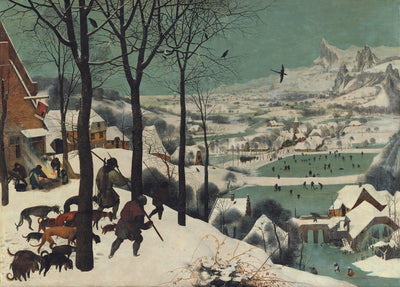
| 4 |  Hunters in the Snow |
A tired pack trudges home with the hunters and just one fox. | 5,400 |
| 5 | The Dog | It is the whole picture: one small head peering over a dark slope. | 4,400 |
| 6 | The Painter and his Pug | Trump, Hogarth's pug, stands for the painter's own fighting spirit. | 110 |
| — |  Poker Game |
Four dogs play cards, the first of 18 such paintings by Coolidge. | Fewer than 50, under this title |
| — |  Julie Manet and Her Greyhound Laërte |
Laërte, a gift from the poet Mallarmé, stands at Julie's knee while she is in mourning. | Fewer than 50 |
| — | Eos | Prince Albert's greyhound guards his top hat and gloves. | No data |
Figures are average Google searches a month in the US, as of October 2026. Big numbers count everyone who looks up the painting, not only dog lovers.
Coolidge's canvas is better known as Dogs Playing Poker. The count above is only for its real title, Poker Game, so it leaves out everyone who searches the nickname.
Dogs with a message (1434 to 1565)
01The Arnolfini Portrait, Jan van Eyck (1434)

Zoom
A small brown dog stands between the merchant, probably Giovanni di Nicolao di Arnolfini, and his wife in van Eyck's double portrait, staring straight out at us. The National Gallery in London calls it "the watchful terrier" and explains that it was not in Van Eyck's first underdrawing: he painted it in at a late stage, together with the chandelier, the chair, the beads on the wall and the discarded shoes. Every hair of its fur is rendered in oil, and by the shadow of the dog's leg the gallery points out the painter's own thumbprint.
Dogs were a common sign of faithfulness in marriage, the gallery notes, so the terrier is usually read as fidelity. The panel, oil on wood (probably oak), measures 82.2 × 60 cm (32.4 × 23.6 in), and the gallery bought it in 1842 for 600 guineas. Its signature over the mirror is explained in our guide to Renaissance art, and the painting's technical tricks in what Jan van Eyck actually invented.
The same couple opens our list of famous love paintings, where the subject is the marriage rather than the dog.
02Venus of Urbino, Titian (1538)
At the foot of Venus's bed a small dog sleeps curled up while, at the back of the room, one of two maids searches a painted chest. The Uffizi says it is "the same one that appears in another Titian in the Uffizi," his portrait of Eleonora Gonzaga, so one museum owns two pictures of the same dog, and it reads the animal as a reference to fidelity in marriage. Guidobaldo II della Rovere bought the canvas directly from Titian, as a letter of 1538 records; it is oil on canvas, 119 × 165 cm (46.9 × 65.0 in).
The rest of its story, from the wedding dress on the maid's shoulder to the dowry that took it to Florence, is in our Italian Renaissance paintings. Manet's Olympia, the first picture in our famous cat paintings, puts an arched black cat at the foot of the bed, where Titian put his dog.
03Hunters in the Snow, Pieter Bruegel the Elder (1565)

Zoom
Here the dogs are working animals, and they look it. The Kunsthistorisches Museum in Vienna describes the hunters returning to the village "accompanied by an exhausted pack of dogs," with "only a single fox" hanging from one of the spears on their shoulders. Follow the pack across the snow at lower left: a long day, and little to show for it.
Bruegel's winter scene is painted on an oak panel of 116.5 × 162 cm (45.9 × 63.8 in); the museum's full title for it is Hunters in the Snow (Winter).
Dogs among important people (1656 to 1745)
04Las Meninas, Diego Velázquez (1656)

Zoom
Hand-painted oil reproductionSee sizes ›
In the right foreground of Las Meninas, a big dog lies on the floor with its eyes half closed while a boy rests a foot on its back. The Prado names the dog a mastiff and the boy Nicolasito Pertusato, "provoking" it, with Mari Bárbola beside him. Around them stand the Infanta Margarita, two maids of honor and Velázquez at his easel, while the king and queen appear only in a mirror. The canvas is dated 1656 and measures 320.3 × 279.1 cm (126.1 × 109.9 in).
Velázquez was not the first to tuck a dog into the corner of a crowded group portrait. In Rembrandt's The Night Watch (1642), a small dog crouches at the foot of the drummer in the bottom-right corner. It was long assumed to be drawn from life, but in 2025 the Rijksmuseum curator Anne Lenders argued that Rembrandt most likely took it from a design drawing by Adriaen van de Venne for the title page of Jacob Cats's emblem book Self-stryt, first published in 1620. More on the painting is in our most famous Rembrandt paintings.
The original and our hand-painted copy
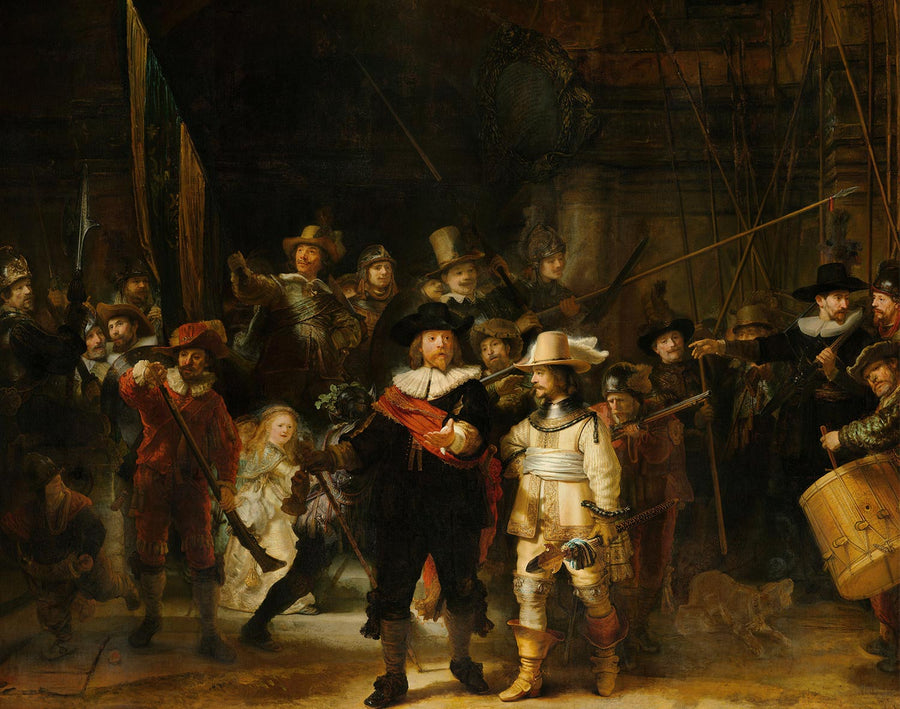
The original
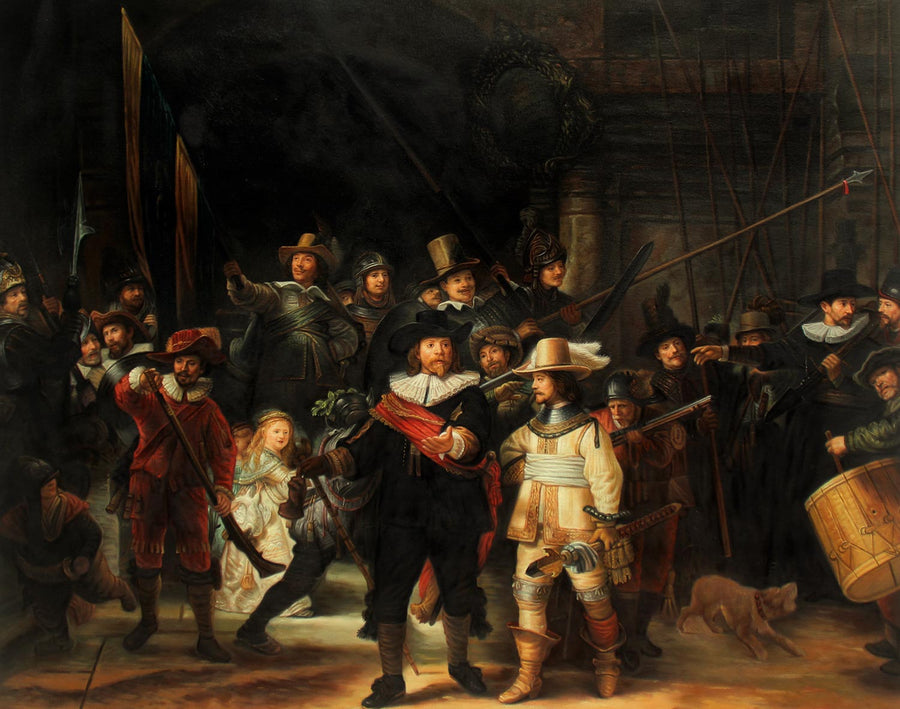
Our reproduction, painted by hand in oil
05The Painter and his Pug, William Hogarth (1745)

Zoom
Hogarth painted himself as a picture inside a picture, an unframed oval canvas propped on volumes of Shakespeare, Swift and Milton, and gave the real space beside it to his pug. Tate identifies the dog as probably Trump and calls him "an emblem of the artist's own pugnacious character." Its catalogue adds that Hogarth "was apparently fond of remarking on the resemblance between himself and his dog."
The palette at lower left carries the serpentine "Line of Beauty and Grace," the principle behind Hogarth's ideas about art. X-rays show that he first wore a formal coat and wig here and later switched to the informal cap and clothes. The canvas is 90 × 69.9 cm (35.4 × 27.5 in), Tate records its purchase in 1824, and Hogarth used his 1749 engraving of it as the frontispiece for bound sets of his prints.
Dogs painted for their own sake (1820 to 1894)
06The Dog, Francisco de Goya (1820–1823)

Zoom
Hand-painted oil reproductionSee sizes ›
This is one of the fourteen Black Paintings that covered two rooms of Goya's house outside Madrid, painted in mixed technique on the wall and later moved to canvas. Its titles came later, from other people. The painter Antonio Brugada listed it simply as "Un perro" (A dog), Charles Yriarte's 1867 book described a dog fighting against the current, and the Prado's catalogue of 1900 settled on Perro semihundido, the "half-submerged dog." All three appear in the Prado's record for The Dog, which gives its size as 131 × 79 cm (51.6 × 31.1 in) and lists it in Room 067.
It hung on a side wall of the upstairs room, next to a scene called Two Witches whose whereabouts are now unknown. Our walk through the Quinta del Sordo puts each mural back on its wall, and The Dog also stands among the darkest pictures in art in our answer to what a famous all-black painting is.
07Eos, Edwin Landseer (1841)

Zoom
Hand-painted oil reproductionSee sizes ›
Eos was Prince Albert's greyhound, and she came with him to Britain when he married Queen Victoria in 1840. In a letter to his future wife he wrote that she "sleeps by the stove, is very friendly if there is plum-cake in the room," and is "keen on hunting, sleepy after it, always proud and contemptuous of other dogs."
Victoria commissioned Landseer's portrait of Eos as a Christmas present. In a story the Royal Collection tells, the painter borrowed Albert's hat and gloves without telling him, which caused some panic among the prince's servants when he wanted to go out and they could not be found. The surprise worked.
“Amongst my presents to him was a large life size picture of Eos by Landseer, with which he was quite delighted, & it came as a complete surprise.”
The picture hung in the prince's dressing room at Buckingham Palace and remains in the Royal Collection. Britannica describes Landseer as best known for his paintings of animals, praising the anatomical knowledge of his early work and faulting the later pictures for a sentimental, too-human treatment of animals. He also made the four bronze lions at the base of Nelson's Column in Trafalgar Square, unveiled in 1867.
08Julie Manet and Her Greyhound Laërte, Berthe Morisot (1893)

Zoom
Hand-painted oil reproductionSee sizes ›
After her husband Eugène Manet died in 1892, Morisot moved with their daughter Julie to a small apartment on Rue Weber in Paris. In 1893 Julie posed in its living room, still in mourning, in a black silk dress with puffed sleeves, with Japanese prints on the wall behind her. The dog at her side was a gift from the poet Stéphane Mallarmé, and the Musée Marmottan Monet's French title calls Laërte a levrette, a female greyhound.
Morisot died in Paris on 2 March 1895, and Mallarmé became the teenager's guardian. The portrait had a prominent place in the 1896 memorial exhibition he helped organize, and Claude Monet chose it as the painting to remember her by; it came to the Marmottan in 1966 with the bequest of his son Michel. It is oil on canvas, 73 × 80 cm (28.7 × 31.5 in). How Julie's parents and uncle Édouard became one family of painters is told in Manet and Morisot.
09Poker Game, Cassius Marcellus Coolidge (1894)

Zoom
Hand-painted oil reproductionSee sizes ›
Four big long-eared dogs sit at a green card table, one of them in spectacles with a pipe in his teeth. This 1894 canvas is where Coolidge's card-playing dogs begin: the Associated Press calls Poker Game the first in a series of 18 oil paintings on the theme. When the Lucas Museum of Narrative Art opened in Los Angeles in September 2026, it hung a few steps from a Frida Kahlo self-portrait.
More card-playing dogs followed. In 1903 the advertising firm Brown & Bigelow commissioned 16 more oil paintings from Coolidge to advertise cigars, among them A Friend in Need, in which a bulldog in the foreground secretly slips an ace to his partner.
Painters known for their dogs
Besides Landseer and Coolidge, look for George Stubbs, the painter of Whistlejacket in our list of famous horse paintings, who painted hounds too: Tate dates his A Couple of Foxhounds to 1792. In France, Rosa Bonheur painted A Limier Briquet Hound around 1856, a small oil of 36.8 × 45.7 cm (14.5 × 18.0 in) now in the Met. Bonheur and Morisot both appear in our guide to famous female artists.
Two more dog pictures are famous enough to know by name. One is a floor: the mosaic at the main entrance of the House of the Tragic Poet in Pompeii, which reads CAVE CANEM, "beware of the dog," and is now protected by glass. The other is Giacomo Balla's Futurist Dynamism of a Dog on a Leash (1912), oil on canvas, 89.9 × 109.9 cm (35.4 × 43.3 in), in the Buffalo AKG Art Museum; an inscription on the back of the original canvas reads CANE AL GUINZAGLIO, "dog on a leash."
Did Van Gogh ever paint a dog?
A dog does turn up in his work. The Van Gogh Museum holds a small drawing from his Paris years, Woman Walking Her Dog ('A La Villette'), made between May and September 1886 in pencil, pen and ink and chalk, 16.8 × 10.1 cm (6.6 × 4.0 in).
He also wrote about one. In December 1883, back with his parents in Nuenen, he told his brother Theo that the family felt the same reluctance about taking him in as about having "a large, shaggy dog in the house," one that comes in "with wet paws" and "barks so loudly."
“And I, admitting that I am a sort of dog, accept them as they are.”
A dog for your own wall
The painted dogs that hold up on a wall come with a story you can tell a guest: a terrier added late in the painting, a pug that looked like its owner, a greyhound guarding a prince's hat. Our dog paintings collection gathers many more breeds, the animal paintings collection covers every other kind of animal, and the pictures everyone recognizes are gathered in the most famous paintings in the world.
Sources
- National Gallery, London: Jan van Eyck, The Arnolfini Portrait
- Uffizi Galleries: Titian, Venus of Urbino
- Kunsthistorisches Museum Vienna: Pieter Bruegel the Elder, Hunters in the Snow (Winter)
- Museo del Prado: Diego Velázquez, Las Meninas
- Anne Lenders, "The Dog in The Night Watch: Rembrandt Inspired by Adriaen van de Venne", The Rijksmuseum Bulletin 73, no. 3 (2025)
- Smithsonian Magazine: the mystery of the small dog in The Night Watch (September 2025)
- Tate: William Hogarth, The Painter and his Pug (display caption and catalogue entry)
- Museo del Prado: Francisco de Goya, Perro semihundido (The Dog)
- Royal Collection Trust: Edwin Landseer, Eos (Royal Pets)
- Royal Collection Trust: Eos (Victoria and Albert: Gifts Exchanged)
- Encyclopaedia Britannica: Sir Edwin Landseer
- Merriam-Webster: Landseer Newfoundland
- Musée Marmottan Monet: Berthe Morisot, Julie Manet et sa levrette Laërte (inv. 5027)
- Encyclopaedia Britannica: Berthe Morisot
- Associated Press: 5 must-see things at George Lucas's new Museum of Narrative Art (September 2026)
- My Modern Met: The story behind the iconic Dogs Playing Poker paintings (2018)
- Tate: George Stubbs, A Couple of Foxhounds
- The Metropolitan Museum of Art: Rosa Bonheur, A Limier Briquet Hound
- Pompeii Archaeological Park: House of the Tragic Poet
- Buffalo AKG Art Museum: Giacomo Balla, Dynamism of a Dog on a Leash
- Van Gogh Museum: Woman Walking Her Dog ('A La Villette')
- Vincent van Gogh: The Letters, letter 413 to Theo van Gogh (about 15 December 1883)