4.9/5
4.9/5


The Quinta del Sordo was a small two-storey country house across the Manzanares from Madrid. Francisco Goya bought it on February 27, 1819, at 72, and between about 1820 and 1823 he covered the walls of its two main rooms with 14 murals we now call the Black Paintings. The house is gone. The paintings survived, and you can still reconstruct which one hung on which wall.
A farmhouse on a hill across the river
Picture a hill called Cerro Bermejo, just past the Segovia bridge, with the Royal Palace in view on the far bank. That is where Goya bought his country estate, about 300 meters from the bridge, on land that is now bounded by the streets Doña Mencía, Baena, Caramuel and Juan Tornero in the Latina district. In 1819 it belonged to the old village of Carabanchel, outside the city.
The building was modest: two main rooms, each 9 by 4.5 meters, one per floor, plus a kitchen wing Goya added. Those two rooms are the whole story. Everything he painted in the house went onto their walls.
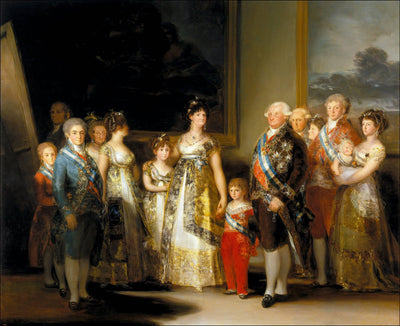
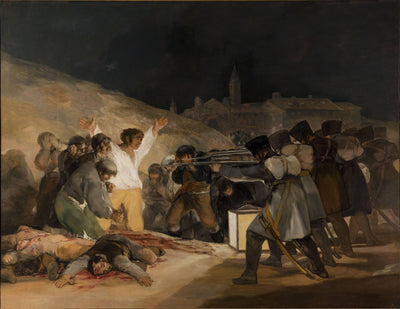
Remember who moved in. This was the court painter of the royal family portrait of 1800–1801 and of the Madrid firing squad he painted in 1814, deaf since an illness in 1792–1793. Scroll through the Goya paintings that get copied most and you can see how far the court work sits from what came next.
Why the house is called the Quinta del Sordo
Not because of Goya, although he was deaf too. The man who sold it to him, Pedro Marcelino Blanco, was also deaf. And in Goya's day neighbors called the place the Quinta de Goya or the Jardín de Goya; "Quinta del Sordo" is a fairly recent name.
One trap if you search Madrid today: Quinta del Sordo at Calle del Rosario 15 is a creative co-working space in La Latina. It borrowed the name. Goya's house stood on the other side of the river.
What are Goya's Black Paintings?
They are 14 oil murals Goya painted straight onto the walls of his house, probably in 1820–1823, when he was in his mid-seventies. Nobody commissioned them, he never titled them, and they were never meant to leave the house. The walls had been papered, and he painted on top of that layer. The names you know today (Saturn, The Dog, The Fates) came later, from other people.
Room by room
Two kinds of evidence fix the placement: an inventory made by Goya's friend Antonio Brugada after the painter's death, and the photographs J. Laurent took inside the house in 1874, just before the murals came down.
| Room | Paintings |
|---|---|
| Ground floor | Witches' Sabbath (The Great He-Goat), A Pilgrimage to San Isidro, Saturn Devouring His Son, Judith and Holofernes, La Leocadia, Two Old Men, Two Old Ones Eating Soup |
| Upper floor | The Dog, Atropos (The Fates), Fight with Cudgels, Asmodea, Pilgrimage to the Fountain of San Isidro, Men Reading, Man Mocked by Two Women |
Downstairs: a coven, a pilgrimage and a hungry god

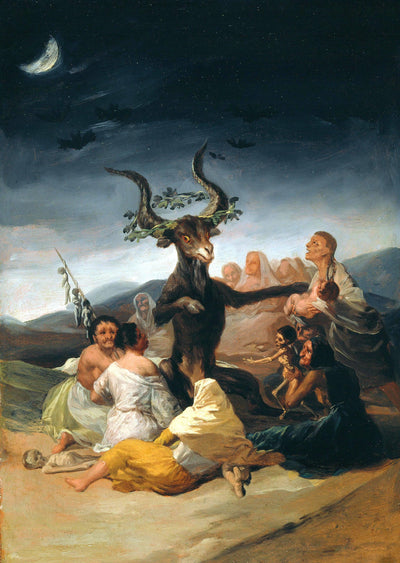
Walk in and the two long walls face each other, each one painting squeezed between windows. On one side, the Witches' Sabbath with its goat in a monk's habit, a crowd of witches around the devil. On the other, A Pilgrimage to San Isidro, a procession of singing, grimacing faces. The room had plenty of windows onto the countryside, so forget the idea of a dark cave.
The Sabbath in the Prado isn't the whole wall. About 140 cm were cut from its right side during the transfer to canvas, and it now measures 140.5 by 435.7 cm. Laurent's photographs show what was lost.
Flanking a window on the short wall were Judith and Holofernes and Saturn Devouring His Son (143.5 by 81.4 cm). Two women killing, a god devouring. The Saturn mural has a story of its own, including the claim that it was more explicit before restoration.
The woman by the door

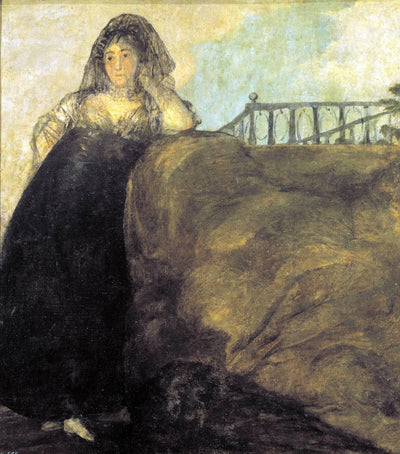
Leocadia was painted on the left-hand side of the door, in the place both Brugada's 1828 inventory and Charles Yriarte's 1867 account give her. She is usually identified as Leocadia Weiss (born Zorrilla), 35 years younger than Goya, who lived with him at the house. In her portrait in black she leans on what looks like a mound or a tomb.
Look closer at that mound. X-rays suggest it may first have been painted as an open fireplace, and the veil was added later. A woman by the hearth, turned into a mourner. Above the door hung Two Old Ones Eating Soup.
Upstairs: fates, fighters and a dog

Upstairs, each long wall had one window, so the big compositions are Atropos (The Fates) and Fight with Cudgels, two men clubbing each other while sunk to their knees. Asmodea shows figures flying over a landscape. Men Reading and Man Mocked by Two Women are the small upright panels.
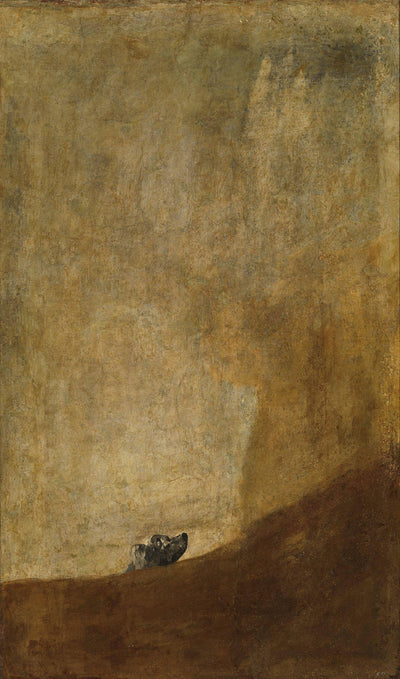
And then the half-sunken dog. A head, a slope, and a huge empty ochre field above it, 131.5 by 79.3 cm. The painter Antonio Saura called it "the world's most beautiful picture," and the Prado curator Manuela Mena said "there is not a single contemporary painter in the world who does not pray in front of The Dog." Laurent's photograph shows the dog looking toward a rocky outcrop, with shapes that may be birds, details the canvas no longer carries.
After Goya left
In 1823, with the liberal government falling, Goya put the house in the name of his grandson Mariano. In 1824 he left for Bordeaux, where he died on April 16, 1828. The paintings stayed on the walls for about fifty years while the estate changed hands.
- 1830: Mariano transfers the estate to his father, Javier Goya.
- 1864: Luis Rodolfo Coumont buys it.
- 1873: the French banker Baron Frédéric Émile d'Erlanger buys it.
- 1874: Laurent photographs the murals, and Salvador Martínez Cubells of the Prado starts moving them to canvas.
- 1878: the canvases are shown at the Paris World's Fair, in the Palais du Trocadéro.
- 1881: d'Erlanger gives them to the Spanish state, by Royal Decree of December 20.
The demolition came in stages. The wing with the paintings was pulled down around 1876, and a narrow-gauge railway station named Goya opened on the site in 1884, running until 1970. The main house hung on into the twentieth century. In 1909, when a Goya museum was proposed for the site, it was already close to ruin, and it was later torn down.
Where are the 14 Black Paintings now?
All 14 are in the Museo del Prado in Madrid. They didn't arrive together: ten went straight to the Prado and four to the Presidency of the Council of Ministers, which handed them over on February 3, 1898. The Prado has shown them since 1889, and in 2022 they hung in room 67 of the Villanueva building.
The house came back once, as a film. From June 3, 2022, Philippe Parreno's La Quinta del Sordo, a 40-minute immersive piece, played in rooms 64 and 65, next door to the real paintings, lit to imitate candlelight and an open fire.
Why are Goya's paintings in the house so dark?
Nobody knows, and Goya left no word. The usual answer points to his age, his deafness, a serious illness around 1819 and years of war and repression. I'd add the simplest reason: these were private walls, and he painted them for himself. One dissent is worth knowing. In 2003 the historian Juan José Junquera argued they couldn't have been painted in Goya's lifetime; Nigel Glendinning defended their authenticity, and the Prado accepts them as Goya's.
If the Black Paintings pull you in, set them beside the hundred-odd pictures everyone recognizes and see how few painters went this far.
A Goya for your own wall
The walls in Carabanchel are gone, but the images can hang in a room again. Art & See paints every Goya in the studio's catalog by hand, in oil on canvas, from the court portraits to the murals of the Quinta, so the dog, the witches and Leocadia can live with you rather than behind museum glass.
Sources
- Instituto Cervantes, El Rinconete: La Quinta del Sordo
- Fundación Goya en Aragón, Leocadia (La Leocadia)
- Fundación Goya en Aragón, the Prado screens La Quinta del Sordo (2022)
- Esther Schipper, La Quinta del Sordo, Philippe Parreno
- ACCIONA Cultura, La Quinta del Sordo at the Museo del Prado
- esMadrid, Quinta del Sordo