4.7/5


Raphael's best-known self-portrait is a small panel in the Uffizi in Florence, painted when he was about 23. He also put his face in the Vatican fresco The School of Athens, and three more portraits are debated: a lost one, a double portrait in the Louvre, and a youthful drawing. Here is how to tell them apart, and what they show about Raphael's paintings and the man who made them. The chart sorts the five faces from the surest to the shakiest and says what each claim rests on.
If you want the wider picture, our list of famous self-portraits places Raphael next to Dürer, Rembrandt and Van Gogh, and famous portraits covers the sitters he painted for others.
How sure are we that each face is Raphael?
| Face | How sure | Made | Where it is now | What the claim rests on |
|---|---|---|---|---|
| The Uffizi panel | 🟢 Accepted | 1504–1506 | Uffizi, Florence | It was listed in the 1660s among painters' portraits “painted by their own hand,” and tests for a 1983 show settled who made it. |
| The School of Athens | 🟢 A safe bet | 1509–1511 | Stanza della Segnatura, Vatican | Vasari says the fresco holds his portrait, and the face matches the Uffizi panel. |
| Portrait of a Young Man | 🟡 Open question | 1513–1514 | Lost since January 1945 | Its features fit the face in the fresco, but no one has proved who sat for it. |
 Self-Portrait with a Friend |
🟡 Open question | c. 1518–1520 | Louvre, Paris | Tradition says the man at the back is Raphael, and a pupil may have painted much of it. |
| The Oxford drawing | 🔴 Disputed | c. 1500 | Ashmolean Museum, Oxford | A later hand wrote “portrait of himself when a youth” on it, but the scholar Parker did not name Raphael as the sitter. |
How sure each face is reflects what the museums and scholars quoted in this article say, not a vote of our own.
Only the first two are safe. The other three lean on an old tradition or on a face that looks alike, and none of them has been proven.
The Uffizi panel: Raphael at about 23

Zoom
The painting is 47.3 by 34.8 centimeters, oil on poplar, and shows only head and shoulders against a plain brown ground. The Uffizi dates it to 1506; Wikipedia gives 1504–1506, during his early years in Florence. He wears a dark cap and a dark robe, with a white shirt barely visible beneath. The Uffizi calls these his simple working clothes, an intentional allusion to his trade.
Look at the technique: translucent glazes over a white ground, which the Uffizi links to an interest in Flemish painting. Wikipedia adds that the surface is worn and the picture may be unfinished. The panel came from Urbino, and it reached Florence with Vittoria della Rovere, who brought art there in the 1630s as her dowry. Between 1663 and 1667 it was recorded among Cardinal Leopoldo de' Medici's "portraits of painters painted by their own hand." Its authorship was settled by investigations for a 1983 exhibition at Palazzo Pitti, when reflectography revealed the preparatory drawing.
Raphael in The School of Athens (1509–1511)
Raphael moved to Rome in 1508 at the invitation of Pope Julius II, and between 1509 and 1511 he painted The School of Athens in the Stanza della Segnatura, a fresco 500 by 770 centimeters. Raphael included a self-portrait beside Ptolemy, and Wikipedia labels the figure as Raphael in the guise of Apelles, the painter of antiquity; Vasari also says the fresco holds accurate portraits of Raphael himself. The Uffizi says that in both portraits the artist shows himself with identical expression and features. Most identities in the fresco are guesses, since Raphael left no labels, so this is one of the safer ones. The fresco is among the most famous paintings in the world, and a painter sneaking in as a bystander is part of its charm.
The lost Portrait of a Young Man (1513–1514)
Another candidate hung in Kraków for over a century. Portrait of a Young Man, probably 1513–1514, oil on panel, 72 by 56 centimeters, was brought to Poland in 1798 by Prince Adam George Czartoryski along with Leonardo's Lady with an Ermine. Many scholars have considered it Raphael's self-portrait, since its features are compatible with the face in The School of Athens, but the sitter is not verified. In 1939 the Nazis seized the collection. The painting was last seen at Wawel Castle in January 1945, and its whereabouts have been unknown since. A reported rediscovery in 2012 was a hoax, and the empty original frame hangs in the National Museum in Kraków.
Self-Portrait with a Friend (c. 1518–1520)

Zoom
The Louvre's double portrait is oil on canvas, 99 by 83 centimeters. The man behind, on the left, is traditionally Raphael himself, although that is not certain. The man in front rests a hand on the hilt of a sword, which gave the painting an old title, Raphael and His Fencing Master. Modern historians generally prefer a close friend or a pupil. Candidates include Giulio Romano and Polidoro da Caravaggio, and in 2024 Claudia Viggiani proposed Lorenzo de' Medici the younger in Finestre sull'Arte. None is settled.
Infrared reflectography shows the two figures were first painted almost side by side, and that Raphael later moved his own figure higher. Much of the painting is thought to have been executed by a pupil. It belonged to Francis I of France.
The Oxford drawing: Raphael as a youth?
A black chalk drawing of a boy in the Ashmolean Museum in Oxford (WA1846.158) was long taken for Raphael's portrait of himself as a youth, around 1500. A later hand wrote on it, "Ritratto di se medessimo quando giovane," or "portrait of himself when a youth." The Royal Collection Trust, which holds a 19th-century photograph of it, calls the attribution very controversial: Parker dated the drawing around 1504 and did not name Raphael as the sitter. Treat it as a possible youthful self-portrait, not a proven one.
Did Raphael give himself a new nose?
In 2020, for the 500th anniversary of his death, researchers from Tor Vergata University in Rome built a 3-D reconstruction from a plaster cast of a skull believed to be Raphael's, made when the remains in the Pantheon were examined in 1833. Mattia Falconi, who worked on it, said the eyes and mouth line up with Raphael's self-portraits. The nose was the mismatch: long and slender in the Uffizi painting, more prominent in the reconstruction. The team suggested Raphael replaced it with an idealized version: "he has been kind to himself about his nose," Falconi said. Be careful with this one: the reconstruction shows a man closer to 37, and the portrait was painted at 23, so age could explain part of it. Smithsonian reported in August 2020 that the reconstruction captures about 80 percent of the original face. Some researchers have questioned whether the skull is Raphael's at all, since several students and apprentices were buried near him.
How Raphael's portraits differ from Leonardo's
Raphael studied Leonardo closely in Florence; Wikipedia calls Leonardo the most striking influence in the work of those years. You can see it in Maddalena Doni, painted around 1506: the pose and the hands placed one over the other resemble the Mona Lisa. But Leonardo's landscapes are threatening, while Raphael's low horizon lights surfaces evenly and the mood is serene.

Zoom
Her husband, Agnolo Doni, was painted as a companion piece.

Zoom
Hand-painted oil reproductionSee sizes ›
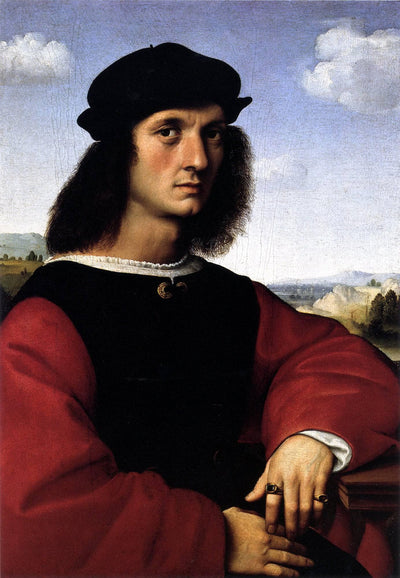
Later portraits grow quieter. The Castiglione of about 1514–1515 is a diplomat and writer in grey and black, an image of restraint. Rembrandt sketched it at an auction in 1639 and later echoed it in his own self-portraits.
And there is a last, more private signature. In La Fornarina, painted 1518–1519, the armband on the woman's arm reads "Raphael Vrbinas," Raphael of Urbino. Tradition says she is Margherita Luti, a baker's daughter and his lover, though that is questioned. He died on Good Friday, April 6, 1520, and was buried in the Pantheon at his own request, as Finestre sull'Arte recounts. For more of what he painted, see our guide to Raphael's paintings and the most famous Raphael paintings.

Zoom
Hand-painted oil reproductionSee sizes ›
What kind of art style did Raphael use?
He is a High Renaissance painter: clear composition, balanced figures and calm space. After his apprenticeship with Perugino, whom he assisted from about 1500, he worked in Florence from about 1504 and in Rome from 1508 until his death at 37.
A few of them on your wall
Raphael's faces suit a wall because they ask for nothing: a steady gaze, soft light, no drama. Self-Portrait with a Friend is the closest we sell to the question this article asks. My advice: pair the double portrait with Castiglione if you want two calm faces in one room. Each is hand-painted in oil on canvas, in seven sizes, and a photo of the finished canvas is sent to you for approval before shipping. See the full Raphael collection.
Sources
- Raphael, Self Portrait, Uffizi Galleries
- Self-portrait (Raphael), Wikipedia
- The School of Athens, Wikipedia
- Portrait of a Young Man (Raphael), Wikipedia
- Self-Portrait with a Friend, Wikipedia
- Raphael's self-portrait with friend: a possible identification of the friend, Finestre sull'Arte
- 3-D facial reconstruction suggests Raphael's self-portrait presents an idealized version, Smithsonian Magazine
- Portrait of Maddalena Doni, Wikipedia
- Portrait of Baldassare Castiglione, Wikipedia
- La Fornarina, Wikipedia
- Raphael, Wikipedia
- File:Raffaello Sanzio.jpg, Wikimedia Commons
- Raphael, presumed self-portrait drawing (Ashmolean WA1846.158), Royal Collection Trust
- A red rose on Raphael's tomb, Finestre sull'Arte