4.7/5


So, what did Jan van Eyck invent? Not oil paint. He perfected it, and the thing he really invented was a way of using it: thin translucent glazes that make painted light behave like real light. Around that technique he built a handful of ideas nobody had put on a panel before, from a mirror that shows the room behind you to a signature that reads like a sworn statement.
Three of the five below are in the Arnolfini Portrait, and all five are visible in the small group of Van Eyck paintings that survive and still get copied by hand. Each one changed how a painted room, a face or a reflection could look.
Some context first. Jan van Eyck is first documented in 1422, working in The Hague. From 1425 he was painter to Philip the Good, Duke of Burgundy, and in 1428 the duke sent him to Portugal to paint his future wife, Isabella. He died in 1441. His surviving pictures are few, and the dated ones start in 1432.
The five ideas, and where to see each one
| Innovation | Best example | Year | Where it hangs |
|---|---|---|---|
| Oil glazes built up in layers | Ghent Altarpiece | 1432 | St Bavo's Cathedral, Ghent |
| A mirror that shows the whole room | Arnolfini Portrait | 1434 | National Gallery, London |
| The signature as a witness statement | Arnolfini Portrait, Léal Souvenir | 1432–1434 | National Gallery, London |
| A face that turns to meet you | Portrait of a Man (Self Portrait?) | 1433 | National Gallery, London |
| Paint that passes for carved stone | Annunciation Diptych | about 1433–1435 | Museo Thyssen-Bornemisza, Madrid |
1. Oil glazes that hold light
Look at the brass chandelier in the Arnolfini room, or the jewels in the Ghent panels. The shine doesn't sit on top of the color. It seems to come from inside it.
That effect comes from glazing: building oil paint up in thin, translucent layers, each one tinting the one below. Van Eyck is credited with originating a style of minutely realistic surfaces and natural light, and the oil medium is what made it possible, because it let him stack those glazes one over another. Once you know to look for it, you see it everywhere in his work: in fur, in metal, in the wet gleam of an eye.
The proof piece is the Ghent Altarpiece, set up in the Vijd chapel on 6 May 1432. It has 18 panels and it's Jan's largest work. His brother Hubert began it. After Hubert's death in 1426, Jan finished it and painted over a large part of his brother's work. A rhymed quatrain on the frame calls Hubert "the greatest painter ever" and Jan the one "who came second in painting." Keep that modesty in mind. It comes back.
Two details show what the glazes could do. In the central meadow where the Lamb stands on its altar, Jan replaced his brother's natural spring with a monumental fountain and added much of the vegetation. And he was among the first painters to put a realistic moon, craters included, into a picture. The restoration that began in 2012 removed 16th-century overpaint and let people see his original paint layer for the first time since then.
Did he invent oil painting itself? No. That full story belongs to another article. What he did was push the medium further than anyone before him.
2. A mirror that shows the room behind you

Here's the trick that made the double portrait of a Bruges merchant and his wife famous. On the back wall hangs a large convex mirror. In it you see the couple from behind, and past them two men coming into the room, one of them raising his arm. The mirror shows the space where you, the viewer, would be standing.
Before this, a painting was a window you looked through. Van Eyck made it a room you're standing in. The whole panel is only 82.2 × 60 cm, yet the mirror's frame holds ten short, blunt spokes, each with a tiny scene from the Passion of Christ. Get close. You'll need to.
The man is Giovanni di Nicolao di Arnolfini, an Italian merchant working in Bruges. His wife's identity is unknown; she was probably his second wife. Infrared images show the underdrawing was done in stages, with real changes to the faces and proportions as the work went on, so the calm you see was fought for. The picture hangs in Room 52 in London.
Is the Arnolfini Portrait his most famous work?
For most people, yes. The Ghent Altarpiece is bigger and, to many historians, the more important work, but the Arnolfini couple is the image people recognize on sight: the green dress, the little dog, the raised hand, and that mirror. It's also the easiest Van Eyck to go and see, in a national museum in central London.
3. The signature as a witness statement
Van Eyck signed like a notary.
Above the Arnolfini mirror, in flamboyant script, he wrote Johannes de Eyck fuit hic. 1434: "Jan van Eyck was here. 1434." Not "made this." Was here. Put that next to the two men in the mirror and the painting starts to read as a record of an event, with the painter as one of the witnesses.
He did the same thing, more dryly, on other panels. A portrait he dated 10 October 1432 carries his signature with the exact day, and the words LEAL SOVVENIR (loyal remembrance) look carved into a stone ledge. The small Saint Barbara in Antwerp is inscribed "Jan van Eyck made me. 1437." Dating a picture to the day is a big part of why his career can be followed so closely.
Then there's the motto. On the frame of his probable self-portrait he painted Als Ich Can, "as I can," in Greek letters. It's a pun on his own name, and the same false modesty as the Ghent quatrain, from a man who clearly knew how good he was.
4. A face that turns to meet you

A man in a red headdress, turned three-quarters, looks straight out of a dark ground. The panel is tiny, 26 × 19 cm, and the lower frame reads "Jan van Eyck made me on 21 October 1433."
It's almost certainly a self-portrait. The sitter leans forward as if into a mirror, and his eyes aim in slightly different directions, as if the painter were concentrating on each one in turn. An Amsterdam inventory of 1655 already listed it as "a portrait of Jan van Eyck by his own hand."
Why count this as an invention? Because it's a private likeness of a real person, turned toward you and holding your gaze, painted with the same glazes he used on altarpieces. Portrait painters kept that formula for a very long time. The red-turbaned man of 1433 still sits in his original 15th-century frame, motto and all.
5. Paint that passes for carved stone
Here Van Eyck shows off. In a small Annunciation now in Madrid, painted about 1433–1435, the angel and the Virgin are white figures on black, standing in niches on hexagonal bases, made to look like sculpture. The figures seem to push out over the edge of the frame, and Gabriel's wing crosses it and throws a shadow. The Virgin's back shows in the dark stone behind her, as if in a mirror. Even the frames are painted to look like stone, with the inscriptions apparently cut into them.
This one-color method is called grisaille. He didn't invent it, but he used it to argue that a painter could beat a sculptor at his own game. The same impulse gives the Léal Souvenir its cracked parapet, with letters that disappear into a chip in the stone.
The saint seated before her half-built tower takes it one step further. Saint Barbara, 32 × 18.2 cm, is nearly monochrome, with ochre and blue in the background that may have been added later. Behind her, workers carry stones and hoist them with a crane onto a tower modeled on Cologne Cathedral's. Scholars still argue whether it's unfinished or a deliberate grisaille, and the imitation marble on the frame was never completed. Either way, the 1437 panel in Antwerp lets you watch him draw with the brush.
What was Van Eyck's style known for?

Close focus and far focus at the same time. That's the short answer.
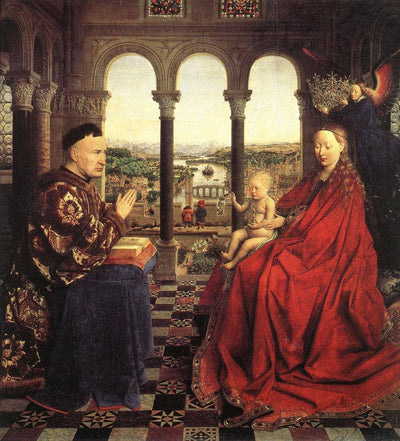
Nicolas Rolin kneeling before the Virgin is the best place to test it. Rolin was chancellor to Philip the Good, and he commissioned the panel around 1430. Up front you get brocade, a tiled floor and marble columns with carved capitals. Then three arches open onto a garden of lilies, roses and peonies, two small figures seen from behind leaning toward the river, and a city split by that river, with a bridge, a small castle on an island and church spires. Past the city come vineyards, mills and, at the very back, snow-capped mountains. The whole panel is 66 by 62 cm.
His style comes down to one habit: everything, near or far, gets the same patient attention. The oxidized varnish that had darkened the Rolin panel came off when it was restored for the first time since 1800, and the distance now reads the way he meant it to.
Why he still matters
Look at almost any portrait or interior painted in Europe after him and you'll find at least one of these five ideas at work. Layered oil glazes became the normal way to paint. The face that meets your eye became the normal portrait. And the dated signature turned the painter into a person with a name and a record, which is a large part of why so much is known about Jan and so little about many painters of his generation.
If you keep a mental list of the paintings everyone should be able to name, the Arnolfini couple belongs near the top.
A Bruges room on your own wall
Van Eyck's glazes are exactly what a copyist has to rebuild, layer by layer, which is why these panels are worth having painted by hand rather than printed. You can browse the full set of Van Eyck works the studio reproduces, including the Arnolfini couple, the Rolin Madonna, Saint Barbara and the Lamb from Ghent, each painted in oil on canvas.
Sources
- National Gallery, London: The Arnolfini Portrait
- National Gallery, London: Jan van Eyck
- National Gallery, London: Portrait of a Man (Self Portrait?)
- National Gallery, London: Portrait of a Man (Léal Souvenir)
- Musée du Louvre: La Vierge du chancelier Rolin
- KMSKA, Antwerp: Saint Barbara
- Museo Nacional Thyssen-Bornemisza: The Annunciation Diptych
- KIK-IRPA: Hubert van Eyck and the Ghent Altarpiece