4.9/5


These twelve Italian Renaissance paintings tell the story of the Renaissance from start to finish. The list begins with a church wall in Florence that was painted around 1427. It ends with a chapel wall in Rome, done in 1541. Botticelli, Leonardo, Michelangelo and Raphael each have two works here. The first four come from Tuscany in the 1400s, the same years as our Early Renaissance paintings. Up top they are sorted by how many photos of each one people have shared, plus a note on which can never leave their walls.
We group them by city, so you go from Florence to Milan and then on to Rome and Venice. To learn how and when they were made, read our guide to Renaissance art. Painting in Italy before Masaccio and after Titian has a list of its own, from Giotto to the Futurists. For famous works from the rest of the world, you can browse the world's most famous paintings.
The 12 Italian Renaissance paintings, by how often they are photographed
| Rank | Painting | Made on | Where to see it | Can it travel? | Photos on Commons |
|---|---|---|---|---|---|
| 1 | The School of Athens | Fresco on a palace wall | Room of the Segnatura, Vatican City | 🔒 No, part of the wall | 65 |
| 2 | The Last Judgment | Fresco on the Sistine Chapel wall | Sistine Chapel, Vatican City | 🔒 No, part of the wall | 61 |
| 3 | The Birth of Venus | Tempera on canvas | Uffizi, Florence | Yes | 57 |
| 4 | The Last Supper | Painted on a monastery wall | Santa Maria delle Grazie, Milan | 🔒 No, part of the wall | 56 |
| 5 |  Mona Lisa |
Oil on a wood panel | Louvre, Paris | Yes | 47 |
| 6 | The Creation of Adam | Fresco on the Sistine Chapel ceiling | Sistine Chapel, Vatican City | 🔒 No, part of the wall | 47 |
| 7 | The Baptism of Christ | Egg tempera on a wood panel | National Gallery, London | Yes | 29 |
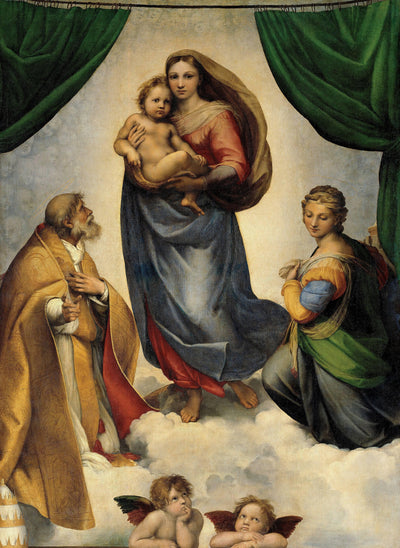
| 8 |  The Sistine Madonna |
Oil on canvas | Gemäldegalerie Alte Meister, Dresden | Yes | 29 |
| 9 | Primavera | Tempera on a wood panel | Uffizi, Florence | Yes | 27 |
| 10 |  Venus of Urbino |
Oil on canvas | Uffizi, Florence | Yes | 22 |
| 11 | Holy Trinity | Fresco on a church wall | Santa Maria Novella, Florence | 🔒 No, part of the wall | 20 |
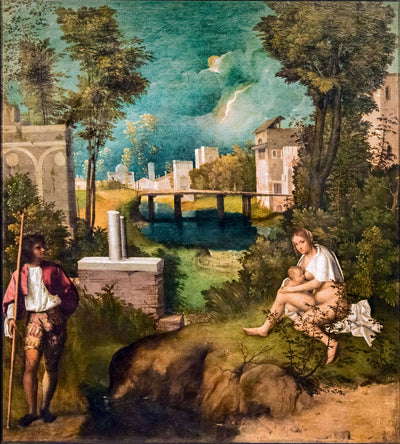
| 12 |  The Tempest |
Oil on canvas | Gallerie dell'Accademia, Venice | Yes | 17 |
Ranked by the number of photos in each painting's Wikimedia Commons category, a rough sign of how often it is photographed (October 2026).
5 of the 12 are painted straight onto walls or ceilings, so the only way to see them is to go to Florence, Milan or the Vatican. The rest are on panels or canvas, and those are the ones a museum can lend or a painter can copy.
Florence and Tuscany: perspective and myth
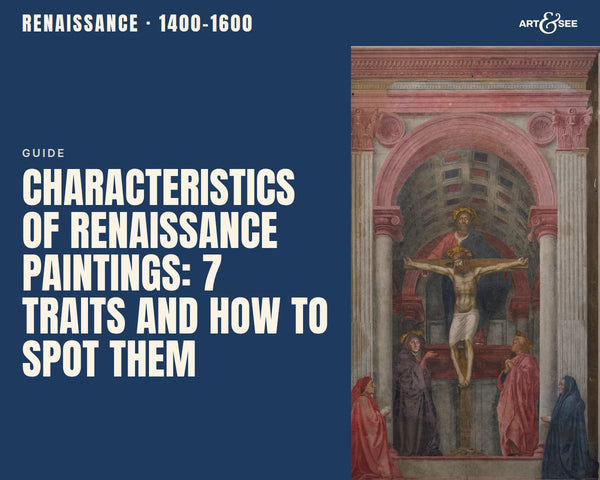
01Holy Trinity, Masaccio (about 1427)

Zoom
Masaccio painted the Holy Trinity on a wall of the church of Santa Maria Novella in Florence. It is a fresco, so the paint went straight onto the wet plaster of the wall. With this work, Masaccio became the first Renaissance painter to use linear perspective. That is a set of rules that makes a flat picture look deep, and it was found by Brunelleschi.
Look at the painted ceiling above Christ. The edges of its squares all lead to one point, and Masaccio put that point low, on the ledge where two people kneel. That is why you seem to look up at Christ from below. Masaccio also gave God real weight. Painters in the Middle Ages often showed God as just a hand, but here he stands behind the cross with a solid body.
More than a hundred years later, the writer Giorgio Vasari was still amazed. To him, the painted ceiling seemed to go so deep that the wall looked as if it had a hole in it.
02The Baptism of Christ, Piero della Francesca (probably about 1437 to 1445)
Piero della Francesca made this painting for the altar of a church in his hometown, Borgo Sansepolcro. He took the Bible story of Jesus being baptized and moved it home. The mountains, the stream and the walnut tree all came from the land around his town. The walled town far away is probably Sansepolcro itself.
Piero had studied math, and he was the first artist to write a book about perspective. You can feel that in the way the picture is built, because it rests on a hidden grid. The dove, the bowl of water and Jesus's joined hands all sit on one straight line. The pale trunk of the walnut tree repeats that line. Look at the water too, which seems to stop at Jesus's feet. In front you can see the pebbles on the riverbed, as if you were standing in the river yourself.
03Primavera, Sandro Botticelli (about 1480)

Zoom
Nine people from old Greek and Roman myths walk across a lawn full of flowers, under orange and laurel trees. The best way to follow them is to read the scene from right to left. First Zephyrus grabs a young woman named Chloris. Next to him she appears again, but now she has changed into Flora, the goddess of spring.
In the middle, Venus stands in modest clothes, and Cupid shoots an arrow above her. Then the three Graces dance in a ring. Mercury, with his helmet and winged sandals, touches a cloud with his staff. No one is sure what the whole painting means, but it is a happy picture of love, peace and plenty.
Botticelli painted the plants with great care. Experts have found at least 42 kinds of plants in it, and 28 of them are in flower. He may even have worked from a herbarium, which is a book of dried plants.
04The Birth of Venus, Sandro Botticelli (about 1485)

Zoom
The Birth of Venus and Primavera share a past. In 1550 Giorgio Vasari saw the two of them together in a country house of the Medici family. Today both hang in the Uffizi in Florence. The Medici most likely paid for The Birth of Venus. The orange trees in it were a sign of the family, but no paper names the painting before Vasari.
Up close, the two are not the same. Primavera is on a board of wood, but The Birth of Venus is on canvas. In the 1400s, canvas was common for art that would hang in the homes of noble families. You can find more by him in our Botticelli oil painting reproductions.
Leonardo in Milan and Florence
05The Last Supper, Leonardo da Vinci (1495 to 1498)

Zoom
Ludovico Sforza, the Duke of Milan, asked Leonardo to paint The Last Supper. It is on a wall of the monks' dining hall at Santa Maria delle Grazie. It shows the moment just after Jesus has said that one of his twelve followers will betray him. Judas holds his money bag tight and pulls back, while Peter leans in with a knife in his hand. Jesus wears no halo, but all the lines of the room lead to the side of his head.
Sadly, Leonardo's way of working nearly ruined it. A true fresco has to be painted fast into wet plaster. But Leonardo worked slowly, with long breaks, so he tried a different kind of paint on a dry wall. Then the paint began to flake off within a few years.
More trouble came later, when someone cut a door through the wall in 1652 and took away Jesus's feet. Then Napoleon's soldiers kept horses in the hall. In World War II a bomb brought down the roof and one wall, so the painting stood in the open air for months. A repair job that took 20 years ended in 1999. Today you get just 15 minutes inside, in a small group. You can see the rest of his small body of work in our ranking of Leonardo's paintings.
06Mona Lisa, Leonardo da Vinci (1503 to 1519)
Leonardo started his portrait of Lisa Gherardini, the wife of a silk trader in Florence, by October 1503. He was still working on it when he died, so it took him the rest of his life. He chose a large, thin board of poplar wood, because he wanted to paint her at life size. He built her face out of soft steps between shadow and light. He laid on thin coats of oil paint that blur every edge, and this smoky look is called sfumato. The same softness makes the land behind her fade into the distance.
The young Raphael was in Florence between 1504 and 1508. He admired the portrait and used it as a model for his own. More than a hundred copies of it are known today. But its fame with everyone came later. In 1911 Vincenzo Peruggia, a glass worker at the Louvre, stole it, and the theft made it famous far beyond art lovers. It was found in 1913.
It went to the United States in 1963, and to Japan and the Soviet Union in 1974. Since then it has stayed at the Louvre, because the wood is so fragile. Here is our hand-painted Mona Lisa in oil next to the original.
The original and our hand-painted copy
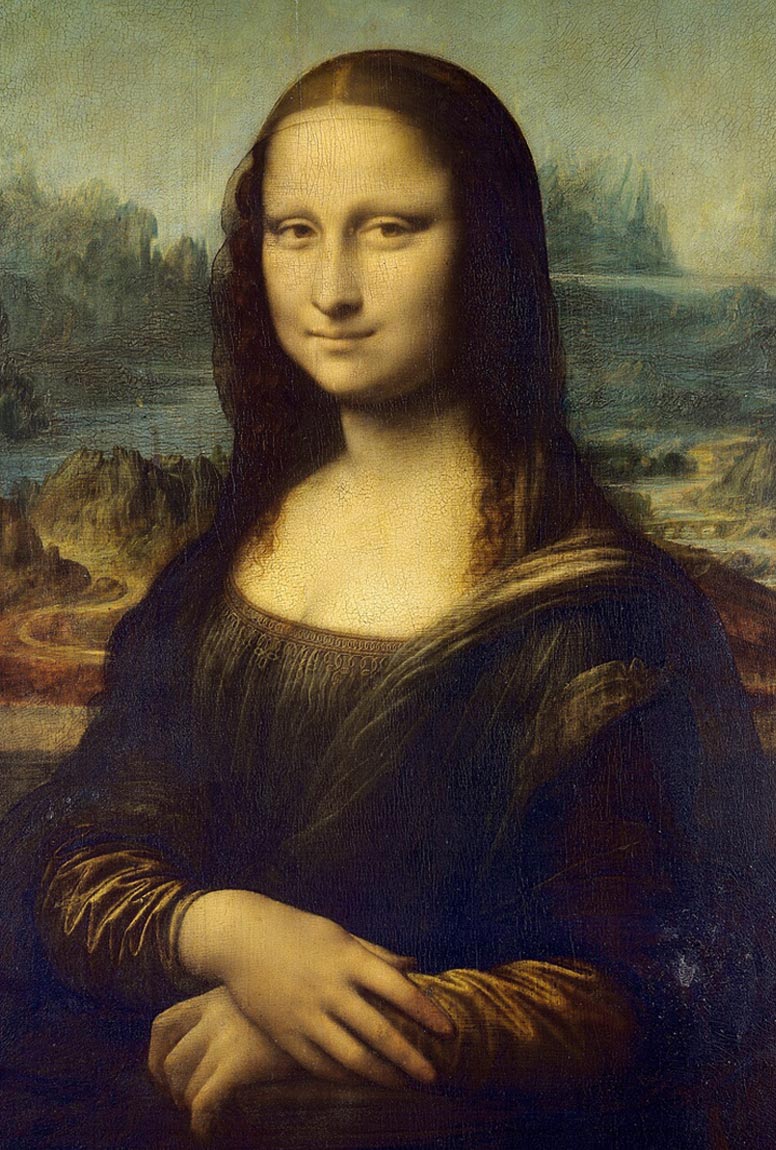
The original
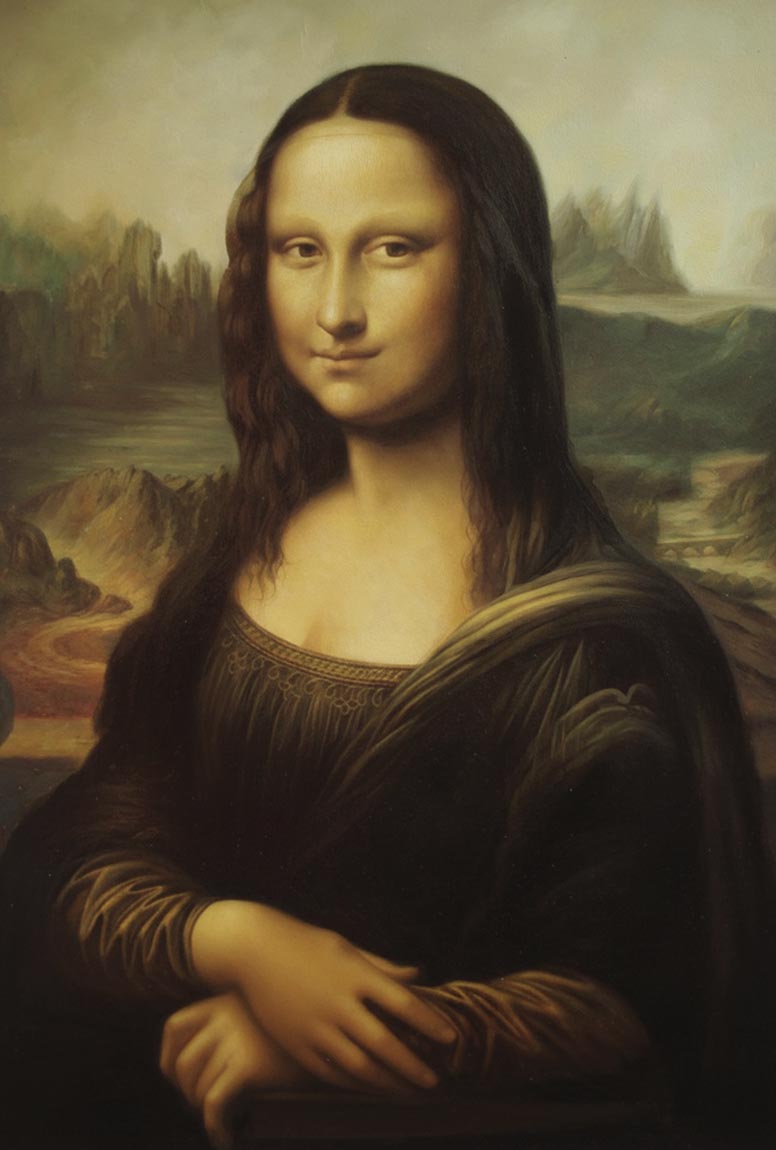
Our reproduction, painted by hand in oil
Rome: the Vatican commissions
Pope Julius II led the Church from 1503 to 1513, and three of the next four works were made for him. Our High Renaissance paintings come from these same years.
07The Creation of Adam, Michelangelo (1508 to 1512)

Zoom
The Creation of Adam is one of nine Bible stories from the book of Genesis. They run down the middle of the Sistine Chapel ceiling, which Michelangelo painted from 1508 to 1512. He was done with the half near the door in August 1510, so Adam is in the second half.
The whole scene is about touch, because the breath of life passes from God to Adam through their fingers. God is wrapped in a wide cloak, and angels hold him up as they fly. He leans toward Adam, who lies there like an athlete at rest. Adam's beauty has a meaning, because the Bible says people were made in God's image. Our guide to Michelangelo's most famous paintings covers the other scenes on the ceiling.
08The School of Athens, Raphael (1508 to 1511)

Zoom
This room in the Vatican was Pope Julius II's library and private office. Its walls and ceiling show the great fields of learning, which are religion, philosophy, justice and poetry. Raphael painted the room from 1508 to 1511. It was his first work in the Vatican, and it marks the start of the High Renaissance. The School of Athens fills the wall for philosophy, the study of big questions about life. The thinkers stand in a tall hall with curved ceilings, based on Bramante's plan for the new St. Peter's church.
Plato points up to the sky, and he and Aristotle stand in the center. Around them, Pythagoras explains music, Diogenes lies on the steps next to a dish and Euclid teaches geometry. Zoroaster and Ptolemy hold globes of the sky and the earth. One man leans on a block of marble. He is Heraclitus, but he has Michelangelo's face, and at that time Michelangelo was painting the Sistine Chapel close by. Our room-by-room guide to the Raphael Rooms covers the other three walls.
09The Sistine Madonna, Raphael (1512 to 1513)

Zoom
Pope Julius II asked for this painting for the main altar of San Sisto, a church in Piacenza. So Raphael put in the two saints that people prayed to there, Sixtus and Barbara. A curtain opens, and Mary comes down from the sky on clouds with the baby Jesus in her arms. Both of them look serious, as if they already know about the pain to come. The two little angels leaning on the ledge at the bottom were the very last thing Raphael added. You can order The Sistine Madonna as an oil painting.
The painting has gone a long way since then. In 1754, after almost two years of hard bargaining, it was bought for Augustus III, the King of Poland. In July 1945, after World War II, Soviet army units took it to Moscow. It was shown in Berlin in 1955, and in 1956 it came back to the Gemäldegalerie Alte Meister museum in Dresden.
10The Last Judgment, Michelangelo (1536 to 1541)
Michelangelo came back to the Sistine Chapel more than twenty years after the ceiling. From 1536 to 1541 he covered the whole wall behind the altar with The Last Judgment. Christ is in the center, just before he judges every soul, and Mary turns beside him. Saint Bartholomew holds his own skin, which had been cut from his body. Its face is usually seen as Michelangelo's own. At the bottom, the boatman Charon drives the damned out of his boat. That idea comes from Dante's poem Inferno.
The naked bodies caused a big fuss. Biagio da Cesena ran the pope's ceremonies, and Vasari wrote that Biagio said it belonged in bathhouses and taverns, not in a pope's chapel. Then in 1564 the Council of Trent, a big meeting of Church leaders, ordered some of the bodies covered. Daniele da Volterra painted the first cloths over them. Ever since, people have called him "il Braghettone," the breeches-maker. Later painters added more cloth over the years.
Venice: landscape and color
11The Tempest, Giorgione (about 1505)
The Tempest got its name from a short note that just lists what you see. In 1530 Marcantonio Michiel saw the painting in the study of Gabriele Vendramin, a collector in Venice. He wrote it down as "the little landscape on canvas with the storm, the Gypsy woman and the soldier." On the right, a woman with only a white cloth feeds a baby, and on the left a man leans on a staff. Between them, lightning flashes over a walled town.
Today the painting is in the Gallerie dell'Accademia in Venice, which got it only in 1932. The museum likes one idea about its meaning best. The Vendramin family said they came from Aeneas, a hero of old Roman stories. So the mother may be Lavinia, and the baby may be their early ancestor Silvius. But the bigger point is that the landscape itself is the star. Giorgione painted it in oil, and it is one of the first calm country scenes in Venetian art. You can order a hand-painted copy of The Tempest.
12Venus of Urbino, Titian (1538)

Zoom
We know the year of the Venus of Urbino from a letter of 1538. It says that Guidobaldo II della Rovere bought "the naked woman" straight from Titian. She may be a bride. In Venice, a young woman said yes to the man who wanted to marry her by touching his hand. This took place at home, in a ceremony called the toccamano. The sleeping dog stands for loyalty, and the myrtle plant on the windowsill stands for lasting love. Behind her, two maids take a gold and light blue wedding dress out of a chest. You can see our Venus of Urbino in oil.
Titian had painted this kind of Venus before. Giorgione's Sleeping Venus wasn't done when Giorgione died in 1510, so Titian gave it its landscape. It began a long line of Venus paintings in Venice, above all by Titian. Later the Venus of Urbino came to Florence with Vittoria della Rovere when she married Grand Duke Ferdinando II de' Medici. It was part of her dowry, the gifts a bride brought to her new home.
What makes a painting Italian Renaissance
So what are the main features of Italian Renaissance paintings? Britannica says Renaissance art grew out of three things at once. Artists looked harder at nature, and they brought back the learning of ancient Greece and Rome. They also saw each person as someone unique. You can see all three in this list. Look at Piero's home valley, Botticelli's old gods and Leonardo's portrait of a real merchant's wife.
Four more clues help you spot these works. Perspective sets up the space, as in Masaccio's painted ceiling. Careful study of the human body shapes the figures, as in Adam's body. The groups are neatly arranged, as in Raphael's hall of thinkers. And soon after a painting from Flanders, the Portinari Altarpiece, came to Florence in 1483, painters in central Italy began to use oil paint. Oil is what Leonardo used for the Mona Lisa, and it became the paint of Venice. Our guide to the features of Renaissance paintings goes through them one by one.
Who is the most famous Italian Renaissance painter? Usually it is Leonardo, and the Louvre calls his Mona Lisa the most famous work in the world. Britannica builds the High Renaissance around three men, Leonardo, Michelangelo and Raphael. It names Masaccio as the man who founded Renaissance painting. Some of the best-known Renaissance works are statues too. Two of them are Michelangelo's Pietà (1498) and David (1501 to 1504), and both are in our list of Michelangelo's most famous sculptures.
Where the story goes next
Britannica says the Renaissance ended as one united period in 1527. That was the year of the Sack of Rome, when the city was attacked and looted. So The Last Judgment and the Venus of Urbino are late works. In Venice, though, Titian went on painting as if nothing had changed. Our comparison of Baroque and Renaissance art picks up the story with Caravaggio. The timeline of art movements shows where both of them fit.
Sources
- Smarthistory on Khan Academy, Masaccio, Holy Trinity
- National Gallery, London, Piero della Francesca, The Baptism of Christ (NG665)
- Uffizi Galleries, Botticelli, Spring (Primavera)
- Uffizi Galleries, Botticelli, The Birth of Venus
- Britannica, Last Supper (Leonardo da Vinci)
- Louvre, Portrait of Lisa Gherardini (Mona Lisa), collection record
- Vatican Museums, Sistine Chapel ceiling
- Vatican Museums, The Creation of Adam
- Vatican Museums, Room of the Segnatura
- Vatican Museums, School of Athens
- Staatliche Kunstsammlungen Dresden, Raphael, The Sistine Madonna (Gal.-Nr. 93)
- Vatican Museums, The Last Judgement
- Gallerie dell'Accademia di Venezia, Giorgione, La tempesta
- Britannica, Giorgione
- Uffizi Galleries, Titian, Venus of Urbino
- Britannica, Renaissance art