4.7/5


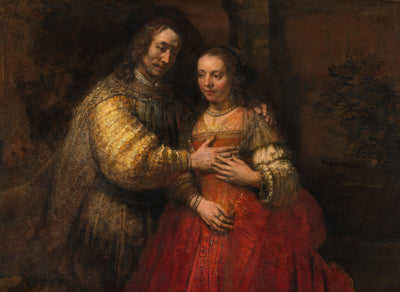
Famous love paintings catch a single gesture between two people: a hand resting on a woman's chest in Rembrandt's The Jewish Bride, a slipper kicked into the air in Fragonard's The Swing, a couple sealed in gold in Klimt's The Kiss and two veiled heads pressed together in Magritte's The Lovers. All eight pictures here belong to the long tradition of love and romance paintings, and each reads love its own way: as a secret, a game, a political farewell, a memorial or a riddle. The table below puts them in line from most Googled to least across the US, and it names the two lovers in every picture.
Every entry gives the holding museum's date and size, the detail to look at first and the story the museum tells about the couple. Three of them share the title The Kiss, and putting those three side by side shows how far the subject traveled in half a century.
The eight love paintings people search for most
| Rank | Love painting | Painter | Who the lovers are | Searches a month (US) |
|---|---|---|---|---|
| 1 |  The Kiss |
Gustav Klimt | A man and a kneeling woman, wrapped together in gold | 27,100 |
| 2 | The Lovers | René Magritte | A man and a woman who kiss with cloth over their heads | 5,400 |
| 3 |  The Swing |
Jean-Honoré Fragonard | A young wife on a swing, her husband at the ropes and her lover hiding in the bushes | 4,400 |
| 4 |  The Jewish Bride |
Rembrandt | Isaac and Rebecca from the Book of Genesis, as the museum now reads it | 1,300 |
| 5 | Birthday | Marc Chagall | Chagall himself and Bella, a few weeks before their wedding | 720 |
| 6 |  Beata Beatrix |
Dante Gabriel Rossetti | Dante's Beatrice, painted from Rossetti's late wife, with Dante behind her | 590 |
| 6 |  The Kiss |
Edvard Munch | A couple by a window whose faces melt into one | 590 |
| 8 |  The Kiss |
Francesco Hayez | A volunteer kissing his sweetheart farewell as he leaves for war | 260 |
Each number is the average count of Google searches per month in the United States for that painting, collected in October 2026.
Klimt's The Kiss gets about five times as many searches as the painting in second place. Of the seven with trend data, it is the only one whose searches rose, up 50% in the last six months compared with the six before.
Love in private (about 1665 to 1768)
01The Jewish Bride, Rembrandt (about 1665–1669)

Zoom
The Rijksmuseum in Amsterdam now calls this painting Isaac and Rebecca, known as "The Jewish Bride". Its reading comes from Genesis: afraid that King Abimelech would kill him and take his wife, Isaac passed Rebecca off as his sister, and the two gave themselves away with a moment of intimacy when they thought nobody was watching. Rembrandt paints that unguarded moment. The man's right hand rests on the woman's chest and his left arm lies across her shoulders, while she lays her own hand over his.
The canvas measures 121.5 × 166.5 cm (47.8 × 65.6 in) and is on loan to the museum from the City of Amsterdam. The Rijksmuseum notes that Rembrandt worked here "with exceptional freedom", laying the paint on thickly and scratching into it with the butt end of his brush. Start with the man's gold sleeve, where the paint stands thickest.
A hand-painted copy of The Jewish Bride follows the same composition, and the rest of his career is laid out in the most famous Rembrandt paintings.
02The Swing, Jean-Honoré Fragonard (1767–1768)
The Swing is love as a game of glances. In the Wallace Collection's description, a young woman in a pink silk frock flies through the air on a swing, with her husband at the ropes on the right and her young lover hidden in the bushes on the left. The force of the swing sends one of her slippers flying, which gives the lover a clear view, and he answers by offering his hat.
The canvas, 81 × 64.2 cm (31.9 × 25.3 in), hangs at the Wallace under its French title, Les hasards heureux de l'escarpolette. How a courtier ordered it, and why the first painter he asked turned the job down, is told in our guide to famous Rococo painters. Our hand-painted The Swing is shown next to the original below.
The original and our hand-painted copy
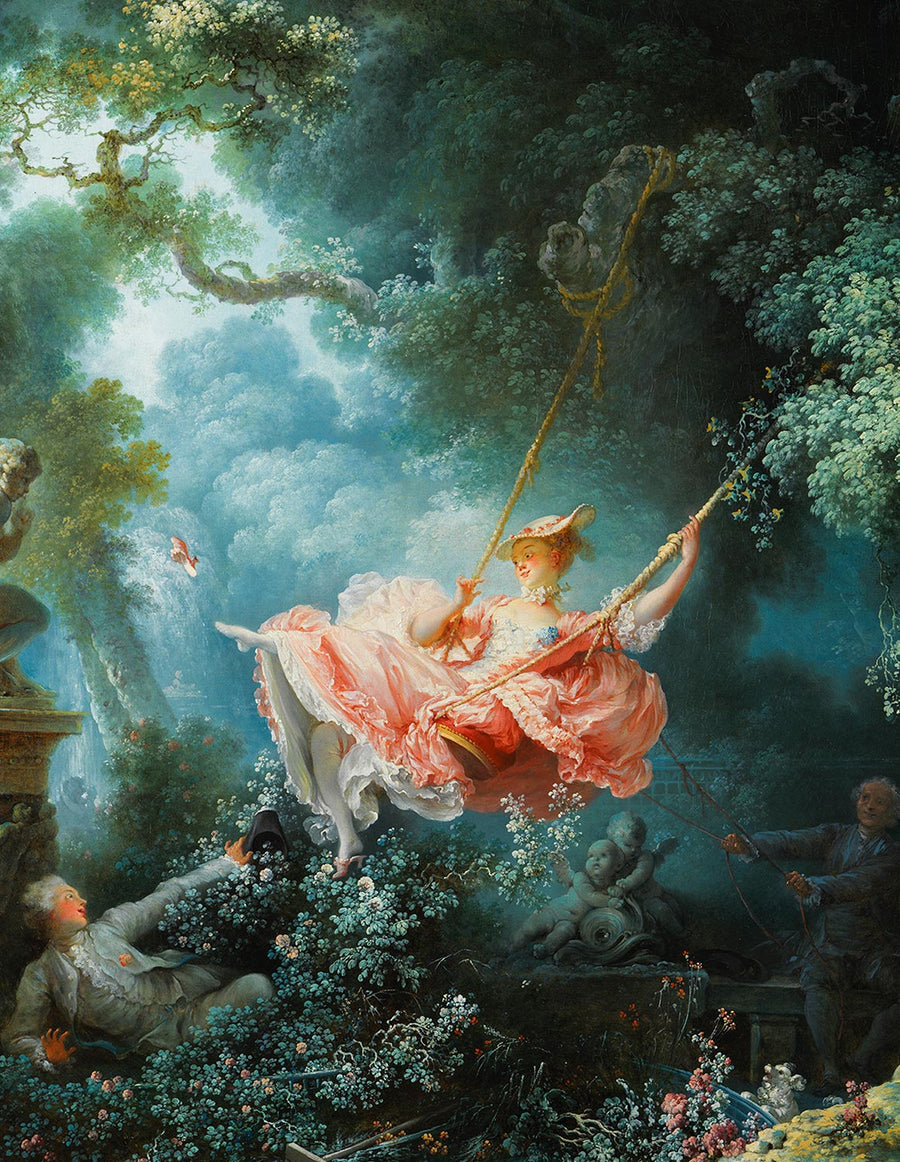
The original
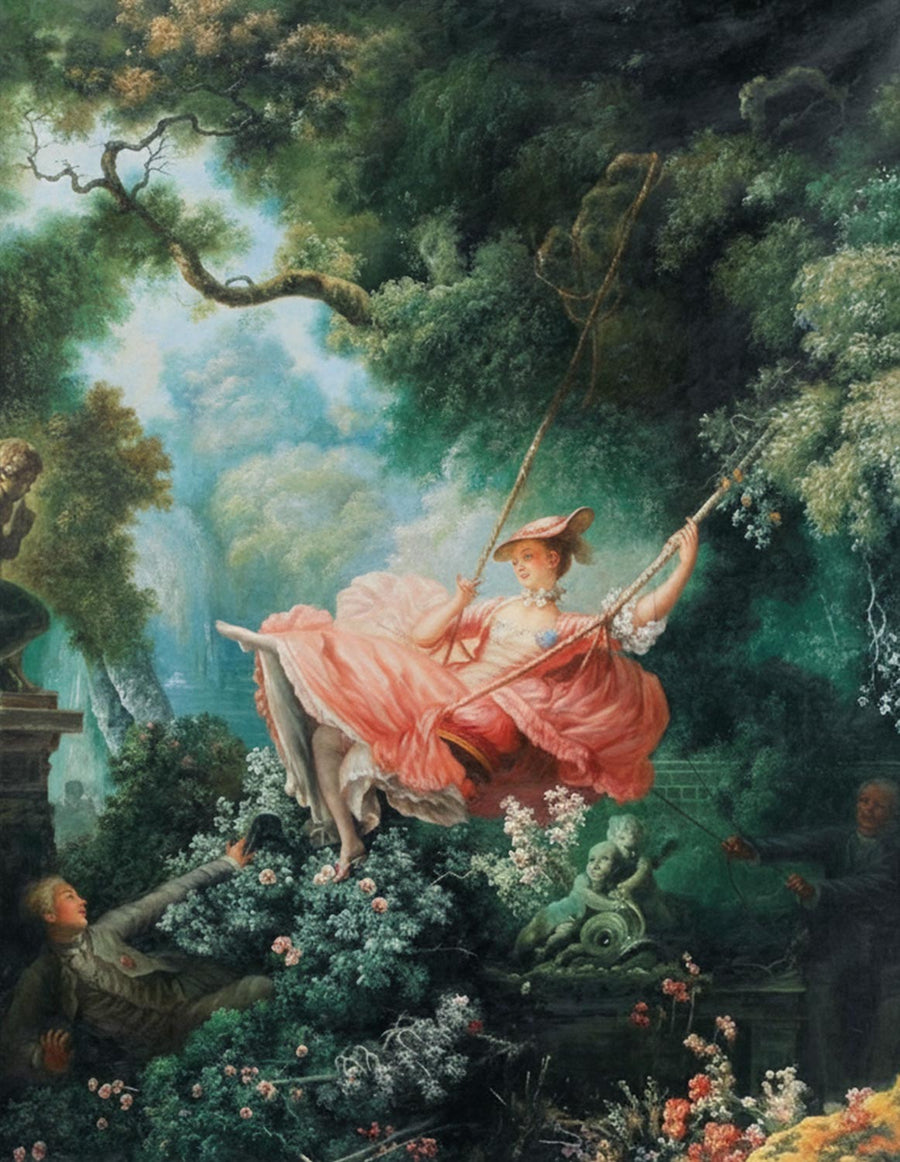
Our reproduction, painted by hand in oil
Love, politics and grief (1859 to about 1870)
03The Kiss, Francesco Hayez (1859)

Zoom
The Pinacoteca di Brera in Milan calls Hayez's The Kiss one of the best-known paintings of the whole Italian 19th century, loved by public and critics since it was first shown at the annual exhibition of the Brera Academy. The couple are painted at about half life size, and the young man's face is almost completely hidden by his feathered hat. His left leg is bent, with the foot already on the first of three stone steps.
That foot on the stair is the point. Brera reads the medieval costumes as an allegory of 1859, the year of the war that freed Milan from Austrian rule: a volunteer patriot saying goodbye to the woman he loves. The canvas is 112 × 88 cm (44.1 × 34.6 in). The flag colors hidden in the clothes and the dagger under his cloak are unpacked in our famous Italian paintings, and you can order a hand-painted Hayez Kiss.
04Beata Beatrix, Dante Gabriel Rossetti (about 1864–70)

Zoom
Hand-painted oil reproductionSee sizes ›
This is love after death. Tate, which owns the first version, says Rossetti saw it as a memorial to his wife, Elizabeth Siddal, who died in 1862 and who was his model for Beatrice, the woman the poet Dante loved and mourned in the Vita Nuova. Behind her, a ghostly Dante looks across at the figure of Love.
The Art Institute of Chicago, which owns Rossetti's second version, decodes the symbols. "The Dove" was Rossetti's nickname for Siddal; the white poppy stands for the laudanum overdose that killed her; the bridge behind her is Florence's Ponte Vecchio; and the sundial's shadow falls on nine, the age at which Dante and Beatrice met and also the hour and day of her death.
Grief explains a stranger episode that Tate records. Rossetti buried his unpublished poems, among them one on Dante's Vita Nuova, with his wife, then retrieved them and published them in 1870.
The Tate picture is oil on canvas, 86.4 × 66 cm (34.0 × 26.0 in), presented in 1889 by Georgiana, Baroness Mount-Temple, in memory of her husband. Its place in the movement is covered in our guide to the Pre-Raphaelite Brotherhood, and a hand-painted Beata Beatrix is available too.
Modern love (1897 to 1928)
05The Kiss, Edvard Munch (1897)

Zoom
Hand-painted oil reproductionSee sizes ›
Munch paints the kiss with no costume and no ornament. In this oil of 1897, now at MUNCH, the Munch museum in Oslo, a couple stand pressed together in a dim room beside a window, and their faces shade into each other until the two read as one. The museum's own text points to the tension between the bright life outside the window and the frozen moment inside.
Munch first tried the motif in a tentative version, probably painted in 1888–89, and came back to it in several variations. This canvas, 100 × 81.5 cm (39.4 × 32.1 in), belongs to his Frieze of Life, the series he discussed in 1918 after some 30 years of work on it. Our hand-painted Munch Kiss is painted after this 1897 version.
06The Kiss, Gustav Klimt (1908–09)

Zoom
Hand-painted oil reproductionSee sizes ›
If one picture has to answer the question of the most famous painting about love, it is this one. The Belvedere in Vienna, which owns it, calls it "probably the most popular work by Gustav Klimt" and the high point of his Golden Epoch, inspired in part by the Byzantine mosaics he saw in Ravenna in 1903 (Belvedere).
The museum's collection record dates it 1908, completed 1909, and lists an unusual recipe: gold leaf, gold paint, silver, platinum and lead with oil paint in the figures, on a square canvas of 180 × 180 cm (70.9 × 70.9 in), against a background of brass leaf glazed over.
Vienna first saw it unfinished, at the Kunstschau exhibition of 1908. The Ministry of Culture and Education bought it while the show was still running, and afterward Klimt completed the flower meadow at left, reworked the ornament of the robes and lengthened the kneeling woman's lower legs, which had come out too short. The Belvedere reads the very high price as probably a kind of compensation for the rejection of his university Faculty Paintings, a story told in why Klimt was controversial; the gold and pattern are explained in how to recognize Klimt's style. A hand-painted copy of Klimt's The Kiss can be ordered as well.
07Birthday, Marc Chagall (1915)
Chagall, back in his native Vitebsk since the outbreak of war in 1914, married Bella there on July 25, 1915. According to the Museum of Modern Art, Birthday was painted a couple of weeks earlier, on his own birthday, July 7: Bella had come to his studio with a bouquet of flowers, and he made the picture the same day.
In the painting Bella stands holding the flowers while Chagall floats above her, twisting his neck right round to kiss her. Bella's own account, quoted in the museum's notes, remembers him floating "up among the rafters". MoMA notes a second version, painted in 1923, in the Guggenheim collection.
The original is oil on cardboard, 80.6 × 99.7 cm (31.8 × 39.3 in), at MoMA in New York.
08The Lovers, René Magritte (1928)
Magritte painted The Lovers in Paris in 1928: a man and a woman kiss, but each head is wrapped in cloth. The MoMA gallery label puts it plainly: "a barrier of fabric divides the intimate embrace of two lovers, transforming an act of passion into one of isolation and frustration."
Some have linked the hidden faces to the death of Magritte's mother, whose body was found in the River Sambre after her suicide when he was fourteen. Magritte disagreed with such readings; MoMA quotes him: "'What does it mean?' It does not mean anything, because mystery means nothing either, it is unknowable." The canvas, 54 × 73.4 cm (21.4 × 28.9 in), came to MoMA from the collector Richard S. Zeisler.
Famous paintings of couples
Six of the eight paintings above show a couple. Two other famous couples in art are worth knowing, and neither is quite what it seems.

Zoom
Hand-painted oil reproductionSee sizes ›
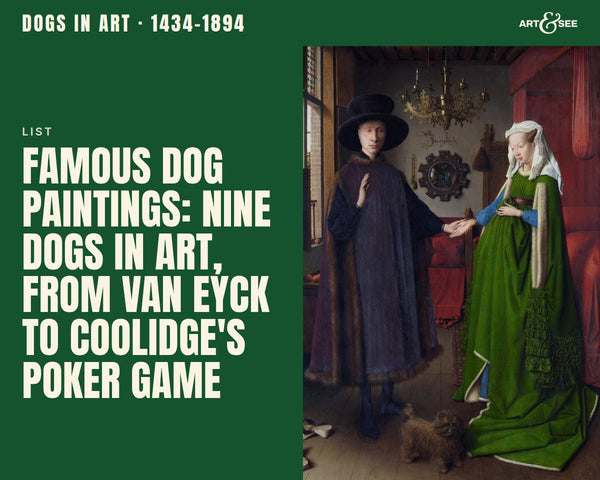
Jan van Eyck's Arnolfini Portrait (1434) shows, according to the National Gallery in London, probably Giovanni di Nicolao di Arnolfini, an Italian merchant working in Bruges, and his wife. For many years it was understood as a picture of a marriage ceremony, the gallery says, "though not anymore". Its audio description reads the small dog as a common sign of faithfulness in marriage and points out one lit candle beside a snuffed-out one in the chandelier.
The panel is oil on wood, probably oak, 82.2 × 60 cm (32.4 × 23.6 in), and the gallery bought it in 1842. Van Eyck's technique is explained in what Jan van Eyck actually invented, and the couple takes its place among the great faces of art in famous portraits.
Grant Wood's American Gothic (1930) is the other. The Art Institute of Chicago describes the pair as a farmer and his daughter, posed by Wood's sister and his dentist, so the stern couple in one of America's most famous paintings, as the museum calls it, are not husband and wife.
Romantic paintings, with a capital R
Romantic painting, the movement, is not the same as painting about romance. Tate puts Romanticism at its height from about 1780 to 1830 and defines it by a new interest in human psychology, personal feeling and the natural world. Its key pictures are mostly landscapes and history scenes, such as Friedrich's Wanderer above the Sea of Fog (about 1817), Géricault's The Raft of the Medusa (1818–1819) and Delacroix's Liberty Leading the People (1830), all covered in our guide to Romanticism art.
Hayez's The Kiss belongs to both worlds. Brera counts it, despite its love subject, as historical Romanticism, the school Hayez led in Italy.
Living with a love painting
A love painting makes a natural gift for a wedding or an anniversary, so choose by the kind of love you want in the room: Klimt's celebration, Fragonard's flirtation or Rembrandt's quiet tenderness. Browse the full love and romance paintings collection, see famous cat paintings for a household that runs on whiskers, or start with the most famous paintings in the world.
Sources
- Rijksmuseum, Rembrandt, Isaac and Rebecca, known as "The Jewish Bride" (collection record)
- Wallace Collection, Fragonard, The Swing (P430)
- Wallace Collection, Conserving The Swing
- Pinacoteca di Brera, Il Bacio di Francesco Hayez (room 38 description, in Italian)
- Tate, Dante Gabriel Rossetti, Beata Beatrix (catalogue entry)
- Art Institute of Chicago, Rossetti, Beata Beatrix (1871–72)
- MUNCH, Edvard Munch, The Kiss, 1897 (collection record)
- MUNCH on Google Arts & Culture, Edvard Munch, The Kiss
- Belvedere, Gustav Klimt, Der Kuss (Liebespaar) (collection record, in German)
- Belvedere on Google Arts & Culture, Gustav Klimt, The Kiss
- Museum of Modern Art, Marc Chagall, Birthday
- Museum of Modern Art, exhibition checklist with notes on Chagall's Birthday
- Museum of Modern Art, René Magritte, The Lovers
- National Gallery, London, Jan van Eyck, The Arnolfini Portrait
- Art Institute of Chicago, Grant Wood, American Gothic
- Tate, Romanticism (art term)