4.7/5


El Greco's most famous paintings are The Burial of the Count of Orgaz, The Disrobing of Christ, View of Toledo, Laocoön, Pentecost and The Opening of the Fifth Seal. All six come from the years he spent in Spain after 1577, most of them in Toledo, and together they show why El Greco still looks modern: stretched figures, acid colors and skies that seem to be breaking apart. Here is the story of each, with the facts that make them worth a closer look. In the chart, the six are ranked by how tall each original canvas is, with El Greco's age while he worked on it and the place it hangs today.
He was born Doménikos Theotokópoulos on Crete in 1541. If you want him in context, see our guides to famous Spanish paintings and famous religious paintings, which cover the country he made his home.
El Greco's six famous paintings, from the tallest down
| Size rank | El Greco canvas | Height by width (cm) | His age while painting | Museum today |
|---|---|---|---|---|
| 1 |  The Burial of the Count of Orgaz |
480 by 360 | About 45 to 47 | Santo Tomé, Toledo |
| 2 |  The Disrobing of Christ |
285 by 173 | About 36 to 38 | Toledo cathedral, in the sacristy |
| 3 |  Pentecost |
275 by 127 | About 55 to 59 | Prado, Madrid |
| 4 |  The Opening of the Fifth Seal |
224.8 by 199.4 | From about 67 to the end of his life | The Met, New York |
| 5 |  Laocoön |
142 by 193 | From about 69 to the end of his life | National Gallery of Art, Washington |
| 6 |  View of Toledo |
121.3 by 108.6 | About 55 to 59 | The Met, New York |
His age is worked out from his birth year, 1541, and the dates of each painting, so it can be one year out either way.
The Burial of the Count of Orgaz is the clear giant, more than one and a half times as tall as the next one. The Opening of the Fifth Seal would rank second if it were whole, because an attempted repair in 1880 cut at least 175 centimeters off the top.
From Crete to Toledo
According to Wikipedia, El Greco trained as an icon painter in the Cretan school, went to Venice around 1567 and moved to Rome in 1570, absorbing Mannerism and the color of Titian and Tintoretto. He arrived in Toledo in 1577 and stayed until his death on April 7, 1614. He signed in Greek letters, often adding "Krēs," meaning Cretan.
Contemporaries and later Spanish critics largely dismissed him. Interest revived in the late 19th and early 20th centuries through critics such as Julius Meier-Graefe, and Cézanne, Picasso and the Expressionists later drew on his work. That is also why some of his best works feel so current. Even in Toledo his patrons were not always happy: Wikipedia notes that Philip II disliked his work and ended royal patronage, and as the next two paintings show, his own clients argued over price and details. His answer was usually to keep painting the way he wanted.
The Disrobing of Christ (1577 to 1579)

Zoom
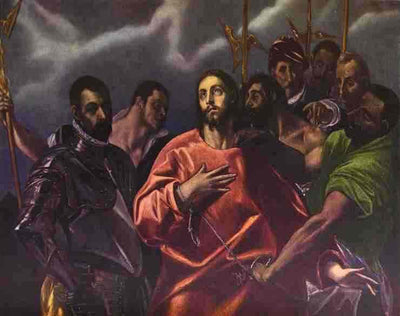
The Disrobing of Christ (El Expolio) was an early commission in Spain, for the cathedral of Toledo. It is oil on canvas, 285 by 173 centimeters, and it still hangs in the cathedral's sacristy. A document dated July 2, 1577 is the earliest record of him in Spain. Christ's bright red robe is the focal point; the crowd crushes him from every side.
The cathedral objected to details. The three Marys are not mentioned in the Gospels at this moment, and the tormentors stand higher than Christ's head. After arbitration El Greco received 350 ducats, though his own appraiser had valued the work at 950, according to Wikipedia. He was asked to remove the objected figures. He never did.
The Burial of the Count of Orgaz (1586 to 1588)

Zoom
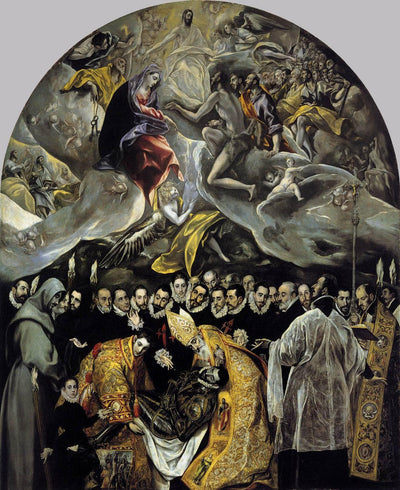
If you can see only one El Greco in person, make it The Burial of the Count of Orgaz. It is still in the church of Santo Tomé in Toledo, the place it was painted for, and it measures 480 by 360 centimeters. The parish priest, Andrés Núñez, commissioned it for the side chapel of the Virgin, and the contract, signed on March 18, 1586, set a deadline of Christmas 1587.
The subject is a local legend. Gonzalo Ruiz de Toledo, mayor of Orgaz, died in 1323, and Saints Stephen and Augustine are said to have come down from heaven to bury him. El Greco painted the mourners as real Toledans in 16th-century dress. Wikipedia notes that the boy at the left is his son Jorge Manuel, and a handkerchief in the boy's pocket carries the artist's signature and the date 1578, the year Jorge Manuel was born. Above, a heavenly zone includes Christ, the Virgin and John the Baptist. The pricing was left to appraisers, and El Greco ended up accepting the lower estimate of 13,200 reales.
My advice: look at the faces first, then raise your eyes. The painting teaches you how to read it from bottom to top.
View of Toledo (c. 1596 to 1600)

Zoom
Hand-painted oil reproductionSee sizes ›
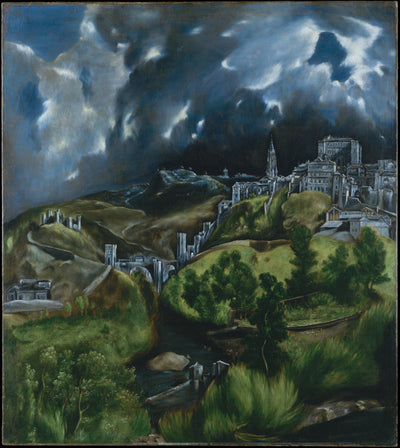
View of Toledo is one of only two surviving landscapes by El Greco, the other being View and Plan of Toledo. It is oil on canvas, 121.3 by 108.6 centimeters, in the Metropolitan Museum of Art in New York. The sky is exceptionally dark near the city, and the hills below are a vivid green. According to Wikipedia, the Castle of San Servando is placed accurately, but many other landmarks are moved, and the curator Walter Liedtke reads the picture as an ideal or hoped-for vision rather than a literal view.
Landscapes were rare in Spanish painting of his time, which is part of why this one stands apart from the most famous paintings in the world.
Laocoön (1610 to 1614)

Zoom
Hand-painted oil reproductionSee sizes ›
Laocoön is El Greco's only mythological painting. It shows the Trojan priest and his two sons killed by sea serpents after he warned against the Trojan horse, and it measures 142 by 193 centimeters. It hangs in the National Gallery of Art in Washington. Behind the figures is a gloomy view of Toledo, with the horse moving toward the city. Wikipedia links the Toledo setting to a local legend that its people descended from the Trojans.
The Opening of the Fifth Seal (1608 to 1614)

Zoom
Hand-painted oil reproductionSee sizes ›
His late vision of the Apocalypse, The Opening of the Fifth Seal, is based on Revelation 6:9 to 11, in which the souls of martyrs cry out for justice. St. John dominates the canvas, and naked souls receive white robes behind him. It is 224.8 by 199.4 centimeters and hangs at the Met. The top of the painting was cut off: an attempted restoration in 1880 removed at least 175 centimeters, so the original showed more.
Scholars such as Ron Johnson and John Richardson argue that the picture influenced Picasso's early Cubism, especially Les Demoiselles d'Avignon (1907), since Ignacio Zuloaga, who then owned the painting, showed it to Picasso, who reportedly studied it while working on that picture.
Pentecost (c. 1596 to 1600)

Zoom
Hand-painted oil reproductionSee sizes ›
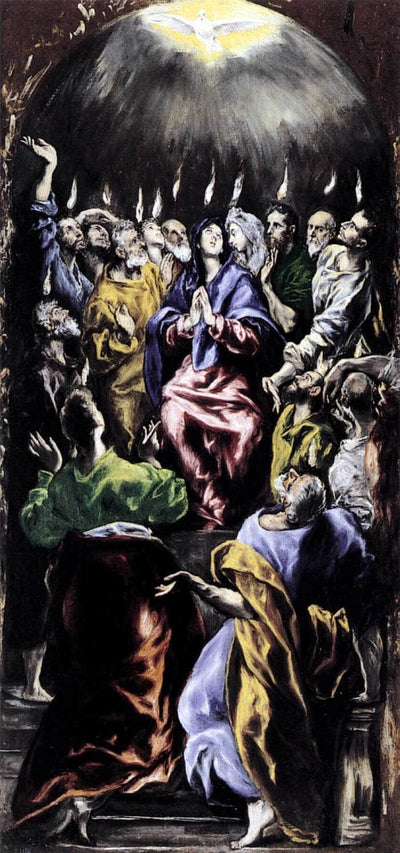
Pentecost is a tall canvas, 275 by 127 centimeters, and one of the six surviving paintings from an altarpiece El Greco made for the chapel of the Colegio de la Encarnación in Madrid, also known as the Colegio de doña María de Aragón. Wikipedia dates the project to 1596 to 1599 and says the work was valued at just over 63,000 reales, the highest price El Greco received in his life.
Five of the surviving canvases, including this one, are now in the Prado in Madrid. The college was secularized in Goya's lifetime and the altarpiece was taken apart, which is why scholars still argue about how the whole once looked. Seen alone, Pentecost shows how far he had moved from the crowded scenes of his early Toledo years: a narrow vertical, with everything pulled upward.
What makes an El Greco look like an El Greco
The signs are easy to learn. Figures are elongated. Colors are unconventional. The compositions are dramatic and vertical, and the style is generally linked to Mannerism, with scholars still debating how much it owes to his Byzantine roots. As for how many paintings he left, scholars disagree widely: Camón Aznar attributed 787 to 829, Wethey 285, and Sœhner 137, according to Wikipedia.
A few of them on your wall
Each reproduction is hand-painted in oil on canvas by our studio artists, in seven sizes with custom sizes on request, and we send a photo of the finished canvas for your approval before shipping. Browse the full El Greco collection. View of Toledo starts from $350.