4.7/5


Édouard Manet and Berthe Morisot were close friends, colleagues and, from 1874, brother- and sister-in-law. She modeled for him, he painted her again and again, and she may have helped steer him toward painting outdoors. The story starts in 1868 and ends with his death in 1883. It is one of the most interesting pairings among the artists in the Manet oil painting collection, and in 2025 and 2026 a major museum show was built around it. To follow the friendship from start to finish, the timeline below pairs each turning point with a picture you can look at.
Manet and Morisot, year by year
| When | What happened between them | Picture to look at |
|---|---|---|
| 1868 | Henri Fantin-Latour introduces them. Morisot is 27 and already shows her work at the Salon. | — |
| 1868 to 1869 | Manet paints her on the left side of a balcony scene, and the 1869 Salon crowd is unkind about it. |  The Balcony |
| 1869 | Morisot is already painting outdoors with quick, dabbed strokes, before Manet starts to do the same. |  The Harbor at Lorient |
| March 1870 | She asks him only for advice, but he repaints parts of her canvas on the day it is due, and she is horrified. | The Mother and Sister of the Artist |
| 1872 | Manet paints her dressed in black, holding violets that may be a joke on her name. |  Berthe Morisot with a Bouquet of Violets |
| 1872 to 1873 | His girl at an iron fence picks up the balcony idea that Morisot had painted. |  The Railway |
| 1874 | She marries his brother Eugène and shows ten works at the first Impressionist show, while Manet stays with the Salon. |  The Cradle |
| April 1880 | After seeing her Summer and Winter, Manet paints two seasons of his own in the same shape. | Jeanne (Spring) |
| 1883 | Manet dies on April 30, aged 51, a year after his last major painting. | A Bar at the Folies-Bergère |
| 1895 | Morisot dies at 54 in Paris on March 2, after catching pneumonia while nursing her daughter Julie. | — |
| 2025 to 2026 | A museum show about the two of them opens in San Francisco and then moves to Cleveland, closing July 5, 2026. | — |
The dates follow Wikipedia and the exhibition reviews cited in the Sources list below.
How they met, and why it matters
Manet was born in 1832 and Morisot in 1841. Henri Fantin-Latour introduced them in 1868, when Morisot was 27 and already exhibiting at the Salon (her first entry was in 1864). She came from a well-off family, copied paintings in the Louvre from 1858 with her sister Edma, and met Corot in 1861, who nudged her toward painting outdoors (Wikipedia).
Manet was a famous scandal by then. His Luncheon on the Grass was rejected by the 1863 Salon and shown at the Salon des Refusés, and his Olympia caused an uproar in 1865 for presenting a confident courtesan instead of a goddess (Wikipedia). If you are curious how he differs from the Impressionists, our piece on Monet versus Manet compares them.
The Balcony and the portraits

Zoom
Her first appearance in his art is The Balcony, painted in 1868–69 and now in the Musée d'Orsay (170 by 124 cm). Manet based it on Goya's Majas on the Balcony. Morisot sits on the left, the painter Jean Baptiste Antoine Guillemet stands in the middle and the violinist Fanny Claus is on the right. The 1869 Salon crowd was unkind: the press called it "discordant," and Albert Wolff dismissed it as "coarse art." Morisot's own verdict was that she looked "more peculiar than ugly" (Wikipedia).
“I look more peculiar than ugly; it seems that people asking about it have used the words femme fatale to describe me.”

Zoom
Manet kept painting her. A review of the exhibition counts twelve oil portraits that Manet painted of Morisot (19th-Century Art Worldwide). The best known are The Rest (about 1870), where she reclines in white, and Berthe Morisot with a Bouquet of Violets (1872), where she looks straight at us in black.

Zoom
Hand-painted oil reproductionSee sizes ›
The catalogue essayist Isolde Pludermacher argues that Manet made a pun on her name in the violets: a "bouquet de Berthe" was a cluster of violets worn in place of a bow on a collar. Wikipedia adds that Manet gave her an easel as a Christmas present, and that their letters show warm affection (Berthe Morisot, Wikipedia). Both are small clues to a friendship that was warm, teasing and professional all at once.
Who influenced whom
The old story is that Manet taught and Morisot followed. The recent research says it ran both ways. According to the same review, Morisot was working outdoors with rapid, dabbed paint from at least 1869, before Manet. The scholar Patry sees her, rather than Monet or Renoir, as the main stimulus for Manet's turn to plein-air painting around 1874, and the curator Emily Beeny argues the balance of influence shifted around 1879–80, when Morisot more often took the lead.
The give and take was not always gentle. In March 1870 Morisot had asked Manet only to advise her on her Salon entries. He picked up a brush and repainted parts of her double portrait The Mother and Sister of the Artist on the very day the canvases had to be sent off, and she was horrified. Conservators at the National Gallery of Art in Washington have since found, by X-ray and infrared imaging, that his most likely changes were bold red accents and thick paint on the face and hands of her mother (19th-Century Art Worldwide).
You can see the exchange inThe Railway (1872–73). Its girl at an iron fence picks up the balcony motif that Morisot had painted. After seeing Morisot's Summer and Winter (about 1878–80) at the Impressionist exhibition of April 1880, Manet painted Jeanne (Spring) and Méry (Autumn) in the same format. The exhibition argues he was completing a four-seasons set, which one reviewer calls tempting but unprovable (19th-Century Art Worldwide). A wall text at the show coined the word "morisotian" for what Manet's Autumn lacks (Squarecylinder review).

Zoom
Hand-painted oil reproductionSee sizes ›
Brothers, sisters and the Impressionists
In 1874 Morisot married Manet's younger brother Eugène, which made her family. That same year she showed ten works at the first Impressionist exhibition as the only woman exhibiting, and Manet chose to stay with the official Salon (19th-Century Art Worldwide). Morisot took part in all the Impressionist shows but one, missing 1879, the year after her only child, Julie, was born in November 1878.

Zoom
Hand-painted oil reproductionSee sizes ›
One of her ten works in 1874 was The Cradle (1872, 56 by 46 cm). Her sister Edma watches her sleeping daughter Blanche. It drew little interest and did not sell at the asking price of 800 francs; the family kept it until the Louvre acquired it in 1930, and it is now in the Musée d'Orsay (Wikipedia). Morisot's own world, harbors, gardens and family, is in the Berthe Morisot collection, including The Harbor at Lorient (1869) and Eugène Manet with his daughter at Bougival.

Zoom
Hand-painted oil reproductionSee sizes ›
Quick answers to what people ask
Was Manet in love with Morisot?
Nobody knows. Scholars have speculated about an unspoken attachment, and one reviewer reads a mutual flirtation that turned into suppressed desire after her marriage (Squarecylinder). Another reviewer praises the catalogue authors for restraint toward the popular star-crossed-lovers story: the two were "demonstrably sensitive to each other's charms," but there is no factual support for any infidelity (19th-Century Art Worldwide).
What disease did Manet have?
He developed locomotor ataxia, a known late effect of syphilis. In April 1883 gangrene, linked to syphilis and rheumatism, led doctors to amputate his left foot. He died 11 days later, on April 30, 1883, aged 51. His last major painting was A Bar at the Folies-Bergère (1882).
Why was Manet controversial?
Because he painted modern life as it looked. Olympia (1863–65) showed a courtesan staring back at the viewer, and Luncheon on the Grass put a nude woman beside clothed men with brushwork one critic compared to a "floor mop."
What happened to Morisot?
She died in Paris on March 2, 1895, aged 54, of pneumonia caught while nursing Julie. In 1894 the critic Gustave Geffroy had named her one of "the three great ladies" of Impressionism. Her picture After Lunch (1881) sold for $10.9 million at Christie's in 2013.
The 2025–26 exhibition
The exhibition Manet & Morisot ran at the Legion of Honor in San Francisco from October 11, 2025 to March 1, 2026, then at the Cleveland Museum of Art from March 29 to July 5, 2026 (dates from the 19th-Century Art Worldwide review). Cleveland calls it the first major exhibition devoted to the artistic exchange between the two, and lists 36 paintings and six drawings and prints at its venue. It covers about 1868 to 1883 and a friendship "by turns collaborative and competitive" (Cleveland Museum of Art).
A few of them on your wall
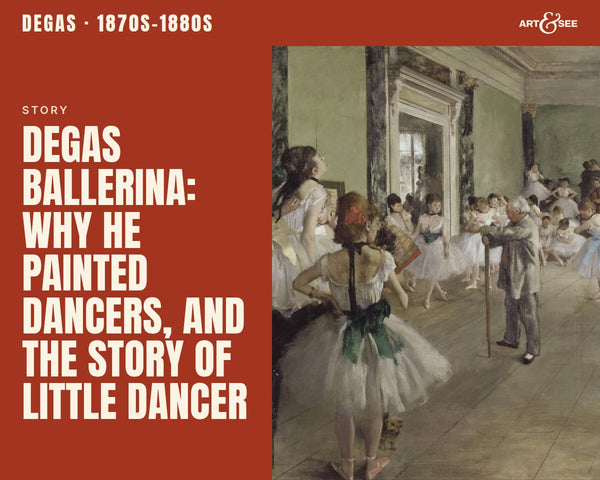
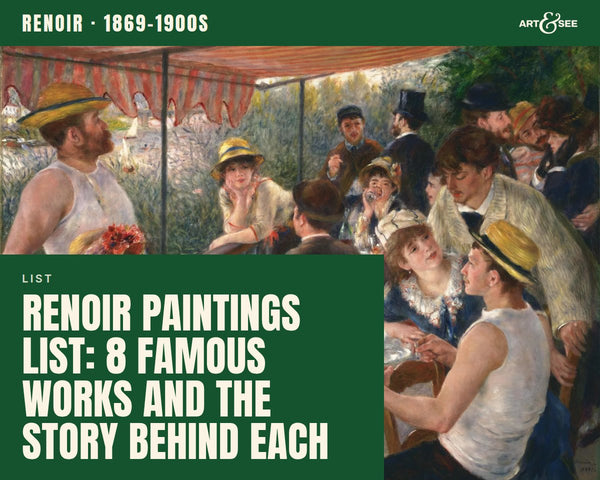
Both painters hang well together: a Manet portrait for contrast, a Morisot for light. Each is painted by hand in oil on canvas, and several of Manet's works rank among the most famous paintings in the world. My advice: pair a dark Manet like the Violets portrait with a pale Morisot like The Cradle, and let the two answer each other, as they did. For more of their circle, see Degas and his ballerinas and Renoir's most famous paintings.