4.7/5


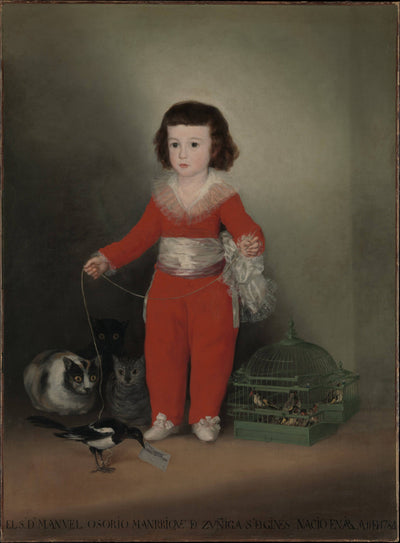
Famous cat paintings run from Goya's little boy in red, shadowed by three cats, and the black cat at the foot of Manet's Olympia to Carl Kahler's My Wife's Lovers, a single canvas holding 42 long-haired cats. Here are six cats in art painted or printed between 1787 and 1896, with the story behind each and the small things a cat lover spots first, then the modern painters people ask about. Our studio artists hand-paint copies of several, and more cats wait in our cat paintings collection. First, a chart counts the cats in each picture, explains what each cat is doing there and shows how many US searches each work gets a month.
The eyes are the place to start, because that is where a painted cat either comes alive or turns into a cushion. Every artist below got the eyes right, and each one gave the cat a job: spy, rival, sitter, star or mascot.
Six famous cat paintings: the cat's job and how often people search
| Cat picture | Cats | What the cat is up to | People searching each month |
|---|---|---|---|
 Manuel Osorio Manrique de Zuñiga |
3 | Three cats lock their eyes on the boy's pet magpie. The Met sees them as a hint that a child's innocence passes quickly. | 210 |
 Olympia |
1 | A wide-awake black cat takes the spot where Titian put a sleeping dog, his sign of a faithful marriage. Manet's cat has been read as a hint of feminine wiles. | 14,800 |
 Julie Manet (Child with a Cat) |
1 | The calico shares the title and squeezes its eyes shut in Julie's arms. | 720, for her name alone |
| My Wife's Lovers | 42 | These were the real pets of one rich cat lover, with Sultan, the cat she brought home from Paris, at the center. | No data |
 The White Cat |
1 | With its back humped and its legs like stilts, it pokes fun at a cat meeting a stranger. | 140 |
| Tournée du Chat Noir avec Rodolphe Salis | 1 | It is the mascot on a poster for the Chat Noir cabaret, with a red ring behind its head like a halo. | Fewer than 50 |
The search figures are Google's US monthly averages, looked up in October 2026.
Olympia is searched more than the other five put together. The Renoir figure counts searches for Julie Manet's name, which can also lead to other portraits of her, and the canvas with 42 cats has no search figure at all.
Cats that steal the scene
01Manuel Osorio Manrique de Zuñiga, Francisco Goya (1787–88)

Zoom
Goya painted Manuel, son of the count and countess of Altamira, in a red suit with a pale silk sash, holding a string tied to his pet magpie. The bird carries Goya's calling card in its beak, which doubles as the painter's signature, as the Met points out. To the left, three cats have locked onto the magpie: a calico crouched low, a gray tabby sitting up straight, and a black cat so deep in the shadow that you see little more than two yellow eyes. On the right, a green cage is packed with finches.
The Met reads this cast of animals as a reminder of the frail boundary between a child's world and the forces of evil, or of how quickly innocence passes. Manuel died a few years after the sitting, at the age of eight; an inscription along the bottom edge spells out his name and his birth year, 1784. The oil on canvas measures 127 × 101.6 cm (50.0 × 40.0 in) and came to the museum with the Jules Bache Collection in 1949. We offer a hand-painted copy of Goya's portrait of Manuel, and our guide to how Goya's style moved from court portraits to the Black Paintings shows where it sits in his career.
02Olympia, Edouard Manet (1863)

Zoom
Manet built Olympia on Titian's Venus of Urbino (1538), and the change a cat lover sees first is at the foot of the bed. Titian put a sleeping dog there, which the Uffizi reads as a reference to fidelity in marriage. Manet swapped it for a black cat that is wide awake, back arched, tail raised like an exclamation mark, its yellow eyes on you. Sotheby's, cataloguing a Picasso in 2006, called the pairing of a woman and a cat an allusion to "feminine wiles and sexual aggression," with Olympia as the notorious example.
Dated 1863 and measuring 130.5 × 191 cm (51.4 × 75.2 in), the canvas caused a scandal at the Salon of 1865, where critics mocked "this yellow-bellied odalisque," as the Musée d'Orsay recounts. In 1890 a public subscription started by Claude Monet gave it to the French state, and in October 2026 it hangs on the Orsay's ground floor. If the two names still blur, here is how to tell Manet from Monet; the nude herself, and everything else Manet took from Titian, is covered in our guide to famous nude paintings, and the dog he removed opens our tour of famous dog paintings.
03Julie Manet (Child with a Cat), Pierre-Auguste Renoir (1887)

Zoom
Hand-painted oil reproductionSee sizes ›
Berthe Morisot and her husband Eugène Manet, the painter's brother, commissioned this portrait of their daughter Julie from Renoir in 1887, out of admiration for his talent and friendship for the man, the Orsay explains. Julie, born in 1878, was eight or nine. She holds a calico, white with orange and dark patches, whose eyes are squeezed shut, the face of a cat that has decided to stay exactly where it is. The museum keeps the second title, L'enfant au chat (The Child with a Cat), so the cat shares the billing.
At least four drawings prepared the canvas. Julie later remembered that Renoir painted it "in little pieces, which was not his usual way of working," and that Degas grumbled on seeing it: "By making round figures all the time, Renoir is making flowerpots" (our translation of the Orsay's French). Renoir was then chasing firm outlines and an almost enameled finish, which puzzled several friends but appealed to Morisot. Signed "Renoir 87" at upper right, the oil on canvas measures 65.5 × 53.5 cm (25.8 × 21.1 in) and entered the Orsay in 1999. You can order a hand-painted copy of Julie Manet with her cat, or meet the rest of Renoir's circle among the famous Impressionist painters.
When the cat is the whole picture
04My Wife's Lovers, Carl Kahler (1891–93)

Zoom
In 1891 Kate Birdsall Johnson, a San Francisco millionaire, hired the Austrian painter Carl Kahler to paint her cats. According to Sotheby's catalogue, she loved Persians and Angoras above all and kept 350 cats at her summer estate near Sonoma, with servants hired just to care for them; every cat answered to its own name. Kahler had built his career on horse-racing scenes in Australia and New Zealand and had never painted a cat. He spent three years sketching hers until he knew their personalities, then gathered 42 into one canvas, 177.8 × 258.4 cm (70.0 × 101.7 in).
The cat at the center is Sultan. Johnson found him in Paris, was told he was not for sale, offered twice his value and brought him home; an 1893 newspaper profile of Kahler described Sultan's tawny brown coat with splashes of yellow, his white breast and his large green eyes. The title supposedly came from Johnson's husband. The canvas was a sensation at the 1893 Chicago World's Fair, came through the 1906 San Francisco earthquake, and in 1949 Cat Magazine called it "the world's greatest painting of cats." On November 3, 2015, it sold at Sotheby's in New York for $826,000, against the auction house's estimate of $200,000 to $300,000, as Smithsonian Magazine reported.
05The White Cat, Pierre Bonnard (1894)

Zoom
Hand-painted oil reproductionSee sizes ›
Anyone who has watched a cat meet a stranger knows this pose. Bonnard's white cat, with ginger touches on its head and tail, humps its back so high that its legs turn into stilts, sinks its head into its shoulders and narrows its eyes to slits. The Orsay calls it a deliberate, humorous distortion and finds the animal at once familiar and wild. Preparatory drawings and an X-ray show that Bonnard kept changing the shape and position of the legs, and some of those second thoughts can be seen with the naked eye.
The museum also sees Japanese prints behind it, in the bold, off-center layout and in the subject itself, since Hokusai and Kuniyoshi had drawn cats before him. Across his career Bonnard painted cats again and again, sometimes as a barely visible detail, sometimes, as here, as the whole subject. The picture is oil on cardboard, 51.9 × 33.5 cm (20.4 × 13.2 in), signed and dated "Bonnard 94" in dark green at lower left, and the Orsay bought it in 1982. The White Cat is also available as an oil copy on canvas.
06Tournée du Chat Noir avec Rodolphe Salis, Théophile-Alexandre Steinlen (1896)

Zoom
This one is a color lithograph, not a painting: a poster announcing the tour of Le Chat Noir, the Montmartre cabaret, "avec Rodolphe Salis." Steinlen's black cat sits bolt upright, whiskers fanned out, yellow eyes narrowed, its tail curling down around the R of Rodolphe. Behind its head, a red ring of lettering works like a saint's halo. The Rijksmuseum's copy, printed by Charles Verneau in Paris, measures 140 × 99 cm (55.1 × 39.0 in), so the cat on the wall was far bigger than any cat in the street.
Steinlen was born in Lausanne in 1859, settled in Paris in 1881 and joined the Montmartre circle of Toulouse-Lautrec, according to the Victoria and Albert Museum, which adds that in their lifetimes Steinlen was the more famous of the two, because his commercial work reached a wider public.
The writers behind these cats
Writers come into the story too. The V&A says the name Le Chat Noir, with its echoes of black magic and witches, was probably influenced by Edgar Allan Poe's short story The Black Cat. Earlier, the French writer Champfleury devoted a whole book to cats, Les Chats; the copy of its 1870 edition at the Art Institute of Chicago includes original prints by Manet, alongside plates after Delacroix and the Swiss artist Gottfried Mind.
Did Marc, Klimt and Picasso paint cats?

Zoom
Hand-painted oil reproductionSee sizes ›
Franz Marc did. In Two Cats, Blue and Yellow (1912), a blue cat twists to lick a hind leg thrown up in the air while a yellow cat lies behind it, chin down, watching. The colors follow his private code: "Blue is the male principle, harsh and spiritual. Yellow is the female principle, soft, joyful and sensual," he wrote to August Macke on 12 December 1910 (translated, as quoted in a Christie's catalogue note). The oil on canvas, 74 × 98 cm (29.1 × 38.6 in), belongs to the Kunstmuseum Basel.
Gustav Klimt is remembered for living with cats rather than painting them. A large number roamed freely through both of his studios, and a photograph by Moriz Nähr from about 1910 shows him with a cat in his arms, according to the Belvedere. The cats crumpled and tore his drawings, which did not trouble him. When the critic Arthur Roessler asked why he put up with it, Klimt said they "only pee on the others, and, you know, it makes the best fixing agent!" You will find no cat in The Kiss or in Adele Bloch-Bauer I; for what you will find there, see how to recognize Klimt's style.
Pablo Picasso did, and not sweetly. In Cat Catching a Bird (1939), oil on canvas, 81 × 100 cm (31.9 × 39.4 in), a cat with eyes like a black-and-white mask sinks radiant white claws into a wounded red-and-black bird. The Musée national Picasso-Paris, which owns it, notes that Franco had proclaimed victory in Spain a few weeks before it was painted, and suggests the cat may stand for the aggressor.
“I adore cats that have gone wild, their fur bristling... They hunt birds, roam about, run through the streets like demons... They give you fierce looks, ready to leap at your face.”
Two years later came Dora Maar au Chat (1941), Picasso's portrait of his companion Dora Maar seated with a cat, 129.5 × 97 cm (51.0 × 38.2 in). He once likened her to an "Afghan cat," and Sotheby's catalogue recalls the writer James Lord's story that when Maar's dog died, Picasso insisted on replacing it with a cat she despised for its vicious scratching; in the portrait he gave her long, talon-like nails. It sold at Sotheby's in New York on May 3, 2006, for $95.2 million, at the time the second-highest price ever paid for a painting at auction, as Antiques and The Arts Weekly reported. For couples painted with more tenderness, see our famous love paintings.
A painted cat for your own wall
Goya's calico, Renoir's sleepy cat in Julie's arms and Bonnard's humpbacked white cat all keep good company in a room a real cat already rules. Browse our cat paintings collection or the wider animal paintings, and for pictures beyond the cat world, start with the most famous paintings in the world.
Sources
- The Met, Goya, Manuel Osorio Manrique de Zuñiga (1784–1792), collection record
- Musée d'Orsay, Edouard Manet, Olympia, collection record (French)
- Uffizi Galleries, Titian, Venus of Urbino
- Musée d'Orsay, Auguste Renoir, Julie Manet, collection record (French)
- Sotheby's, Carl Kahler, My Wife's Lovers, 19th Century European Art, lot 40 (2015)
- Smithsonian Magazine, the 2015 sale of My Wife's Lovers
- Musée d'Orsay, Pierre Bonnard, Le Chat blanc, collection record (French)
- Rijksmuseum, Steinlen, poster for Le Chat Noir (RP-P-1969-78)
- Victoria and Albert Museum, Steinlen, Tournée du Chat Noir avec Rodolphe Salis
- Art Institute of Chicago, Champfleury, Les Chats (1870)
- Artchive, Franz Marc, Two Cats, Blue and Yellow
- Christie's, Franz Marc lot note quoting his letter to August Macke (12 December 1910)
- Belvedere (Franz Smola), Klimt and his cats, Google Arts & Culture
- Musée national Picasso-Paris, Chat saisissant un oiseau, work sheet (French, PDF)
- Sotheby's, Pablo Picasso, Dora Maar au chat, Impressionist & Modern Art Evening Sale, lot 14 (2006)
- Antiques and The Arts Weekly, Sotheby's sells Dora Maar au chat (May 2006)