4.7/5


The Turner landscapes worth knowing run from a frosty English roadside in 1813 to a barely-there sunrise over a Scottish border castle painted about 1845. Across those decades, J.M.W. Turner turned landscape from a record of places into a record of light, weather and atmosphere. Here is that story in six paintings, with the facts behind each. The chart below follows the six in time and names the light or weather Turner was chasing in each, plus the London museum where it hangs.
He belongs to the great age of Romantic painting, but he did something none of his contemporaries did: he kept going until the subject nearly disappeared. If you like the idea of a wider tour, our guides to Romantic landscape paintings and famous ocean paintings put him next to his rivals.
Six Turner landscapes, the light in each, and where to stand in front of it
| Date | Turner landscape | Light and weather | London museum |
|---|---|---|---|
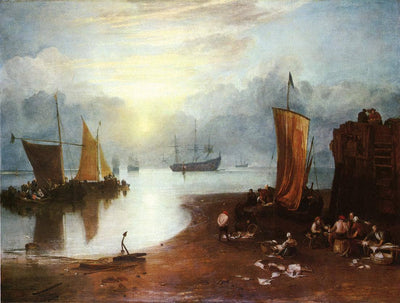
| c. 1807 |  Sun Rising through Vapour |
A hazy low-tide shore where the sun and the mist swallow the horizon | National Gallery, London, Room 40 |
| 1813 |  Frosty Morning |
Low sun on a bright, cold winter morning beside a country road | Tate Britain, London |
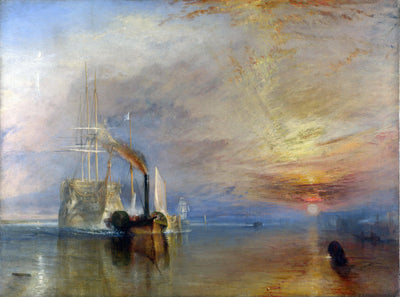
| 1839 |  The Fighting Temeraire |
The sun goes down in the wrong direction for a ship heading up the Thames | National Gallery, London, Room 40 |
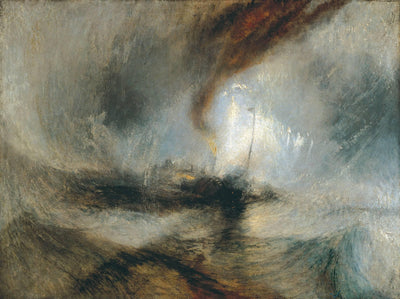
| 1842 |  Snow Storm: Steam-Boat off a Harbour's Mouth |
A snowstorm at sea that one critic called “soapsuds and whitewash” | Tate Britain, London |
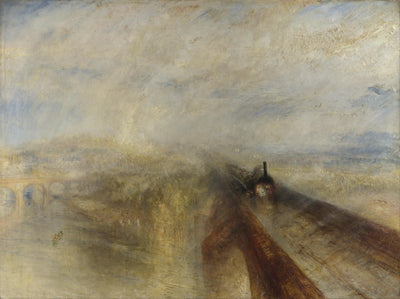
| 1844 |  Rain, Steam and Speed |
Rain and golden haze around a train racing across a bridge | National Gallery, London, Room 40 |
| c. 1845 |  Norham Castle, Sunrise |
Morning mist in pale blue and gold, with the castle almost gone | Tate Britain, London |
Dates and rooms are from the National Gallery and Wikipedia pages listed at the bottom of this guide.
Three of them hang in Room 40 of the National Gallery and three at Tate Britain, so two London museums cover all six. Fishermen at Sea, a moonlit sea he showed at the Academy in 1796 at age 21, hangs at Tate Britain too.
A topographer who learned fast
Turner (1775 to 1851) was born near Covent Garden in London and entered the Royal Academy Schools in 1789, at 14. According to the National Gallery, he showed watercolors at the Academy from 1790 and oils from 1796, and his early work follows the 18th-century topographical tradition: accurate views of real places. His early development drew on Claude and Richard Wilson, whose Italianate landscapes made the countryside feel like a stage lit from within.

Zoom
Fishermen at Sea is dated 1796, Wikipedia notes, and he was 21. It hangs in Tate Britain. He became a Royal Academician in 1802, at 27, so within six years he went from newcomer to member of the establishment.
Frosty Morning, 1813: the ordinary made grand

Zoom
This is the Turner that people who think of him only as blurry tend to miss. Frosty Morning shows a bright early winter morning and a group of men clearing a ditch beside a road. It is 113.5 by 174.5 centimeters and was exhibited at the Royal Academy in 1813. According to Wikipedia, the picture grew from a sketch Turner made when his coach stopped on the way to Yorkshire, and the catalogue carried a line from James Thomson's The Seasons: "The rigid hoar frost melts before his beam."
Notice what is not here: no ruin, no myth, no battle. Just workers, horses, cold air and low sun. Turner could handle the ordinary. That is why his later haze reads as a choice, not a limitation.
Sun Rising through Vapour: the edges start to dissolve
In Sun Rising through Vapour, fishermen unload their catch at low tide on a still, hazy shore, according to the National Gallery, where it hangs in Room 40. The people and boats are clear enough, but the sun and the mist swallow the horizon. It is a good picture to stand in front of if you want to see how Turner makes humidity visible: nothing is drawn, everything is lit.
Ships, steam and storms
Most of the Turner paintings that the public thinks of first are not pure landscapes. They are landscapes with something moving through them, usually something modern.

Zoom
Hand-painted oil reproductionSee sizes ›
The Fighting Temeraire (1839). The ship fought at Trafalgar in 1805. In 1838 she was sold to a Rotherhithe shipbreaker for £5,530 and towed up the Thames to be scrapped. The National Gallery notes that Turner probably did not see the tow and worked from reports. His sun even sets in the wrong direction for a ship going up the Thames, which got debated in The Times. Turner kept the picture until his death, calling it "his Darling," and it joined the national collection through the Turner Bequest in 1856. If the Temeraire is on your list of the best-loved pictures anywhere, it is also among the famous paintings people most want to own.
Snow Storm: Steam-Boat off a Harbour's Mouth (1842). It is 91.5 by 122 centimeters, oil on canvas, now at Tate Britain. Turner claimed he had sailors lash him to a mast for four hours to observe the storm, but historians doubt it: he was 67 and in poor health, and there is no record of the steamer Ariel leaving Harwich in 1842. Critics were harsher than the weather. One called it "soapsuds and whitewash," and Turner reportedly grumbled, "I wish they'd been in it." John Ruskin, writing in Modern Painters in 1843, praised it as Turner's best marine painting. These details come from Wikipedia's entry on the painting.

Zoom
Hand-painted oil reproductionSee sizes ›
Rain, Steam and Speed, The Great Western Railway (1844). A steam engine of the Firefly class races toward you across Brunel's Maidenhead viaduct, finished in 1838. The National Gallery measures it at 91 by 121.8 centimeters. Turner steepened the perspective to suggest speed and trimmed the double track to a single line. Look for the small boat on the river and the plough near the right edge: slow, old ways of work, set against the new machine. There is also a lightly brushed hare on the track, though the paint has turned transparent with age and it is now invisible.
Norham Castle, Sunrise: almost nothing left

Zoom
Hand-painted oil reproductionSee sizes ›
Painted around 1845, Norham Castle, Sunrise is one of Turner's last paintings. It is 90.8 by 121.9 centimeters and shows the castle above the River Tweed, the border between England and Scotland, dissolved into pale blue and gold. Turner first visited the castle in 1797, produced a watercolor shown at the Royal Academy in 1798, and by the end of his career had made six versions of the subject, Wikipedia reports. In 1831 he told a companion that this subject had started him on the road to success.
So the soft late picture is not a break with his early work. It is the same place, painted again and again over almost fifty years, until the architecture is a shadow. My advice: if you want one Turner for a quiet room, this is the one.
How Turner built light in oil
The question people ask most is what Turner's style actually is. In practice it is a method. According to Wikipedia, he layered thin, semi-transparent paint, for instance blue over brown or ochre, to get an optical green rather than mixing it. He blocked in colors that related to the final lighting instead of the traditional dark underpainting, and he finished with three or four coats of mastic varnish to give the colors what is described as a healthy glow. By age 25 he had also made watercolor a medium with much the same expressive power as oil.
That layered approach is why oil suits his subjects so well. In his late work he simplified shapes and pushed light and color further, and when Monet and Pissarro saw his paintings in London in 1870, his use of color and light influenced them strongly.
What he left, and what it is worth
Turner died on December 19, 1851, in the Chelsea house of Sophia Booth, a widow with whom he spent his last years. He left the nation about 100 finished oil paintings, 200 unfinished canvases, more than 19,000 sketches, drawings and watercolors, and about 200 sketchbooks, as Wikipedia summarizes. Tate Britain opened the Clore Gallery in 1987 to show the bequest.
Because so much went to museums, rare Turners rarely reach the market. When Rome, from Mount Aventine did, it sold at Sotheby's London on December 3, 2014 for £30.3 million, including the buyer's premium, as Wikipedia's page on the painting records, and the sale was reported at the time as a world auction record for the artist.
A few of them on your wall
Turner's skies and water look wonderful in oil because the whole picture is about glazes of light. Each reproduction here is hand-painted in oil on canvas by our studio artists, in seven sizes, with a photo of the finished canvas sent for your approval before shipping. Browse every Turner painting we offer, or the wider landscape oil paintings collection. Norham Castle, Sunrise starts from $350.
Sources
- J.M.W. Turner, National Gallery, London
- Rain, Steam and Speed, National Gallery
- The Fighting Temeraire, National Gallery
- J. M. W. Turner, Wikipedia
- Frosty Morning, Wikipedia
- Snow Storm: Steam-Boat off a Harbour's Mouth, Wikipedia
- Norham Castle, Sunrise, Wikipedia
- Rome, From Mount Aventine, Wikipedia
- Victorian Web, Fishermen at Sea
- Wikipedia, Sun Rising through Vapour