4.9/5
4.9/5


In 1893 a painting at the Louvre, long sold as a Frans Hals, turned out to carry a different monogram under the fake Hals signature: two initials and a five-pointed star. It belonged to Judith Leyster, a Haarlem painter who had simply dropped out of the story. That happens a lot with famous female artists. Their work gets reassigned to men, their names fall off wall labels, and a century later a museum rediscovers them. The twenty women below are the ones worth knowing first, from a Roman painter who took a Medici commission to a Japanese artist who still covers rooms in dots. Several of them painted pictures that now sit among the paintings people come back to for centuries.
They run in rough date order. Nobody needs a ranking here; a Ruysch bouquet and a Frankenthaler stain painting do different jobs.
Renaissance and Baroque painters who broke in early
1. Sofonisba Anguissola (about 1532–1625)
Anguissola painted herself again and again, and those self-portraits, one of them from about 1556, spread her name faster than any commission could. In 1559 Philip II of Spain invited her to Madrid as a lady-in-waiting to his queen, and she spent years painting the royal family. She lived into her nineties.
2. Lavinia Fontana (1552–1614)
Fontana is often called the first woman to run a career on the same terms as male painters, outside a court or a convent. She was the portraitist Bologna's noblewomen wanted for twenty years from the 1580s, and in 1604 moved to Rome to work for the court of Pope Paul V. She also had eleven children, of whom only three outlived her. Her husband, also a painter, worked as her assistant. Her 1577 self-portrait at the clavichord shows the musician-lady image she wanted clients to see.
3. Artemisia Gentileschi (1593–about 1654)
If you only learn one name from this list, make it this one. Artemisia trained in her father Orazio's studio in Rome, and at 17 she was raped by Agostino Tassi, one of his associates. At the trial that followed, she was the one tortured. She moved to Florence, where she became the first woman admitted to the city's Academy of the Arts of Drawing, and later worked in Venice, Naples and, in 1639, London.
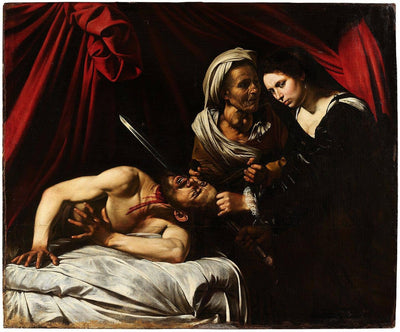
Her Judith, painted about 1620 for Grand Duke Cosimo II de' Medici, is the most violent picture in Florence: blood spurts up and stains Judith's breast while her maid pins Holofernes down. It hangs at the Uffizi in a room shared with Caravaggio, and Artemisia needed Galileo's help to get paid for it. Compare it with Caravaggio's take on the same beheading and you see the difference at once: his Judith flinches, hers leans in and works.

In 2018 the National Gallery in London bought her self-portrait as Saint Catherine, a canvas from about 1615–17 that surfaced only a year earlier. She paints herself as the martyr who survived torture on the wheel. Given the trial, it's hard not to read it personally. Copies of Artemisia's other biblical heroines show how often she came back to women who fight.
4. Clara Peeters (about 1587–after 1636)
Peeters dated her first oil paintings in 1607–1608 and was turning out still lifes steadily by 1612. Her Still Life of Fish and Cat, painted after 1620, is typical: wet fish in a ceramic colander, pewter plates catching the light, and a cat eyeing dinner from the foreground.
5. Judith Leyster (1609–1660)
Back to the Louvre monogram. Leyster painted most of her work in Haarlem between about 1629 and 1635, much of it musicians and cheerful genre scenes close enough to Hals in style to fool buyers. After she married in 1636 her output fell off sharply. The mix-up with Hals tells you how good she was. The Concert, a trio of musicians from about 1633, hangs in Washington.
6. Rachel Ruysch (1664–1750)
Ruysch went to study with the flower painter Willem van Aelst at fifteen and built a career that ran for more than sixty years. She joined the Hague painters' guild in 1701 and served as court painter in Düsseldorf from 1708 until 1716. She was still at it in 1747, when she wrote her age, 83, on a finished canvas.
Portraitists of the eighteenth century
7. Angelica Kauffman (1741–1807)
Swiss-born and trained by her father, Kauffman was painting commissioned portraits in her early teens. Rome's Accademia di San Luca elected her in 1765, she moved to London the next year, and for sixteen years her work was a fixture at the Royal Academy's exhibitions. When she died in Rome, the sculptor Antonio Canova staged her funeral on the model of Raphael's.
8. Élisabeth Vigée Le Brun (1755–1842)
By fifteen she was supporting her mother and brother with portrait fees. She joined the Academy of Saint Luke at 19, and in 1783 the Royal Academy admitted her as one of only four women members. The Revolution sent her running with her nine-year-old daughter, and she spent twelve years painting aristocrats in Rome, Vienna and St. Petersburg before settling back in France in 1809. She left more than 600 paintings, almost all of them flattering.
Nineteenth-century realists and Impressionists
9. Rosa Bonheur (1822–1899)
Bonheur trained with her father and made piles of sketches before touching a canvas, and she won a Salon gold medal in 1848. The big payoff was The Horse Fair, painted 1852–55: more than five meters wide, with heavy horses rearing and stamping while grooms fight to hold them. Queen Victoria admired it, and Cornelius Vanderbilt gave it to the Metropolitan Museum in 1887. In 1865 she received the cross of the Legion of Honor from Empress Eugénie.

10. Berthe Morisot (1841–1895)
Morisot studied with Corot, showed at the Salon from 1864, and then hung in the 1874 exhibition that gave Impressionism its name. She married Édouard Manet's brother Eugène, and they had one daughter, Julie. Her brushwork is quick and light, and Morisot's mothers, daughters and sunlit rooms reward a close look at how little paint she needed.
11. Mary Cassatt (1844–1926)
Cassatt left Pennsylvania for Paris, settled there in 1874, and three years later Degas asked her to show with the Impressionists. She took the mother-and-child subject, which could easily go sentimental, and made it look observed. In the 1893 picture of a woman washing a child's feet, the view is steeply from above and the patterns flatten out the way they do in Japanese prints. The Art Institute of Chicago bought it in 1910, its first Cassatt.
Her sailboat scene from 1893–94, with a man's dark back filling the foreground and a mother holding a baby, was the centerpiece of her first American solo show in New York in 1895. Critics called its flat colors unfeminine. Cheekier is the bored child slumped in a blue armchair. There's plenty more among Cassatt's mothers and children. She also made more than 220 prints, and failing eyesight stopped her working for her last fifteen years or so.

12. Suzanne Valadon (1865–1938)
From 1880 until 1893 Valadon worked as a model, posing for Renoir and Toulouse-Lautrec. She was watching how they worked. In 1909, at 44, she started painting full time, and within two years she had a successful first solo show. Her nudes, like the one arranging her hair from about 1916, look nothing like the ones she posed for. Her son, Maurice Utrillo, became a painter too.
Modern women who changed what a painting could be
13. Hilma af Klint (1862–1944)
Af Klint painted her first abstract canvases in Stockholm in 1906, five years before Kandinsky's. The case for her priority rests on about 200 abstract paintings, including the series she called The Ten Largest, painted between August and December 1907. Kandinsky gets the textbook credit. She got there first.
14. Paula Modersohn-Becker (1876–1907)
She settled in the artists' colony at Worpswede near Bremen in 1898, then kept escaping to Paris, where she studied in 1900 and set up her own studio in 1906. In between she married the landscape painter Otto Modersohn in 1901 and visited Rodin's studio in 1903. She went back to Worpswede in 1907 and died there that year, with her best years plainly ahead of her.
15. Georgia O'Keeffe (1887–1986)
Alfred Stieglitz first exhibited her work in 1916, and by the mid-1920s she was counted among America's most important artists, known for New York skyscrapers and flowers blown up until they filled the canvas. In 1929 she spent her first summer in northern New Mexico, and in 1949 she moved there for good. She kept two houses there, one at Ghost Ranch. "I had to create an equivalent for what I felt about what I was looking at – not copy it," she once explained, and nearly 150 of her paintings are in Santa Fe. She painted her last unassisted oil in 1972 and, nearly blind, kept working with assistants past 90.
16. Tamara de Lempicka (1898–1980)
Born in Warsaw, Lempicka got out of St. Petersburg after the 1917 revolution and reinvented herself in Paris as the painter of Art Deco glamour, all hard light and polished surfaces. Her 1929 self-portrait in a green Bugatti became an icon, though the car she actually drove was a yellow Renault. She moved to the United States in 1939 and died in Cuernavaca, Mexico.
17. Frida Kahlo (1907–1954)
Kahlo was badly hurt in a bus accident at 18 and began painting during the year-plus it took her to recover. She married Diego Rivera in 1929 (then divorced him, then married him again) and had her first solo show at the Julien Levy Gallery in New York in 1938. Most of her work is self-portraiture, small and frontal, with a heavy debt to Mexican folk art. Her 1937 self-portrait dedicated to Leon Trotsky hangs in Washington. Her fame is mostly posthumous; it took off in the 1980s. The blue house in Coyoacán where she spent most of her life opened as a museum in July 1958.
18. Lee Krasner (1908–1984)
Krasner studied with Hans Hofmann, worked for the WPA's Federal Art Project in the 1930s and was a committed abstract painter before she met Jackson Pollock. She introduced him to Willem de Kooning and the critic Clement Greenberg. They married in 1945, and the marriage lasted eleven years, until his fatal car crash. Her real recognition came late, around 1978.
19. Helen Frankenthaler (1928–2011)
From 1950 Frankenthaler worked out the stain technique she's known for: thin paint soaked into the canvas so that color and surface become the same thing, like watercolor at the scale of a wall. She studied with Rufino Tamayo as a schoolgirl, was briefly married to Robert Motherwell, and got retrospectives at both the Whitney and MoMA.
20. Yayoi Kusama (born 1929)
Kusama grew up in Matsumoto, in a family of seed growers, and her mother tore up her drawings to push her toward marriage. She kept drawing. She had her first Tokyo solo show in 1954, moved to New York, and started the Infinity Net paintings: thousands of tiny loops across a whole canvas. The mirror rooms came later. In 1966 she walked through Manhattan in a pink kimono as a performance piece. "I'd like to keep creating art until the day I die," she has said, and she is still working.
Who is the most famous female artist?
Frida Kahlo, by any measure of public recognition. Her face is on tote bags, film posters and museum queues. Among painters of the old masters era, Artemisia Gentileschi has overtaken everyone else in the last few decades. For the auction record, it's O'Keeffe: her 1932 Jimson Weed/White Flower No. 1 sold for $44.4 million at Sotheby's on November 20, 2014, almost four times the previous high for a woman, $11.9 million. The Georgia O'Keeffe Museum was the seller.
Why did so many of these painters disappear?
Mostly through attribution. A good picture with no clear signature drifted toward the nearest famous man, as Leyster's did toward Hals. Marriage often ended careers; Leyster's output dropped after 1636, and Kauffman and Vigée Le Brun were rare in keeping theirs going. And the ones who did get admitted to academies, like Artemisia in Florence or Vigée Le Brun in Paris, were counted as exceptions for a reason. Many of these women are only now getting the museum shows their male peers had a century ago. The best-known pictures of women, painted mostly by men, make an interesting comparison.
Hanging one at home
Most of these paintings belong to museums and will never come up for sale. A copy painted by hand in oil is the next best thing, and Art & See makes them on canvas for people who'd rather live with a Cassatt than a poster of one. Start with the mothers and boats above, or look through the wider list of masterpieces it paints.
Sources
- Uffizi Galleries, Judith Beheading Holofernes
- National Gallery, Self Portrait as Saint Catherine
- National Museum of Women in the Arts, Judith Leyster
- National Museum of Women in the Arts, Rosa Bonheur
- Tate Etc, on Hilma af Klint
- Georgia O'Keeffe Museum, About O'Keeffe
- Museo Frida Kahlo, the museum
- Sotheby's, Tamara de Lempicka: Defining Deco