4.9/5
4.9/5


Renaissance art is the painting, sculpture and building made in Europe in the 1400s and 1500s. Its roots go back to Italy in the 1300s. In those years artists in Florence, Rome, Venice and the lands around Bruges and Ghent changed the way they made pictures. They measured space so it looked deep, and they studied real bodies. They also learned from the art of ancient Greece and Rome. You can see that change in our Early Renaissance paintings, hand-painted in oil. A short timeline after the next section lays out the four periods, the two branches that grew beside them and the cities where each one took place.
It was never just one style, though. Florence had its Early Renaissance, and then came the short High Renaissance of Leonardo, Michelangelo and Raphael. Venice painted with color and light, and painters in Flanders and Germany had a Northern Renaissance of their own. At the end came a style called Mannerism. These times overlapped, and the artists borrowed from one another. This guide tells you where and when each one happened. It names who led each one. It also shows how the pictures were made and which works to know.
What the "rebirth" was
Renaissance is a French word that means "rebirth," and the idea comes from the time itself. In 1550 the painter Giorgio Vasari wrote a book about the lives of the artists. In it he told how artists from Tuscany, the region around Florence, brought drawing and design back to life. In his story, art was born again. Historians today see it a little differently. People already cared about nature, old books and the single person in the late Middle Ages. But those ideas only took the lead in Italy in the 1400s and 1500s.
Three things pushed the change forward. The first was humanism, a way of thinking that put people and their minds at the center. Because of it, an artist was no longer just an unknown craftsman, and a few became the first famous artists. The second was private money. The Medici family led Florence from 1434 until Lorenzo de' Medici died in 1492. They paid for scholars, buildings and painters, and Cosimo de' Medici had grown rich as the pope's banker.
The third was Rome, where Pope Martin V brought the popes back in 1420. The popes after him used art and buildings to make Rome the heart of the Christian world. That run ended in 1527, when the soldiers of Emperor Charles V attacked and robbed Rome. Many artists had to leave.
The four periods of Renaissance art, with dates and cities
| Period | Roughly when | Where | Leading names | A work from this guide |
|---|---|---|---|---|
| 1. Proto-Renaissance | Late 1200s to early 1300s | Italy | Giotto | — |
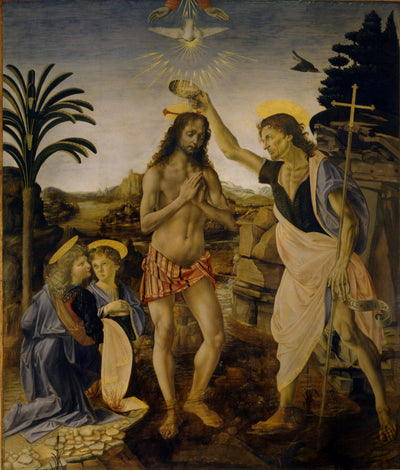
| 2. Early Renaissance | Early 1400s to early 1490s | Florence | Brunelleschi, Ghiberti, Donatello, Masaccio, Piero della Francesca, Verrocchio and Botticelli | The Baptism of Christ (about 1470–1475) and The Birth of Venus (about 1485) |
| 3. High Renaissance | Early 1490s to 1527 | Rome, Milan and Florence | Leonardo, Michelangelo, Raphael and Bramante | Mona Lisa (1503–1519) and The Creation of Adam (finished by 1512) |
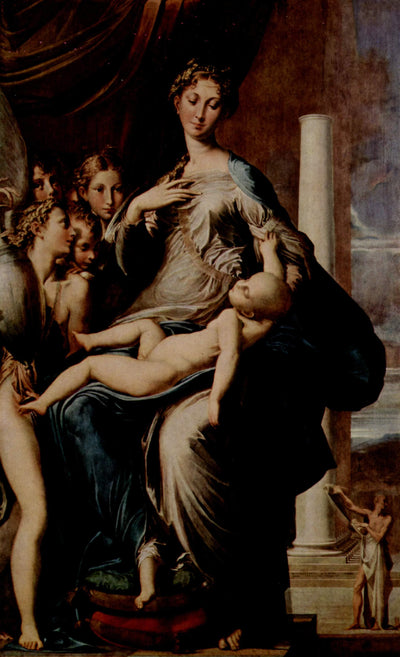
| 4. Mannerism | 1520s to about 1590 | Florence, Rome and Parma, then much of Europe | Pontormo, Rosso Fiorentino and Parmigianino |  Madonna with the Long Neck (1534–1540) Madonna with the Long Neck (1534–1540) |
| Side branch: Venice | Late 1400s through the 1500s | Venice | Giovanni Bellini, Giorgione, Titian, Tintoretto and Veronese |  Bellini's Doge Leonardo Loredan (about 1501–1502) Bellini's Doge Leonardo Loredan (about 1501–1502) |
| Side branch: the North | 1420s to 1560s | Bruges, Ghent and 's-Hertogenbosch, plus Germany and England | Jan van Eyck, Hugo van der Goes, Bosch, Dürer, Holbein and Bruegel | The Ghent Altarpiece (1432) and Hunters in the Snow (1565) |
Each period faded in and out slowly, so treat these years as rough guides, not hard lines.
Venice and the North were not extra steps in a line. They ran at the same time as the Early and High Renaissance in Florence and Rome, and ideas traveled in both directions.
Florence and the Early Renaissance
The first steps came a century earlier. In the late 1200s and early 1300s, the painter Giotto made clear, simple scenes with people who seem to think and feel. That was a break from the flat, decorative pictures before him, so this time is called the Proto-Renaissance, a kind of first Renaissance. Then the plague of 1348 and the wars after it stopped that start. The new art only came back in the early 1400s. You can meet Giotto in our guide to famous Gothic paintings.
A contest opened the new century. In 1401 Florence asked artists to design bronze doors for its Baptistery of San Giovanni, and Lorenzo Ghiberti won. Filippo Brunelleschi lost to him, so he went to Rome with Donatello to study old buildings and statues. When he came home, he built the biggest dome since ancient times over Florence's cathedral.
Brunelleschi also found a way to show depth, and it is called linear perspective. In a picture, lines that run away from you all meet at one point far away. Think of the lines between floor tiles, and that point is called the vanishing point. Leon Battista Alberti then wrote the method down in a book called De Pictura, which means "On Painting." Masaccio is known as the founder of Renaissance painting. You can follow him and the painters after him in our list of Italian Renaissance paintings, one by one.
The next painters, like Piero della Francesca, Pollaiuolo and Andrea del Verrocchio, studied depth and the body even more. They passed what they knew on to their students in the workshop, where a team made the pictures together.

Zoom
Verrocchio's Baptism of Christ, painted around 1470 to 1475, is the classic example of that teamwork. Vasari wrote that Verrocchio's young student Leonardo painted the angel on the left. He painted it so well that he upset his teacher. Experts today think Leonardo did even more, like the land by the river, the golden light and the body of Christ. Some weaker parts, like the hands of God and the dove, seem to come from an older painter, which was normal at the time. The master planned the picture, and his students and helpers painted the smaller parts.
Money and taste shaped the late 1400s too. Lorenzo de' Medici gathered poets, thinkers and painters around him. They believed that looking at beauty could lead a person to God. Botticelli gave that idea its best-known picture, The Birth of Venus. He painted it around 1485 on canvas in tempera, a paint made with egg yolk. It was very probably made for the Medici. Vasari saw it at a Medici country house in 1550, and the orange trees in it were a sign of the family.
Rome and Milan: the High Renaissance
The High Renaissance lasted only about 35 years, from the early 1490s to 1527. It is built around three artists: Leonardo, Michelangelo and Raphael. In Milan, Leonardo painted The Last Supper on a wall between 1495 and 1498, and it has worn away badly since then. He painted the Mona Lisa on a thin board of poplar wood, and he worked on it from 1503 to 1519. The king of France, Francis I, very probably got it in 1518. All of his paintings that still exist are in our guide to Leonardo da Vinci's paintings.
The original and our hand-painted copy
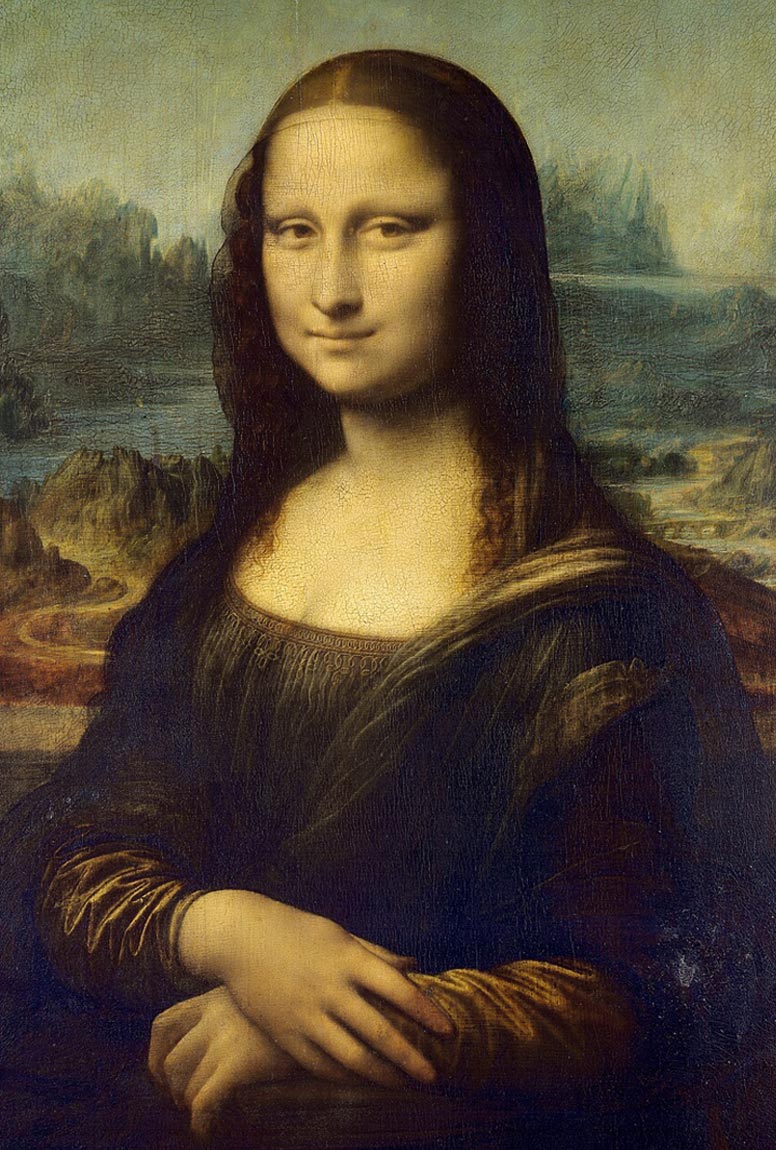
The original
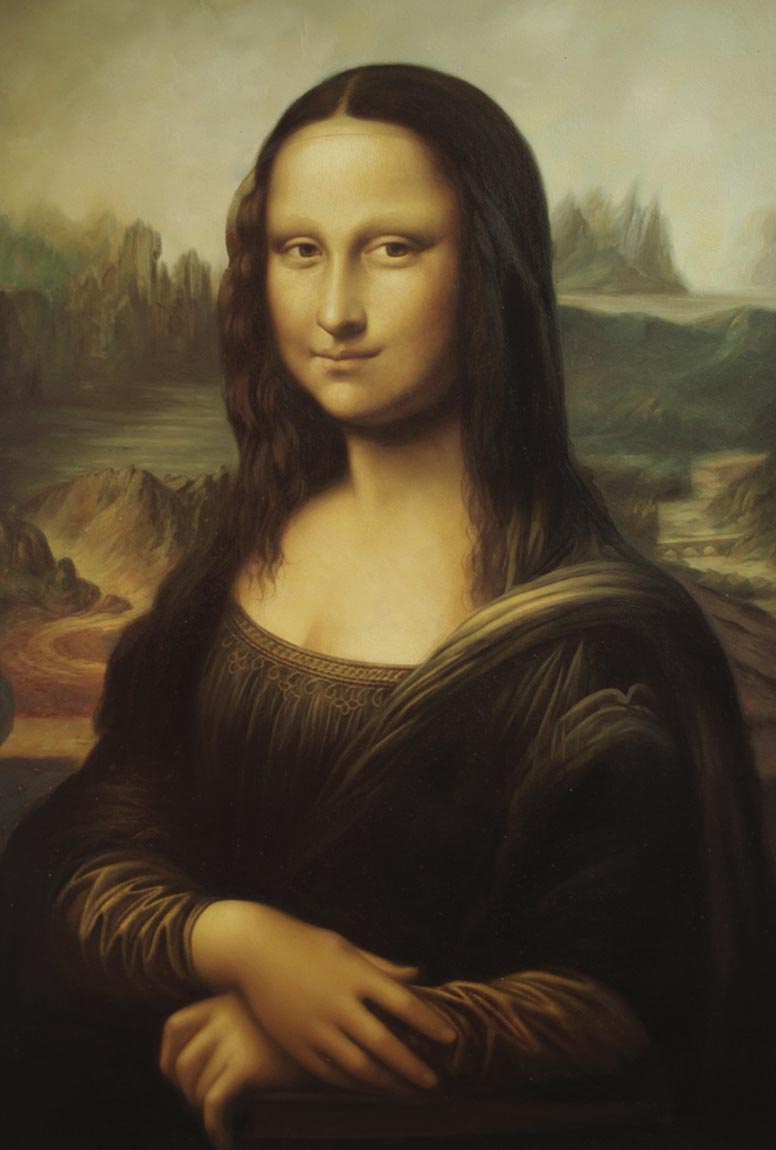
Our reproduction, painted by hand in oil
Rome became the center under Pope Julius II, who ruled from 1503 to 1513. He made Donato Bramante his architect. Together they planned a huge new St. Peter's church to replace the old one from the 300s. For the ceiling of the Sistine Chapel, he turned to Michelangelo, who signed the contract on May 8, 1508. That first plan covered only twelve apostles and some patterns. But Michelangelo called it "a poor thing," so the pope let him plan the whole ceiling himself.
Michelangelo finished the first half of the ceiling in August 1510. He finished the rest by October 31, 1512, and The Creation of Adam is in that second half. While he painted up high, Raphael was painting a room called the Stanza della Segnatura nearby in the Vatican. Our walk through the four Raphael Rooms takes you through each one in turn.
Michelangelo thought of himself first as a sculptor. Before the ceiling, between 1501 and 1504, he carved David out of marble. The statue is more than five meters tall. In January 1504 a group that included Leonardo, Botticelli and Perugino chose its place. It would stand at the entrance of the Palazzo Vecchio, and it was unveiled there on September 8, 1504. Our article on Michelangelo's work in marble tells more. Our High Renaissance collection gathers hand-painted copies of paintings from these years.
Venice: color, oil and canvas
Venice worked by different rules, and the two cities went about painting in opposite ways. In Florence, drawing came first, so painters planned each picture in careful drawings. In Venice, painters often built the picture right on the canvas. They used layers of color patches instead of lines. There was a practical reason too. Antonello da Messina brought oil paint to northern Italy, and Venice took it up fast. The damp air there was bad for fresco, which is painting on wet plaster on a wall.
Giovanni Bellini, Giorgione, Titian, Tintoretto and Paolo Veronese came one after another. Even Vasari always stood up for the art of Tuscany. But he agreed that Giorgione and Titian were brilliant at the new way of painting.

Zoom
Bellini's portrait of Doge Leonardo Loredan shows what oil paint could do. The doge ruled Venice, and Loredan held that job from 1501 until he died in 1521. Bellini painted him around 1501 to 1502, from the chest up and behind a low stone ledge. That is how old marble statues of Roman emperors look. Then he did better than any statue. Oil dries slowly, so he could blend it into soft changes across the face. Loredan's white silk robe has gold and silver thread in it, and it was only worn on the biggest feast days.
The Northern Renaissance
North of the Alps, the change came more through paint than through old ruins. Oil paint was already used in Northern Europe in the 1200s and 1300s. Then Jan van Eyck and Robert Campin found new ways to use it. Oil dries slowly, so it let them paint finer details than egg tempera did. Painters there also seem to have made space look deep just by eye. They didn't use the math the Italians worked out. Our article that asks whether Jan van Eyck invented oil painting sorts the legend from the facts.
Van Eyck worked for Philip the Good, the Duke of Burgundy, from 1425 to 1441, and he lived in Bruges by 1431. He also did something unusual for his time, because he signed and dated his pictures. His brother Hubert began The Ghent Altarpiece, and Jan finished it for a man named Joos Vijd. It was first set up in a chapel in Ghent on May 6, 1432. It is still in Saint Bavo's Cathedral, and a short poem on its frame tells the story:
“Hubert van Eyck, the greatest painter ever, started this work; his brother Jan, who came second in painting, completed this arduous task at the request of Joos Vijd. He entrusts this work to you on 6 May 1432. Admire what they have accomplished.”
A recent repair of the altarpiece solved an old puzzle. X-rays found the name "Lubrect," an old spelling of Hubert's name, with the date he died. So Jan may have painted the top part as a tribute to his late brother. Two years after Ghent, Jan wrote "Jan van Eyck was here" in Latin. He put those words above the curved mirror in The Arnolfini Portrait, with the year 1434.
Ideas traveled both ways, and Tommaso Portinari, who worked for the Medici, ordered a large altarpiece from Hugo van der Goes. It reached Florence in 1476, and it was painted in thin, see-through layers of oil instead of the usual tempera. Soon after that, painters in central Italy began to use oil too.

Zoom
Hand-painted oil reproductionSee sizes ›
Hieronymus Bosch was born and died in the town of 's-Hertogenbosch. He used the same careful skill to paint sin and judgment. He painted The Garden of Earthly Delights between 1490 and 1500 as a triptych, which is a painting in three panels. When it is closed, the outside shows the third day of Creation in shades of gray. When it is open, the left side shows Adam and Eve in Eden.
The center is a crowded garden of lovers, and the Prado sees it as a false paradise full of lust. The right side is a hell where every deadly sin is punished. King Philip II of Spain bought it in 1591, and since 1933 it has been in the Prado in Madrid.
In Germany, Albrecht Dürer came closest to the spirit of Florence. He tried things out with optics, the science of how we see, and he studied nature closely. You can tell from his Self-Portrait of 1500. His prints were cut into wood or metal, and they carried his mix of new and older northern ideas all over Europe. Our guide to famous German paintings picks up his story.

Zoom
Hand-painted oil reproductionSee sizes ›
Hans Holbein the Younger has been called the best portrait painter of the 1500s. He painted The Ambassadors in 1533 on his second trip to England. It shows Jean de Dinteville, who was sent to England by Francis I of France. Next to him stands his friend Georges de Selve, a bishop. That was the year Henry VIII married Anne Boleyn against the pope's wishes.
A strange stretched shape floats between the two men's feet. It only turns into a skull when you look at it from one angle. A small cross with Jesus on it is tucked into the top left corner. Holbein rarely signed his work, but he signed and dated this one on the marble floor. That seems to show how proud he was of it.
Pieter Bruegel the Elder carried the northern way of painting into the 1560s. He painted Hunters in the Snow on a wooden panel, and he signed it "BRVEGEL" at the bottom center. Next to his name he wrote the year 1565 in Roman numbers.
Mannerism and the end of the Renaissance
Leonardo died in 1519 and Raphael in 1520. After that, Italian painting became very aware of its own style. This new style was called Mannerism, and it lasted from the 1520s to about 1590. Its name comes from the Italian word maniera, which means "manner" or "style." High Renaissance pictures felt calm. But Mannerist ones had long arms and legs, small heads, strange poses and flat, unsure space. Rosso Fiorentino and Jacopo da Pontormo led the change in Florence. Then Michelangelo's Last Judgment in the Sistine Chapel, from 1536 to 1541, pushed the human body to extremes.

Zoom
Hand-painted oil reproductionSee sizes ›
Parmigianino's Madonna with the Long Neck, painted from 1534 to 1540, shows the style at full stretch. Parmigianino trained in Parma, and then he studied Michelangelo and Raphael in Rome. Here he drew Mary out into long, unnatural shapes, while the baby Jesus sleeps across her lap. That sleep points ahead to his death. The jar an angel holds up points to the Crucifixion too.
In the bottom right, a small Saint Jerome turns toward a Saint Francis. But Parmigianino painted only one of Francis's feet. His contract of 1534 gave him five months to finish the painting. When he died in 1540, though, it was still in his studio and not done. Two years later someone added words to the base of the column, and they blame "adverse destiny," or bad luck, for the gaps. Our Mannerism and Late Renaissance collection has more from this time.
The Baroque style closed the period. Annibale Carracci and Caravaggio led the way into it. One worked in a classical style, and the other painted life as it really looked. The Church held a long meeting called the Council of Trent, from 1545 to 1563. After it, the Church wanted art that would stir the faith of ordinary people, and the Baroque grew out of that time. Our comparison of Baroque and Renaissance art sets the two side by side.
How Renaissance painters made their pictures
Most of the look of the period comes from a few methods. The table below explains each one in a few words, and it matches each one with a work from this guide.
| Method | How it works | See it in |
|---|---|---|
| Fresco (buon fresco) | Paint goes onto the last layer of wet plaster, the intonaco. Only as much plaster as can be painted in one day, a giornata, is spread at a time, so the paint bonds with the wall. | The Sistine Chapel ceiling |
| Egg tempera | Pigment bound with egg yolk. It was the medium of most early Italian paintings, was often combined with oil in late 15th-century Italy, and grew less common after 1500. | The Birth of Venus; The Baptism of Christ (tempera and oil) |
| Oil and glazes | Pigment ground in linseed, walnut or poppy oil. Thin transparent layers laid over a lighter color change it without hiding it. | The Arnolfini Portrait; Doge Leonardo Loredan |
| Canvas | Hemp or flax cloth fixed over a wooden frame, lighter and easier to move than a wood panel. | Venetian painting; The Birth of Venus |
| Linear perspective | Receding parallel lines drawn so that they meet at a single vanishing point. | Raphael's School of Athens |
| Sfumato | A "smoky" blending that softens contours without harsh outlines. Leonardo advised painting "without lines," and Giorgione brought the effect to Venice. |  Mona Lisa Mona Lisa |
| Cartoon | A full-size drawing on paper, transferred by tracing with a stylus or by pricking the outlines and pouncing charcoal through the holes. | Raphael's cartoons for woven wall hangings (Royal Collection, at the Victoria and Albert Museum) |
These methods explain why the paintings look the way they do. Perspective was built with geometry. Soft faces were built up in thin layers of oil and in sfumato, a smoky blending with no hard outlines. The rich look of Venice came from colors that were layered and blended on canvas. Our guide to the characteristics of Renaissance paintings shows you how to spot each trait.
Where the originals are, and a copy at home
The works in this guide are spread across Florence, Milan, the Vatican, Ghent, Madrid, London, Paris and Vienna. So seeing them all in person takes several trips. Between trips, our studio artists paint each linked work by hand in oil on canvas. Our page of the most famous paintings in the world shows where Renaissance art fits among all the rest.
Sources
- Encyclopaedia Britannica, Renaissance art
- Encyclopaedia Britannica, Mannerism
- Encyclopaedia Britannica, Baroque art and architecture
- The Met, Heilbrunn Timeline of Art History: Venetian Color and Florentine Design
- The Met, Heilbrunn Timeline of Art History: Northern Italian Renaissance Painting
- The Met, Heilbrunn Timeline of Art History: The Papacy during the Renaissance
- The Met, Heilbrunn Timeline of Art History: Jan van Eyck
- Uffizi Galleries, Verrocchio and Leonardo, The Baptism of Christ
- Uffizi Galleries, Botticelli, The Birth of Venus
- Uffizi Galleries, Parmigianino, Madonna with the Long Neck
- Musée du Louvre, Portrait of Lisa Gherardini (Mona Lisa), collection record
- Vatican Museums, Sistine Chapel: the ceiling
- Galleria dell'Accademia, Florence, Michelangelo's David
- National Gallery, London, Giovanni Bellini, Doge Leonardo Loredan
- National Gallery, London, Jan van Eyck, The Arnolfini Portrait
- National Gallery, London, Hans Holbein the Younger, The Ambassadors
- National Gallery, London, glossary: Fresco
- National Gallery, London, glossary: Tempera
- National Gallery, London, glossary: Oil
- National Gallery, London, glossary: Glaze
- National Gallery, London, glossary: Canvas
- National Gallery, London, glossary: Perspective
- National Gallery, London, glossary: Sfumato
- National Gallery, London, glossary: Cartoons
- Saint Bavo's Cathedral, Ghent, The Ghent Altarpiece
- Museo del Prado, Hieronymus Bosch, The Garden of Earthly Delights
- Kunsthistorisches Museum Vienna, Pieter Bruegel the Elder, Hunters in the Snow