4.9/5
4.9/5


Walk to the far end of the Rijksmuseum's Gallery of Honour on a busy morning and you'll see the crowd before you see the canvas. That crowd is the simplest measure of fame there is, and it's the one behind this list of the most famous Rembrandt paintings. Some earned their place on a museum wall. Others earned it in the newspapers: a theft nobody has solved, a knife and acid attack, a record price, a cigar box.
Rembrandt van Rijn was born in Leiden on 15 July 1606 and died in Amsterdam on 4 October 1669. He never went abroad, yet his pictures now hang from St. Petersburg to New York. The fifteen below are the ones people come looking for, and several of them are among the Rembrandt paintings copied most by hand.
What is Rembrandt's most famous painting?
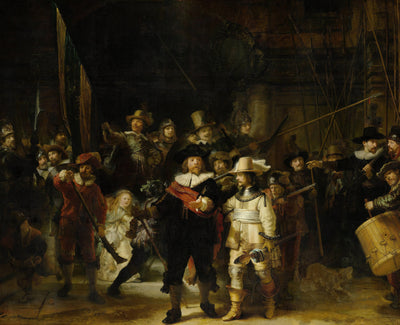
The Night Watch, painted in 1642 for the hall of an Amsterdam civic guard company, is Rembrandt's most famous painting. It hangs in the Rijksmuseum in Amsterdam, stands close to four meters tall and four and a half wide, and has drawn crowds, restorers and, three times, attackers. No other Rembrandt comes close in recognition.
How the fifteen were ranked
Fame here means recognition outside the art history classroom. A painting moves up if a general reader would know it on sight, if it has made headlines, and if a museum builds a visit around it. Scholarly weight counts for less, which is why a couple of pictures experts adore sit below a stolen seascape. Is that unfair to The Conspiracy of Claudius Civilis? Probably. But it matches what people actually search for and travel to see.
| Rank | Painting | Year | Where it hangs |
|---|---|---|---|
| 1 | The Night Watch | 1642 | Rijksmuseum, Amsterdam |
| 2 | The Anatomy Lesson of Dr. Nicolaes Tulp | 1632 | Mauritshuis, The Hague |
| 3 | The Return of the Prodigal Son | 1661–1669 | Hermitage, St. Petersburg |
| 4 | The Storm on the Sea of Galilee | 1633 | Stolen in 1990, still missing |
| 5 | Self-Portrait with Two Circles | c. 1665–1669 | Kenwood House, London |
| 6 | The Jewish Bride | c. 1665–1669 | Rijksmuseum, Amsterdam |
| 7 | Danaë | 1636, reworked by 1643 | Hermitage, St. Petersburg |
| 8 | Aristotle with a Bust of Homer | 1653 | Metropolitan Museum of Art, New York |
| 9 | Belshazzar's Feast | c. 1635–1638 | National Gallery, London |
| 10 | Syndics of the Drapers' Guild | 1662 | Rijksmuseum, Amsterdam |
| 11 | Self-Portrait at the Age of 63 | 1669 | National Gallery, London |
| 12 | Bathsheba at Her Bath | 1654 | Louvre, Paris |
| 13 | The Polish Rider | 1650s | Frick Collection, New York |
| 14 | The Blinding of Samson | 1636 | Städel, Frankfurt |
| 15 | The Conspiracy of Claudius Civilis | c. 1661–1662 | Nationalmuseum, Stockholm |
Amsterdam holds three of the fifteen and London three more. A long weekend in either city covers a fifth of the list.
1. The Night Watch, 1642

Its real title is a mouthful: Militia Company of District II under the Command of Captain Frans Banninck Cocq. The captain in black is giving his lieutenant the order to march, and the whole company is caught in the act of getting moving. That was the new idea. Group portraits of civic guards had been rows of men posing; Rembrandt was the first to paint the sitters actually doing something.
The nickname came later, at the end of the 18th century, when layers of darkened varnish made a daytime scene look like night. It stuck even after the varnish came off in the 1940s. And the picture you see is smaller than the one Rembrandt delivered. In 1715 it was cut down on all four sides to fit between columns in Amsterdam's Town Hall, and two figures on the left disappeared with the trimmings.
Look for the girl in gold in the left middle ground, lit as if by a spotlight, with a dead chicken hanging at her waist. She is the company's mascot, painted as a person, and once you find her you can't stop seeing her.
The canvas has survived a shoemaker's knife in 1911, a slashing in 1975 and an acid attack in 1990. Since July 2019 conservators have studied it inside a glass room in the gallery, so visitors watch the work happen. It measures 379.5 by 453.5 centimeters and weighs 337 kilograms, and it has been on loan from the City of Amsterdam since 1808. If this is the one you want on your own wall, there's a hand-painted Night Watch at a size a living room can take.
2. The Anatomy Lesson of Dr. Nicolaes Tulp, 1632
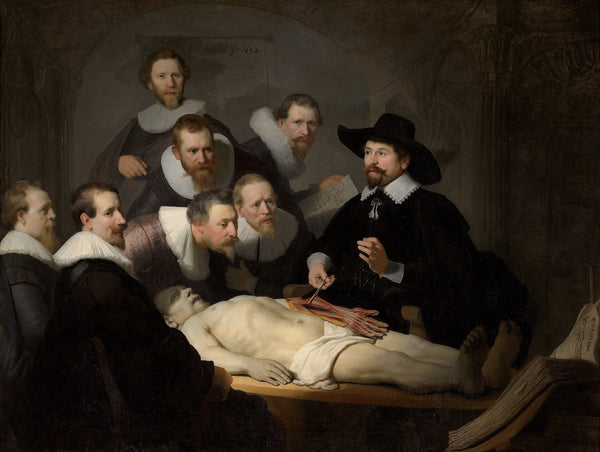
Rembrandt was 26 when Amsterdam's surgeons hired him, and this was his first major commission in the city. Dr. Tulp lifts the muscles of the left forearm while his colleagues lean in to look. The body on the table belonged to Aris Kindt, a thief convicted of armed robbery and hanged.
Earlier anatomy portraits kept the corpse to one side. Here it runs straight across the middle of the picture, pale and lit, and the living men arrange themselves around it. The Dutch state bought the painting in 1828 for 32,000 guilders, after King William I blocked its sale, and it has hung in the Mauritshuis in The Hague ever since. If you've met the surgeons' group portrait before, odds are it was on a textbook cover or a lecture slide.
3. The Return of the Prodigal Son, 1661–1669
A son in rags kneels. His old father pulls him in. That is nearly all that happens on a canvas 262 centimeters tall, painted in Rembrandt's last years, long after his wife Saskia's death in 1642 and his bankruptcy in 1656.
Watch the father's hands. The left one is broad and heavy, a man's hand; the right is slimmer and softer. People read them as a father's grip and a mother's touch resting on the same back. The Dutch priest Henri Nouwen sat in front of it for hours at the Hermitage in 1986 and wrote a whole book about it, published in 1992, and plenty of readers who've never been to St. Petersburg know the painting from its cover.
4. The Storm on the Sea of Galilee, 1633

Nobody has seen the original since 18 March 1990. That night two men dressed as police officers got into the Isabella Stewart Gardner Museum in Boston and left with thirteen works, this one included. It is still the largest art theft in American history, the museum still offers a $10 million reward, and an empty frame still hangs in the Dutch Room where the picture used to be.
The theft made the painting famous far beyond museum audiences, but it would deserve a place anyway. It is Rembrandt's only known seascape. A fishing boat climbs a wave, the sail tears loose, and the disciples fight the ropes while Christ is woken in the stern. One man looks straight out at you from the boat. That face is Rembrandt's own. Since the only way to see it now is in reproduction, a hand-painted Storm on the Sea of Galilee is about as close as anyone gets.
5. Self-Portrait with Two Circles, c. 1665–1669
Rembrandt painted himself more than forty times, and this late one at Kenwood House in London is the one many people picture first. He faces you with his palette, brushes and maulstick, and behind him two great arcs curve across the wall. Nobody agrees on what they mean. Hemispheres of the world, a nod to the old story of Giotto drawing a perfect circle freehand, plain design: each theory has its fans.
The hands are barely there, a few quick strokes, and the picture carries no signature or date. If you'd like one of his faces looking back at you at home, there's a hand-painted Rembrandt self-portrait as well.
6. The Jewish Bride, c. 1665–1669
The nickname dates from the early 19th century and is almost certainly wrong. The Rijksmuseum now titles it Isaac and Rebecca, a couple from Genesis, though who actually posed is still an open question. What nobody argues about is the paint. The man's sleeve is laid on so thickly it looks almost sculpted, and Rembrandt scratched into the wet paint with the butt end of his brush.
His hand rests on her chest; hers rests lightly on his. It's one of the few tender images of marriage from the 1600s that doesn't feel posed.
7. Danaë, 1636
A woman in bed raises her hand toward light spilling past a curtain. In the Greek myth, Zeus arrives as a shower of gold; Rembrandt gives us only the glow. He finished the painting in 1636 and reworked it by 1643 at the latest, changing the face from that of his wife Saskia to that of Geertje Dircx, the woman who lived with him after Saskia died.
On 15 June 1985 a visitor to the Hermitage threw sulphuric acid on the canvas and cut it twice with a knife. The worst damage hit her face, her hair, her right arm and her legs. Restorers worked on it from 1985 until 1997, so the Danaë on the wall today is part original, part patient repair. For the glow without the scars, there's a hand-painted copy of Danaë too.
8. Aristotle with a Bust of Homer, 1653
A Sicilian nobleman, Don Antonio Ruffo, ordered a painting from Rembrandt without naming a subject. He got a philosopher in a broad black hat, one hand resting on a marble head of Homer, and a gold chain across his chest, the gift of his pupil Alexander the Great. When the Metropolitan Museum of Art bought it at auction in 1961 for $2.3 million, no picture had ever sold for more, public or private.
9. Belshazzar's Feast, c. 1635–1638
A king at a banquet turns and sees a hand writing on the wall. His guests spill the gold cups stolen from the Temple in Jerusalem. This is Rembrandt at his most theatrical, all flash and shock, and it's the painting most people picture when they hear "the writing on the wall."
The Hebrew letters came from a text by the Amsterdam rabbi Menasseh ben Israel, and Rembrandt set them in vertical columns instead of rows read right to left. That may be the point: nobody at the feast can read them. Victorian critics found it tame. The National Gallery in London bought it in 1964, and it is now among the gallery's most licensed images.
10. Syndics of the Drapers' Guild, 1662
If you grew up in the US, you may know this one from a cigar box: it's on the Dutch Masters packaging. Six men from Amsterdam's cloth guild, five officials and a servant, look up from their sample book as though you'd just walked in. That interrupted glance is the whole trick, and it's why the group portrait of the cloth inspectors feels alive where most guild portraits look like board minutes. It hung in the guild's hall until 1771.
11. Self-Portrait at the Age of 63, 1669
This is one of three self-portraits Rembrandt painted in the last months of his life. X-rays show he first painted himself holding a brush, then painted the hands out and let the face carry everything. The National Gallery bought it at auction in 1851 for 10 guineas, and it now hangs in Room 22 of the London gallery. Look at the sagging fold under his right eye, made with one swirl of a heavily loaded brush.
12. Bathsheba at Her Bath, 1654
King David's letter has arrived, and Bathsheba sits holding it, thinking about what it asks. Rembrandt painted her on a square canvas 142 centimeters a side, and the model is traditionally said to be Hendrickje Stoffels, his companion in the 1650s. The Louvre received it in 1869 as one of 583 works given by Dr. Louis La Caze. Few nudes anywhere look this thoughtful.
13. The Polish Rider, 1650s
A young horseman in a fur hat rides through a dark landscape. Henry Clay Frick bought it in 1910 from the Polish count Zdzisław Tarnowski, and it still hangs in the Frick Collection in New York. Since 1984 some scholars have argued that another hand helped finish it; the Frick labels it plainly as Rembrandt. It's one of only two equestrian portraits in his work.
14. The Blinding of Samson, 1636
The most violent picture Rembrandt ever painted. A soldier drives a blade into Samson's eye while Delilah runs for the door with his hair in her hand. The canvas is more than three meters wide, and Rembrandt sent it to Constantijn Huygens, secretary to the House of Orange, partly as an apology for commissioned paintings that were running late. The Städel in Frankfurt bought it in 1905.
15. The Conspiracy of Claudius Civilis, c. 1661–1662
This was meant to be the largest painting of his life, a lunette about five meters by five for Amsterdam's new town hall. The city sent it back, probably put off by the odd crown Rembrandt had set on the rebel leader's head. He cut it down to a fragment he could sell, and that fragment, a table of conspirators swearing an oath, has been shown at the Nationalmuseum in Stockholm since 1864. Even cut down, it glows like a lantern.
Is Rembrandt Baroque or Renaissance?
Baroque. Rembrandt belongs to the Dutch Golden Age of the 17th century, generations after the Renaissance. His hard contrasts of light and dark, his taste for the dramatic moment, and his thick, visible paint all mark him as a Baroque painter, though a very Dutch one, working for Amsterdam's guilds and merchants rather than for popes and kings.
Bringing one home
Five of the paintings above, The Night Watch and the lost Storm among them, can be ordered as hand-painted oil copies, and the full run of Rembrandt copies sits in one place. If you'd rather compare him with other masters first, start with the hundred pictures everyone knows by sight.