4.9/5
4.9/5


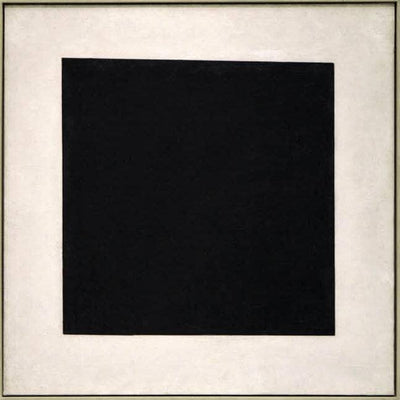
The most famous all-black painting is Kazimir Malevich's Black Square. It is a black square on a white background, and he painted it in oil on canvas in 1915. Today it belongs to the Tretyakov Gallery in Moscow, and it ranks among the best-known paintings in the world. But it has rivals that share its color and little else. Goya filled the walls of his house in Madrid with dark paintings. After the Second World War, Frank Stella, Ad Reinhardt, Mark Rothko and Pierre Soulages made black the main subject of their work. And in this century, engineers have raced each other to make the blackest black of all. Near the end, one chart gathers all nine, says how much of each canvas is truly black and gives a Wikipedia count for the three where we found one.
Black Square, Malevich (1915)

Zoom
Malevich first showed his 1915 Black Square at an art show in Petrograd, the city now called Saint Petersburg. The show opened on December 19, 1915, and 14 artists took part. Malevich had 39 works there, but he gave this one a special spot. He hung it high up, across the corner where two walls meet. In a Russian Orthodox home, that corner is where the family keeps its icons, the holy pictures of saints. Malevich called his square "a bare icon without a frame."
He named his new style Suprematism, and he picked its two colors on purpose. In the Tretyakov's notes on the painting, white stands for space without end, and it is a color that holds all the others. Black stands for using as little as possible, because it is a "non-color" that soaks up every other color. Malevich called the square "the zero of forms" and "the face of the new art." His students and followers formed a group called UNOVIS, and they wore a black square sewn on a sleeve or a collar. On his late paintings, Malevich even used a black square in place of his signature.
When the painting was first shown, the list of works called it Quadrangle, a word for any shape with four sides. That name fits, because its corners aren't perfect right angles. The gallery thinks Malevich did that on purpose, so the shape would seem to move instead of sitting still. In 2015 experts at the gallery studied the canvas closely, and they found two earlier pictures full of shapes hidden under the black paint.
Malevich's other shapes grew out of this square, and you can follow them through his Suprematist paintings and the rest of his work. To see how it changed painting, read about where abstract art came from and look at more famous abstract paintings. For the Russian art around it, take our tour of famous Russian paintings.
Four Black Squares

Zoom
Malevich kept coming back to his square. After 1915 he painted it three more times, each time for a certain show. He wasn't trying to make exact copies, so the later squares differ in size and shape. The second Black Square dates from about 1923, and it is the biggest of the four. It hangs in the Russian Museum in Saint Petersburg. He made it with a black circle and a black cross for the Venice Biennale, a big art show in Italy. But the three paintings were never shown there, because of quarrels and plots among the Russian organizers.
The 1929 Black Square is the closest to the first one, and it is in the Tretyakov too. Malevich painted it for his own show at the gallery, which opened at the end of 1929. A worker at the gallery later remembered the reason. Cracks had appeared on the 1915 canvas, so Malevich set out to paint a new one to take its place. He worked carefully from the original in the mornings, before visitors were let into the rooms.
The last and smallest is the fourth Black Square, from the early 1930s, and it belongs to the Hermitage in Saint Petersburg. Over those years Malevich kept giving the square new meanings. He called it "the embryo of all possibilities," which means the seed that everything else could grow from. In the late 1920s he told his students that he had wanted it to show space without end and time without end. Near the end of his life, his friend Ivan Klyun said, Malevich sent a message to the Tretyakov's director. In it he said that the best work in the whole gallery was his own Black Square.
Goya's Black Paintings (1820–1823)

Zoom
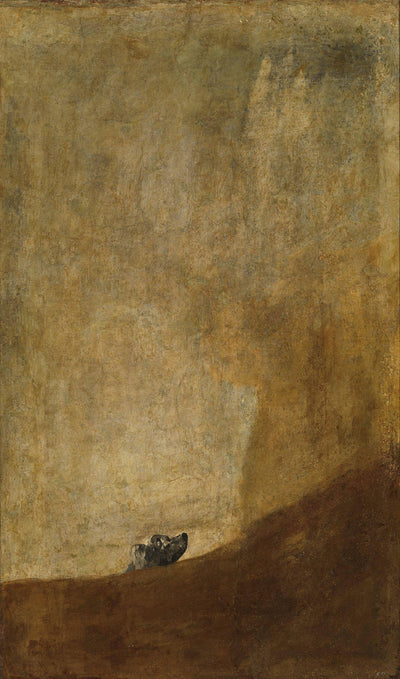
Goya's name often comes up next to Malevich's, but his "black" means something else. Goya's Black Paintings are pictures he painted right on the walls of his own house in Madrid, which was called la Quinta del Sordo. They got their name from their many dark colors and from their gloomy subjects. They are dark, but they aren't all black, because pale skin and yellow-brown shapes shine through the gloom.
Goya gave the house to his grandson before he left for Bordeaux, in France, in 1823. In 1873 a man named Baron Émile d'Erlanger bought it, and he had the wall paintings moved onto canvas. A lot of paint was lost along the way. Then he gave them to Spain, and they have hung in the Prado museum since 1889. Saturn was on the ground floor. The god in it may stand for a very human fear, the fear of losing your power. You can read why Goya painted Saturn on his own dining room wall. Then you can walk through the Quinta del Sordo room by room to see where each painting once was.

Zoom
Hand-painted oil reproductionSee sizes ›
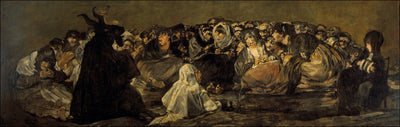
Upstairs was The Dog, and its Spanish name means "half-sunk dog." In Goya's Dog, only the dog's head rises above a dark slope, under a wide space that is almost empty. Back on the ground floor was Witches' Sabbath, also called The Great He-Goat. It is more than four meters wide. It shows a crowd of witches with animal faces, and they gather in front of a goat, which is the devil. Goya used witchcraft here to show how low people can sink.
When Witches' Sabbath was taken off the wall, more than 1.4 meters of it were cut away. A writer once described a young woman at its center, but now she sits at the right edge. The rest of Goya's work, from royal portraits to The Third of May 1808, is in the ten most famous Goya paintings.
So the same color does two opposite jobs. Goya's darkness is crowded with people, fear and stories, but Malevich's black doesn't point to anything outside the canvas at all.
The black canvases after 1950
For Malevich, black was a starting point. After the Second World War, a few painters made black the whole subject of a painting. That gave Malevich's famous all-black painting some real rivals.
Frank Stella's Black Paintings (1958–1960)
Frank Stella painted his black in stripes. In The Marriage of Reason and Squalor, II from 1959, two matching sets of upside-down U shapes sit side by side. Each set has twelve black stripes, and thin lines of bare canvas run between them. Stella painted them freehand, with store-bought black enamel, a shiny kind of paint, and a housepainter's brush. He made this second version for a 1959 show at the Museum of Modern Art in New York, and the museum bought it there. In the show's catalog, his friend Carl Andre wrote: "His stripes are the paths of brush on canvas. These paths lead only into painting."
Ad Reinhardt's "ultimate" paintings (1960s)
Ad Reinhardt went even further. In the last ten years of his life he painted nothing but square black canvases, and he called them his "ultimate" paintings. In 1961 he described the shape and size he wanted them to have:
“A square (neutral, shapeless) canvas, five feet wide, five feet high, as high as a man, as wide as a man's outstretched arms (not large, not small, sizeless)”
At first his Abstract Painting from 1963 looks flat and black. But if you keep looking, a grid of nine squares appears. The corners are a reddish black, and a cross runs through the middle. Its bar going up and down is bluish, and its bar going across is greenish.
To get that smooth, dull surface, he mixed black with a little red, green or blue. Then he let the paint stand for weeks until the colored powder separated from the liquid. He poured the liquid off and brushed on what was left, so no brushstroke would show. When the black paintings were first shown at MoMA in 1963, their bare look shocked visitors. At least one person even canceled a museum membership in protest.
The Rothko Chapel, Houston (1964–1971)
Mark Rothko's black is one you can walk into. In 1964 John and Dominique de Menil asked him to make a place for quiet thought and prayer in Houston, Texas. He finished the paintings in 1967, but he died in 1970, and he never went to Houston. The chapel was built after his death, and it opened in February 1971. Fourteen large paintings hang on its walls. As your eyes get used to the light, you see that they aren't all black. The chapel doesn't belong to any one religion, and people of every faith are welcome there.
Pierre Soulages and "outrenoir" (from 1979)
By the end of 1946, Pierre Soulages had stopped painting pictures of people and things. He made black his color for the rest of his life. "I love the authority of black," he said. "It is a color that does not compromise." He also called it a color that is "at once color and non-color." When he spread it with different tools, his black turned smooth or rough, and it caught the light in surprising ways. In 1979 he found a new way of painting, and in 1996 he named it "outrenoir," which means beyond black. A museum of his work opened in his hometown of Rodez in 2014, and he died in October 2022 at the age of 102.
Anish Kapoor and the race for the blackest black
The newest rival isn't a paint at all. Vantablack is a coating made of carbon nanotubes, which are tiny tubes of carbon, and a British company called Surrey NanoSystems makes it. In 2016 it started a fight in the art world. News reports said the sculptor Anish Kapoor, who had already worked with it, was the only artist allowed to use it. The painter Christian Furr didn't like that, and he said, "I've never heard of an artist monopolizing a material." To monopolize something means to keep it all to yourself.
Three years later, engineers at MIT made an even blacker coating. They offered their method free to any artist for a project that wasn't meant to make money. They showed it in an artwork by Diemut Strebe at the New York Stock Exchange. There it covered a yellow diamond of 16.78 carats, and the diamond looked like a flat black hole.
Nine famous all-black paintings, and how black each one really is
| All-black work | Artist and date | Where it is | How black is it, really? | Wikipedia reach (languages) |
|---|---|---|---|---|
 Black Square Black Square |
Kazimir Malevich, 1915 | Tretyakov Gallery, Moscow | A black square on a white ground. Two earlier pictures full of shapes hide under the black paint. | no data |
| Black Square, second version |
Kazimir Malevich, about 1923 | Russian Museum, Saint Petersburg | Still a black square, and the biggest of the four. | no data |
| Black Square, 1929 version |
Kazimir Malevich, 1929 | Tretyakov Gallery, Moscow | The closest of the four to the first one, painted after cracks showed up on the 1915 canvas. | no data |
| Black Square, fourth version |
Kazimir Malevich, early 1930s | Hermitage, Saint Petersburg | The smallest of the four squares. | no data |
| Goya's Black Paintings, such as Saturn, The Dog and Witches' Sabbath | Francisco Goya, 1820–1823 | Museo del Prado, Madrid | Dark, but not all black. Pale skin and yellow-brown shapes shine through the gloom. | no data |
| Frank Stella's Black Paintings, such as The Marriage of Reason and Squalor, II | Frank Stella, 1958–1960 | Museum of Modern Art, New York | Stripes of shiny black enamel, with thin lines of bare canvas left between them. | 35, for Stella's own page |
| Abstract Painting | Ad Reinhardt, 1963 | Museum of Modern Art, New York | It looks flat and black at first. Then a grid appears in reddish, bluish and greenish blacks. | 15, for Reinhardt's own page |
| The Rothko Chapel paintings | Mark Rothko, painted 1964–1967 | Rothko Chapel, Houston | Fourteen big canvases that turn out not to be all black once your eyes get used to the light. | 12, for the chapel |
| Pierre Soulages's outrenoir paintings | Pierre Soulages, from 1979 | Named outrenoir in 1996, and his museum is in Rodez, France | Black is the whole idea. He spread it smooth or rough, so it catches the light in surprising ways. | no data |
We checked Wikipedia in October 2026 and found a trustworthy page for only three of the nine. Two of those pages are about the painter, not the painting.
With six blanks, a fair ranking is not possible, so the nine simply follow their dates. That puts first the 1915 square, which this guide calls the most famous all-black painting.
A black square on your own wall
A black canvas pulls the whole room toward it, so it needs space and a quiet wall around it. Malevich's square from 1915 suits a bright room without much in it. Goya's half-sunk dog wants a darker corner, where someone can stand close and look for a while.
Sources
- Tretyakov Gallery, Kazimir Malevich, Black Suprematic Square (1915)
- Tretyakov Gallery, Kazimir Malevich, Black Square (1929)
- State Russian Museum, Kazimir Malevich, Black Square (c. 1923), Virtual Russian Museum catalog
- Museo del Prado, Francisco de Goya, Saturn
- Museo del Prado, Francisco de Goya, Witches' Sabbath, or the Great He-Goat
- Museo del Prado, Francisco de Goya, Perro semihundido (The Dog)
- MoMA, Frank Stella, The Marriage of Reason and Squalor, II (1959)
- MoMA Learning, Ad Reinhardt, Abstract Painting (1963)
- Rothko Chapel, Fact Sheet
- Centre Pompidou, Camille Morando, "Soulages, l'œuvre au noir"
- Artforum, "Artists Angered as Anish Kapoor Receives Exclusive Rights to Vantablack" (2016)
- MIT News, "MIT engineers develop blackest material to date" (2019)
- Surrey NanoSystems, Vantablack
- Musée du Louvre, From the Mona Lisa to The Wedding Feast at Cana