4.9/5
4.9/5


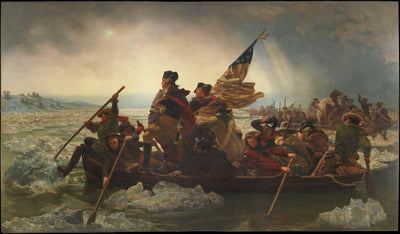
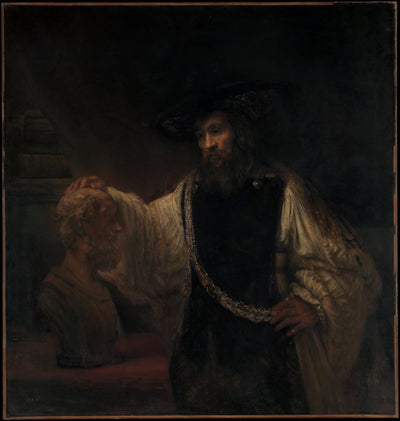
The famous paintings at the Met start with Emanuel Leutze's Washington Crossing the Delaware, which the museum calls the "unavoidable highlight of the American Wing," and Rembrandt's Aristotle with a Bust of Homer, which it counts "among the most celebrated works of art at The Met." The nine below, from Vermeer and David to Degas, Monet, Van Gogh and Picasso, each come with the gallery number that the Met's collection page gave on October 15, 2026. Several also belong among the most famous paintings in the world.
They are grouped by the Met's own curatorial departments: the American Wing, European Paintings, and Modern and Contemporary Art. Sizes are given height before width.
At a glance
| # | Painting | Artist | Year | Gallery (Oct. 15, 2026) |
|---|---|---|---|---|
| 1 |  Washington Crossing the Delaware Washington Crossing the Delaware |
Emanuel Leutze | 1851 | 760 |
| 2 |  Madame X Madame X |
John Singer Sargent | 1883–84 | 771 |
| 3 |  Aristotle with a Bust of Homer Aristotle with a Bust of Homer |
Rembrandt | 1653 | 616 |
| 4 |  Young Woman with a Water Pitcher Young Woman with a Water Pitcher |
Johannes Vermeer | c. 1662 | 614 |
| 5 |  The Death of Socrates The Death of Socrates |
Jacques-Louis David | 1787 | 634 |
| 6 |  The Dance Class The Dance Class |
Edgar Degas | 1874 | 815 |
| 7 |  Bridge over a Pond of Water Lilies Bridge over a Pond of Water Lilies |
Claude Monet | 1899 | 819 |
| 8 |  Self-Portrait with a Straw Hat Self-Portrait with a Straw Hat |
Vincent van Gogh | 1887 | 825 |
| 9 | Gertrude Stein | Pablo Picasso | 1905–06 | 965 |
The American Wing
01Washington Crossing the Delaware, Emanuel Leutze (1851)

Zoom
Leutze's Washington hangs in Gallery 760, and the canvas measures 378.5 × 647.7 cm (149.0 × 255.0 in). The signature at lower right reads "E. Leutze / Dusseldorf 1851," a reminder that this American icon was painted in Germany, where, the Met notes, it was a great success at a time of revolutionary fervor in the country itself.
The Met's provenance record names every owner. The dealer Goupil, Vibert and Company handled it in 1851 and 1852, the New York collector Marshall O. Roberts kept it from 1852 until his death in 1880, and John Stewart Kennedy acquired it at the January 1897 sale of Roberts's estate and gave it to the museum that same year.
The picture is not a record of the event. As Dave Kindy points out in HistoryNet, the Continental troops flew the Grand Union flag rather than the Stars and Stripes shown here, the men crossed in larger flat-bottomed Durham boats, and the real crossing took place around midnight in a snowstorm. Leutze's first version, which hung in the Kunsthalle Bremen, was destroyed in a 1942 RAF bombing raid.
Look closely at who is in the boat. On the Met's audio guide, the Mohawk cultural historian Scott Manning Stevens picks out soldiers, farmers, an African American man and, at the back of the boat, a Native American in fairly accurate Northeast Woodlands dress. More national icons are in our guide to famous American paintings.
02Madame X, John Singer Sargent (1883–84)

Zoom
Gallery 771 holds the portrait that nearly derailed Sargent's career. It measures 208.6 × 109.9 cm (82.1 × 43.3 in) and is signed "John S. Sargent 1884." The sitter, Virginie Amélie Avegno Gautreau, was a Louisiana-born woman known in Paris for her artful appearance, and Sargent painted her without a commission, hoping the picture would bring him praise and clients at the Salon of 1884.
It drew ridicule instead. Viewers were shocked by her skin tone and cosmetics, and by a jeweled strap that Sargent had painted slipping off her right shoulder. Gautreau and her mother begged him to take it down; he refused, repainted the strap after the Salon closed and kept the canvas in his studio. The Met's Heilbrunn Timeline traces its palette and brushwork to Velázquez, the profile to Titian and the flat handling of face and figure to Manet and Japanese prints. In spring 1886 Sargent moved to England for the rest of his life.
Thirty-two years after the Salon, on January 8, 1916, he offered the painting to the Met's director, Edward Robinson. Once the purchase was agreed, he asked that it not be called by her name "on account of the row I had with the lady years ago," so the museum's paperwork called her Madame X. It is also one of the ten faces in our list of famous portraits.
“I suppose it is the best thing I have done.”
European Paintings before 1800
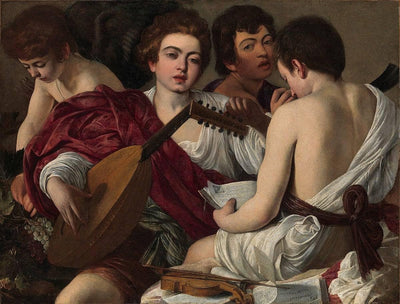
This department also holds Caravaggio's The Musicians (1597) in Gallery 620. The Met identifies the second boy from the right as a self-portrait and believes this is the concert that, according to his contemporary Giovanni Baglione, Caravaggio painted right after joining the household of Cardinal Francesco Maria del Monte. Our guide to famous Italian paintings follows him and the Italians around him.
03Aristotle with a Bust of Homer, Rembrandt (1653)

Zoom
Rembrandt painted Aristotle with a Bust of Homer in 1653 for Don Antonio Ruffo, a Sicilian nobleman who rarely left Messina and ordered it through an agent; it was shipped to his palace in Messina in the summer of 1654. The canvas, 143.5 × 136.5 cm (56.5 × 53.7 in), hangs in Gallery 616.
Ruffo's inventory described it only as a half-length philosopher, possibly Aristotle or Albertus Magnus, and until 1917 writers took the sitter for Ariosto, Tasso, Virgil and others. The medallion on the chain shows Alexander the Great, Aristotle's royal pupil, and the Met reads the picture as a meditation on fame: worldly success weighed against Homer's lasting achievement. Rembrandt made it just as his dark palette and heavy paint were falling out of fashion in Amsterdam.
As a painter, I would spend most of my minutes here on the sleeves and the chain, where you can see how thickly Rembrandt built up the paint. The Met bought the picture at the Parke-Bernet sale of Mrs. Alfred W. Erickson's estate in New York on November 15, 1961. More of his work is in our guide to Rembrandt's most famous paintings.
04Young Woman with a Water Pitcher, Johannes Vermeer (c. 1662)

Zoom
Hand-painted oil reproductionSee sizes ›
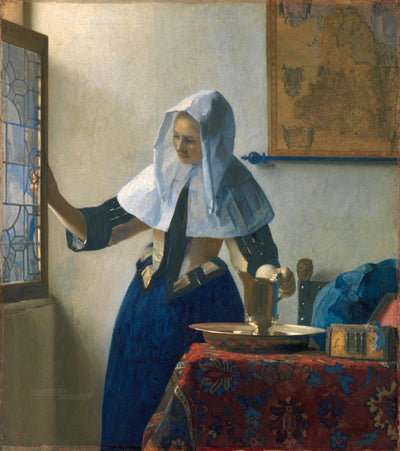
Vermeer's Young Woman with a Water Pitcher measures only 45.7 × 40.6 cm (18.0 × 16.0 in), so it is easy to walk past in Gallery 614. A woman stands at an open window with one hand on the casement and the other on a gilt silver pitcher, linen protecting her hair and dress as she begins her morning washing. It was the first Vermeer to enter an American public collection: Henry G. Marquand bought it in Paris in 1887 and gave it to the Met in 1889.
Technical study shows that the picture was once busier. A larger map originally reached to the left behind her, framing her head, and the back of a chair stood at an angle in the left foreground, partly overlapping the window. Vermeer painted both out.
The Heilbrunn Timeline essay on Vermeer illustrates the five paintings by him that the Met owns. One of them, Study of a Young Woman (c. 1665–67), hangs in the same gallery. It is a tronie, a study of a face in costume rather than a commissioned portrait, and the Met notes that it is nearly identical in size to Girl with a Pearl Earring. Our list of every Vermeer painting and where to see it covers the rest.
05The Death of Socrates, Jacques-Louis David (1787)

Zoom
Hand-painted oil reproductionSee sizes ›
David showed The Death of Socrates at the Salon of 1787, two years before the French Revolution. It hangs in Gallery 634 and measures 129.5 × 196.2 cm (51.0 × 77.2 in). Convicted of impiety, Socrates chose poison over renouncing his beliefs. Here he points toward the heavens, still talking about the immortality of the soul, as he reaches for the hemlock held out by a disciple who cannot bear to watch.
David worked from Plato's Phaedo and consulted scholars of antiquity to get the furniture and clothing right. The old man at the foot of the bed is usually identified as Plato, who was not there that day; the Met reads him as a nod to the author who preserved the story. Look on the bench at right for David's signature and the Greek word ATHENAION, "of Athens."
It is uncertain which of two brothers, Trudaine de Montigny or Trudaine de la Sablière, commissioned the canvas. They ran a salon of liberal young Parisians with the poet André Chénier, and all three died on the guillotine in 1794. The Met bought the painting in 1931. His other key works are in our guide to Jacques-Louis David's paintings.
European Paintings of the 1800s
06The Dance Class, Edgar Degas (1874)

Zoom
Hand-painted oil reproductionSee sizes ›
The baritone Jean-Baptiste Faure commissioned The Dance Class in 1873, and Degas delivered it in November 1874. The poster for Rossini's Guillaume Tell on the wall is a tribute to Faure, who had starred in that opera. The canvas measures 83.5 × 77.2 cm (32.9 × 30.4 in) and hangs in Gallery 815.
At right, the ballet master Jules Perrot leans on a long cane while a dancer holds a pose for him, and some twenty-four women, dancers and their mothers, wait their turn. The room is imagined: Degas set it in the old Paris Opéra, which had recently burned down. Faure lent the picture to the 1876 Impressionist exhibition, and Mary Cassatt, as quoted in the Met's catalogue entry, called it "more beautiful than any Ver Meer [sic] I ever saw." A variant is in the Musée d'Orsay. Our article on why Degas painted ballerinas tells the longer story.
07Bridge over a Pond of Water Lilies, Claude Monet (1899)

Zoom
Monet bought land with a pond near his property at Giverny in 1893 and put a Japanese-style footbridge over it late that year. In the summer of 1899 he turned the bridge into a series: eighteen canvases in 1899 and 1900, twelve of which he showed at Durand-Ruel's gallery in Paris in 1900. The Met's version, 92.7 × 73.7 cm (36.5 × 29.0 in), is in Gallery 819.
Three details set it apart, according to the Met. It is one of only two in the series painted in a vertical format, which gives the lilies slightly more prominence. It lacks the tuft of irises that flanks the bridge at left in every other version of that year. And only four of the bridge's seven supporting bars are visible. Louisine and H. O. Havemeyer bought it in 1901, and it came to the Met with her bequest in 1929.
“A landscape does not get under your skin in one day. And then all of a sudden I had the revelation of how enchanting my pond was. I took up my palette. Since then I’ve hardly had any other subject.”
His late Water Lilies of 1919, 101 × 200 cm (39.8 × 78.7 in), hangs in Gallery 822. Our article on Monet's Japanese bridge paintings follows the other versions of the bridge.
08Self-Portrait with a Straw Hat, Vincent van Gogh (1887)

Zoom
Van Gogh painted more than twenty self-portraits during his stay in Paris from 1886 to 1888. Short of money for models, he became his own sitter: "I purposely bought a good enough mirror to work from myself, for want of a model," he wrote. This one, 40.6 × 31.8 cm (16.0 × 12.5 in), shows his awareness of Neo-Impressionist technique and color theory, and it is painted on the back of an earlier peasant study, The Potato Peeler. It hangs in Gallery 825.
He gave it away himself around 1887 or 1888, to an owner in Asnières. Adelaide Milton de Groot lent it to the Met in 1936 and left it to the museum when she died in 1967.
Gallery 822 holds his Wheat Field with Cypresses, 73.2 × 93.4 cm (28.8 × 36.8 in), painted on the spot at Saint-Rémy in the summer of 1889. Van Gogh counted it among his "best" summer landscapes and made two studio versions that September, one of them now in the National Gallery, London. The Met bought it from Dieter Bührle in 1993.
Modern and Contemporary Art
09Gertrude Stein, Pablo Picasso (1905–06)
Picasso's portrait of Gertrude Stein hangs in Gallery 965 and measures 100 × 81.3 cm (39.4 × 32.0 in). Stein, an American writer living in Paris, was among the first Americans to embrace the European avant-garde, and her weekly salons filled her apartment with artists and writers. Her early patronage and friendship, the Met says, were critical to Picasso's success.
He painted her between 1905 and 1906, at the end of his Rose Period. Her body is reduced to simple masses, a hint of the Cubism to come, and her face is set like a mask with heavy-lidded eyes, after his encounter with Iberian sculpture. Picasso gave the canvas to Stein in the autumn of 1906, and she left it to the Met when she died in 1946.
The same department shows Jackson Pollock's Autumn Rhythm (Number 30) in Gallery 899, a drip painting 269.9 × 528.3 cm (106.3 × 208.0 in) that the Met bought in 1957, the year after his death. Our list of famous abstract paintings shows where it fits, and for the modern masters across town, see famous paintings at MoMA.
From Gallery 760 to Gallery 965
Start with Leutze in the American Wing and finish with Picasso among the moderns; the Met's page for each painting, linked below, shows where it hangs on the morning you go. If one of them stays with you, Leutze's crossing and the other works on our famous paintings page are painted by hand in oil on canvas.
Sources
- The Met Collection: Emanuel Leutze, Washington Crossing the Delaware (97.34)
- Dave Kindy, "What's Wrong With This Picture? Washington Crossing the Delaware," HistoryNet
- The Met Collection: John Singer Sargent, Madame X (16.53)
- Stephanie L. Herdrich, "From the Archives: How Madame X Came to The Met," The Met
- Heilbrunn Timeline of Art History: John Singer Sargent (1856–1925)
- The Met Collection: Rembrandt, Aristotle with a Bust of Homer (61.198)
- The Met Collection: Johannes Vermeer, Young Woman with a Water Pitcher (89.15.21)
- The Met Collection: Johannes Vermeer, Study of a Young Woman (1979.396.1)
- Heilbrunn Timeline of Art History: Johannes Vermeer (1632–1675)
- The Met Collection: Jacques Louis David, The Death of Socrates (31.45)
- The Met Collection: Edgar Degas, The Dance Class (1987.47.1)
- The Met Collection: Claude Monet, Bridge over a Pond of Water Lilies (29.100.113)
- The Met Collection: Claude Monet, Water Lilies (1998.325.2)
- The Met Collection: Vincent van Gogh, Self-Portrait with a Straw Hat (67.187.70a)
- The Met Collection: Vincent van Gogh, Wheat Field with Cypresses (1993.132)
- The Met Collection: Pablo Picasso, Gertrude Stein (47.106)
- The Met Collection: Jackson Pollock, Autumn Rhythm (Number 30) (57.92)
- The Met Collection: Caravaggio, The Musicians (52.81)
- The Met Collection: Pieter Bruegel the Elder, The Harvesters (19.164)
- The Met Collection: Velázquez, Juan de Pareja (1971.86)
- The Met Collection: El Greco, View of Toledo (29.100.6)
- The Met Collection: The Temple of Dendur (68.154)