4.9/5
4.9/5


The Rijksmuseum counts 37 Vermeer paintings, and that's the count this list follows. Be clear on what it means, though. Thirty-four of them are accepted by nearly every scholar. The other three are argued over: a Saint Praxedis on loan in Tokyo, a tiny Girl with a Flute in Washington, and a small Young Woman Seated at the Virginals in a private New York collection. So the honest answer is 34 certain, 37 possible. When the Rijksmuseum gathered 28 of them in Amsterdam for a 16-week run in 2023, the biggest show in its history drew 650,000 visitors from 113 countries.
Thirty-seven is a strange number for a painter who worked for about twenty years. Johannes Vermeer (1632–1675) lived and worked in Delft, and the surviving pictures average out to fewer than two a year, most of them small, most of them a single woman in a room near a window on the left. That scarcity is half the reason people chase them. More than half the body of work sits in just five cities, and plenty of people try to see it all.
Which Vermeer paintings are the most famous?
Three stand above the rest, and all three are in the Netherlands, two of them under one roof. You'll find all three among the Vermeers the studio paints by hand.
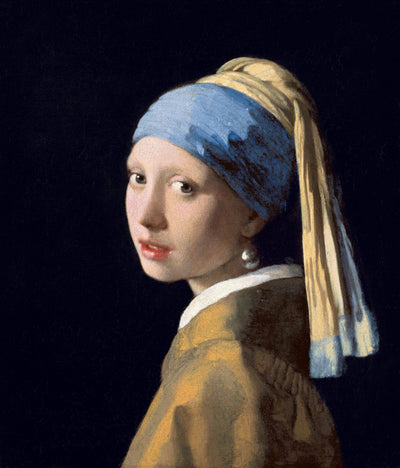
Girl with a Pearl Earring

Painted around 1665–1667 and only 46.5 by 40 cm, the girl in the blue and yellow turban is the main reason people go to the Mauritshuis in The Hague. Nobody knows who sat for it, and that blank is part of the pull: she turns as if you just said her name, and the story stops there.
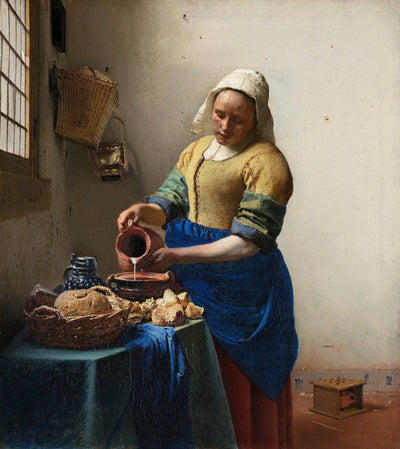
The Milkmaid

A kitchen maid pours a thin line of milk into a bowl, completely absorbed in the job. That's the whole plot. Vermeer painted it around 1660, on a canvas of 45.5 by 41 cm, and it hangs in Amsterdam at the Rijksmuseum. Look at the bread on the table: the crust is built from tiny dots of light paint, a trick that makes the crust catch the light. If one picture explains why he's loved, it is this quiet kitchen scene.
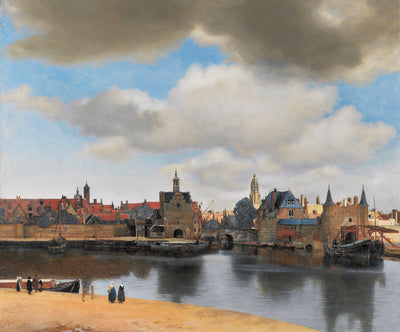
View of Delft

He painted almost no outdoor scenes, which makes his big view of the town across the water all the more surprising. At 98.5 by 117.5 cm it's one of his largest canvases, dated to about 1660–1663. The trick is the weather: clouds keep the near walls and boats in shadow while sunlight falls on the rooftops further back, so the eye travels straight into the city. It shares a building with the Pearl Earring, since the Mauritshuis owns both, plus the early Diana and Her Companions.
How many did he actually paint?
Nobody knows the true number, because an unknown share of his output is lost. What survives is small, and the list has moved again and again since the 1860s. When the French critic Théophile Thoré brought Vermeer back into view in 1866 in the Gazette des Beaux-Arts, he catalogued about 70 paintings as his, many of them wrong. The list has been shrinking and arguing with itself ever since.
Thoré admitted the hunt had got out of hand. "This obsession has caused me considerable expense," he wrote. "To see one picture by van der Meer, I traveled hundreds of miles."
Today the three open cases look like this. The National Gallery of Art in Washington has moved Girl with a Flute out of his hand and credits it to someone working in his studio, though many scholars still accept it. Saint Praxedis, a religious scene dated 1655, has a few strong supporters and many doubters. The Leiden Collection's small Young Woman Seated at the Virginals was accepted by the curators of the 2023 Amsterdam show. If you want to follow the arguments painting by painting, a catalogue that tracks every one of them keeps the details current. Only a handful carry a date in his hand, and two of those are The Procuress (1656) and The Astronomer (1668), which is why the rest are dated by style and given as ranges.
The full list, with where each one hangs
Numbers follow a rough order of when they were painted. Dates are approximate unless a single year is given.
| # | Painting | Date | Where it is |
|---|---|---|---|
| 1 | Diana and Her Companions | c. 1653–1656 | Mauritshuis, The Hague |
| 2 | Christ in the House of Martha and Mary | c. 1654–1656 | National Gallery of Scotland, Edinburgh |
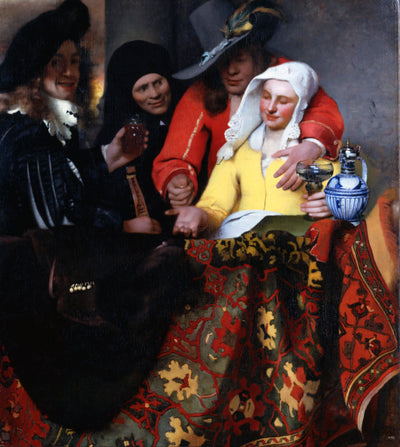
| 3 | The Procuress | 1656 | Gemäldegalerie Alte Meister, Dresden |
| 4 | A Maid Asleep | c. 1656–1657 | Metropolitan Museum of Art, New York |
| 5 | Girl Reading a Letter at an Open Window | c. 1657–1659 | Gemäldegalerie Alte Meister, Dresden |
| 6 | Officer and Laughing Girl | c. 1657–1660 | Frick Collection, New York |
| 7 | The Milkmaid | c. 1660 | Rijksmuseum, Amsterdam |
| 8 | Girl Interrupted in Her Music | c. 1658–1661 | Frick Collection, New York |
| 9 | The Glass of Wine | c. 1658–1661 | Gemäldegalerie, Berlin |
| 10 | The Little Street | c. 1658 | Rijksmuseum, Amsterdam |
| 11 | The Girl with a Wine Glass | c. 1659–1662 | Herzog Anton Ulrich-Museum, Braunschweig |
| 12 | View of Delft | c. 1660–1663 | Mauritshuis, The Hague |
| 13 | The Music Lesson | c. 1662–1665 | Royal Collection, Windsor Castle |
| 14 | Woman with a Lute | c. 1662–1665 | Metropolitan Museum of Art, New York |
| 15 | Young Woman with a Water Pitcher | c. 1662–1665 | Metropolitan Museum of Art, New York |
| 16 | Woman in Blue Reading a Letter | c. 1662–1665 | Rijksmuseum, Amsterdam |
| 17 | Woman with a Pearl Necklace | c. 1662–1665 | Gemäldegalerie, Berlin |
| 18 | Woman Holding a Balance | c. 1662–1665 | National Gallery of Art, Washington |
| 19 | The Concert | c. 1663–1666 | Isabella Stewart Gardner Museum, Boston (stolen in 1990) |
| 20 | A Lady Writing | c. 1662–1667 | National Gallery of Art, Washington |
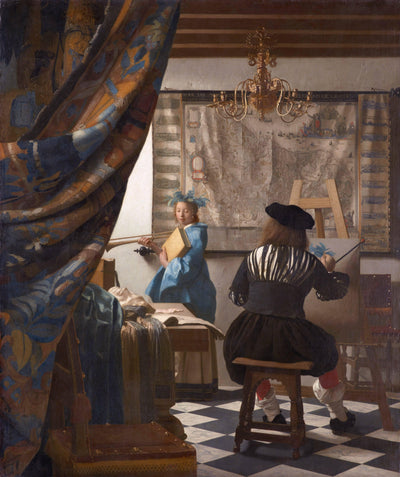
| 21 | The Art of Painting | c. 1666–1668 | Kunsthistorisches Museum, Vienna |
| 22 | Girl with a Pearl Earring | c. 1665–1667 | Mauritshuis, The Hague |
| 23 | Girl with a Red Hat | c. 1665–1667 | National Gallery of Art, Washington |
| 24 | Mistress and Maid | c. 1666–1668 | Frick Collection, New York |
| 25 | Girl with a Flute (disputed) | c. 1665–1670 | National Gallery of Art, Washington |
| 26 | Study of a Young Woman | c. 1665–1674 | Metropolitan Museum of Art, New York |
| 27 | The Astronomer | 1668 | Louvre, Paris |
| 28 | The Geographer | c. 1668–1669 | Städel Museum, Frankfurt |
| 29 | The Love Letter | c. 1667–1670 | Rijksmuseum, Amsterdam |
| 30 | The Lacemaker | c. 1669–1671 | Louvre, Paris |
| 31 | The Guitar Player | c. 1670–1673 | Kenwood House, London |
| 32 | Lady Writing a Letter with Her Maid | c. 1670–1671 | National Gallery of Ireland, Dublin |
| 33 | A Young Woman Standing at a Virginal | c. 1670–1672 | National Gallery, London |
| 34 | A Young Woman Seated at a Virginal | c. 1670–1675 | National Gallery, London |
| 35 | Allegory of Faith | c. 1670–1674 | Metropolitan Museum of Art, New York |
| 36 | Saint Praxedis (disputed) | 1655 | National Museum of Western Art, Tokyo (long-term loan) |
| 37 | A Young Woman Seated at the Virginals (disputed) | c. 1670 | The Leiden Collection, New York (private) |
City by city
Group them by city and a Vermeer trip gets simple.
- New York: eight on public view. The Metropolitan Museum has five, the Frick Collection three. The disputed Leiden picture is privately owned and rarely shown.
- Washington: four at the National Gallery of Art, counting Girl with a Flute. Girl with a Red Hat is painted on a wooden panel only about 23 by 18 cm, so look closely.
- Amsterdam: four at the Rijksmuseum, including The Little Street, his only other surviving outdoor scene.
- The Hague: three at the Mauritshuis.
- London: three, two at the National Gallery and The Guitar Player at Kenwood House on Hampstead Heath. The Music Lesson belongs to the Royal Collection at Windsor Castle, so check it's on view before you go.
- Dresden, Berlin and Paris: two each.
- One each: Edinburgh, Braunschweig, Vienna, Frankfurt, Dublin and Tokyo.
Boston is the sad exception. The Gardner Museum still owns a Vermeer, but you can't see it.
The stories behind four of them
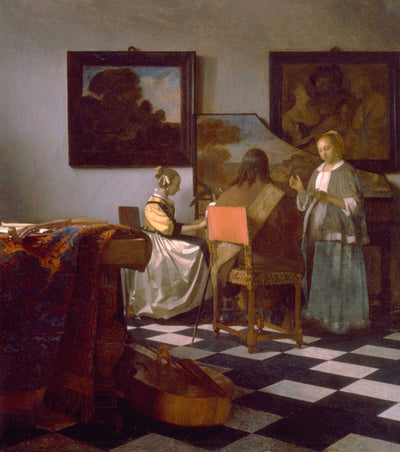
The one that was stolen
In the early hours of March 18, 1990, thieves got into the Isabella Stewart Gardner Museum and left with 13 works. his Concert, a man and two women making music was among them, along with three Rembrandts. None has come back, the empty frames still hang on the walls, and a $10 million reward stands for information leading to their return. It is the only Vermeer whose location is unknown.
The one Hitler owned

The big studio picture now in Vienna is 120 by 100 cm and was painted around 1666–1668. A painter, seen from behind, works on a model dressed as Clio, the muse of history, under a map of the seventeen provinces of the Netherlands. Vermeer's widow, Catharina Bolnes, held on to it after his death until 1676. It passed through the Czernin family collection in Vienna, was acquired by Adolf Hitler in 1940, and reached the Kunsthistorisches Museum on November 7, 1946. You can read its long road back to Vienna in more detail.
The one that got its Cupid back
For well over two centuries, Girl Reading a Letter at an Open Window in Dresden had a blank wall behind her. X-rays showed something underneath. After a four-year restoration in Dresden (2017–2021), a standing Cupid with a bow, arrows and two masks reappeared on that wall. Lab work showed the overpainting was not Vermeer's own and was added decades after he finished. The Cupid tramples the masks, a sign of sincere love beating deceit, and the picture now looks the way it did when it left his studio.
The early one people skip
The Procuress, his earliest dated picture, carries the year 1656 and hangs in Dresden near the letter reader. It's big, 143 by 130 cm, crowded with figures and loud with red and yellow, and it's the best proof that the quiet Vermeer had to be invented. Compare it with the standing virginal player in London, painted some fifteen years on, where a single figure and a Cupid on the wall carry the whole story.
If Vermeer sends you looking for more, the paintings people ask about most makes a good next stop.
A Delft room for your own wall
Seeing all 37 takes a passport and a few years. Living with one is easier. Every picture in the studio's set of Vermeer reproductions is painted by hand in oils, from the Pearl Earring to the Delft view, so the light from that window on the left can fall across a room of yours instead of a gallery wall.
Sources
- Essential Vermeer, complete catalogue
- Essential Vermeer, dating the paintings
- Rijksmuseum, Vermeer exhibition press release
- Rijksmuseum, The Milkmaid
- Kunsthistorisches Museum, The Art of Painting
- Isabella Stewart Gardner Museum, reward announcement
- Staatliche Kunstsammlungen Dresden, restoration press release
- National Gallery London, A Young Woman Standing at a Virginal