4.9/5
4.9/5


MoMA's famous paintings begin with Vincent van Gogh's The Starry Night, one of the most famous paintings in the world, and Salvador Dalí's The Persistence of Memory, then run through Claude Monet's Water Lilies, Pablo Picasso's Les Demoiselles d'Avignon, Jackson Pollock's One: Number 31, 1950 and Andy Warhol's Campbell's Soup Cans. All of them belong to the Museum of Modern Art at 11 West 53 Street in Manhattan, and they are only part of what it holds among the famous paintings made since the 1880s.
Below are 11 of them in the order they were painted, from 1889 to 1962, with what MoMA's own records say about each. The museum moves works between its galleries and storage, so we opened every collection page on October 15, 2026: seven of the 11 were on view that day, and for the four that were not, we name a work by the same artist you could see instead.
At a glance
| # | Painting | Artist | Year | Where at MoMA (Oct. 15, 2026) |
|---|---|---|---|---|
| 1 |  The Starry Night The Starry Night |
Vincent van Gogh | 1889 | Floor 5, gallery 501 |
| 2 |  The Sleeping Gypsy The Sleeping Gypsy |
Henri Rousseau | 1897 | Floor 5, gallery 501 |
| 3 |  Les Demoiselles d'Avignon Les Demoiselles d'Avignon |
Pablo Picasso | 1907 | Floor 5, gallery 502 |
| 4 |  Dance (I) Dance (I) |
Henri Matisse | 1909 | Floor 5, gallery 506 |
| 5 |  The Dream The Dream |
Henri Rousseau | 1910 | Not on view |
| 6 |  Water Lilies Water Lilies |
Claude Monet | 1914–26 | Floor 5, gallery 515 |
| 7 | The Persistence of Memory | Salvador Dalí | 1931 | Floor 5, gallery 517 |
| 8 | Self-Portrait with Cropped Hair | Frida Kahlo | 1940 | Not on view |
| 9 | Broadway Boogie Woogie | Piet Mondrian | 1942–43 | Not on view |
| 10 |  One: Number 31, 1950 One: Number 31, 1950 |
Jackson Pollock | 1950 | Not on view |
| 11 | Campbell's Soup Cans | Andy Warhol | 1962 | Floor 4, gallery 412 |
1889 to 1910: the canvases that opened modern art
01The Starry Night, Vincent van Gogh (1889)
Van Gogh painted The Starry Night in mid-June 1889, during the twelve months he spent at the Saint-Paul-de-Mausole asylum in Saint-Rémy, in southern France. MoMA's label shows how much he changed what he saw: the view started from his window, but he painted it in several daytime sessions, built the village from other views because it could not be seen from his room, and pulled the cypress much closer than it stood. The bright moon is at right; the large star left of center is Venus. Oil on canvas, 73.7 × 92.1 cm (29.0 × 36.3 in).
MoMA acquired it in 1941. Its press release of September 29 that year announced it as the first canvas by Van Gogh to enter the collection of a New York museum, and noted that until about three years earlier it had belonged to Miss G. P. van Stolk of Rotterdam. The credit line, "Acquired through the Lillie P. Bliss Bequest (by exchange)," hides a better story, told in MoMA's audio guide. Bliss, one of the three women who brought together the group that founded MoMA, had wanted a Van Gogh and never owned one. Ten years after her death, director Alfred Barr wrote to a dealer asking whether The Starry Night was still for sale, and the dealer offered to swap it for three pictures from her collection.
Van Gogh himself was less sure of it. Writing to the painter Émile Bernard on or about November 26, 1889, he said he was once again allowing himself "to do stars too big" and called the result a "new setback"; the Van Gogh Museum's edition of his letters reads this as a reference to The Starry Night. How the picture still became Van Gogh's most famous piece of art, ahead of Sunflowers, is a story of its own.
The original and our hand-painted copy
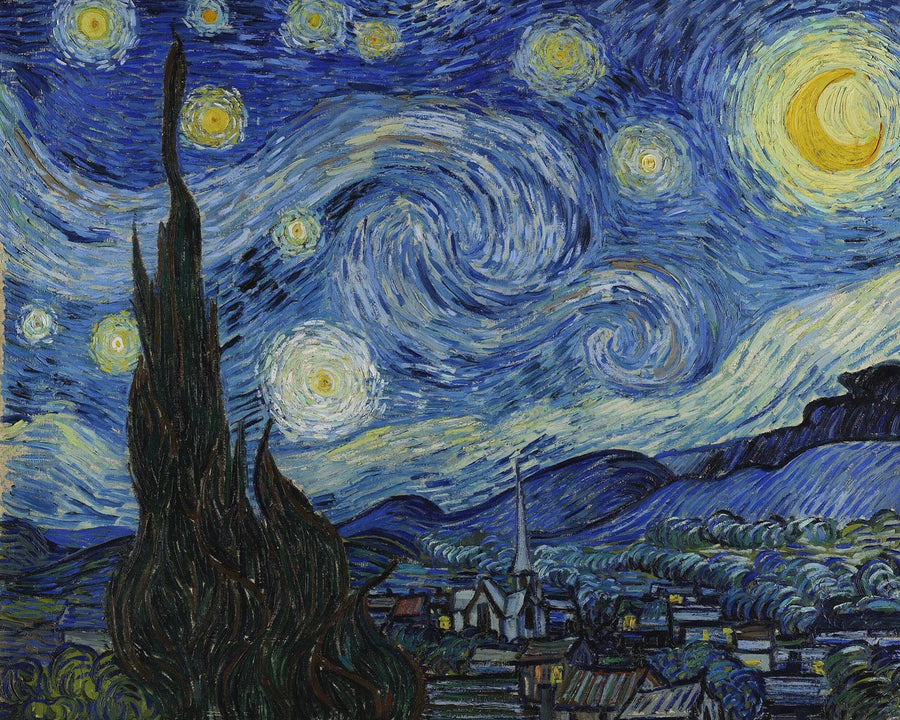
The original
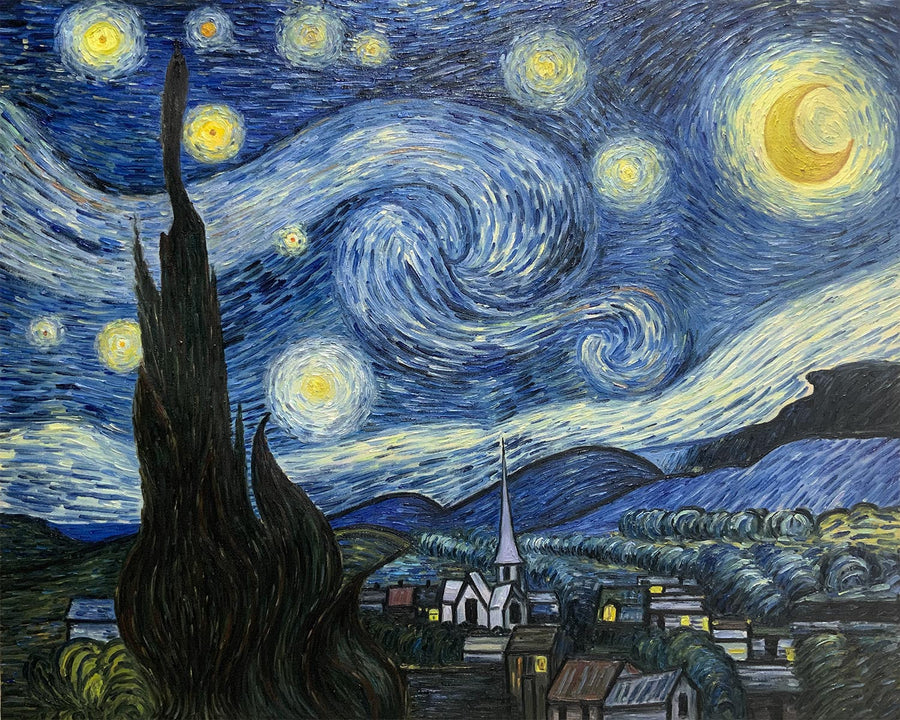
Our reproduction, painted by hand in oil
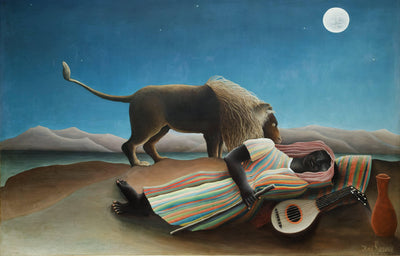
02The Sleeping Gypsy, Henri Rousseau (1897)

Zoom
Rousseau worked for decades in a customs office outside Paris before he took up painting seriously in middle age, which earned him the nickname le Douanier, the Customs Officer. He sent The Sleeping Gypsy to the 1897 Salon des Indépendants as La Bohémienne endormie: a woman in a striped dress sleeps in the desert while a lion stands over her, and nothing happens. MoMA connects the desert setting to Rousseau's interest in northern Africa. Oil on canvas, 129.5 × 200.7 cm (51.0 × 79.0 in).
The New York collector John Quinn owned it for some years; after his death it went to a Swiss collector. MoMA announced it on January 22, 1940, as a gift of Mrs. Simon Guggenheim, and Alfred Barr wrote that Rousseau "painted larger canvases but this is unique in the concentrated power of its composition." In mid-October 2026 it hung in the same room as The Starry Night.
03Les Demoiselles d'Avignon, Pablo Picasso (1907)
Picasso began this canvas in the winter of 1906–7 in his cramped Paris studio, a 25-year-old Spanish immigrant, and worked through hundreds of preparatory sketches; MoMA dates the painting to June–July 1907. Five women are pressed into a shallow space, built from angular lines and splintered planes. The title, which it received around 1916, refers to sex workers on the carrer d'Avinyó in Barcelona, the city where Picasso spent his youth. Oil on canvas, 243.9 × 233.7 cm (96.0 × 92.0 in).
Visitors who saw it in the studio in the summer of 1907 were shocked, and it was not exhibited publicly until 1916. MoMA traces the striding figure at left to ancient Egyptian and South Asian sculpture, the raised elbows of the middle pair to Roman copies of Greek statues, and the faces at right to African and Oceanic masks. Picasso's dealer, Daniel-Henry Kahnweiler, called it the "beginning of Cubism," though others deny that it is Cubist at all.
A year later, in November 1908, Picasso hosted a party for Rousseau in his studio, and the 64-year-old guest of honor thanked his host with this line:
“We are the two greatest painters of the era, you in the ‘Egyptian’ genre, I in the modern genre.”
By "Egyptian," MoMA suggests, Rousseau meant the flattened planes and jutting forms of Picasso's newest paintings.
04Dance (I), Henri Matisse (1909)
In March 1909 the Russian collector Sergei Shchukin commissioned two large panels from Matisse, Dance and Music, to hang on the staircase landing of his house. Matisse painted this canvas quickly in Paris as a compositional study for Dance; the finished pair, completed in 1910, is in the Hermitage Museum in St. Petersburg. MoMA dates its version to early 1909. Oil on canvas, 260.4 × 390.4 cm (102.5 × 153.7 in).
Five pale pink dancers circle on a green hill against a blue sky. When it was new, the simplified bodies and the missing perspective were attacked as inept or willfully crude; Matisse felt the picture evoked "life and rhythm." Nelson A. Rockefeller gave it to the museum in honor of MoMA's first director, Alfred H. Barr, Jr., and it hangs in a room given over to Matisse.
05The Dream, Henri Rousseau (1910)

Zoom
The Dream is the last and largest of Rousseau's jungle paintings. He painted his first in 1891 and about 20 more over the next two decades; this one, 204.5 × 298.5 cm (80.5 × 117.5 in), was shown at the Salon des Indépendants in 1910, the year he died. A critic asked him why a sofa stood in a rainforest, and Rousseau replied: "This woman asleep on the couch is dreaming she has been transported into the forest, listening to the sounds from the instrument of the enchanter."
Like Dance (I), it came to MoMA from Nelson A. Rockefeller. On October 15, 2026, its page read "Not on view," which made The Sleeping Gypsy the Rousseau to find that day.
1914 to 1943: a pond, melting watches and a city grid
06Water Lilies, Claude Monet (1914–26)

Zoom
Hand-painted oil reproductionSee sizes ›
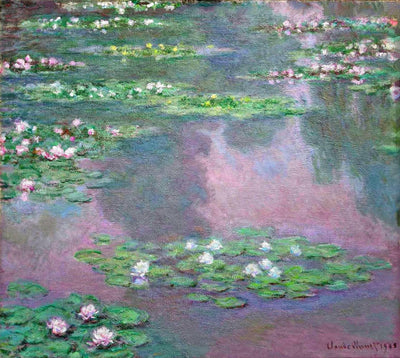
MoMA's Water Lilies is three panels of oil on canvas, each 200 × 424.8 cm (78.7 × 167.2 in), together 200 × 1276 cm (78.7 × 502.4 in). Monet made some forty large panels of the lily pond in his garden at Giverny between 1914 and his death in 1926, reworking them continuously. Twenty-two went onto curved walls at the Musée de l'Orangerie in Paris, his gift to France; the rest stayed in his studios until the late 1940s, when collectors and MoMA's curators began to take an interest.
For Monet by the roomful, see which museum has the most Monet paintings. Our hand-painted Water Lilies is a different picture from the series, a single canvas Monet signed and dated 1905.
07The Persistence of Memory, Salvador Dalí (1931)
Dalí's melting watches fill a canvas of only 24.1 × 33 cm (9.5 × 13.0 in). His own phrase for them was "the camembert of time." Ants swarm a gold watch as a sign of decay, the soft creature across the middle is roughly his own face in profile, and the golden cliffs in the distance are the coast of Catalonia, Dalí's home.
A year earlier he had formulated what he called his "paranoiac-critical method," cultivating hallucinations on purpose in order to make art. MoMA's credit line for the painting reads simply "Given anonymously." Dalí and Picasso both appear in our guide to famous Spanish paintings.
08Self-Portrait with Cropped Hair, Frida Kahlo (1940)
Kahlo and Diego Rivera divorced in late 1939. In this small canvas, 40 × 27.9 cm (15.7 × 11.0 in), she trades the embroidered Tehuana dresses and flowers she often wore in her self-portraits for a loose man's suit. Locks of hair cover the floor, a cut braid lies by the chair and she holds the scissors in her lap; only her high heels and one earring remain. The words across the top come from a popular Mexican song: "Look, if I loved you it was because of your hair. Now that you are without hair, I don't love you anymore."
MoMA reads the picture as both the violence of the separation and a new autonomy: after the divorce Kahlo vowed to support herself by selling her own work. Edgar Kaufmann, Jr. gave it to the museum. On October 15, 2026, it was off the wall, but her My Grandparents, My Parents, and I (1936) was on view in gallery 517.
09Broadway Boogie Woogie, Piet Mondrian (1942–43)
Mondrian arrived in New York in 1940, one of many European artists escaping the war, and heard boogie-woogie on his first evening in the city. This canvas, 127 × 127 cm (50.0 × 50.0 in), leaves out black and breaks his once uniform bars of color into small multicolored blocks that MoMA compares to traffic jumping from intersection to intersection.
He died in 1944. The painting was not on view in mid-October 2026, but five other Mondrians were, in galleries 503, 508, 512 and 513. Our guide to famous abstract paintings follows abstraction from Hilma af Klint to Mark Rothko.
After the war: poured paint and soup cans
10One: Number 31, 1950, Jackson Pollock (1950)
One is 269.5 × 530.8 cm (106.1 × 209.0 in) of interlaced threads of oil and enamel paint, one of three wall-size canvases Pollock made in quick succession in the summer and fall of 1950. He laid the canvas on the floor and poured, dribbled and flicked paint onto it, sometimes straight from the can or with sticks and stiffened brushes. "Technique is just a means of arriving at a statement," he said.
On October 15, 2026, One was not on view; Number 1A, 1948 was, in gallery 401, and Echo: Number 25, 1951 in gallery 405.
11Campbell's Soup Cans, Andy Warhol (1962)
Warhol showed these 32 canvases in July 1962 at the Ferus Gallery in Los Angeles, set out on shelves like products in a grocery aisle. Each is 50.8 × 40.6 cm (20.0 × 16.0 in), in acrylic with metallic enamel paint, and only the label changes from can to can. "I used to drink it," he said of the soup. "I used to have the same lunch every day, for 20 years, I guess, the same thing over and over again."
As a painter, the detail I would point to is that they look printed but are not: Warhol painted them by hand and stamped only the fleur-de-lys pattern along the bottom edge of each can.
Before you go to 53rd Street
MoMA rotates its galleries, so open a painting's page on moma.org the week you go: it says "On view" with a floor and gallery, or "Not on view." If one of these stays with you, The Starry Night, The Dream and The Sleeping Gypsy are among the famous paintings our artists paint by hand in oil. With a second museum day in New York, add the famous paintings at the Met, and for the wider French story around Rousseau, Monet and Matisse, see the most famous French paintings.
Sources
- MoMA, Vincent van Gogh, The Starry Night (collection record and label)
- MoMA audio, Lillie P. Bliss and the Birth of the Modern: The Starry Night
- MoMA press release, "Museum of Modern Art Acquires Important Van Gogh," September 29, 1941
- Van Gogh Museum, Vincent van Gogh: The Letters, letter 822 to Emile Bernard (c. 26 November 1889)
- MoMA, Henri Rousseau, The Sleeping Gypsy (collection record)
- MoMA press release, "The Museum of Modern Art Acquires Two Important Paintings," January 22, 1940
- MoMA, Henri Rousseau (artist essay by Annemarie Iker, 2021)
- MoMA, Pablo Picasso, Les Demoiselles d'Avignon (collection record and label)
- MoMA, Henri Matisse, Dance (I) (collection record and label)
- MoMA, Henri Rousseau, The Dream (collection record and label)
- MoMA, Claude Monet, Water Lilies (collection record and label)
- MoMA, Salvador Dalí, The Persistence of Memory (collection record and label)
- MoMA, Frida Kahlo, Self-Portrait with Cropped Hair (collection record and label)
- MoMA, Piet Mondrian, Broadway Boogie Woogie (collection record and label)
- MoMA, Jackson Pollock, One: Number 31, 1950 (collection record and label)
- MoMA, Andy Warhol, Campbell's Soup Cans (collection record and label)