4.9/5
4.9/5


Most painters record history. Jacques-Louis David helped make it, then painted the result. He sat in the National Convention, voted for the death of Louis XVI in January 1793, went to prison when Robespierre fell, and a decade later was painting Napoleon's coronation for the emperor himself. He saw six regimes come and go between his birth in Paris in 1748 and his death in exile in Brussels in 1825. Few artists have ever stood that close to power, and his pictures show it.
The twelve paintings below follow that life in order. Four of them are among the David paintings copied most often by hand, and every one of them tells you something about where he stood when he made it.
A slow start, then Rome
His father was killed in a duel when David was nine. The boy was sent toward François Boucher, the great Rococo decorator and a family friend, who passed him on to Joseph-Marie Vien, a painter already looking back to antiquity. It was the right handoff.
Then came the Prix de Rome, the Academy's scholarship to study in Italy. David lost it in 1771, again in 1772, again in 1773. He won in 1774 and left for Rome in October 1775. He came back to Paris in the summer of 1780 a different painter: harder, clearer, obsessed with the Roman republic.
1. The Oath of the Horatii (1784)

Louis XVI commissioned it through his arts administrator, the comte d'Angiviller, in late 1781 or early 1782. The subject and the size were supposed to be different. David changed both, got permission to go back to Rome in 1784, and painted it there, finishing in July 1785. Shown at the Salon that September, it made him the leader of a new style overnight.
Look at how the room is built. Three arches, three groups, and a floor laid out like a stage. The brothers raise their arms toward the swords their father holds up; on the right the women fold in on themselves, because one of the sisters is engaged to a man on the enemy side. The picture is 3.3 by 4.25 meters and hangs in the Salle Daru, on the first floor of the Denon wing. If you want the full effect of the oath with the three raised arms at home, go big; it loses its punch small.
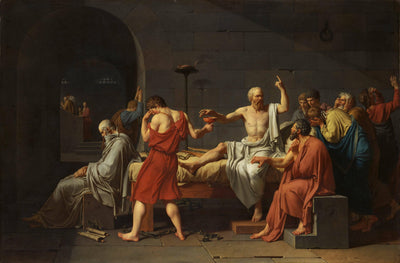
2. The Death of Socrates (1787)
Two years later David painted the Athenian philosopher reaching for the cup of hemlock while still lecturing his grieving students. It's smaller, about 130 by 196 centimeters, and quieter, but the logic is the same: a man choosing principle over life. Socrates' hand hovers over the cup without looking at it. He's mid-sentence, finger raised, and the only calm body in the room. David's scene of the philosopher's last lesson was exhibited in 1787 and entered the Metropolitan Museum's collection in 1931.
3. Antoine-Laurent Lavoisier and His Wife (1788)
This is the portrait that shows what David could do with living people. The chemist Antoine Lavoisier sits at a table of glass instruments, pen in hand, looking up at his wife, Marie-Anne, who leans on his shoulder and looks straight at us. It's more than 2.5 meters tall, a full-length double portrait on the scale of a history painting. Lavoisier died in 1794. The painting is also at the Met, bought in 1977.
4. The Lictors Bring to Brutus the Bodies of His Sons (1789)
The king commissioned it in May 1786 for 6,000 livres, and the subject was meant to be Coriolanus. David switched to Lucius Junius Brutus, the Roman consul who condemned his own sons to death for plotting to restore the monarchy. The timing was uncanny: it went on view at the Salon that opened on August 25, 1789, with the Revolution already under way. David added a note that it was painted during the Revolution, in 1789, and he meant it.
Brutus sits in shadow on the left, turned away. The bodies come in behind him. All the light and noise belong to the women.
The Revolution years
From here on, David was no longer painting republican virtue from a safe distance. He was elected a deputy for Paris to the National Convention in 1792, with Marat's backing. He voted for the king's execution. In 1793 and 1794 he held high office alongside Robespierre, and he designed the Republic's festivals and funerals.
5. The Tennis Court Oath (1791)
On June 20, 1789, the deputies of the Third Estate, locked out of their hall at Versailles, crowded into an indoor tennis court and swore not to separate until France had a constitution. David wasn't there. He persuaded the Jacobins and the Assembly to back a painting of it anyway, and showed a large pen-and-ink drawing of the composition in his studio before the Salon of September 1791.
The canvas itself was planned at about 7 by 10 meters. It was never finished, for political and financial reasons: by 1792 several of the heroes in it had become enemies of the Revolution. What survives is a ghostly underdrawing with a few painted heads, kept at the palace where the oath was sworn. It's the most honest document of the Revolution David ever made, precisely because events outran it.
6. The Death of Marat (1793)

Jean-Paul Marat, the radical journalist who had helped get David elected, was stabbed to death in his bath by Charlotte Corday. David painted him that same year as a secular martyr. The top half of the canvas is almost empty. Below, a wooden crate serves as a tombstone, inscribed "À MARAT, DAVID," with the date in the revolutionary calendar, Year Two.
It's 165 by 128 centimeters, much smaller than you expect, and it hits harder than anything on this list. Studio replicas survive in Reims, Dijon and Versailles, but the original is in Brussels, where it entered the Royal Museums of Fine Arts collection in 1893 after a family bequest.
7. The Intervention of the Sabine Women (1799)
After Robespierre's fall, David was arrested. He was released in December, jailed again from May to October 1795. In his cell at the Luxembourg in September 1794 he started sketching a new picture, and this time the subject was reconciliation: Hersilia, wife of Romulus, throwing herself between the Roman and Sabine armies, with babies on the ground at the fighters' feet.
Nobody commissioned it. David worked on it in a borrowed studio at the Louvre and, when it was done, opened a paid exhibition on December 21, 1799, charging 1.80 francs at the door. The state bought the 5-meter canvas of Hersilia stopping the battle in 1819 for 50,000 francs.
8. Madame Récamier (1800)
Juliette Récamier, a Paris hostess who kept a famous salon, and her husband commissioned this portrait in the spring of 1800. By the end of the year David had stopped. She sits barefoot on an antique-style daybed in a plain white dress, turned three-quarters toward us, in a nearly empty room. The bareness is partly because the picture is unfinished, and it looks more modern for it. David kept it in his studio until he died.
Napoleon's painter
The general who took control of France understood images as well as David did. In 1804, the year Napoleon crowned himself, he named David his First Painter.
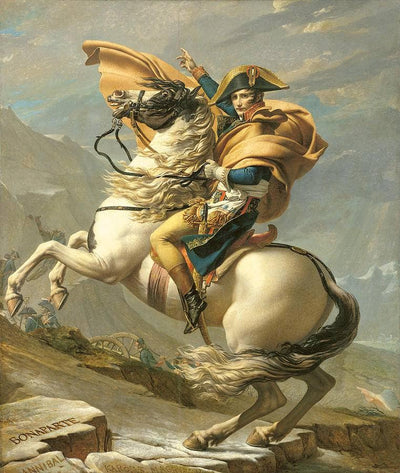
9. Napoleon Crossing the Alps (1800)
After French troops crossed the Alps in May 1800, Charles IV of Spain ordered a portrait of the First Consul for the hall of great captains in his Madrid palace. David gave him a rearing horse, a cloak whipping in the wind and a hand pointing up the mountain. In reality Bonaparte crossed on a mule, which is a far better animal on a snowy pass.
It worked so well that David painted five versions, changing the color of the cloak, the uniform and the horse's tack. The first, the Spanish king's, is now at Josephine's former house at Malmaison, outside Paris. It's the most famous political poster painted before posters, and the rearing-horse portrait of Bonaparte is still the image most people picture when they hear his name.
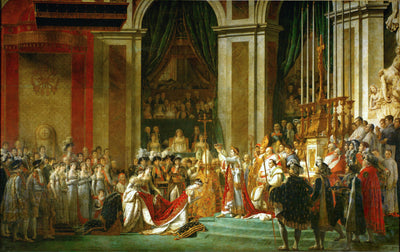
10. The Coronation of Napoleon (1805–1807)

Napoleon ordered it in September 1804, weeks before the ceremony at Notre-Dame on December 2. The finished canvas is 6.21 by 9.79 meters and holds more than two hundred life-size figures, 93 of them identifiable portraits; many of those people came to David's studio to pose in the clothes they'd worn that day. David asked 100,000 francs. He got 65,000, paid in three installments.
The moment he chose is clever. Napoleon had already crowned himself, which looked arrogant. So David shows him raising a second crown over Josephine, which looks generous. Napoleon's mother sits in the gallery box, although she was in Rome at the time. The Notre-Dame coronation scene went on show at the Salon of 1808 and hangs today in the same Louvre room as the Horatii, so you can stand between his first great picture and his biggest without changing rooms.
11. The Emperor Napoleon in His Study at the Tuileries (1812)
No horse, no crown. Napoleon stands by his desk in uniform, hair thinning, stockings wrinkled, the candles burned down to stubs and papers everywhere, as if he'd been working through the night for France. It's image management of a subtler kind, and it's in the National Gallery of Art in Washington.
What happened to Jacques-Louis David after Napoleon fell?
The Bourbons came back, and a man who had voted to execute Louis XVI had nowhere to stand. In January 1816 David left for Brussels. He kept painting and kept teaching. He died in Brussels on December 29, 1825. His body is buried in the Evere cemetery there; his heart went to Père Lachaise in Paris.
12. Mars Being Disarmed by Venus and the Graces (1824)
His last big picture is a surprise: pink, pale, a little absurd. Venus and the Graces strip the god of war of his weapons while Cupid kneels at his feet. It's 308 by 265 centimeters and hangs in Brussels, not far from Marat. After thirty years of oaths and executions, the old revolutionary ended on a picture in which love wins without a fight. Read it as a joke or a confession; I think it's a bit of both.
Who did David teach?
The list of his students is its own history of French painting: Anne-Louis Girodet, Antoine-Jean Gros, François Gérard and, above all, Jean-Auguste-Dominique Ingres, whose training David largely oversaw. Ingres carried the clean line and the cool surface deep into the nineteenth century. When the Louvre marked the bicentenary of David's death with a show of about 100 works in 2025, it called him the father of the French School, and that's about right.
Where the twelve paintings hang
| Painting | Year | Where |
|---|---|---|
| The Oath of the Horatii | 1784 | Louvre, Paris |
| The Death of Socrates | 1787 | Metropolitan Museum of Art, New York |
| Lavoisier and His Wife | 1788 | Metropolitan Museum of Art, New York |
| The Lictors Bring to Brutus the Bodies of His Sons | 1789 | Louvre, Paris |
| The Tennis Court Oath (unfinished) | 1791–1792 | Palace of Versailles |
| The Death of Marat | 1793 | Royal Museums of Fine Arts, Brussels |
| The Intervention of the Sabine Women | 1799 | Louvre, Paris |
| Madame Récamier | 1800 | Louvre, Paris |
| Napoleon Crossing the Alps (first version) | 1800 | Château de Malmaison |
| The Coronation of Napoleon | 1805–1807 | Louvre, Paris |
| Napoleon in His Study | 1812 | National Gallery of Art, Washington |
| Mars Being Disarmed by Venus | 1824 | Royal Museums of Fine Arts, Brussels |
Five of the twelve hang in the Louvre's Salle Daru alone. If you can only make one trip, that's the one. And if these twelve have you curious about the rest of the canon, start with the hundred or so pictures everyone recognizes.
A David on your own wall
David's big canvases were built to be read across a room, which is why they survive being copied at a size you can live with. Art & See's painters work from the originals' composition and palette, one brushstroke at a time, in oil on canvas. You can browse every David the studio paints by hand and choose the size that suits your room.