4.7/5


Famous portraits run from Jan van Eyck's Arnolfini couple of 1434 to Grant Wood's American Gothic of 1930, with Leonardo's Mona Lisa, Velázquez's Pope Innocent X and Vermeer's Girl with a Pearl Earring in between. Below are ten of them in the order they were painted, each with the story of its sitter and of what happened to the picture afterward. We paint nine of the ten by hand in oil, alongside the rest of our hand-painted portrait paintings. Up first is a ranking of the ten by the number of Wikipedia languages with a page on each portrait, next to the real person who sat for it.
A portrait here means one person painting another. Painters who turned the mirror on themselves have their own list, famous self-portraits, and Raphael's self-portrait follows one Renaissance case in detail. Our list of famous paintings of women looks at women in art more broadly; this one also takes in a pope, a diplomat, a merchant and a farmer. Several of these faces also appear among the most famous paintings in the world.
The 10 most famous portraits, by how many languages tell their story
| Fame spot | Famous face | Who sat for it | Wikipedia editions with a page |
|---|---|---|---|
| 1 |  Mona Lisa |
Lisa Gherardini, wife of a silk merchant in Florence | 133 |
| 2 |  Girl with a Pearl Earring |
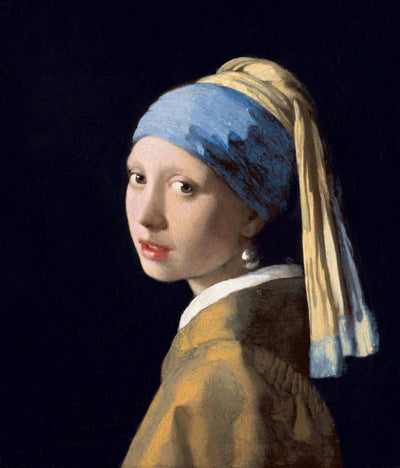
No one we can name. Vermeer painted a type, not a likeness, though someone probably posed | 71 |
| 3 |  Lady with an Ermine |
Cecilia Gallerani, a lady-in-waiting at the court of Milan | 48 |
| 4 |  American Gothic |
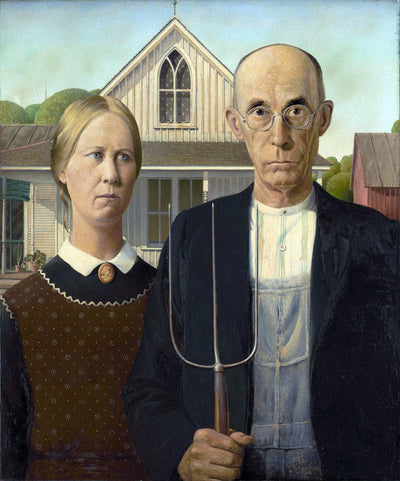
Wood presents them as a farmer standing with his daughter | 44 |
| 5 |  The Arnolfini Portrait |
Most likely the merchant Arnolfini, an Italian living in Bruges, and his second wife | 42 |
| 6 |  Arrangement in Grey and Black No. 1 (Whistler's Mother) |
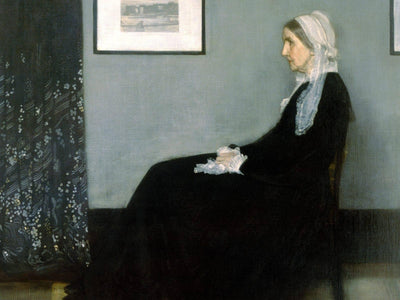
The painter's own mother, in his London studio | 29 |
| 7 | Madame X | Virginie Amélie Avegno Gautreau, born in Louisiana | 25 |
| 8 |  Portrait of Baldassare Castiglione |
Baldassare Castiglione, a writer and diplomat | 18 |
| — |  Portrait of Pope Innocent X |
Pope Innocent X, born Giovanni Battista Pamphilj | No data |
| — |  Portrait of Adele Bloch-Bauer I |
Adele Bloch-Bauer, the only person Klimt painted twice at full length | No data |
Language counts were taken from Wikipedia in October 2026.
The Mona Lisa has a page in nearly twice as many languages as the runner-up. Two faces have no count, because the only pages found belong to other pictures: Francis Bacon's study after the pope, and Klimt's second portrait of Adele.
Renaissance faces: the sitter turns toward us
01The Arnolfini Portrait, Jan van Eyck (1434)

Zoom
The man is probably Giovanni di Nicolao di Arnolfini, an Italian merchant working in Bruges, and the woman is probably his second wife, according to the National Gallery in London. Van Eyck painted them on a panel, probably oak, of just 82.2 × 60 cm (32.4 × 23.6 in), and signed it above the mirror: "Johannes de Eyck fuit hic. 1434," or "Jan van Eyck was here." The gallery also settles the question most visitors ask. She is not pregnant; she is holding up the bulky fabric of a fashionable gown, as ladies commonly did.
The panel traveled for four centuries before it settled. Its first recorded owner, Don Diego de Guevara, gave it to Margaret of Austria, regent of the Netherlands, whose 1516 inventory lists it at Mechelen. Her niece Mary of Hungary took it to Spain in 1556, and it stayed in the Spanish royal collection; it is presumed to have left Spain during the Peninsular War. A Scottish soldier, James Hay, who fought at Vitoria in 1813 and was badly wounded at Waterloo, then came to own it, possibly out of Joseph Bonaparte's baggage. The National Gallery bought it in 1842 for 600 guineas, the first Netherlandish painting in its collection. For the methods behind its detail, read what Jan van Eyck actually invented.
02Lady with an Ermine, Leonardo da Vinci (about 1490)
Leonardo's sitter is Cecilia Gallerani (about 1473–1536), a lady-in-waiting and the mistress of Ludovico Sforza of Milan. The National Museum in Kraków reads the animal in her arms on three levels. Ludovico, nicknamed "Ermellino Bianco," had received the Order of the Ermine from the King of Naples in 1488; the Greek word for the animal echoes her surname; and in the imagery of the time the ermine stood for purity.
Her name was attached to the picture only at the end of the 19th century, through research into letters to Isabella d'Este and a sonnet by the poet Bernardo Bellincioni. The oil on wood panel measures 53.4 × 39.3 cm (21.0 × 15.5 in). The black background is not Leonardo's: it was repainted in the 19th century. Originally the background was modeled with light, so that she seemed to step out of half-shadow. Adam Jerzy Czartoryski bought the panel in Italy around 1800, and from 1809 it was shown in the Gothic House at Puławy; today it belongs to the National Museum in Kraków and is kept at its Czartoryski Museum. Our guide to Leonardo da Vinci's paintings sets it beside his other works.
The original and our hand-painted copy
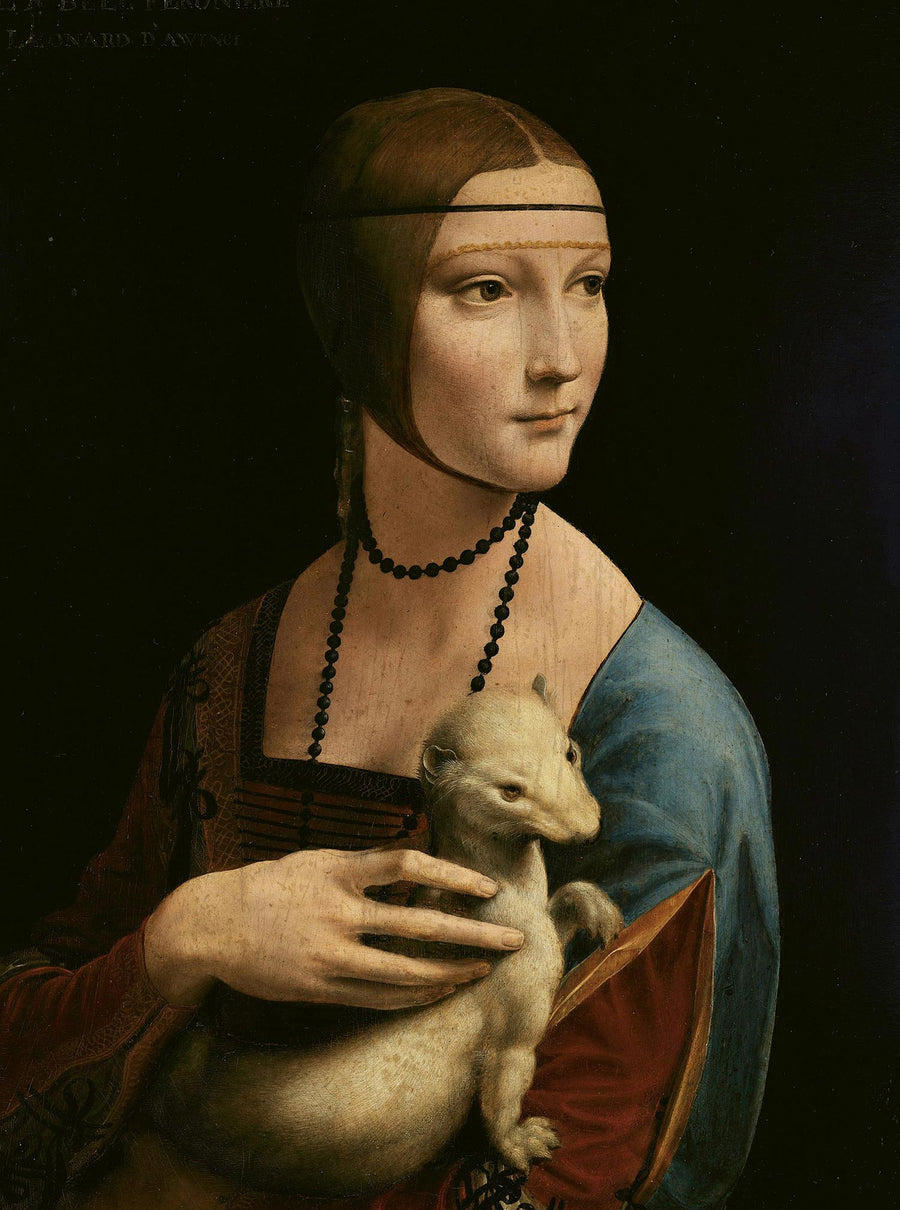
The original
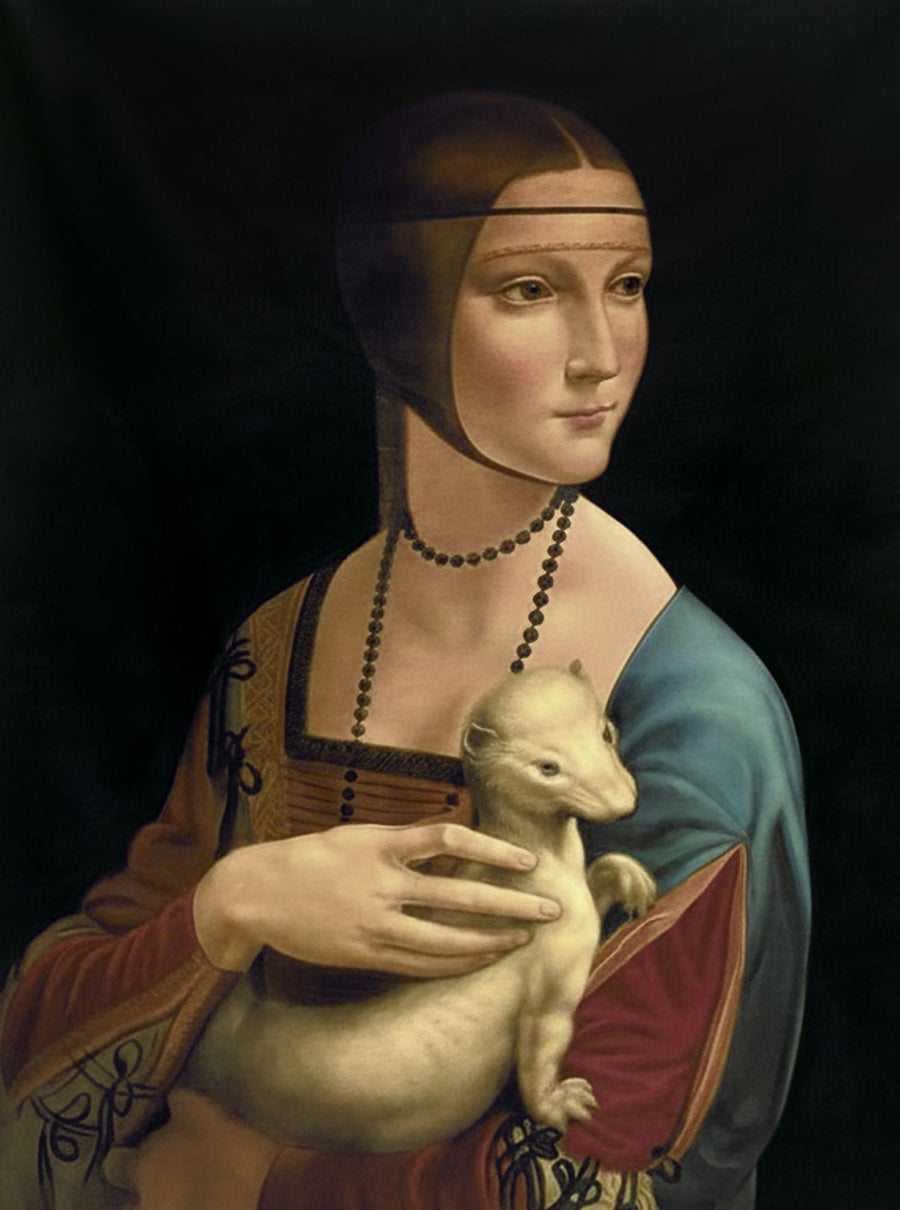
Our reproduction, painted by hand in oil
03Mona Lisa, Leonardo da Vinci (1503–1519)
The Mona Lisa shows Lisa Gherardini (1479–1542), wife of the Florentine silk merchant Francesco del Giocondo. Leonardo chose a poplar panel of 79.4 × 53.4 cm (31.3 × 21.0 in), large enough to paint her at life size, started it by October 1503 and kept working on it until his death. The Louvre writes that Francis I very probably acquired it in 1518.
What made it a model for later portraits was the arrangement, and the Louvre traces each part of it to Flemish painting: the three-quarter view in place of the traditional profile, the figure set before a balustrade that opens onto a landscape, as in Memling's Benedetto Portinari of 1487, and the joined hands. Leonardo made these conventions feel natural. Infrared images show her seated in a round-backed chair of the kind called a pozzetto, her body turning toward us and her right hand coming to rest on her left on the armrest. Even the smile may be a pun, since giocondo means happy in Italian.
In his Lives of 1550, Giorgio Vasari wrote that Leonardo had musicians play and sing and kept jesters on hand so that she would not look melancholy, although the Louvre points out that Vasari never saw the painting. Its theft in 1911 by Vincenzo Peruggia, a glazier at the Louvre, made it famous far beyond the art world; it was found in 1913.
The original and our hand-painted copy
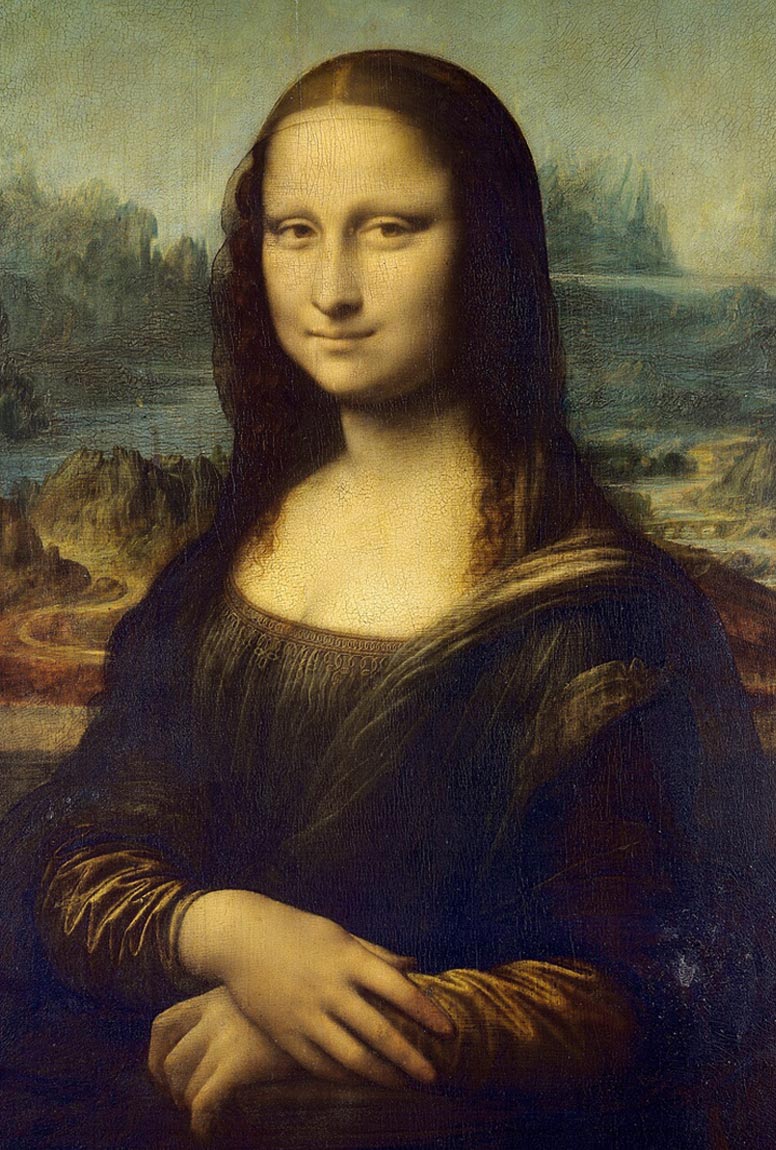
The original
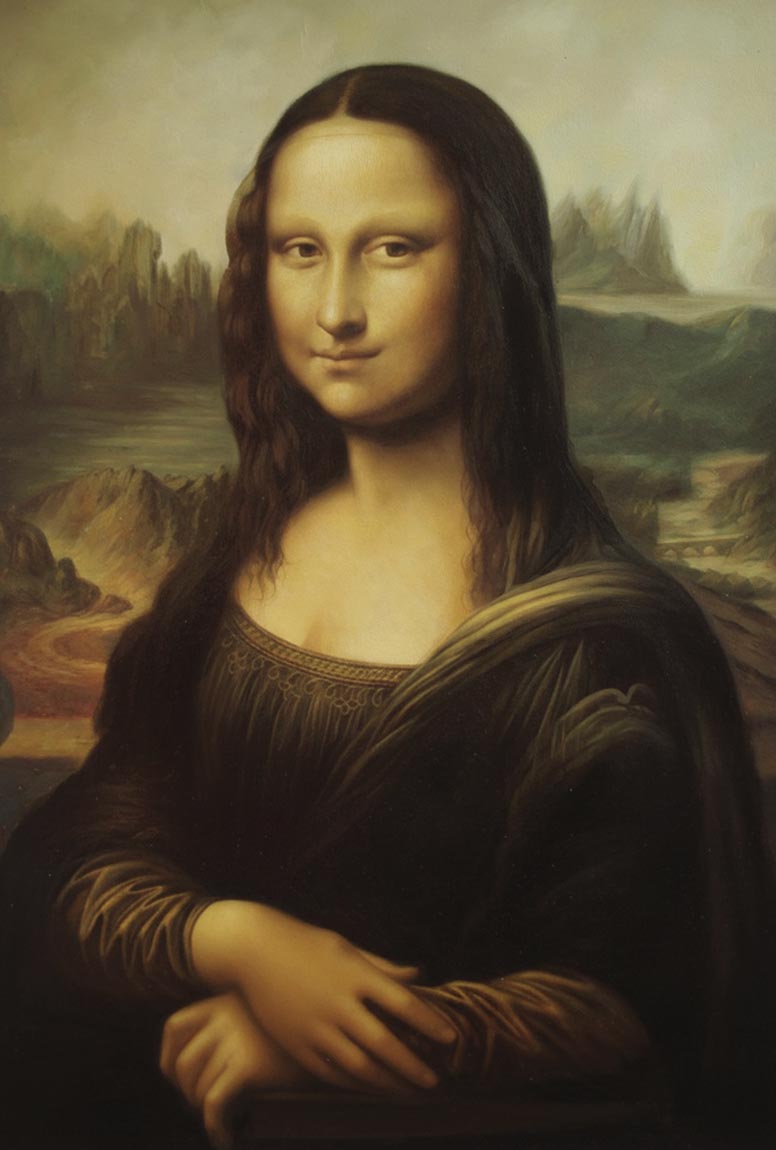
Our reproduction, painted by hand in oil
04Portrait of Baldassare Castiglione, Raphael (about 1514–1515)

Zoom
The Louvre notes that the young Raphael admired the Mona Lisa during his Florentine years, 1504 to 1508. About a decade later he painted Baldassare Castiglione (1478–1529), writer and diplomat, in the same three-quarter turn, with the hands joined at the lower edge. Castiglione was then writing The Book of the Courtier, a dialogue on the ideal courtier set at the court of Urbino; Britannica dates the writing to 1513–1518 and publication to 1528. Raphael's portrait of him is oil on canvas, 82 × 67 cm (32.3 × 26.4 in).
Its owners read like a short history of collecting. Rubens made his own copy, dated 1630, now at the Courtauld in London. In April 1639 the original was sold in Amsterdam with the collection of Lucas van Uffelen, and Rembrandt made a quick sketch of it, noting on the sheet that it went for 3,500 guilders; the drawing is in the Albertina in Vienna. The buyer, the collector Alfonso López, sold it to Cardinal Mazarin in 1641, and Louis XIV acquired it from Mazarin's heirs in 1665. The Benesch catalogue of Rembrandt's drawings sees its influence in his self-portraits of 1639 and 1640, and the National Gallery finds the shape and colors of a Raphael portrait in the second of them, Self Portrait at the Age of 34.
The 17th century: a pope and a girl in a turban
05Portrait of Pope Innocent X, Diego Velázquez (1649–1650)

Zoom
Velázquez painted Giovanni Battista Pamphilj, pope from 1644 to 1655, probably between the end of 1649 and January 1650, according to the Galleria Doria Pamphilj in Rome, which still owns the canvas. It measures 141 × 119 cm (55.5 × 46.9 in). The gallery points out that Velázquez made no attempt to hide the pope's ugliness, "that satirical, saturnine, coarse and hideous aspect" that his enemies read as a sign of a stubborn spirit.
The praise started early. An old English guidebook quotes Sir Joshua Reynolds calling it "the finest picture in Rome," and the French historian Hippolyte Taine called it "the masterpiece amongst all portraits." In the mid-19th century Prince Filippo Andrea V Doria Pamphilj had the architect Andrea Busiri Vici build a separate room just for this painting at the end of the gallery's first wing.
06Girl with a Pearl Earring, Johannes Vermeer (about 1665)

Zoom
Hand-painted oil reproductionSee sizes ›
Is Girl with a Pearl Earring a portrait at all? The Mauritshuis says no. It is a tronie, a study of a type, here a girl in exotic dress, rather than a likeness of a particular person, even if someone probably sat for it. Rembrandt had made such heads popular in Dutch art around 1630, often using himself as the model, sometimes in a remarkable cap or helmet. Vermeer's canvas is small, 44.5 × 39 cm (17.5 × 15.4 in). He used ultramarine, a precious pigment, for the dry paint of the turban, against the thick impasto of the white collar.
The painting reached the public only in 1881, at an auction in The Hague; our guide to Dutch Golden Age paintings tells how the collector Arnoldus des Tombe got it for almost nothing. Four years later Abraham Bredius, the future director of the Mauritshuis, saw it in Des Tombe's house and became its first champion.
“Vermeer overshadows all the rest; the girl’s head, so superbly modelled that one is almost inclined to forget one is looking at a painting, and that single gleam of light, will alone hold your attention.”
Its pull has since become a research subject: the Mauritshuis worked with brain scientists to find out why visitors cannot take their eyes off her. Our list of every Vermeer painting and where to see each one covers the rest of his work.
Modern faces, 1871 to 1930
07Arrangement in Grey and Black No. 1 (Whistler's Mother), James McNeill Whistler (1871)

Zoom
Hand-painted oil reproductionSee sizes ›
Whistler painted his mother in the summer of 1871 in his London studio at 2 Lindsey Row; the picture measures 144.3 × 163 cm (56.8 × 64.2 in). The Musée d'Orsay sees the double title, an arrangement in grey and black first and a portrait of his mother second, as a sign of the stylized manner he was moving toward, with a pared-down composition and neutral tones. Soon he dropped anecdote altogether and gave his paintings only musical titles, stressing harmony over subject.
The French state bought it from the artist in 1891 for the Musée du Luxembourg. It moved to the Louvre in 1925 and to the Musée d'Orsay in 1986, which calls it one of the most famous works by an American artist outside the United States. Whistler's Mother is one of the portraits we paint by hand.
08Madame X, John Singer Sargent (1883–84)

Zoom
Virginie Amélie Avegno Gautreau, born in Louisiana and known in Paris for her artful appearance, posed for Sargent without a commission: he hoped that painting and exhibiting her portrait at the Salon of 1884 would enhance his reputation. The Met owns the result, 208.6 × 109.9 cm (82.1 × 43.3 in), and our tour of famous paintings at the Met tells how a slipping shoulder strap turned it into a scandal and why the museum calls her Madame X.
Two other pictures of her show the road to it. In 1882–1883 Sargent painted her raising a glass on a panel of 32 × 41 cm (12.6 × 16.1 in) and inscribed it to her mother, Madame Anatole Avegno, as a "témoignage d'amitié," a token of friendship. The surgeon Samuel Pozzi later owned it, and Isabella Stewart Gardner bought it at the sale of his collection in Paris in June 1919; it is now in her museum in Boston. Tate in London has a second canvas of the sitter, Study of Mme Gautreau, dated about 1884.
09Portrait of Adele Bloch-Bauer I, Gustav Klimt (1907)

Zoom
Hand-painted oil reproductionSee sizes ›
Klimt began Adele Bloch-Bauer I in 1903 as a wedding-anniversary present for her parents, but he was a slow portraitist and it was not ready in time. That December he visited Ravenna and saw the sixth-century mosaics of Empress Theodora in the Church of San Vitale, which he called of "unprecedented splendor." The Neue Galerie sees them in the jewel-like patches and the layers of gold and silver he laid over oil on canvas. Adele is the only person Klimt painted twice in full-length portraits.
In 1938 the Nazis seized it from the family's Vienna home, one of five Klimt paintings they took, and for decades it was shown in Vienna as "Woman in Gold," a title that hid who she was. The heir Maria Altmann fought for the family's paintings until an Austrian arbitration panel ruled that they be returned, and in 2006 Ronald S. Lauder acquired the portrait for the Neue Galerie New York. For what Klimt's work fetches today, see the most expensive Klimt painting.
10American Gothic, Grant Wood (1930)

Zoom
Hand-painted oil reproductionSee sizes ›
American Gothic borrows the stiffness of old family photographs. The Art Institute of Chicago describes the pair as a farmer and his daughter, posed stiffly and dressed, in Wood's words, like "tintypes from my old family album." Behind them stands a house in the Carpenter Gothic style of the 1880s, like one Wood had seen in Eldon, Iowa. It is oil on beaverboard, 78 × 65.3 cm (30.7 × 25.7 in).
Shown at the museum's annual exhibition of American painting in the fall of 1930, it became an instant sensation, and its ambiguity set viewers guessing about the figures and their story. Many viewers took it as satire of Midwesterners out of step with a modernizing world; Wood meant it as a reassuring picture of rural values at the start of the Great Depression.
A face to live with
A portrait brings a gaze into the room, so choose the one you would like to meet every morning: Castiglione's level calm, the pope's hard stare or the farmer's fixed gaze. Every portrait linked to our shop above is painted by hand in oil, and our portrait paintings collection has many more faces to choose from.
Sources
- Musée du Louvre, Portrait of Lisa Gherardini (Mona Lisa), collection record
- Musée du Louvre, Raphael, Baldassare Castiglione, collection record
- National Gallery, London, Jan van Eyck, The Arnolfini Portrait
- National Museum in Kraków, Leonardo da Vinci, Lady with an Ermine
- Britannica, Baldassare Castiglione
- Rembrandt drawings catalogue (Benesch 451–500), sketch after Raphael's Castiglione
- The Courtauld, Peter Paul Rubens, Portrait of Baldassare Castiglione
- National Gallery, London, Rembrandt, Self Portrait at the Age of 34
- Galleria Doria Pamphilj, Velázquez, Portrait of Pope Innocent X Pamphilj
- Cleveland Museum of Art, Popes by Numbers (Francis Bacon)
- Mauritshuis, Johannes Vermeer, Girl with a Pearl Earring
- Musée d'Orsay, Whistler, Arrangement en gris et noir n°1
- Franklin D. Roosevelt Presidential Library, 1934 Mothers of America stamp pane
- The Metropolitan Museum of Art, John Singer Sargent, Madame X
- Isabella Stewart Gardner Museum, Sargent, Madame Gautreau Drinking a Toast
- Tate, John Singer Sargent, Study of Mme Gautreau
- Neue Galerie New York, Klimt's Adele Bloch-Bauer I (Woman in Gold)
- Art Institute of Chicago, Grant Wood, American Gothic
- Britannica, Fayum portrait
- National Portrait Gallery, Smithsonian, Obama portraits by Kehinde Wiley and Amy Sherald
- The Huntington, Thomas Gainsborough, The Blue Boy