4.7/5


Edgar Degas painted ballerinas because they were his best subject and his best income. After his family fell into debt, dancers sold well, and he found that the backstage world of rehearsals, tired feet and bored mothers gave him more to paint than any polished performance. More than half of his works show dancers, and the whole body of work lives in the Edgar Degas oil painting collection. Here is the story from first picture to the wax sculpture everyone asks about. The chart below lines the six works up by year, with what each one is made of and the museum that keeps it today.
Six Degas ballet works, in the order he made them
| Year | Ballet work | Made of | Surface and color | Where it lives now |
|---|---|---|---|---|
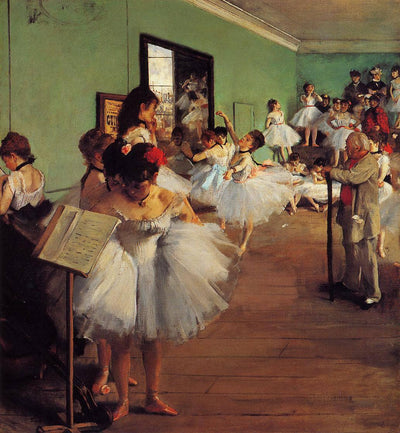
| 1874 |  The Dance Class |
Oil on canvas | A make-believe classroom with a Rossini poster on the wall, painted as a tribute to the singer Faure | Metropolitan Museum of Art, New York |
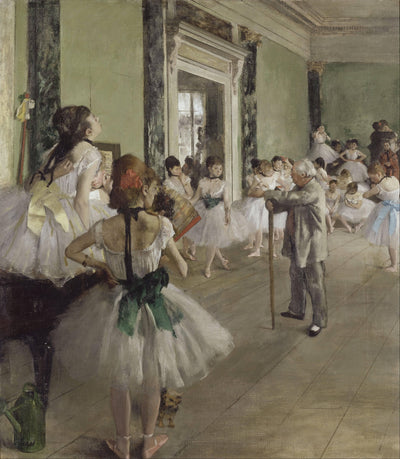
| 1874 to 1876 |  The Ballet Class |
Oil on canvas | The old teacher Jules Perrot leaning on his stick while the girls stretch and the mothers wait | Musée d'Orsay, Paris |
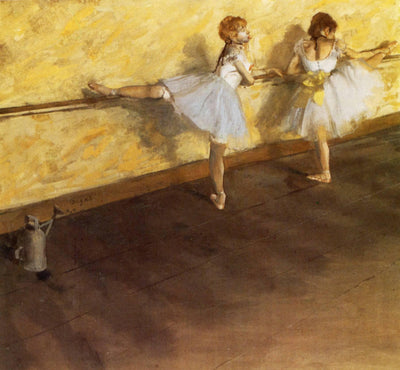
| 1877 |  Dancers Practicing at the Barre |
Oil | Just two girls in front of a long yellow wall | Metropolitan Museum of Art, New York |
| 1878 to 1881 | Little Dancer of Fourteen Years | Colored beeswax built over a metal frame | Marie van Goethem, first shown in a real tutu and slippers with a wig of human hair | National Gallery of Art, Washington, D.C. |
| About 1890 |  Dancers in Blue |
Oil on canvas | A tight knot of blue tutus, with no teacher and no room left around them | Musée d'Orsay, Paris |
| About 1890 |  Dancers, Pink and Green |
Oil on canvas | Dancers bunched close together, fixing their straps and sleeves | Metropolitan Museum of Art, New York |
Each year, material and museum here is taken from the museum and Wikipedia records named at the end of this article.
Five of the six hang in New York or Paris. The wax girl is the odd one out, since she was the only sculpture Degas showed while he was alive, and her single wax version stays in Washington.
Why Degas painted ballerinas
Degas was born in Paris in 1834 and died there in 1917. His first major dancer picture was Mlle. Fiocre in the Ballet La Source, shown at the Salon of 1868. From 1870 he turned to ballet subjects more often, partly because they sold and partly because his brother's debts had left the family bankrupt. He needed the money (Wikipedia).
He did not paint the stage the way the audience saw it. He painted the classroom, the wings and the rehearsal, with dancers shown as workers doing a job: stretching, waiting, scratching a back, retying a slipper. His own line explains the method: "In art, nothing should look like chance, not even movement." One estimate puts his output on the subject at about 1,500 works (Wikipedia).
You can see this idea in the Fiocre painting that launched the subject, a staged scene, and then in everything that follows, which is anything but staged.
The classroom: Jules Perrot and The Ballet Class

Zoom
The best single picture for the question is The Ballet Class, in the Musée d'Orsay. It is an oil on canvas of 85 by 75 cm, painted between 1874 and 1876, and the singer and collector Jean-Baptiste Faure commissioned it. The silver-haired teacher is Jules Perrot, a legend of Romantic ballet who was about 64 when Degas painted him. Around him the girls sit, stretch and fiddle with their dresses, while stage mothers watch from the back wall.
Look for the small details: a can for wetting the floor to keep down dust, a little dog, a girl arching her back at left. They are there because Degas planned the picture from drawings in his studio. Degas even painted Perrot over an earlier male teacher, thought to be Louis Mérante, and replaced a girl adjusting her slipper with one holding a fan (Wikipedia).

Zoom
Degas painted a closely related version in 1874, The Dance Class, now at the Metropolitan Museum of Art. It is an oil on canvas of 83.5 by 77.2 cm, and its imagined classroom, with a Rossini poster on the wall, is a tribute to Faure (Wikipedia). If you want one on your wall, pick this one for its green wall and warm wood floor: it feels like looking through an open door at a lesson in progress. For a quieter composition, Dancers Practicing at the Barre (Metropolitan Museum, 1877) keeps only two girls and a long yellow wall.
The wax girl: Little Dancer Aged Fourteen
Now the sculpture. Little Dancer of Fourteen Years shows Marie van Goethem, a student at the Paris Opera Ballet school whose parents had come from Belgium. Degas worked on it in wax between 1878 and 1881 and showed it at the sixth Impressionist exhibition in 1881. It was the only sculpture he exhibited in his lifetime (Philadelphia Museum of Art).
The sculpture is two-thirds life size (the Metropolitan Museum's bronze cast stands 97.8 cm tall). The version shown in 1881 was dressed in a real bodice, tutu and slippers, with a wig of human hair. Wax figures in real clothes already existed in religious and folk art, but they were unusual in the fine-art world, and visitors reacted badly. Joris-Karl Huysmans called it "the first truly modern attempt at sculpture I know," while critic Paul Mantz was harsh and others compared the girl to a monkey (Wikipedia).
Marie came from a poor family. Her mother was a laundress and her father, a tailor from Belgium, had died, leaving the mother to support three daughters on a laundress's income. Marie is estimated to have earned five to six francs for a four-hour sitting. She left the Opera ballet the year after the exhibition because she missed too many classes, and no trace of her later life has been found (Wikipedia).
How the wax was made, and remade

Zoom
Degas built the figure from pigmented beeswax over a metal armature supported with rope and clay-covered paintbrushes. The wax in Washington is not exactly the one the public saw in 1881. In 1903 the New York collector Louisine Havemeyer wanted to buy it, and Degas took it back to his working studio to rework it, but never sold it. After his death it was found in a corner of the studio. A plaster taken before the rework survives in a private collection and records the first pose, bodice and hairdo.
That explains a detail that confuses visitors. The Hébrard bronzes follow the reworked, second state of the figure, while a limited edition cast since 1997 at the Valsuani foundry follows the earlier plaster (Wikipedia). The Met's own record dates its bronze as modeled in 1881 and cast in 1922, with a modern tutu (Metropolitan Museum of Art).
How many Little Dancers are there, and where are they?
There is one wax, which Paul Mellon bought in 1956 and which is now at the National Gallery of Art in Washington, D.C. as part of the Mellon gifts beginning in 1985. After Degas died, his heirs had bronzes cast: at least 28 exist in museums worldwide, made at the Hébrard foundry from 1920 to 1936 and later at Valsuani until the mid-1970s. The Saint Louis Art Museum, which has one cast around 1920, bought it in 1957 (Saint Louis Art Museum). A Hébrard bronze sold at Sotheby's in February 2009 for £13,257,250, about $19 million (Wikipedia).
That is why the answer to "Where are the Degas ballerina sculptures?" is: the wax is in Washington, and the bronzes are spread across major museums. The sculpture cannot be reproduced as a painting, but the same dancer's world is on canvas below.
Color takes over: Dancers in Blue and Pink and Green

Zoom
Hand-painted oil reproductionSee sizes ›
Degas's eyesight was found defective during rifle training in 1870 and worsened after 1890, until he was nearly blind at the end. His later ballerinas get bigger, simpler and more colorful. Dancers in Blue is an oil on canvas of about 1890, roughly 85 by 75 cm, now in the Musée d'Orsay (Wikidata record, inventory RF 1951 10). Compared with the Ballet Class, the teacher, the classroom and the watching mothers have disappeared. Only a knot of blue tutus and the color remain. Do not confuse it with Degas's square pastel Blue Dancers of 1897 in the Pushkin Museum in Moscow, a different work (Wikipedia).

Zoom
Hand-painted oil reproductionSee sizes ›
The same taste shows in Dancers, Pink and Green, an oil on canvas of about 1890 at the Metropolitan Museum, 82.2 by 75.6 cm, where the dancers are bunched together, adjusting straps and sleeves (Metropolitan Museum of Art). Compare it to the Ballet Class: same painter, same subject, two completely different ways of seeing.
A few of them on your wall
Degas belongs among the most famous paintings in the world, and every picture above can be painted by hand in oil on canvas. The Ballet Class suits a hallway or study, and Blue Dancers brings a lot of color into a plain wall. If you enjoy Degas's circle, read about Renoir's most famous paintings and Manet and Morisot. My advice: choose the composition you could look at every morning, not the most famous one.
Sources
- Edgar Degas, Wikipedia
- Little Dancer of Fourteen Years, Wikipedia
- Marie van Goethem, Wikipedia
- The Ballet Class (Degas, Musée d'Orsay), Wikipedia
- The Dance Class (Degas, Metropolitan Museum of Art), Wikipedia
- Dancers in Blue (Danseuses bleues), Wikidata
- Dancers, Pink and Green, Metropolitan Museum of Art
- The Little Fourteen-Year-Old Dancer, Metropolitan Museum of Art
- Blue Dancers, Wikipedia
- Little Dancer, Aged Fourteen, Philadelphia Museum of Art
- Little Dancer of Fourteen Years, Saint Louis Art Museum