4.9/5


Kandinsky's Composition VII, Malevich's Black Square, Mondrian's Broadway Boogie Woogie, Pollock's Autumn Rhythm and Rothko's Seagram murals are among the famous abstract paintings below: ten works, made between 1912 and 1959, that each changed what a painting could be. They move from the first canvases with no subject at all, through the grid, to paint poured, soaked and stacked in fields of color. Five of them are in our abstract art paintings collection as hand-painted canvases, and if the idea itself is new to you, start with what abstract art is and how to read it. The first table lines the ten up by how many times Americans type each title into Google, and whether that number is climbing or sliding.
The top 10 abstract paintings by how often people search for them
| Spot on the list | Abstract work | Who made it | Google lookups each month | Six-month change |
|---|---|---|---|---|
| 1 |  Black Square |
Kazimir Malevich | 2,900 | 📈 Up 8% |
| 1 |  Broadway Boogie Woogie |
Piet Mondrian | 2,900 | 📉 Down 26% |
| 1 | Autumn Rhythm (Number 30) | Jackson Pollock | 2,900 | 📉 Down 25% |
| 4 |  Composition VII |
Wassily Kandinsky | 2,400 | 📉 Down 37% |
| 5 | Mountains and Sea | Helen Frankenthaler | 880 | 📉 Down 20% |
| 6 |  Suprematist Composition: White on White |
Kazimir Malevich | 320 | 📉 Down 37% |
| 7 |  Tableau I |
Piet Mondrian | 260 | 📉 Down 47% |
| 8 |  The Swan, No. 1 |
Hilma af Klint | 140 | 📈 Up 32% |
| 9 | The Seagram murals | Mark Rothko | 50 | 📈 Up 36% |
| 10 | Amorpha, Fugue in Two Colors | František Kupka | Fewer than 50 | Not enough searches to judge |
Search counts are Google's monthly averages for the United States, gathered in October 2026. The change compares the latest half year with the half year just before it, and three works tie for first place.
Only three of the ten were searched more in the last six months than in the six before: Black Square, The Swan, No. 1 and the Seagram murals. Every other work lost ground, and Tableau I dropped the most.
1906 to 1915: the first pictures of nothing
01The Swan, No. 1, Hilma af Klint (1915)

Zoom
Af Klint's temple paintings began in 1906, seven years before Kandinsky's Composition VII, after, as her foundation's chronology puts it, a spiritual being called Amaliel offered her a commission. The Swan comes near the end of that cycle: she started the series in 1914, as the First World War broke out, and completed it in 1915.
Moderna Museet notes that the swan stands for the ethereal in many mythologies and religions, and lists this canvas as part of Group IX/SUW, in the collection of the Hilma af Klint Foundation in Stockholm. Our guide to famous female artists sets out the case for her as a pioneer, and the painting is available as The Swan, No. 1.
02Amorpha, Fugue in Two Colors, František Kupka (1912)
Kupka's canvas, oil, 211 × 220 cm (83.1 × 86.6 in), is about movement rather than any object that moves: the National Gallery Prague's highlight text says it captures the dynamics of motion while blurring the line between subject and background. The "fugue" in the title may point to Bach and also to the word's older sense of flight, the gallery adds.
Its historical weight, as the gallery puts it, is that it was the first abstract painting presented to the public, at the Paris Salon d'Automne of 1912. The painting belongs to the National Gallery Prague.
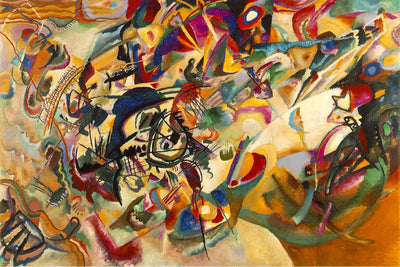
03Composition VII, Wassily Kandinsky (1913)

Zoom
The Tretyakov Gallery, which received it in 1929 from Moscow's State Museum of New Western Art, presents Composition VII as one of his central works of the early 1910s, the picture that marks his arrival at creative maturity. It is oil on canvas, 200 × 300 cm (78.7 × 118.1 in). The museum's text says he did not build the forms deliberately: he guided and refined what rose up in his imagination, and he compared making a work to the creation of a universe.
Our list of Kandinsky paintings follows the Compositions and Improvisations around it, and the canvas is available as Composition VII.
04Black Square, Kazimir Malevich (1915)

Zoom
Hand-painted oil reproductionSee sizes ›
Malevich showed it at The Last Futurist Exhibition 0,10 in Petrograd, which opened on 19 December 1915. The catalogue listed it as a quadrilateral, the Tretyakov notes, because its sides are not quite straight. It is oil on canvas, 79.5 × 79.5 cm (31.3 × 31.3 in), and he described the square as the first form to express the absence of an object, the founding image of the style he called Suprematism.
In 2015 Tretyakov researchers found two earlier geometric compositions under the paint. Malevich painted the image again about 1923 (Russian Museum), in 1929 (Tretyakov) and in 1931–1932 (Hermitage); our article on the famous all-black painting follows those versions and the black canvases that came after. The 1915 composition is available as Black Suprematistic Square.
1918 to 1943: down to essentials
05Suprematist Composition: White on White, Kazimir Malevich (1918)

Zoom
Hand-painted oil reproductionSee sizes ›
Three years after the black square, Malevich took color out as well. MoMA's canvas, oil, 79.4 × 79.4 cm (31.3 × 31.3 in), is within a millimeter of the 1915 picture, and the museum calls it one of the first paintings to propose that modern art need not refer to any reality outside itself. A white square, barely set apart from a slightly warmer white ground, seems to drift because it is tipped and pushed off center. It is available as a hand-painted White on White.
06Tableau I, Piet Mondrian (1921)

Zoom
Hand-painted oil reproductionSee sizes ›
Mondrian worked out Neo-Plasticism, his approach to abstraction, while the First World War kept him in the Netherlands, and took it back to Paris in 1919, MoMA notes. Two canvases dated 1921 carry the title Tableau I: the RKD's catalogue raisonné places this tall one in the Museum Ludwig in Cologne and the other, nearly square, in the Kunstmuseum Den Haag. See our Tableau I.
07Broadway Boogie Woogie, Piet Mondrian (1942–43)
Mondrian reached New York in October 1940, after his London studio was bombed in the Blitz, and found boogie woogie, the percussive blues piano pioneered by Black musicians in the American South, according to MoMA. In this canvas, oil, 127 × 127 cm (50.0 × 50.0 in), the black grid is gone: yellow lines broken into small squares of red, blue and gray take its place. MoMA acquired it in 1943.
From March 21 to July 31, 2027, MoMA's exhibition Mondrian Boogie Woogie will hang it beside Victory Boogie Woogie (1942–44), coming from the Kunstmuseum Den Haag, the first time in 30 years the two have been shown together; the show then moves to The Hague, from September 10, 2027 to January 30, 2028. Our guide to famous paintings at MoMA tells its New York story in more detail.
After 1945: paint as action and as field
08Autumn Rhythm (Number 30), Jackson Pollock (1950)
Autumn Rhythm was made with the canvas flat on the ground, the method Tate describes as Pollock moving around it, pouring paint from the can or trailing it from a brush or a stick. It measures 269.9 × 528.3 cm (106.3 × 208.0 in), in what the Met catalogs as oil-modified alkyd resin on canvas.
The museum's label ties the scale to the mural painting of the 1930s and to Thomas Hart Benton and David Alfaro Siqueiros, both of whom Pollock had worked alongside. The Met acquired it in 1957, the year after his unexpected death, which the label reads as a sign of how fast his way of painting entered the canon. It also has a place among our famous American paintings.
09Mountains and Sea, Helen Frankenthaler (1952)
Frankenthaler also worked on the floor, but she poured oil paint thinned with turpentine from coffee cans onto canvas that had no priming, so the color soaked into the weave instead of sitting on top of it, the National Gallery of Art explains. The painting, in oil and charcoal and 297.8 cm (117.2 in) wide, is on extended loan to the gallery in Washington from the Helen Frankenthaler Foundation.
Morris Louis and Kenneth Noland saw it very soon after it was made, the gallery adds. Louis called it "the bridge between Pollock and what is possible," as the critic Karen Wilkin recounted, and she has written that the picture is regarded as the Urtext of stain painting.
10The Seagram murals, Mark Rothko (1958–59)
In 1958 Rothko took a commission for a series of paintings for the most exclusive room of the Four Seasons restaurant in New York's Seagram Building. By 1959, after eight months on it, he declined the commission and returned his fee, having decided that a fashionable restaurant was not a place to contemplate his art, Tate says. In the late 1960s he gave nine of the canvases to Tate, where, under his agreement with the gallery, they are on permanent show with gray walls to his specification. Their titles name what you see: Black on Maroon, Red on Maroon.
He rejected the label himself. "I'm not an abstractionist," he told the critic Selden Rodman at the Whitney Annual in 1956, saying he was interested only in expressing basic human emotions, "tragedy, ecstasy, doom, and so on."
Famous abstract artists and their dates
The painters behind the ten works, in order of birth:
- Hilma af Klint (1862–1944)
- Wassily Kandinsky (1866–1944)
- František Kupka (1871–1957)
- Piet Mondrian (1872–1944)
- Kazimir Malevich (1879–1935)
- Mark Rothko (1903–1970)
- Jackson Pollock (1912–1956)
- Helen Frankenthaler (1928–2011)
Next to them stands Willem de Kooning (1904–1997), who, in Tate's description, worked in a spontaneous, improvisatory way, often with large brushes. His Interchange and Pollock's Number 17A both appear in our ranking of the most expensive paintings ever sold.
Did Van Gogh paint abstract art?
Not in the sense of the ten works above. The Starry Night (June 1889), now at MoMA, heightens what he saw, but it still shows a village, a cypress and a sky full of stars. Van Gogh tried abstraction and backed away. Writing from Saint-Rémy to Émile Bernard around 26 November 1889, he recalled that when Gauguin was in Arles he had once or twice allowed himself "to be led into abstraction," in a woman rocking a cradle and a woman reading novels. It had seemed an attractive route, he wrote, "But that's enchanted ground," and "one soon finds oneself up against a wall." Read why The Starry Night became his most famous painting, or see our hand-painted Starry Night.
The original and our hand-painted copy
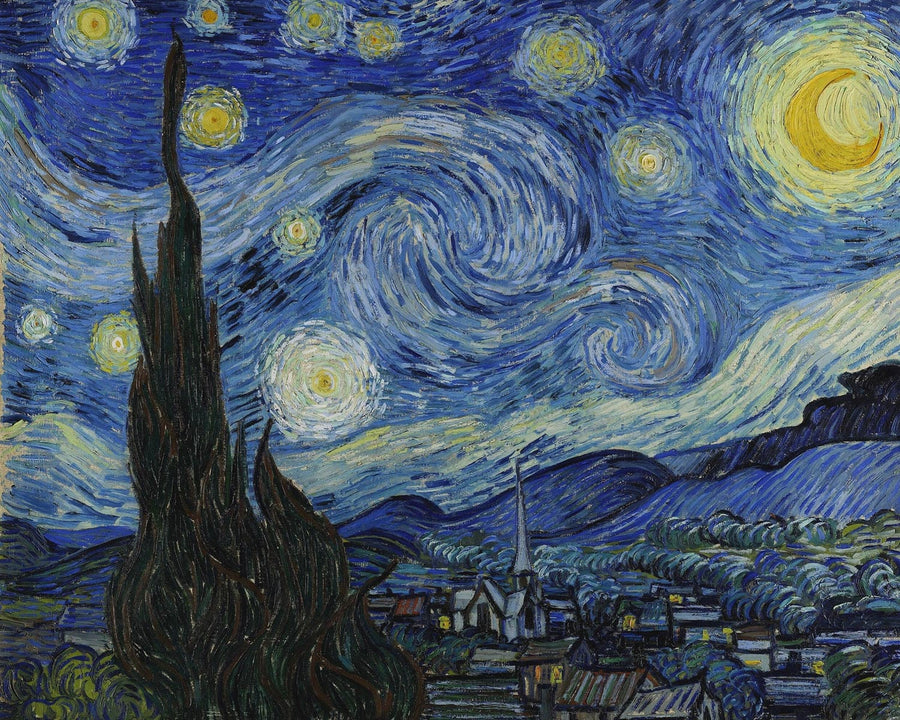
The original
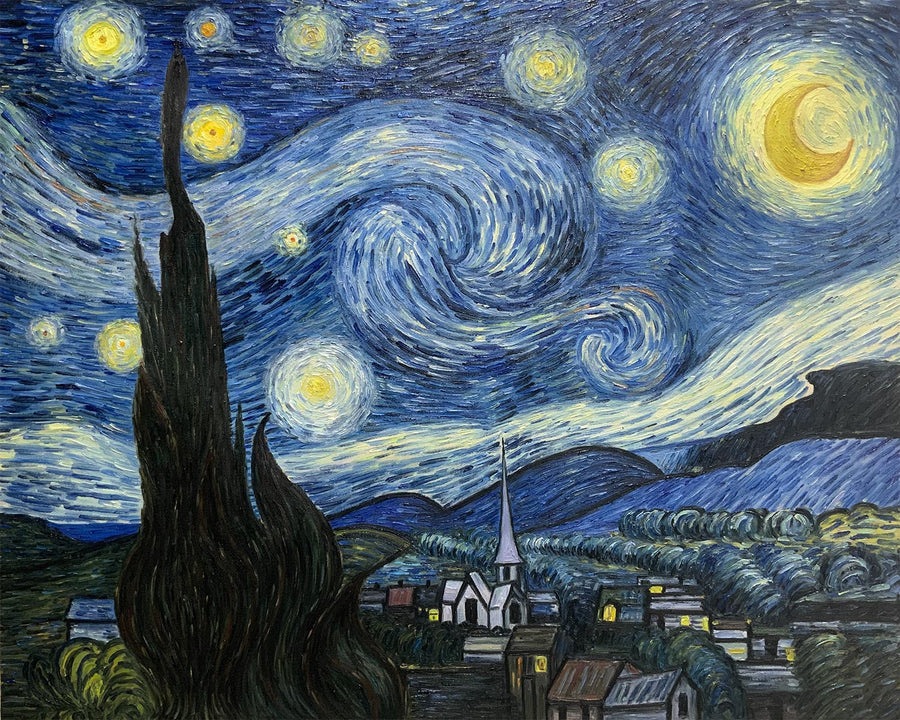
Our reproduction, painted by hand in oil
Living with an abstract painting
With no story to carry it, an abstract canvas depends on where it hangs: a big Kandinsky needs distance, while a Malevich square rewards standing close. If one of the early pioneers belongs on your wall, browse our abstract art collection. To place them among the other movements, use our art movements timeline, or see these painters beside the Old Masters among the world's most famous paintings.
Sources
- Hilma af Klint Foundation, About Hilma af Klint (chronology)
- Moderna Museet, Hilma af Klint: The Swan, No. 1, Group IX/SUW (exhibition texts)
- National Gallery Prague, 150 years since the birth of František Kupka
- Czech Centres with the National Gallery Prague, František Kupka, Amorpha, The Fugue in Two Colors
- Tretyakov Gallery, Wassily Kandinsky, Composition VII (1913)
- Tretyakov Gallery, Kazimir Malevich, Black Suprematic Square (1915)
- MoMA, Kazimir Malevich, Suprematist Composition: White on White (collection record)
- RKD, Piet Mondrian catalogue raisonné, Paris 1920–1921 (B104–B132)
- MoMA, Piet Mondrian, Broadway Boogie Woogie (collection record)
- MoMA press release, Mondrian Boogie Woogie (June 8, 2026)
- The Met, Jackson Pollock, Autumn Rhythm (Number 30) (collection record and label)
- Tate, Abstract expressionism (art term)
- National Gallery of Art, Helen Frankenthaler, Mountains and Sea (tour stop)
- National Gallery of Art, press release on Helen Frankenthaler (December 2011)
- Tate press release, Mark Rothko's Seagram Murals at Late at Tate Liverpool (2009)
- James Panero, Helen Frankenthaler (1928–2011): the bridge between Pollock and what is possible (with Karen Wilkin's New Criterion texts)
- Selden Rodman, Conversations with Artists, Rothko passage (excerpt in The Marginalian)
- Van Gogh Museum, Vincent van Gogh: The Letters, letter 822 to Émile Bernard (c. 26 November 1889)
- MoMA, Vincent van Gogh, The Starry Night (collection record)