4.7/5


Famous American paintings make an odd family portrait. A boy losing his leg to a shark in Havana harbor. A president standing beside a table with a bald eagle carved into its leg. An all-night diner with no door. Line up the 25 below by date and they tell the country's story better than most textbooks do, from the Revolution and the push west through the Depression and the Great Migration to a president painted against flowers from three continents.
They run in order from 1778–2018. Most hang in public museums, and the Metropolitan Museum of Art alone holds six. A few also turn up on a longer list of the paintings everyone recognizes, American or not, which is a fair test of how far a picture has traveled.
What is the most famous American painting?
Grant Wood's American Gothic, from 1930, is the most famous American painting. It became a sensation the year it was first shown at the Art Institute of Chicago, which still owns it. Washington Crossing the Delaware is the usual runner-up, and outside the United States the answer is often Whistler's Mother, which has belonged to France since 1891.
Revolution and a new republic
1. Watson and the Shark, John Singleton Copley (1778)
Brook Watson lost his leg to a shark while swimming in Havana harbor in 1749. Almost thirty years later he had Copley paint the moment, with the shark turning back for him and a harpoon raised over the water. Watson kept the picture until he died and left it to Christ's Hospital, a London school, as a lesson for the boys. The National Gallery of Art in Washington bought it from the school in 1963.
2. George Washington (Lansdowne Portrait), Gilbert Stuart (1796)
Senator William Bingham of Pennsylvania and his wife ordered this portrait in 1796 as a gift for the Marquess of Lansdowne, the British prime minister who had helped negotiate the end of the Revolutionary War. It's just over eight feet tall. Stuart borrowed the grammar of European state portraits and then Americanized it: the bald eagle on the table leg, and a pose thought to echo Washington's address to Congress in December 1795. Engravings of it spread fast. The canvas itself stayed in Britain until the National Portrait Gallery bought it in 2001.
3. Declaration of Independence, John Trumbull (1818)
It isn't the signing. Trumbull painted June 28, 1776, the day the first draft went before the Second Continental Congress, with Jefferson laying the document in front of John Hancock. Congress commissioned the enlarged version in 1817, and at 12 by 18 feet it has hung in the Capitol Rotunda since 1826. Of the 47 men in the room, 42 signed. You probably own a copy already: it's on the back of the two-dollar bill.
Rivers, mountains and the push west
4. The Oxbow, Thomas Cole (1836)
The full title is View from Mount Holyoke, Northampton, Massachusetts, after a Thunderstorm. Cole splits the canvas down the middle: storm and broken trees on the left, a tidy farmed valley on the right, the Connecticut River looping between them. Is it a celebration of settlement or a warning about it? Cole never settles it, which is why people still argue over it in gallery 759 at the Met. The rest of Cole's Hudson River landscapes ask the same question more quietly.
5. Fur Traders Descending the Missouri, George Caleb Bingham (1845)
A trader and a boy drift downriver in a dugout, a dark animal chained at the bow, the water flat as glass. Nothing happens, and that's the point. Bingham made the frontier look calm enough to settle. The Met bought it in 1933.
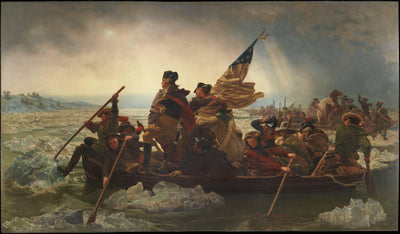
6. Washington Crossing the Delaware, Emanuel Leutze (1851)

Almost nothing in it is accurate. Washington stands upright in a small boat on an icy river, which no sane officer would do. None of that has hurt it. Leutze's crossing measures 149 by 255 inches, more than twelve feet by twenty-one, and has belonged to the Met since 1897. Stand at the far end of gallery 760 and it still works like a movie poster.
7. Niagara, Frederic Edwin Church (1857)
Church dropped the foreground. There's no ledge, no railing, no tourist, only the lip of the falls running across a canvas more than twice as wide as it is tall. He sold it the year he painted it. The Corcoran Gallery bought it in 1876, and it moved to the National Gallery of Art in 2014.
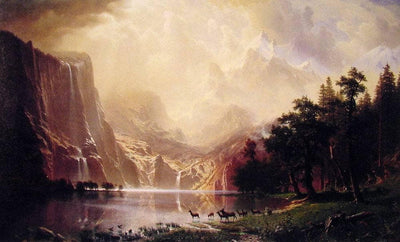
8. Among the Sierra Nevada, California, Albert Bierstadt (1868)

Bierstadt was a showman. He sold tickets to unveilings, hung his canvases in darkened rooms behind curtains, and planted stories in the papers. This six-by-ten-foot Sierra view toured Berlin and London before it came home, feeding European dreams of emigrating to a promised land. It's now at the Smithsonian American Art Museum.
After the Civil War
9. Whistler's Mother, James McNeill Whistler (1871)
Its real title is Arrangement in Grey and Black No. 1, and Whistler cared more about the arrangement than the mother. The French state bought it in 1891, and it's often called the most important American painting not on American soil. It lives at the Musée d'Orsay and rarely crosses the Atlantic, so its 2015 visit to Williamstown drew crowds. Whistler's other nocturnes and arrangements are just as spare.
10. Breezing Up (A Fair Wind), Winslow Homer (1873–1876)
Three boys and a man in a catboat, heeled over, sun on the sail. Painted a decade after Gettysburg, it's the most cheerful picture Homer ever made, and people needed it. The National Gallery of Art bought it on the last day of 1943. If you like the sea in paint, Homer's marine paintings are the place to start.
11. The Gross Clinic, Thomas Eakins (1875)
Dr. Samuel Gross pauses mid-operation with blood on his fingers while the patient's mother hides her face. Eakins painted it for Philadelphia's Centennial Exhibition of 1876, and plenty of people found it too much. In 2007, 3,600 donors from all fifty states helped buy it so it could stay in the city; it now alternates in five-year stints between the Philadelphia Museum of Art and the Pennsylvania Academy of the Fine Arts. Eakins's rowers and portraits are gentler.
12. Madame X, John Singer Sargent (1883–84)
Virginie Gautreau was 23, American-born and famous in Paris for her looks. Sargent showed her portrait at the 1884 Salon with bare shoulders and a haughty profile, and Paris was scandalized. The fallout crippled his plans to work as a portraitist there, and in 1886 he moved to London. He kept the canvas for three decades and sold it to the Met in 1916.
13. The Banjo Lesson, Henry Ossawa Tanner (1893)
Tanner studied under Eakins at the Pennsylvania Academy, where he was the only Black student, and in 1891 he left for Paris to get away from American racism. Two years later he painted an older man teaching a boy the banjo by firelight, a quiet picture of family and skill passed down in the decades after the Civil War. It's at the Hampton University Museum in Virginia, and Norman Rockwell borrowed from it.
14. The Child's Bath, Mary Cassatt (1893)
Cassatt looks straight down on a woman washing a child's foot in a basin, so the striped dress and patterned rug press flat against the surface like a Japanese print. That's deliberate; she was deep into Japanese art in the 1890s. The Art Institute of Chicago bought her bath scene in 1910, the first Cassatt it ever owned.
15. The Gulf Stream, Winslow Homer (1899)
A Black sailor lies on the deck of a dismasted boat, sharks circling and a waterspout behind him. Put it next to Copley's shark picture and the change in a century is plain: no rescue boat this time. Homer kept reworking it until 1906, the year the Met bought it.
16. Stag at Sharkey's, George Bellows (1909)
Sharkey's Athletic Club was a saloon with a boxing ring in the back, near Bellows's studio. Public boxing was illegal in New York, so fights ran as private club events, and an outsider who stepped in got a temporary membership and the name "stag." Bellows paints the two fighters as one tangle of limbs. It's in the Cleveland Museum of Art.
Depression, migration and the city at night
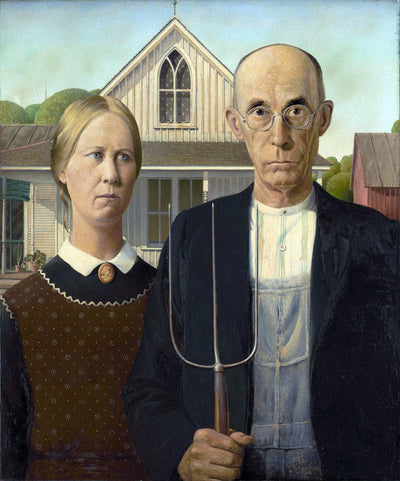
17. American Gothic, Grant Wood (1930)

A farmer and his daughter, not his wife, stand before a house in the 1880s Carpenter Gothic style that Wood had seen in Eldon, Iowa. He wanted them to look like "tintypes from my old family album," he said. Viewers in 1930 read it as satire of stiff Midwesterners. Wood meant it as reassurance at the start of the Depression, and the pitchfork portrait has been read both ways ever since.
18. Jimson Weed/White Flower No. 1, Georgia O'Keeffe (1932)
O'Keeffe painted flowers big so that people in a hurry would have to stop. This one is larger than her usual canvas. In November 2014 it sold at Sotheby's in New York for $44,405,000, nearly three times its high estimate and more than three times the previous auction record for a woman artist, $11.9 million.
19. The Migration Series, Jacob Lawrence (1940–41)
Sixty small panels, captioned like a book, tell how more than a million African Americans left the rural South for Northern cities after World War I. Lawrence, the son of Southern migrants, painted them with a Rosenwald Fund grant, working one color at a time across every panel. Fortune published the series in November 1941, and in 1942 the Phillips Collection took the odd-numbered panels and the Museum of Modern Art the even ones. Lawrence was 24.
20. Nighthawks, Edward Hopper (1942)
Three customers and a counterman under electric light, and no way in: the diner has no door. It started from a restaurant on Greenwich Avenue in New York, but Hopper cleaned the street of everything else. "Unconsciously, probably, I was painting the loneliness of a large city," he said later. The Art Institute of Chicago bought it the year he finished it.
21. Nightlife, Archibald Motley (1943)
Motley saw Nighthawks at the Art Institute and answered it. His cabaret in Bronzeville, on Chicago's South Side, is packed, loud and lit in magenta and violet, every glance going somewhere. It hangs in the same museum as Hopper's diner, and the pair make the best argument on this list about what a city night feels like.
After 1945
22. Christina's World, Andrew Wyeth (1948)
Christina Olson couldn't walk and pulled herself across the fields of her family's farm in Cushing, Maine. Wyeth spent months on the grass before he painted her; only her arms and hands are hers, and the body is his wife Betsy's. When he shipped it to New York he told Betsy, "This picture is a complete flat tire." Within weeks the Museum of Modern Art paid $1,800 for it. Wyeth was 31.
23. Autumn Rhythm (Number 30), Jackson Pollock (1950)
Paint poured and flung across a canvas 8 feet 10 inches high and 17 feet 4 inches wide. Up close it's weather; from across the room it has a pulse. The Met bought it in 1957.
24. Three Flags, Jasper Johns (1958)
Johns dreamed of painting the American flag and did it for the first time a few years later. Here three canvases stack toward you, each smaller than the one behind, the opposite of how perspective should work. He painted in encaustic, hot wax and pigment, so every stroke stays visible. Patriotic or critical? The Whitney bought it in 1980 and people still can't decide.
25. Barack Obama, Kehinde Wiley (2018)
Wiley sat the 44th president in a plain chair against a wall of leaves and put three flowers in it: chrysanthemums for Chicago, jasmine for Hawaii, where Obama was born, and African blue lilies for his father's Kenya. Obama joked that he'd lost the argument over his gray hair and large ears. The portrait was unveiled at the National Portrait Gallery on February 12, 2018, and hangs in the same museum as Stuart's Washington.
Where can you see the most of them?
New York and Chicago. The Met has six of the 25 (The Oxbow, Fur Traders, Washington Crossing the Delaware, Madame X, The Gulf Stream and Autumn Rhythm), and the Art Institute of Chicago has four, including both night scenes. Washington, D.C. covers the most history in one trip: Copley, Church and Homer at the National Gallery, Stuart and Wiley at the Portrait Gallery, Trumbull in the Capitol.
Living with one of them
Most of these pictures will never leave their museums, but several can hang in your home as oil copies painted by hand. Art & See has Leutze, Wood, Bierstadt and Cassatt among them, alongside the paintings people ask for most. Start with the one you'd stop for in the gallery.
Sources
- Architect of the Capitol, Declaration of Independence
- Smithsonian American Art Museum, Among the Sierra Nevada, California
- Philadelphia Museum of Art, The Gross Clinic
- The Phillips Collection, Migration Series press release
- Sotheby’s, Jimson Weed/White Flower No. 1, lot 11
- Whitney Museum, Three Flags
- Smithsonian Magazine, Wyeth’s World
- Smithsonian Magazine, the Obama portraits unveiled