4.9/5
4.9/5


The most famous Italian paintings are Leonardo's Mona Lisa and The Last Supper, Botticelli's The Birth of Venus, Michelangelo's Creation of Adam and Raphael's School of Athens. Ten are below, with their dates, sizes, where to see them and one fact you may not have heard. They run from Florence in the 1480s to Artemisia Gentileschi's Judith around 1620, and most belong on any list of the world's famous paintings.
Italian painters' work also traveled: the Mona Lisa lives in Paris and the Sistine Madonna in Dresden. For the neighbors, see famous French paintings and famous Spanish paintings.
At a glance
| # | Painting | Artist | Year | Where to see it |
|---|---|---|---|---|
| 1 |  Mona Lisa Mona Lisa |
Leonardo da Vinci | 1503 to 1519 | Louvre, Paris |
| 2 | The Last Supper | Leonardo da Vinci | c. 1495 to 1498 | Santa Maria delle Grazie, Milan |
| 3 | The Birth of Venus | Sandro Botticelli | c. 1484 to 1486 | Uffizi, Florence |
| 4 | The Creation of Adam | Michelangelo | c. 1512 | Sistine Chapel ceiling |
| 5 | The School of Athens | Raphael | 1509 to 1511 | Stanza della Segnatura, Apostolic Palace, Vatican |
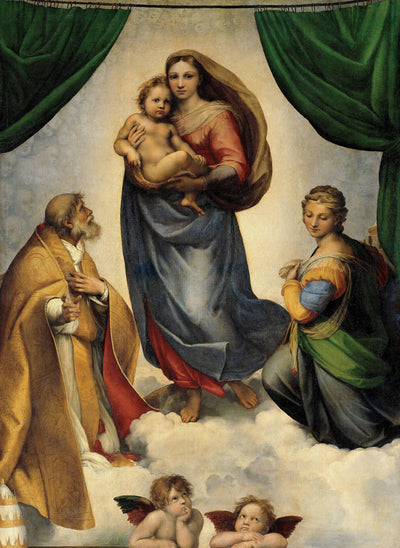
| 6 |  Sistine Madonna Sistine Madonna |
Raphael | c. 1513 to 1514 | Dresden |
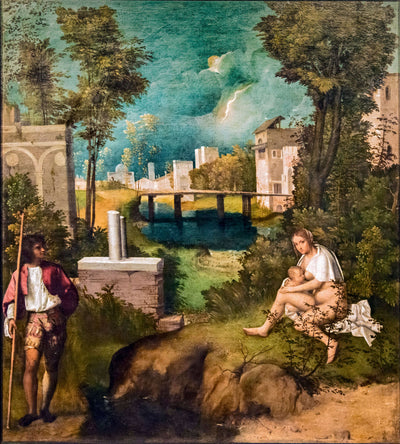
| 7 |  The Tempest The Tempest |
Giorgione | c. 1506 to 1508 | Gallerie dell'Accademia, Venice |
| 8 |  Venus of Urbino Venus of Urbino |
Titian | 1534 | Uffizi, Florence |
| 9 |  The Calling of Saint Matthew The Calling of Saint Matthew |
Caravaggio | 1599 to 1600 | San Luigi dei Francesi, Rome |
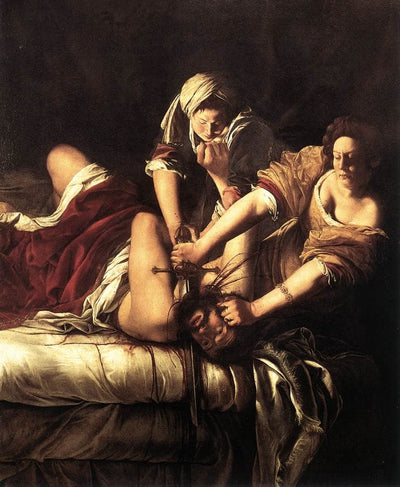
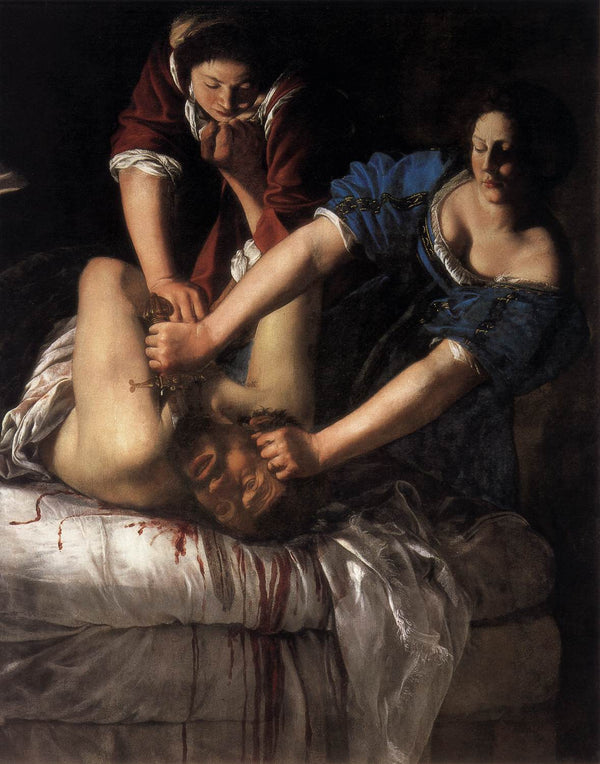
| 10 |  Judith Beheading Holofernes Judith Beheading Holofernes |
Artemisia Gentileschi | c. 1612 to 1620 | Uffizi, Florence (c. 1620 version); Museo di Capodimonte, Naples (1612 to 1613 version) |
Florence, Milan and Rome: 1480s to 1512
01Mona Lisa, Leonardo da Vinci (1503 to 1519)

Zoom
The Mona Lisa is oil on a white poplar panel, 79.4 by 53.4 centimeters (about 31 by 21 inches). The Louvre dates it 1503 to 1519 and notes it was already begun by October 1503. The sitter is traditionally Lisa del Giocondo, wife of the Florentine silk merchant Francesco del Giocondo, though her likeness is not certain. King Francis I acquired the picture after Leonardo died in 1519.
On August 21, 1911, Louvre employee Vincenzo Peruggia stole it. It was found in Florence and returned on January 4, 1914. It has been behind bulletproof glass since a rock attack in 1956, and since April 6, 2005 it has hung in the Salle des États. About 10.2 million people see it each year. In 1962 it was insured for $100 million, a Guinness World Record at the time, according to the Mona Lisa article.
02The Last Supper, Leonardo da Vinci (c. 1495 to 1498)
Ludovico Sforza, Duke of Milan, commissioned the wall painting for the refectory of Santa Maria delle Grazie. It is 460 by 880 centimeters, and it is not true fresco: Leonardo used tempera on a base of gesso, pitch and mastic over the wall plaster. That experiment explains why it began to deteriorate soon after it was finished. By 1556 Vasari called it a "muddle of blots."
On August 15, 1943, Allied bombs hit the refectory, and sandbags protected the wall from splinters. A restoration ran from 1978 to 1999 under Pinin Brambilla Barcilon, and the work returned to display on May 28, 1999. Visitors must book ahead and may stay up to 15 minutes.
03The Birth of Venus, Sandro Botticelli (c. 1484 to 1486)
Botticelli painted Venus in tempera on canvas, not wood, and the canvas is two pieces sewn together over a blue-tinted ground. It measures 172.5 by 278.5 centimeters, per the Uffizi. At that scale, a standing nude had hardly been seen in Western painting since antiquity. Her pose follows the classical Venus Pudica, hands covering the breasts and groin.
Tradition says Simonetta Cattaneo Vespucci was the model, but that is legend. The patron is also uncertain: the Uffizi says a Medici commission is highly probable, but nothing is written about the picture before Vasari describes it in 1550. It moved to the Uffizi in 1815, and you can see it there today.
04The Creation of Adam, Michelangelo (c. 1512)
This is one panel of the Sistine Chapel ceiling, painted for Pope Julius II between 1508 and 1512. The panel is 280 by 570 centimeters (9 feet 2 inches by 18 feet 8 inches). Between the two index fingers is a gap of three quarters of an inch, 1.9 centimeters.
In 1990 the physician Frank Meshberger argued in JAMA that the shapes behind God form an anatomically accurate human brain, a reading that still divides viewers. The panel is the fourth chronological episode in the nine Genesis scenes along the center of the vault.
Rome and Venice: 1509 to 1540
05The School of Athens, Raphael (1509 to 1511)
Raphael painted this fresco in the Stanza della Segnatura of the Apostolic Palace in the Vatican, also for Julius II. It is 500 by 770 centimeters. Plato, holding the Timaeus, and Aristotle, holding the Nicomachean Ethics, stand at the center. Raphael put himself next to Ptolemy.
Tradition reads Plato as a portrait of Leonardo and the brooding figure of Heraclitus as Michelangelo. If that is right, three of the greatest painters in Rome share one wall.
06Sistine Madonna, Raphael (c. 1513 to 1514)

Zoom
Pope Julius II commissioned the Sistine Madonna in 1512 as the altarpiece for the Benedictine monastery of San Sisto in Piacenza, in honor of his late uncle, Pope Sixtus IV. It is oil on canvas, 265 by 196 centimeters. In 1754 Augustus III of Poland bought it for roughly 110,000 to 120,000 francs, and it hangs in Dresden.
It survived the bombing of Dresden, was taken by the Red Army and held in Moscow for about a decade. The Soviets returned it to Germany in 1955. The two winged children at the bottom are putti, often mistaken for cherubim.
07The Tempest, Giorgione (c. 1506 to 1508)

Zoom
Nobody knows exactly what Giorgione's small canvas shows. It is oil on canvas, roughly 83 by 73 centimeters, and it was originally commissioned by the Venetian noble Gabriele Vendramin. There is no contemporary text to explain it, and scholars have proposed the Flight into Egypt, a classical myth and a Paradise with Adam and Eve.
X-rays show that Giorgione first painted another nude female figure before the man was added, per DailyArt. It hangs at the Gallerie dell'Accademia in Venice. During World War II it was among the works the art official Pasquale Rotondi sheltered from German troops, and Italian accounts say it was kept hidden under a bed in his household (PRISMA).
08Venus of Urbino, Titian (1534)

Zoom
Hand-painted in oil · From $350See sizes ›
Titian's reclining Venus is 119 by 165 centimeters and hangs in the Uffizi. Titian was working on it by December 1534, probably for Cardinal Ippolito de' Medici, who died before he saw it. Guidobaldo II della Rovere, who soon became Duke of Urbino, bought it in 1538 after sitting for a portrait in Titian's studio; the Uffizi gives the same size and date. Its pose comes from the Dresden Venus, traditionally attributed to Giorgione, but here the goddess is awake and looks you in the eye.
In his 1880 travel book A Tramp Abroad, Mark Twain called it "the foulest, the vilest, the obscenest picture the world possesses." Manet answered it with Olympia in 1863. The little dog usually stands for fidelity.
“the foulest, the vilest, the obscenest picture the world possesses.”
Caravaggio and Artemisia: 1599 to 1620
09The Calling of Saint Matthew, Caravaggio (1599 to 1600)

Zoom
Hand-painted in oil · From $350See sizes ›
Cardinal Matthieu Cointerel left money in his will for a chapel decorated with scenes from the life of Saint Matthew. The commission for The Calling of Saint Matthew is dated July 1599, with final payment in July 1600. It still hangs in the Contarelli Chapel of San Luigi dei Francesi in Rome, where it was made to be seen.
A beam of light picks out the faces of the men at the table who look at Christ. Most art historians say the bearded man in the middle, pointing at his own chest, is Matthew. A rival reading says Matthew is the young man counting coins at the far left.
10Judith Beheading Holofernes, Artemisia Gentileschi (c. 1612 to 1620)

Zoom
Hand-painted in oil · From $350See sizes ›
Artemisia Gentileschi painted at least two large versions of Judith beheading Holofernes. The smaller, in the Museo di Capodimonte in Naples, dates from 1612 to 1613. The second, in the Uffizi, is dated about 1620 by the museum itself (Uffizi record). In all, six variations of the subject are known.
She was around 18 when Agostino Tassi raped her, and the trial that followed lasted seven months. She became the first woman admitted to the Accademia di Arte del Disegno in Florence. Read the painting for its muscle: Judith's sleeves are rolled up and she is working.
A few of them on your wall
Several of these Italian masterpieces, from the Mona Lisa to Caravaggio's tax collector, are available at Art & See as oil paintings made by hand on canvas, in seven sizes with custom sizes on request. Browse the full collection of famous paintings and pick the one you walked back to twice. A photo of the finished canvas is sent for your approval before it ships, shipping is free worldwide and returns are open for 90 days.
Sources
- Louvre, Portrait of Lisa Gherardini (Mona Lisa), collection record
- Wikipedia, Mona Lisa
- Wikipedia, The Last Supper (Leonardo)
- Wikipedia, The Birth of Venus
- Wikipedia, The Creation of Adam
- Wikipedia, The School of Athens
- Wikipedia, Sistine Madonna
- Wikipedia, The Tempest (Giorgione)
- Wikipedia, Venus of Urbino
- Wikipedia, The Calling of St Matthew (Caravaggio)
- Wikipedia, Artemisia Gentileschi
- Uffizi Galleries, Birth of Venus
- Uffizi Galleries, Venus of Urbino
- Uffizi Galleries, Judith Beheading Holofernes
- DailyArt Magazine, Giorgione, The Tempest
- PRISMA 49, Pasquale Rotondi and the works he saved