4.7/5


The Western nude was shaped by a short run of paintings, from Botticelli's Venus stepping ashore in about 1485 to a small, frank canvas Courbet painted in 1866. Between them come Giorgione's sleeping goddess, Titian's Venus of Urbino, Lavinia Fontana's Minerva, Velázquez's Rokeby Venus, Goya's Nude Maja, Ingres's Grande Odalisque, Cabanel's Birth of Venus and Manet's Olympia. Our nude paintings collection follows the same tradition; the ten entries below say where each original hangs and what happened when people first saw it. A chart near the top lines up the ten by how many Wikipedia languages tell their story, and it sums up the stir each one made.
In 1956 the art historian Kenneth Clark opened The Nude: A Study in Ideal Form by pulling apart two words that most of us use as one.
“To be naked is to be deprived of our clothes, and the word implies some of the embarrassment most of us feel in that condition.”
The word nude, Clark went on, carries "no uncomfortable overtone." Nearly every picture below tested that line, and most of the quarrels they caused were about who had the right to look.
The 10 most famous nudes, and the trouble each one caused
| No. | Nude | Artist | Languages that tell its story | The stir it caused |
|---|---|---|---|---|
| 1 | The Birth of Venus | Sandro Botticelli | 56 | No uproar on record. The goddess is shown a moment before a cloak covers her. |
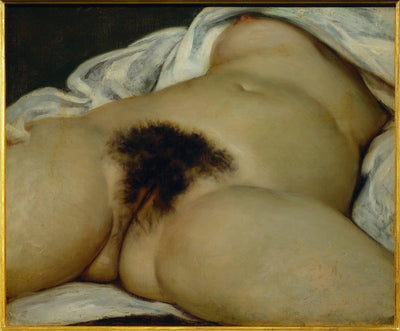
| 2 |  The Origin of the World |
Gustave Courbet | 50 | A close-up with no myth to soften it, kept in private hands until the French state took it in 1995. |
| 3 |  The Nude Maja |
Francisco Goya | 44 | The Inquisition called it "obscene" in 1814. |
| 4 |  Olympia |
Édouard Manet | 40 | It caused an uproar at the 1865 Salon, because she is a woman of Manet's own Paris who stares right back. |
| 5 |  Venus of Urbino |
Titian | 39 | In 1880 Mark Twain called it the "obscenest picture the world possesses," half as a joke. |
| 6 |  The Sleeping Venus |
Giorgione and Titian | 36 | No scandal on record. In 1945 Soviet officials took it to Moscow, and it came home in 1956. |
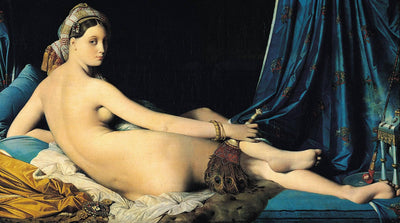
| 7 |  La Grande Odalisque |
Jean-Auguste-Dominique Ingres | 33 | Critics mocked her extra vertebrae, and in 1989 the Guerrilla Girls gave her a gorilla mask. |
| 8 |  The Rokeby Venus |
Diego Velázquez | 30 | A suffragette attacked it with a hatchet in 1914. |
| 9 |  The Birth of Venus |
Alexandre Cabanel | 21 | A hit at the Salon, but Zola compared the goddess to "pink and white marzipan." |
| 10 |  Minerva Dressing |
Lavinia Fontana | No data | No uproar. Its trouble was the name on it: other painters got the credit until 1955. |
Nobody counts book mentions of single paintings, so this list uses the number of Wikipedia languages instead (October 2026). We found no Wikipedia article just for Minerva Dressing.
Two of the top three, the Courbet and the Goya, first hung in private rooms, far from public view.
The Renaissance sets the pose
01The Birth of Venus, Sandro Botticelli (about 1485)
The familiar title is slightly off. The Uffizi, which owns the picture, explains that it shows Venus arriving on land at Cyprus after her birth from the sea foam, carried by the wind Zephyr and perhaps Aura, while a young woman, possibly one of the Graces or the Hora of spring, holds out a cloak covered in flowers. The subject was perhaps suggested by the poet Agnolo Poliziano. Botticelli painted it in tempera on canvas, 172.5 × 278.5 cm (67.9 × 109.6 in).
For a history of the nude, the cloak is the detail to watch: Botticelli's goddess is caught a moment before she is covered. For the paintings that share her level of fame, see our guide to the most famous paintings in the world.
02The Sleeping Venus, Giorgione and Titian (about 1508–1510)

Zoom
Dresden's Gemäldegalerie Alte Meister dates this canvas to about 1508–1510 and credits it to both painters: a document of 1525 says Giorgione began it and his collaborator Titian finished it, although the museum's collection record warns that after many restorations no one can say reliably which passages are whose. It is oil on canvas, 108.5 × 175 cm (42.7 × 68.9 in), and was probably commissioned by Girolamo Marcello for his wedding in 1507.
The wedding may explain the subject. The museum suggests the patron had in mind Latin wedding poems in which the sleeping Venus is asked to wake, join the celebration and favor the new couple's love. Cupid once sat at her feet playing with his bow and arrow, but his figure was in such poor condition that it was painted over with the green of the meadow in 1837; X-rays still pick up fragments of him. Titian painted his own reclining Venus some thirty years later. See The Sleeping Venus as a hand-painted canvas.
03Venus of Urbino, Titian (1538)

Zoom
The Uffizi dates the canvas to 1538, the year a letter shows Guidobaldo II della Rovere buying it directly from Titian, and that letter calls it simply the "naked woman." It is oil on canvas, 119 × 165 cm (46.9 × 65.0 in). The museum reads her as a young bride in a rich Venetian house rather than a goddess, about to be dressed for the toccamano, a ceremony held at home in which a woman touched her suitor's hand to give her consent. Behind her, the maids have taken a wedding dress out of a painted chest. How the picture reached Florence and where it hung there is told in our list of Italian Renaissance paintings.
Three centuries later it could still provoke. Describing the Uffizi's Tribune, where it then hung, Mark Twain wrote:
“…you may look your fill upon the foulest, the vilest, the obscenest picture the world possesses”
He was half joking. What troubled him, he said, was not that she was naked but "the attitude of one of her arms and hand," and he conceded that "she is a work of art, and Art has its privileges." Venus of Urbino is the canvas Manet answered in 1863.
Rome and Madrid: nudes for private rooms
04Minerva Dressing, Lavinia Fontana (1613)

Zoom
Hand-painted oil reproductionSee sizes ›
Lavinia Fontana (1552–1614), a painter from Bologna, made this canvas in Rome, and the inscription under the seated cupid's foot, FACIEBAT MDCXIII, dates it to 1613. Minerva has just put down her arms to dress in rich women's clothes; the spear, the olive tree and the owl that identify her wait in the background, and the dome of St. Peter's shows beyond a dark wall. The canvas, 258 × 190 cm (101.6 × 74.8 in), belongs to the Galleria Borghese in Rome, whose online catalog listed it in storage in August 2026.
Cardinal Scipione Borghese had it from 1613, and a payment for its frame refers to it as Lavinia Fontana's Pallas. It had a forerunner: an earlier nude Minerva she painted in 1604–1605 for Marco Sittico Altemps was the subject of a poem of 1605 by Ottaviano Rabasco, La Pallade ignuda della famosa pittrice Lavinia Fontana (The Naked Pallas of the Famous Woman Painter Lavinia Fontana). The Borghese canvas then spent centuries under other painters' names. A guide of 1700 called it an idea of Titian's, an itinerary of 1818 gave it to Padovanino, and only in 1955 did the scholar Paola della Pergola return it to Fontana on the strength of the documents. Minerva Dressing shows the full composition.
05The Rokeby Venus, Diego Velázquez (1647–1651)

Zoom
Hand-painted oil reproductionSee sizes ›
The National Gallery in London, which catalogs it as The Toilet of Venus, dates the canvas to 1647–51: oil on canvas, 122.5 × 177 cm (48.2 × 69.7 in). The museum notes that the reflection is blurred, so "we can't see who she really is," and that Velázquez first set her head more in profile before changing it. In Spain, it adds, openly sensual images met with the Catholic Church's disapproval, even though the king and collectors close to him owned mythological nudes by Titian and Rubens.
Around 1800 it hung in Madrid in the private cabinet of Manuel Godoy, the Prince of Peace, alongside Goya's nude and two pictures attributed to Titian, according to the Prado. It spent much of the 19th century at Rokeby Park in County Durham, which gave it its nickname, and the Art Fund presented it to the National Gallery in 1906. Its loose, visible brushwork is set against Botticelli's drawn contours in our comparison of Baroque and Renaissance art.
On March 10, 1914, the suffragette Mary Richardson attacked it with a hatchet, and the gallery's keeper counted "seven distinct injuries," according to a report filed from London that day. In her defense she said she had tried to destroy "the picture of the most beautiful woman in mythological history" as a protest against the government's treatment of Emmeline Pankhurst. The Rokeby Venus is also available painted by hand in oil.
06The Nude Maja, Francisco Goya (1795–1800)

Zoom
Hand-painted oil reproductionSee sizes ›
The Prado catalogs it as The Naked Maja, oil on canvas, 97.3 × 190.6 cm (38.3 × 75.0 in), dated 1795–1800, and its catalog entry records the first known reaction. In November 1800 the engraver Pedro González de Sepúlveda saw it in Godoy's palace, hung in an inner cabinet with other Venuses, and wrote in his diary that it was a naked Venus by Goya "but without drawing and dull in the colouring." Her arms, folded behind her head, recall the classical statue of the Sleeping Ariadne in the royal collections; Goya left out Cupid, the goddess's usual companion, and has her look straight back at us with a slight smile.
Godoy's collection was inventoried in 1808 and later seized. At the end of 1814 the Inquisition denounced the nude and its clothed companion as "obscene," naming Goya as the painter of both. The old story that Goya altered the face to hide the sitter, often said to be the Duchess of Alba, does not survive the museum's recent X-ray, which shows the body painted in one go with no changes around the head. The Royal Academy of San Fernando held it from 1836, and it entered the Prado in 1901. Our guide to the most famous Goya paintings places it among his other work, and The Nude Maja is available as an oil copy.
Paris: the nude on public view
07La Grande Odalisque, Jean-Auguste-Dominique Ingres (1814)

Zoom
Hand-painted oil reproductionSee sizes ›
Ingres painted it in Rome in 1814 for Caroline Murat, Queen of Naples, and showed it at the Salon of 1819; the Louvre bought it in 1899. It is oil on canvas, 91 × 162 cm (35.8 × 63.8 in). The critics' complaint about her extra vertebrae belongs to our guide to Neoclassicism, and the museum's other highlights to our tour of famous paintings at the Louvre.
Her second life began in New York. In 1989 the Guerrilla Girls put a gorilla mask on the Odalisque for a poster titled Do Women Have To Be Naked To Get Into the Met. Museum? and printed their count beneath her: fewer than 5% of the artists in the museum's modern art sections were women, but 85% of the nudes were female. The Met itself received a copy of the poster as a gift in 2021. A figure painted to please a queen became shorthand for a question about who paints and who gets painted. See The Grande Odalisque in oil.
08The Birth of Venus, Alexandre Cabanel (1863)

Zoom
Hand-painted oil reproductionSee sizes ›
This was one of the great successes of the Salon of 1863, where Napoleon III bought it for his private collection, the Musée d'Orsay records. It is oil on canvas, 130 × 225 cm (51.2 × 88.6 in). The Orsay is candid about why it pleased: the myth let some artists introduce eroticism without offending public morality, "under the pretext of representing a classical subject." Émile Zola saw through it, comparing the goddess, in the Orsay's translation, to "a delicious courtesan" made "of a sort of pink and white marzipan." Cabanel's Birth of Venus is the official taste of 1863 in one canvas.
That same year the Salon jury turned down Manet's Luncheon on the Grass, 207 × 265 cm (81.5 × 104.3 in), which went on show at the Salon des Refusés instead. Manet had borrowed its subject from the Pastoral Concert in the Louvre, a Titian then attributed to Giorgione, so the picture argued with the very tradition that opens this list; what the public could not accept, the Orsay explains, was a nude woman among clothed men with no myth or allegory to excuse her. Its room and its story are in our guide to the Musée d'Orsay's Impressionist paintings.
Jean-Léon Gérôme had tested the same boundary two years earlier with Phryne before the Areopagus (1861), now in the Hamburger Kunsthalle. Phryne, a courtesan from Thespiae, was tried for blasphemy for comparing her beauty with Venus's, and her advocate Hypereides won her acquittal by unveiling her body before the judges. Gérôme paints that moment: the judges stare in excitement while Phryne hides her face and leaves her body exposed. At the Salon of 1861 critics accused him of pornography and of cheapening an ancient subject.
The original and our hand-painted copy
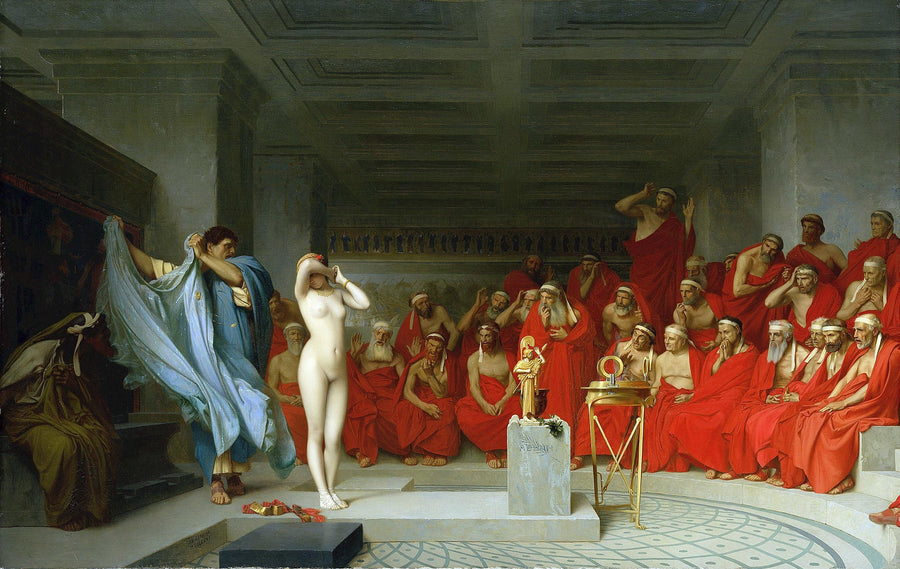
The original
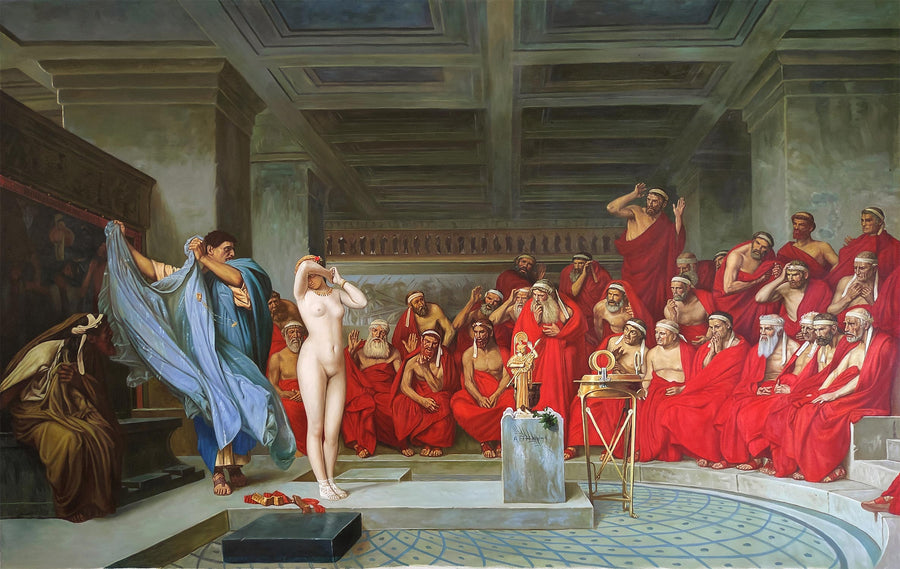
Our reproduction, painted by hand in oil
09Olympia, Édouard Manet (1863)

Zoom
Hand-painted oil reproductionSee sizes ›
The date on the canvas is 1863, but the public first saw Olympia at the Salon of 1865, where it caused a scandal. It is oil on canvas, 130.5 × 191 cm (51.4 × 75.2 in). Two of the sources the Orsay names are earlier entries in this list: Titian's Venus of Urbino and Goya's Maja. Manet kept the old pose and removed the old excuse. His sitter is a woman of his own Paris, and she meets our eyes as if we had walked in without knocking.
The maid has a history of her own. She was posed by a woman known only as Laure, and Manet's portrayals of her were a focus of Posing Modernity, Denise Murrell's exhibition at Columbia University's Wallach Art Gallery in 2018–2019, which was expanded at the Musée d'Orsay in 2019 as Le Modèle noir, de Géricault à Matisse.
In 1890, seven years after Manet's death, Claude Monet organized a public subscription to give the painting to the French state. It hung in the Musée du Luxembourg, entered the Louvre in 1907 and has been at the Orsay since 1986. Olympia is the nude that turned the tradition around.
One that stayed in private rooms
10The Origin of the World, Gustave Courbet (1866)
Courbet's small canvas, 46.3 × 55.4 cm (18.2 × 21.8 in), is an almost anatomical close-up of a woman's body with no myth or story to soften it. The Orsay names its first owner, who probably commissioned it, as the Turkish-Egyptian diplomat Khalil-Bey, whose short-lived Paris collection celebrated the female body until gambling debts ruined him. After him the trail is unclear; the museum's provenance lists Baron Ferenc Hatvany and then, from 1955, the psychoanalyst Jacques Lacan.
In 1995 the French state accepted it in lieu of inheritance tax and assigned it to the Musée d'Orsay, whose catalog page calls it "a famous painting that is seldom actually seen." Even here the line runs back to the start of this list: Courbet, the museum notes, claimed descent from Titian, Veronese and Correggio.
From goddess to sitter
Read in order, the ten pictures move the nude from goddess to bride to a woman of the painter's own city, and the argument shifts from how she looks to who is looking. Portraits ask the same question with clothes on: see our lists of famous portraits, famous self-portraits and famous paintings of women. Hand-painted versions of these Venuses and of later nudes are in our nude paintings collection.
Sources
- Uffizi Galleries, Sandro Botticelli, Birth of Venus
- Staatliche Kunstsammlungen Dresden, Giorgione and Titian, Schlummernde Venus (Sleeping Venus), collection record
- Uffizi Galleries, Titian, Venus of Urbino
- Mark Twain, A Tramp Abroad (1880), chapter 50, Project Gutenberg
- Galleria Borghese, Lavinia Fontana, Minerva in atto di abbigliarsi (inv. 007), collection record
- National Gallery, London, Diego Velázquez, The Toilet of Venus ('The Rokeby Venus') (NG2057)
- Century Ireland (RTÉ), "Famous painting mutilated by suffragette" (London, 10 March 1914)
- London Museum, Mary Richardson, who slashed the "Rokeby Venus", leaving for police court (1914), collection record
- Museo Nacional del Prado, Francisco de Goya, The Naked Maja (P000742)
- Musée du Louvre, Jean-Auguste-Dominique Ingres, Une odalisque, dite La grande odalisque, collection record
- The Metropolitan Museum of Art, Guerrilla Girls, Do Women Have To Be Naked To Get Into the Met. Museum? (1989)
- Musée d'Orsay, Alexandre Cabanel, Naissance de Vénus
- Hamburger Kunsthalle, Jean-Léon Gérôme, Phryne vor den Richtern (HK-1910)
- Musée d'Orsay, Édouard Manet, Le Déjeuner sur l'herbe
- Musée d'Orsay, Édouard Manet, Olympia
- Wallach Art Gallery, Columbia University, Posing Modernity: The Black Model from Manet to Matisse and Beyond
- Musée d'Orsay, Gustave Courbet, L'Origine du monde
- Tate Etc., David Rimanelli, "The nude stripped bare" (Issue 5, Autumn 2005), quoting Kenneth Clark