4.9/5
4.9/5


Eight of the ten most famous Goya paintings belong to one museum, the Museo del Prado in Madrid; the other two are in New York and London. The mood is what changes. Around 1777 Goya designed a tapestry scene of a young woman under a parasol, a little dog in her lap. In his seventies he painted Saturn eating his son on his own dining-room wall.
The list opens with the picture most people mean when they say Goya. The other nine follow in the order he painted them, ending with the Black Paintings he never meant to leave his house.
What is Goya's most famous painting?
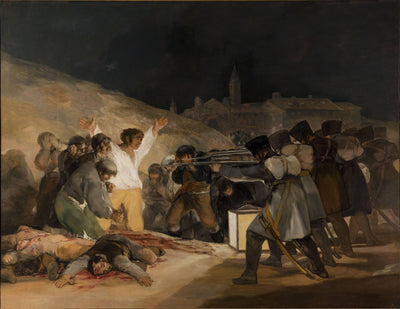
The Third of May 1808 is Goya's most famous painting. He finished it in 1814, and it hangs in Room 064 of the Prado. A French firing squad shoots Madrid civilians after the city rose against the occupying army in May 1808. Kenneth Clark called it "the first great picture which can be called revolutionary in every sense of the word, in style, in subject, and in intention."
Ten paintings, eight in one museum
Here is the list with dates and locations. If you'd rather live with one than fly to Madrid, there are hand-painted versions of these Goya paintings too.
| # | Painting | Year | Where it is |
|---|---|---|---|
| 1 | The Third of May 1808 | 1814 | Museo del Prado, Madrid |
| 2 | The Parasol | about 1777 | Museo del Prado, Madrid |
| 3 | The Duchess of Alba | 1797 | Hispanic Society, New York |
| 4 | The Nude Maja | about 1797–1800 | Museo del Prado, Madrid |
| 5 | Charles IV of Spain and His Family | 1800–1801 | Museo del Prado, Madrid |
| 6 | The Colossus (attributed) | after 1808 | Museo del Prado, Madrid |
| 7 | The Duke of Wellington | 1812–1814 | National Gallery, London |
| 8 | Saturn Devouring His Son | 1820–1823 | Museo del Prado, Madrid |
| 9 | The Dog | 1820–1823 | Museo del Prado, Madrid |
| 10 | Witches' Sabbath (The Great He-Goat) | 1820–1823 | Museo del Prado, Madrid |
1. The Third of May 1808 (1814)

The 1814 canvas of the executions was painted to order. In February 1814, with the French finally expelled, Goya asked Spain's provisional government for the chance to record the heroic actions of the uprising against Napoleon with his brush. The Regency commissioned it that February and March, together with its companion, The Second of May 1808, the street fight against the Mamelukes of the French Imperial Guard. It measures 268 by 347 cm (106 by 137 inches).
What to look for:
- The square lantern on the ground, which throws a dramatic light across the scene.
- The man in the white shirt, arms flung wide, a laborer by his plain shirt and sunburnt face.
- Stigmata-like marks on his right hand, one reason he is so often compared to a crucified Christ.
- The firing squad, seen nearly from behind, one block of shadow.
Manet paraphrased it in his Execution of Emperor Maximilian (several versions, 1867–1869), and Picasso's Massacre in Korea (1951) borrows the composition even more directly.
2. The Parasol (about 1777)
The Parasol (El Quitasol) surprises people who only know the dark Goya. It's a tapestry cartoon, an oil painting made to be woven into a tapestry for the dining room of the Prince and Princess of Asturias at the Royal Palace of El Pardo. It measures 104 by 152 cm and belongs to the Prado.
A woman in a French-style dress sits on the ground, possibly resting from a long walk. Look for the little dog cuddled in her lap and the young man holding the parasol to shade her face. Over five years Goya designed some 42 tapestry patterns, many used at El Escorial and El Pardo. See one before the Black Paintings and the late work hits harder.
3. The Duchess of Alba (1797)
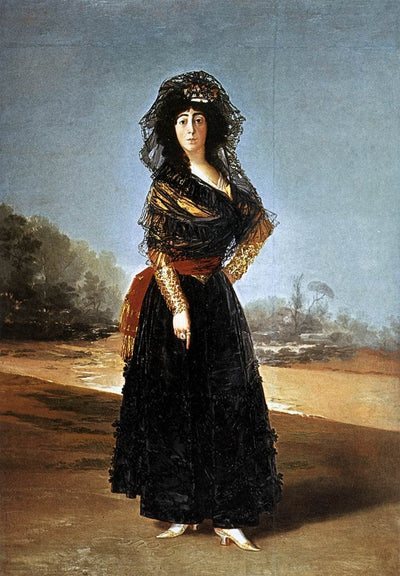
Goya painted her portrait in mourning in 1797: María Cayetana de Silva, 13th Duchess of Alba, at 35. Her husband José had died in 1796.
Follow her finger. The ground at her feet reads "solo Goya" ("only Goya"), and "solo" stayed hidden until a restoration revealed it. She also wears two rings, engraved "Alba" and "Goya."
Read into that what you like. When she died, the portrait was still in Goya's possession. His son Javier sold it, and Archer Milton Huntington bought it in 1906 and gave it to the Hispanic Society in New York in 1907. Goya's other well-known portrait of her, the White Duchess, came two years earlier.
4. The Nude Maja (about 1797–1800)
The reclining nude Godoy kept private (La maja desnuda) fills a canvas 97 by 190 cm, with no mythology attached. Velázquez's Rokeby Venus came with a goddess as cover. Goya's nude has a clothed pendant in contemporary dress, which makes plain that this is a real Spanish woman of his day.
Both pictures belonged to Manuel Godoy, the prime minister. Inquisition investigators found them in 1808, and Goya was summoned on a charge of moral depravity. The pair were sequestered in 1814–1836 and have been in the Prado since 1901.
Who posed? One theory names Godoy's young mistress, Pepita Tudó. Another names the Duchess of Alba, which many scholars reject.
5. Charles IV of Spain and His Family (1800–1801)

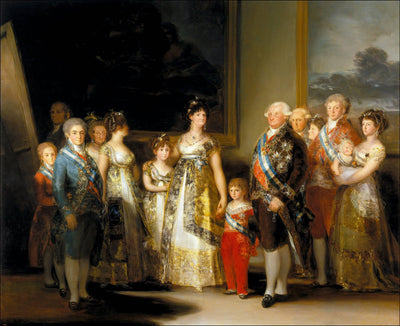
Goya's portrait of the royal family came soon after he reached the top court rank, Primer Pintor de Cámara, in 1799. On a canvas 280 by 336 cm, Queen María Luisa stands at the center, holding her youngest child's hand.
Look to the far left: Goya himself stands in the shadows at a canvas seen only from the back, as in Velázquez's Las Meninas. Then find the young woman with her face turned away, Maria Antonia of Naples, who was expected to marry the future Fernando VII; the hidden face may be why.
Flattering? Théophile Gautier called it a "picture of the corner grocer who has just won the lottery."
6. The Colossus (after 1808)
The Colossus is the famous Goya that might not be a Goya. A giant walks toward the left of the canvas while crowds and herds of cattle flee in all directions through the dark valley below. The one exception is a donkey that stands still.
In June 2008 Manuela Mena, the Prado's chief curator of 18th-century painting and Goya, gave it almost certainly to Asensio Juliá, a friend and collaborator of Goya. In 2021 the museum attributed it back to Goya. The experts still don't agree, and a painting on a similar subject appears in the 1812 inventory of Goya's possessions, which keeps the canvas in his immediate circle at the Prado.
7. The Duke of Wellington (1812–1814)
The Wellington portrait is small, 64.3 by 52.4 cm on a wood panel, and it's on show in Room 38 in London. Wellington sat for Goya shortly after entering Madrid in August 1812, and Goya reworked it as the duke collected new medals and orders.
The National Gallery bought it in 1961. On 21 August 1961, nineteen days after it went on display, it was stolen. Four years later Kempton Bunton contacted a newspaper and returned it through a left-luggage office at Birmingham New Street station, and the gallery recovered it in May 1965. Bunton was found not guilty of stealing the painting and guilty of stealing the frame, which had not been returned.
Meanwhile the 1962 Bond film Dr. No put the missing portrait in the villain's lair. The 2020 film The Duke, with Jim Broadbent and Helen Mirren, retells the theft and the trial.
The Black Paintings, murals from a house outside Madrid
The last three items come from a set of 14 murals Goya painted in oil directly on the plaster walls of the Quinta del Sordo, a two-storey house outside Madrid he moved into in 1819, at 72. All 14 are in the Prado now. Baron Émile d'Erlanger had them transferred to canvas in the 1870s and gave them to the Spanish state in 1881; they have been on view in Madrid since 1889.
The house was named after a previous owner who was deaf, though Goya was nearly deaf himself by then. He gave the murals no titles, or none he revealed, and they were not meant to leave his home. The transfer was brutal, and the works lost a large amount of paint.
Besides the three below, the series includes Atropos (The Fates), Two Old Men, Two Old Ones Eating Soup, Fight with Cudgels, Men Reading, Judith and Holofernes, A Pilgrimage to San Isidro, Man Mocked by Two Women, Pilgrimage to the Fountain of San Isidro, Asmodea and La Leocadia, a portrait of Leocadia Weiss, the companion who went with Goya to Bordeaux in 1824.
The name comes from the many dark pigments and blacks in them and from their somber subjects. Most of Goya's work isn't like this; the tapestry designs show serene everyday scenes. But an undiagnosed illness had left him deaf between late 1792 and early 1793, he had survived two near-fatal illnesses and feared a relapse, and after the Napoleonic Wars and Spain's political turmoil he had grown embittered about mankind.
8. Saturn Devouring His Son (1820–1823)
Saturn hangs in Room 067, where the Prado titles it simply Saturn. It was one of six murals in the dining room of the Quinta del Sordo, facing La Leocadia, in which Goya's companion leans on a rock or mound.
In the myth, Saturn eats each child at birth to stop a prophecy from coming true, and the old stories usually have him swallow them whole. Goya's god tears into the body instead. His eyes bulge and his mouth gapes, and the figure in his hands has already lost its head and part of its left arm. One reading sees in him the fear of losing one's power. There's more in the full story of that dining-room mural.
9. The Dog (1820–1823)

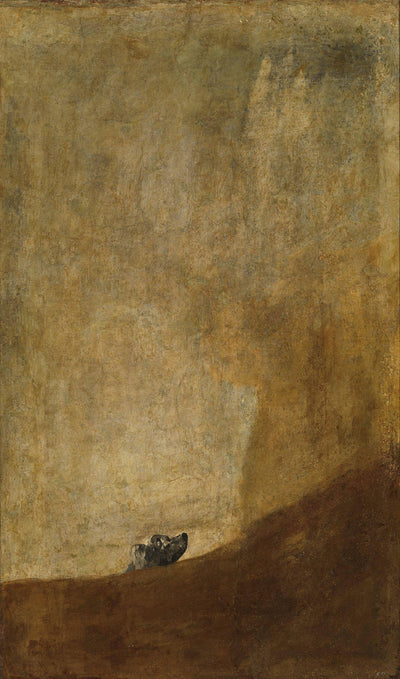
The Dog is almost empty: a dog's head peering over a dark slope, under a vast field of ochre, on a canvas 131.5 by 79.3 cm. In Madrid it's titled The Drowning Dog, it shares the room with Saturn, and it is beyond doubt the most enigmatic of the Black Paintings, often tied to the inevitability of death. In the house it decorated a wall beside the door on the upper floor.
Its admirers go big. The painter Antonio Saura judged it "the world's most beautiful picture." An 1874 photograph of the wall shows the dog looking toward a rocky outcropping and figures that appear to be birds.
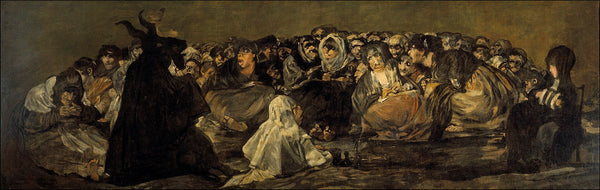
10. Witches' Sabbath, or The Great He-Goat (1820–1823)
The long mural of the witches' gathering measures 140.5 by 435.7 cm (55.3 by 171.5 inches). Brugada called it The Big Billy Goat. The goat sits in silhouette on the left, preaching to a crowd of men and women with animal-like features. On the far right, a young woman sits apart, perhaps waiting to be initiated.
She was once the center of the picture. When the mural came off the wall, more than 1.4 meters of the composition were cut away, which pushed her to the edge.
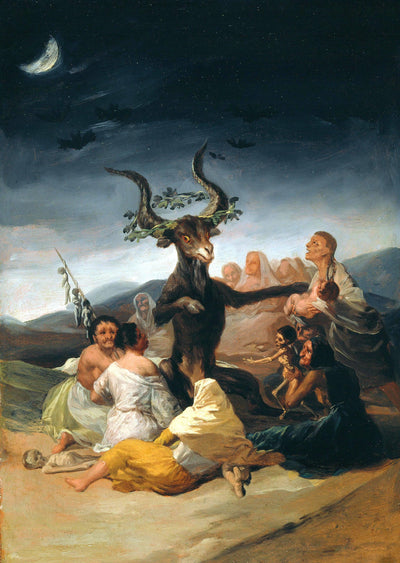
Goya had painted the subject before, far smaller. His Witches' Sabbath of 1798, just 43 by 30 cm, shows Satan as a goat among young and old witches under the moon. The Duke and Duchess of Osuna bought it that year, and it now belongs to the Museo Lázaro Galdiano in Madrid.
Old Master and first modern
Why is Goya so famous?
Because his career spans two eras. He's often called the last of the Old Masters and the first of the moderns. He reached the top of the Spanish court in 1799, the same year he published the 80 prints of Los Caprichos, and the Black Paintings were never commissioned at all.
His influence is easy to trace. Manet and Picasso both built pictures on The Third of May. Picasso and Dalí drew on Los Caprichos and the Black Paintings, and the German Expressionists and the Surrealists saw the origins of modern art in those murals.
The market agrees. On January 25, 2023, a pair of portraits of Doña María Vicenta Barruso Valdés and her mother sold for $16.4 million with fees at Christie's New York, a new auction record for Goya.
In Madrid, the Prado covers most of this list, and the Museo Lázaro Galdiano has the small witches' scene of 1798. New York has the duchess, London has the duke. Goya's ten sit well beside the other paintings everyone recognizes on sight.
A Goya for your own wall
If one of these ten stays with you, the full set of Goya copies at Art & See is painted by hand in oil. The Third of May and The Dog make a good pair to start with, one all noise and lantern light, the other nearly silent, and either one rewards the same slow look as the original in Madrid.