4.9/5


Baroque vs Renaissance art is easiest to understand when you put two paintings side by side. Renaissance paintings are made to be looked at slowly. They show calm groups, clear daylight and a story caught just before or just after its big moment. Baroque paintings are made to hit you all at once. One beam of light cuts through the dark, and bodies lean hard on a slant. The action stops at its most violent second, and it often pushes out toward you. All seven differences sit in one chart below, each with two paintings to set side by side and a note on which of the two Wikipedia covers in more languages.
Below, you will find seven pairs, each with a Baroque painting next to a Renaissance one. Most pairs share the same subject, so you can check every difference with your own eyes. For every trait of the earlier style, read what makes a painting Renaissance. To meet the painters on the other side, from Caravaggio in Rome to Velázquez in Madrid, see the Baroque artists city by city. And if you like the drama of the later style, our Baroque paintings collection has many more.
Baroque vs Renaissance art: the seven differences at a glance
| Aspect | Renaissance | Baroque | Pair to compare | Known in more languages |
|---|---|---|---|---|
| When | Italy, 1400s to about 1520, peaking around 1500 | Roughly the 1600s, with first signs in late 16th-century Italy | Background in the next section | — |
| 1. Moment | Before or after the climax | The climax itself | Giorgione’s Judith and Artemisia Gentileschi’s Judith | Renaissance (16 vs 13 languages) |
| 2. Light | Clear, even daylight | One strong beam against deep shadow | Leonardo’s Last Supper and Caravaggio’s Calling of Saint Matthew | Renaissance (83 vs 32 languages) |
| 3. Composition | Symmetry, triangles, a central axis | Diagonals and straining bodies | Raphael’s Mond Crucifixion and Rubens’s Elevation of the Cross | Baroque (23 vs 17 languages) |
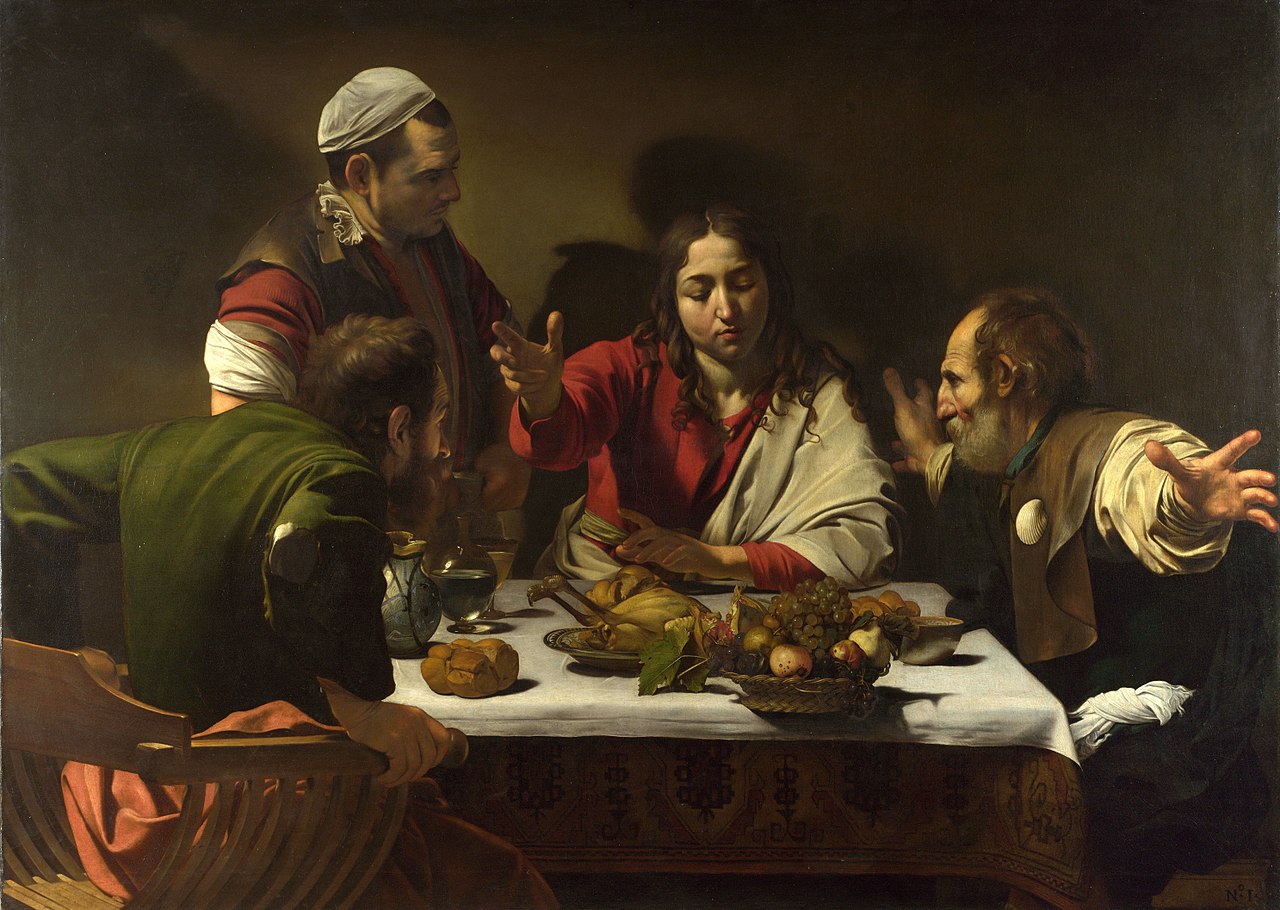
| 4. Space | Figures stay behind the picture surface | Elbows, arms and objects push toward the viewer | Titian’s and Caravaggio’s Supper at Emmaus | Baroque (28 vs 2 languages) |
| 5. Brushwork | Crisp contours, smooth finish | Loose strokes left visible | Botticelli’s Birth of Venus and Velázquez’s Rokeby Venus | Renaissance (56 vs 30 languages) |
| 6. Ceilings | Scenes set in painted frames | The vault opens into an illusion of sky | The Sistine Chapel and Sant’Ignazio in Rome | — |
| 7. Portraits | A still, composed sitter | People caught in the middle of an action | The Mona Lisa and The Night Watch | Renaissance (133 vs 56 languages) |
Each number counts the Wikipedia languages that cover that painting, as of October 2026; the ceilings have no page of their own.
The Renaissance side wins 4 of the six pairs and the Baroque side wins 2. The widest gap is the Mona Lisa, with a page in 133 languages against 56 for The Night Watch.
Why the two styles look so different
Renaissance art comes from Europe in the 1300s, 1400s and 1500s. Renaissance painters studied the real world up close and revived the ideas of the Greeks and Romans, and they treated every person as one of a kind. In the 1400s their pictures grew more and more true to life. The style reached its peak around 1500 with Leonardo, Michelangelo and Raphael. Then, in about 1520, it gave way to a new style called Mannerism.
The Baroque covers roughly the 1600s, but its first signs showed up in Italy in the late 1500s. At that time the Catholic Church was answering the Protestant Reformation, when other churches broke away from it. Church leaders met at the Council of Trent from 1545 to 1563, and they made a plan. Religious art should speak openly to people's feelings and senses. At their last meeting, in December 1563, they approved a rule about holy pictures. It explains why paintings mattered so much:
“…by means of the histories of the mysteries of our Redemption, portrayed by paintings or other representations, the people is instructed…”
In other words, pictures taught people the stories of their faith. Comparing the two styles is an old habit, too. In 1888 a Swiss art historian named Heinrich Wölfflin wrote a book called Renaissance und Barock. Before him, "Baroque" had been an insult, and he turned it into the name of a style. The word may come from barroco, the Portuguese name for a pearl with an odd shape. That is why jewelers still talk about "baroque pearls" today.
01The moment: after the deed, or during it

Zoom
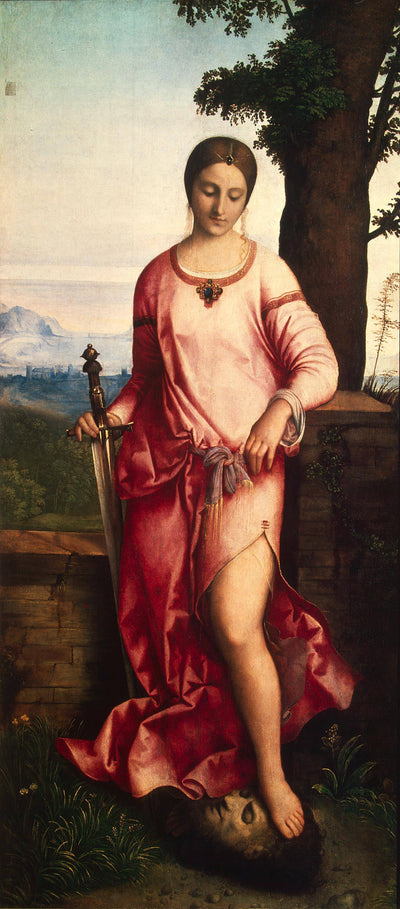
Judith is a hero from the Bible. She saved her city by cutting off the head of Holofernes, the general of the army that surrounded it. In Giorgione's Judith, painted in 1504, the deed is already over. She stands in a cool morning landscape with her sword pointing down. One bare foot rests on the head, but the whole scene stays quiet and thoughtful.
Artemisia Gentileschi painted the same hero around 1620, but she chose the killing itself. In her Judith Beheading Holofernes, the maid pins the drunk general to his bed. Judith grabs his hair and drives the sword into his neck. In fact, his blood sprays so far that it stains her chest. Artemisia is one of the painters on our list of great women artists.
You can see the same split in statues. Michelangelo's marble David in Florence was made between 1501 and 1504, and he stands at rest with his sling over his shoulder. Bernini's David in Rome was made in 1623 and 1624. He twists at the very second before he throws the rock. Its first base was low, and that put the viewer right where Goliath would stand.
02Light: daylight everywhere, or one beam in the dark
Leonardo painted The Last Supper between 1495 and 1498 on a wall of a dining hall in Milan. He didn't use true fresco, which means painting fast into wet plaster. Instead he painted on dry plaster, so he could work slowly and keep making changes. The apostles are reacting to Jesus's words that one of them will betray him. Leonardo wanted to show what he called the "motions of the soul." So each man reacts with his own pose, hands and face. Three windows behind Jesus open onto a sunny landscape, and no face at the table is lost in shadow.

Zoom
Caravaggio's Calling of Saint Matthew works the other way. He painted it in 1599 and 1600 for a side chapel of a church in Rome. The room is dark, and a single beam of light comes in high on the right. It runs across the wall above Jesus's hand, and then it lands on the men counting coins. So the light, not the room, tells you where to look.
Setting bright light against deep dark like this is often called tenebrism. Our guide to Caravaggio's style breaks his method down. When his Saint Matthew paintings were first shown to the public, they caused a sensation. Soon after, in 1601, a collector asked him for the Supper at Emmaus in difference 4.
03Composition: symmetry, or the diagonal

Zoom
Hand-painted oil reproductionSee sizes ›
Raphael painted the Mond Crucifixion around 1502 and 1503 for a burial chapel in a church. Everything in it hangs on one straight up-and-down line. The cross stands in the middle, and an angel on each side catches Jesus's blood in a gold cup. Mary and Saint John stand on the left and right. Two more saints are at the foot of the cross. Raphael even scratched the outline of the cross with a ruler and compass.

Zoom
Hand-painted oil reproductionSee sizes ›
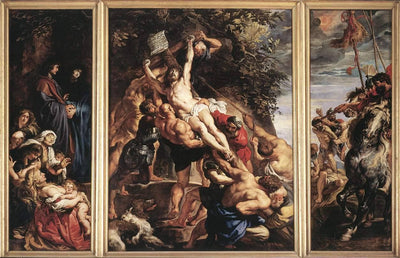
Rubens came home to Antwerp from Italy in October 1608. His Elevation of the Cross, finished in 1610, shows what he brought back with him. It is a triptych, which means a painting made of three panels side by side. It is now in Antwerp's cathedral. In it, lessons from the Italian painters Tintoretto and Caravaggio mix with the true-to-life style of Flemish art.
Here nothing stands straight yet. The cross cuts across the middle panel on a steep slant. A team of men strains to lift Jesus into place. The scene keeps going on the two side panels, so the three parts read as one big moment.
04Space: behind the frame, or in your lap
The Bible story of the meal at Emmaus makes a clean test. Two followers of Jesus sit down to eat with him after he has risen from the dead. They don't know him at first, but they know him when he blesses the bread.

Zoom
Hand-painted oil reproductionSee sizes ›
Titian's Supper at Emmaus was painted around 1535, and he signed it TICIAN on one leg of the table. The table runs straight across the bottom of the picture, and the white cloth hangs straight down. All the people stay on the far side of it, and a landscape opens up behind them. Nothing in the picture reaches out toward you.
Zoom
Caravaggio painted his version in 1601 for a collector in Rome, and it breaks through that wall. The man on the left, seen from behind, is about to jump out of his chair. His elbow sticks out toward us. The man on the right throws his arms wide, and they seem to reach right out of the picture. A basket of fruit tips over the edge of the table, as if it could land at your feet.
05Brushwork: drawn outlines, or paint you can see

Zoom
Botticelli's Birth of Venus, from about 1485, is a picture of clean, sharp edges. The goddess Venus is arriving on the island of Cyprus, and the winds blow her to the shore. The edge of her shell and the folds of the flowery cloak are drawn as clear lines. So is every curl of her hair, and Botticelli even put gold on it so it catches the light.

Zoom
Hand-painted oil reproductionSee sizes ›
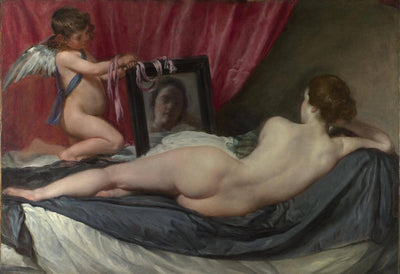
Velázquez's Rokeby Venus was painted between 1647 and 1651. It is the only nude woman by him that survives. Her skin is smooth and pearly, but the curtain and the sheets are painted with quick, lively strokes. Cupid's face and far leg look almost unfinished, and that keeps your eye on Venus. Even her face in the mirror is a blur.
06Ceilings: framed scenes, or open sky
Michelangelo signed the contract for the Sistine Chapel ceiling in May 1508. He finished it by the end of October 1512. He set nine stories from the Bible's book of Genesis inside a painted frame of fake building parts. Nude figures sit beside them. At the base, twelve prophets and sibyls, the wise women of old stories, sit on giant thrones. So each story, The Creation of Adam too, reads as a separate picture in its own frame. You can see its best-known scenes in our guide to Michelangelo's paintings.
Baroque ceilings take the frame away. They seem to melt into painted views of a sky that never ends. Andrea Pozzo painted the ceiling of Sant'Ignazio, a church of the Jesuits in Rome. It shows Saint Ignatius of Loyola in glory among angels, and it praises the Jesuits' work around the world. Pozzo built the whole picture to give "the impression of an infinite space." He also gave the church a dome that isn't really there. It is only painted, but its lines are set up so the trick catches visitors as they walk in.
07Portraits: a sitter who poses, or a company on the move
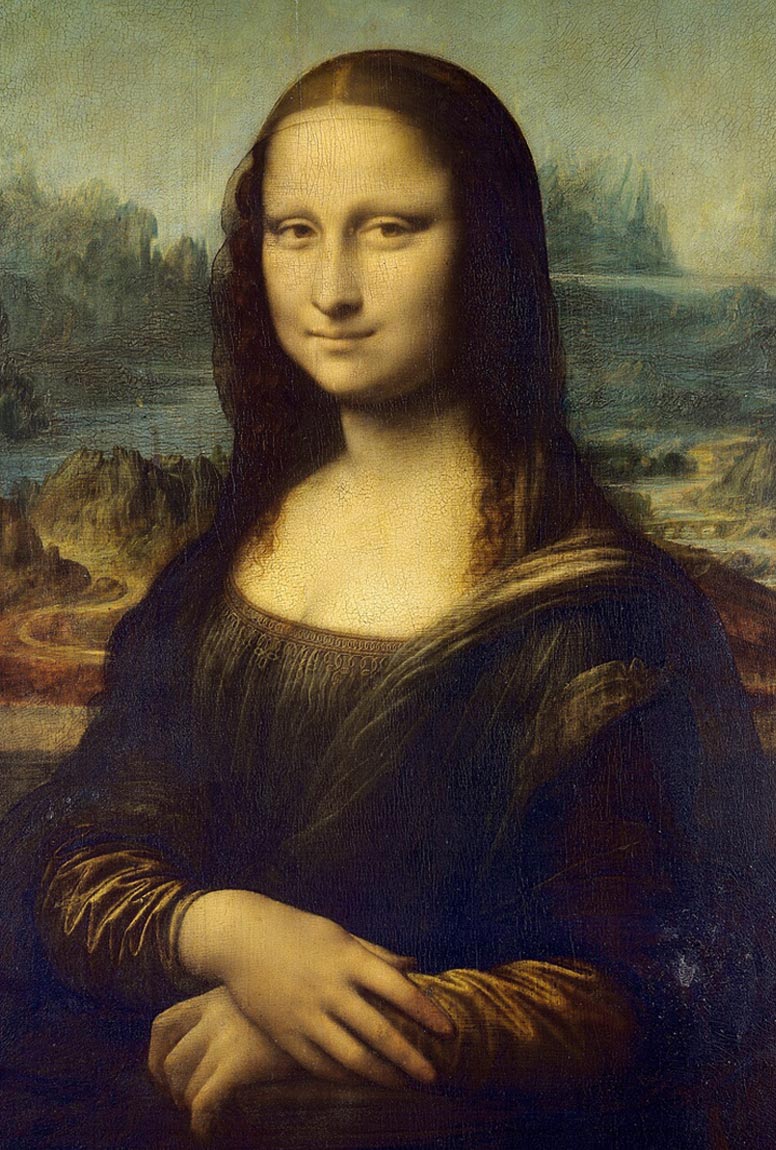
The Mona Lisa is a Renaissance painting, and Leonardo worked on it from 1503 to 1519. Few pictures anywhere are better known, as our list of the world's most famous paintings shows. Back then most portraits showed people from the side. But Leonardo turned his sitter, Lisa Gherardini, partway toward us, an idea that came from portraits made in Flanders. She sits in a chair with a rounded back, and her hands rest on its arm. Behind her, a low wall opens onto mountains, a winding road and a bridge. Nothing happens in the picture, and that stillness is the point.
The original and our hand-painted copy
The original
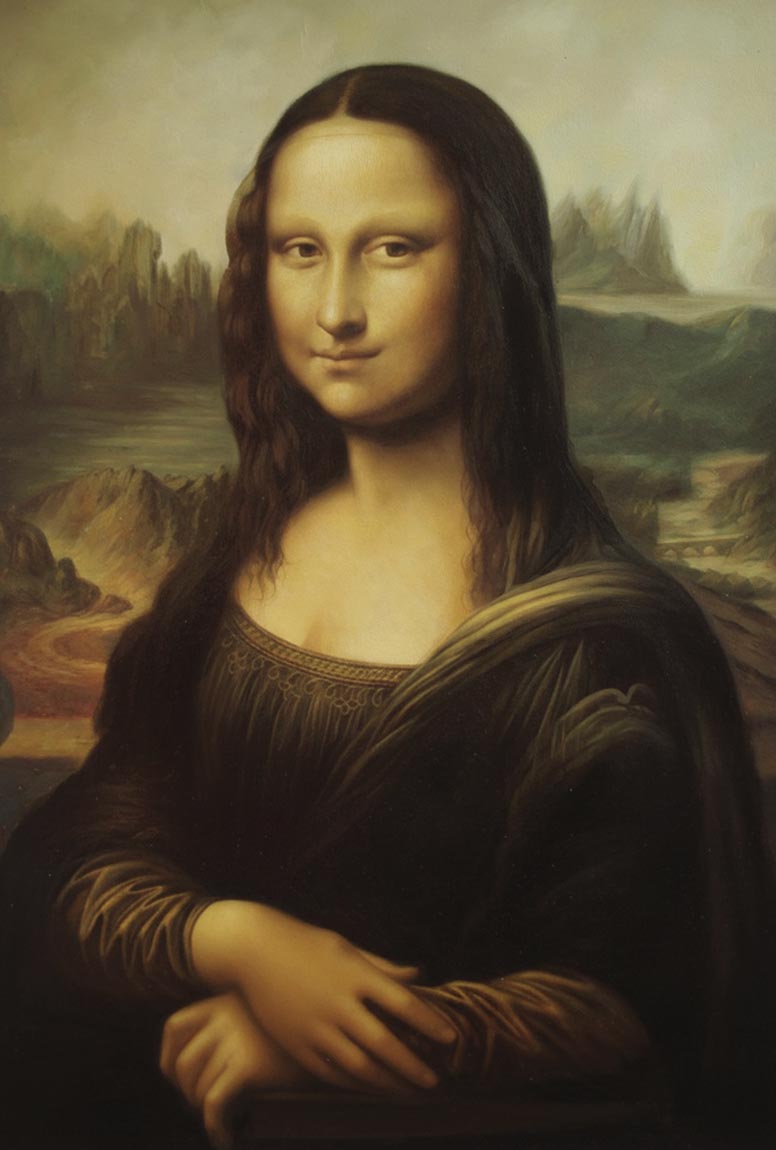
Our reproduction, painted by hand in oil
Rembrandt is a Baroque painter, and The Night Watch from 1642 shows why. It came almost 140 years after Leonardo started the Mona Lisa. According to the Rijksmuseum, Rembrandt was the first painter to show the people in a group portrait actually doing something. Captain Frans Banninck Cocq, dressed in black, tells his lieutenant to start the march. On the left a man loads a gun, and in the middle one is fired. On the right someone cleans one. The light picks out the captain's hand and a girl who was the company's mascot.
Rembrandt worked in the Dutch Republic. There a new middle class was buying pictures, and it liked them true to life. The canvas used to be bigger, too. In 1715 it moved to Amsterdam's Town Hall, and four pieces were cut off so it would fit between two doors. The biggest one came off the left side, and none has ever been found. You can follow him past this painting in our ranking of Rembrandt's best-known works.
The original and our hand-painted copy
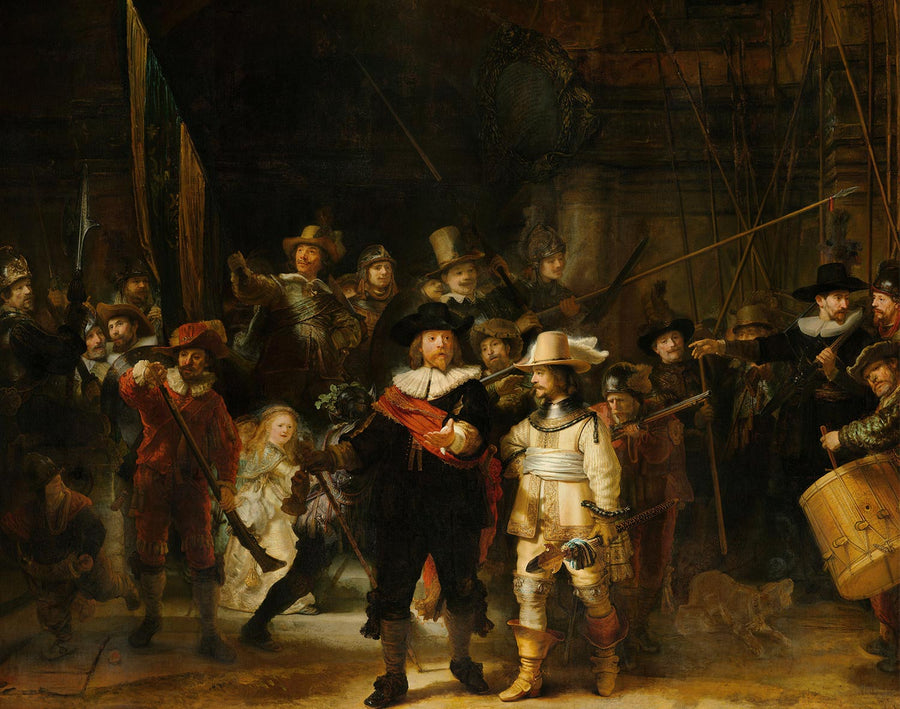
The original
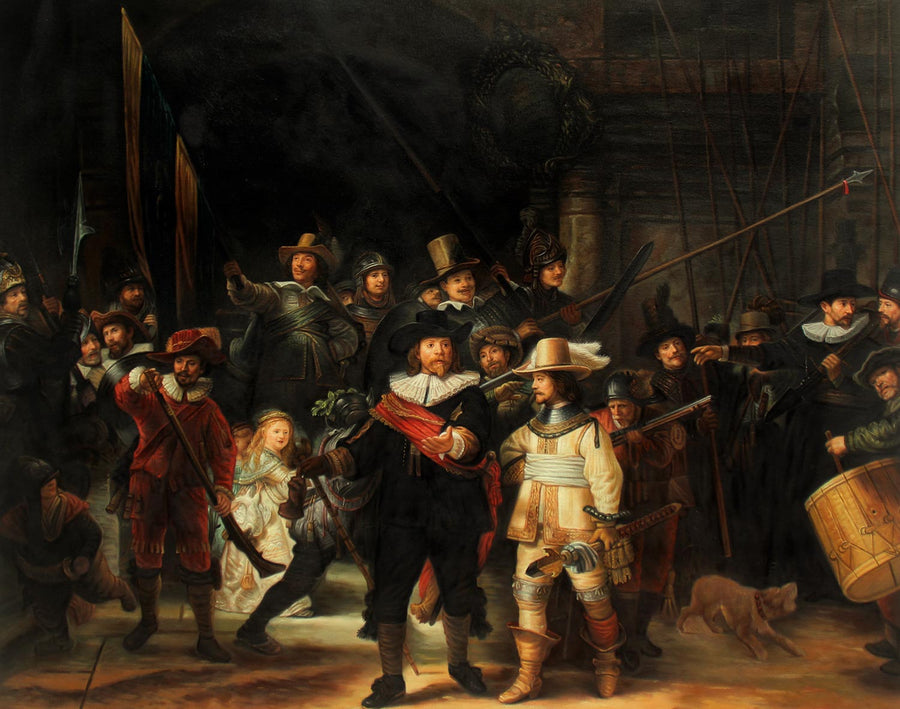
Our reproduction, painted by hand in oil
Between the two: Mannerism
Mannerism is the style that filled the gap. It lasted in Italy from the 1520s, when the Renaissance had passed its peak, until about 1590. Its figures are graceful, but they have strangely long arms and legs, small heads and stiff, made-up poses. The deep space of Renaissance pictures flattens out into a decorative surface. The best-known example is Parmigianino's Madonna with the Long Neck, painted around 1534 to 1540.
So a painting from the 1500s may look neither calm nor dramatic, but strained and elegant. If it does, it is probably Mannerist. Around 1600 the paintings of Annibale Carracci and Caravaggio brought the style to an end. Our overview of Renaissance art follows the whole story. And our list of Italian Renaissance masterpieces picks out the best ones.
Describing the Baroque, and where Classical art fits
How would you describe Baroque art to a friend in one line? It tries to move you through your senses, and it often does it in a dramatic way. Its usual traits are grandeur, rich beauty, drama, energy, movement, tension and strong feeling. It also likes to blur the lines between painting, building and sculpture, just like Pozzo's painted dome. Our guide to the signs of Baroque painting lists six of them to look for.
Classical art is something else again. It is the art of ancient Greece and Rome, and the Renaissance brought it back. Botticelli, for example, took his Venus's modest pose from old statues. He based the two Winds hugging each other on an old Greek carved gem owned by Lorenzo the Magnificent. So Classical art is the source, and Renaissance art brought it back to life. Then Baroque art came as the dramatic reply. Our timeline of art movements puts all three in order.
Testing the difference yourself
For Baroque vs Renaissance art, the fastest test is to find the light before the faces. Even daylight all over usually means Renaissance. One hard beam out of the dark usually means Baroque. Try it first on our Early Renaissance paintings, and then on the Caravaggio and Rubens paintings above.
Sources
- Britannica, Baroque art and architecture
- Britannica, Renaissance art
- Britannica, Mannerism
- Britannica, Heinrich Wölfflin
- Britannica, Peter Paul Rubens
- Council of Trent, Twenty-Fifth Session (1563), trans. J. Waterworth (1848), Hanover Historical Texts Project
- State Hermitage Museum, Giorgione, Judith, collection page (archived copy)
- Uffizi Galleries, Artemisia Gentileschi, Judith Beheading Holofernes
- Galleria dell'Accademia di Firenze, Michelangelo, David
- Galleria Borghese, Gian Lorenzo Bernini, David (archived museum page)
- Museo del Cenacolo Vinciano, The Last Supper
- National Gallery, London, Raphael, The Mond Crucifixion (NG3943)
- KIK-IRPA BALaT, Peter Paul Rubens, The Elevation of the Cross, Cathedral of Our Lady, Antwerp
- POP, French Ministry of Culture (Joconde), Titian, Le Souper à Emmaüs, Louvre INV 746
- National Gallery, London, Caravaggio, The Supper at Emmaus (NG172)
- Uffizi Galleries, Sandro Botticelli, Birth of Venus
- National Gallery, London, Velázquez, The Toilet of Venus ('The Rokeby Venus') (NG2057)
- Vatican Museums, Sistine Chapel, the ceiling
- Church of Sant'Ignazio, Rome, Works of art (Andrea Pozzo)
- Louvre, Portrait of Lisa Gherardini (Mona Lisa), collection record
- Rijksmuseum, The Night Watch (SK-C-5)
- Rijksmuseum, 10 things about Rembrandt’s Night Watch