4.9/5


To see the Musée d'Orsay's Impressionist paintings, head for its upper level (Niveau supérieur): the museum's own collection pages put Manet and Monet in Room 29, Caillebotte and Degas in Room 31, Berthe Morisot in Room 32 and Van Gogh in Room 36. The one exception among the nine below is Manet's Olympia, on the ground floor. If you would rather begin at home, browse our hand-painted Impressionist paintings. To save steps, the table puts the nine along the path a visitor would walk, with the room each painting's museum page named and the day it named it.
Two of the museum's best-known canvases, Renoir's Bal du moulin de la Galette and Cézanne's The Card Players, are off its walls this season; both have their own section after the nine.
Rooms change. Each work's page in the Orsay's online collection names its level and room, or says that it is off view, so check it in the week you go. The table gives the room each page showed and the date it showed it.
A walking plan for the nine, from the ground floor up
| Step | Where in the museum | Painting | Painter | What to spot |
|---|---|---|---|---|
| 1 | Ground floor, Room 14 (Oct. 1, 2026) |  Olympia |
Édouard Manet | The black cat at the end of the bed, its back arched |
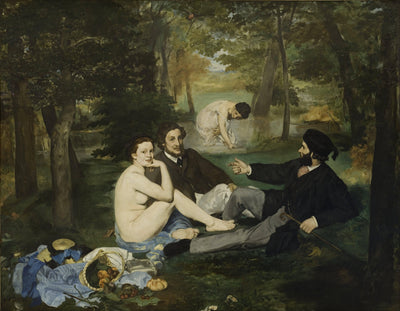
| 2 | Upper level, Room 29 (Aug. 30, 2026) |  The Luncheon on the Grass |
Édouard Manet | A second woman wading in the stream behind the picnic |
| 3 | Upper level, Room 29 (Sept. 21, 2025) |  Poppies |
Claude Monet | The oversized red patches in the front, a step toward abstraction |
| 4 | Upper level, Room 31 (Aug. 4, 2026) |  The Floor Scrapers |
Gustave Caillebotte | Bare backs that owe more to ancient heroes than to Paris workmen |
| 5 | Upper level, Room 31 (Aug. 25, 2026) |  The Ballet Class |
Edgar Degas | A dancer on the piano scratching her back, and a small dog by the feet of the girl in front |
| 6 | Upper level, Room 31 (Oct. 4, 2026) |  In a Café (L'Absinthe) |
Edgar Degas | The mirror behind the pair, repeating their shadows |
| 7 | Upper level, Room 32 (Sept. 12, 2026) | The Cradle | Berthe Morisot | The veil Edma draws between us and her sleeping baby |
| 8 | Upper level, Room 36 (Oct. 10, 2026) |  Starry Night Over the Rhône |
Vincent van Gogh | Orange gas lights shining in the blue river |
| 9 | Upper level, Room 36 (Oct. 9, 2026) | The Church at Auvers | Vincent van Gogh | Stained-glass windows that look like patches of ultramarine |
Each room is the one the painting's page on the Orsay website gave on the day shown. Poppies was last listed in September 2025, so check it before you go.
Two favorites are missing from the walk this season. Renoir's Bal du moulin de la Galette is in London until January 31, 2027, and Cézanne's The Card Players was marked off view on October 4, 2026.
Why France's Impressionists live in a railway station
In Paris, the Orsay is the museum for Impressionism, and the reason is a move. Britannica tells it this way: when the government settled in 1977 on turning the largely empty Gare d'Orsay into a museum, the Jeu de Paume, home of France's Impressionist collection since 1947, had run out of room. The station and its hotel, designed by Victor Laloux, had been finished in 1900. The museum opened in 1986, and many of its paintings came from the Jeu de Paume, the Louvre and the National Museum of Modern Art. Its range is mainly French art from 1848 to 1914.
Most of the works below reached the state through gifts and bequests rather than purchases, and each entry says how. For the painters behind them, start with the most famous Impressionist painters and one work to know each by.
Ground floor: the scandal of 1865
01Olympia, Édouard Manet (1863)

Zoom
Olympia is signed and dated "Ed. Manet, 1863" at lower left and measures 130.5 × 191 cm (51.4 × 75.2 in). It was not shown until the Salon of 1865, where, in the Orsay's words, it "provoked a violent reaction": critics mocked the "yellow-bellied odalisque", and a small group led by Émile Zola defended it.
The museum lists what Manet borrowed: the pose of Titian's Venus of Urbino (1538), Goya's naked Maja, and the odalisque with a Black servant that Ingres and others had painted. What he changed was the woman. The goddess became a Paris prostitute who meets the viewer with a calculating look, and the museum calls the result "the cold and prosaic reality of a truly contemporary subject".
It entered the national collections in 1890, given to the state by a public subscription launched at Claude Monet's initiative. It hung at the Musée du Luxembourg until 1907, then at the Louvre, then from 1947 at the Jeu de Paume, and it came to the Orsay in 1986. On October 1, 2026, its page placed it in Room 14, downstairs from the Impressionist rooms.
Upper level, Room 29: Manet and Monet in the open air
02The Luncheon on the Grass, Édouard Manet (1863)

Zoom
Rejected by the jury of the 1863 Salon, The Luncheon on the Grass went on show that same year as Le Bain at the Salon des Refusés, which Napoleon III had just created, and it became the main attraction, drawing both laughter and scandal. It is signed and dated 1863 and measures 207 × 265 cm (81.5 × 104.3 in).
Manet built it from old masters. The Orsay traces the subject to the Concert champêtre in the Louvre, a Titian then attributed to Giorgione, and the seated group to Marcantonio Raimondi's engraving after Raphael's Judgment of Paris. What shocked was everything else: a naked woman among men in modern clothes, with no myth to excuse her, painted in hard contrasts that critics mocked as a "mania for seeing in blocks". Manet's own joke name for it was "la partie carrée", the foursome. If the two painters' names still trip you up, read how to tell Manet and Monet apart.
The singer Jean-Baptiste Faure bought it from Manet in 1878. Étienne Moreau-Nélaton, who owned it from 1900, gave it to the state in 1906 with a condition that the Orsay's record still notes: no loans and no deposits. The museum's page listed it in Room 29 on August 30, 2026.
03Poppies, Claude Monet (1873)

Zoom
Hand-painted oil reproductionSee sizes ›
Monet settled at Argenteuil after returning from England in 1871 and stayed until 1878, and the fields around the town gave him Poppies, signed and dated "Claude Monet. 73" and only 50 × 65.3 cm (19.7 × 25.7 in). He showed it at the first Impressionist exhibition in 1874, held in the photographer Nadar's former studio.
The Orsay reads the picture as two zones of color split by a diagonal, red on one side and bluish green on the other, with a mother and child below and another pair higher up. The woman with the sunshade and the child in front are probably Camille, Monet's wife, and their son Jean. The red patches in the foreground are disproportionately large, which the museum calls a step toward abstraction.
It was part of the same 1906 Moreau-Nélaton gift as the Luncheon. The museum listed it in Room 29 in September 2025; check its page for the current room.
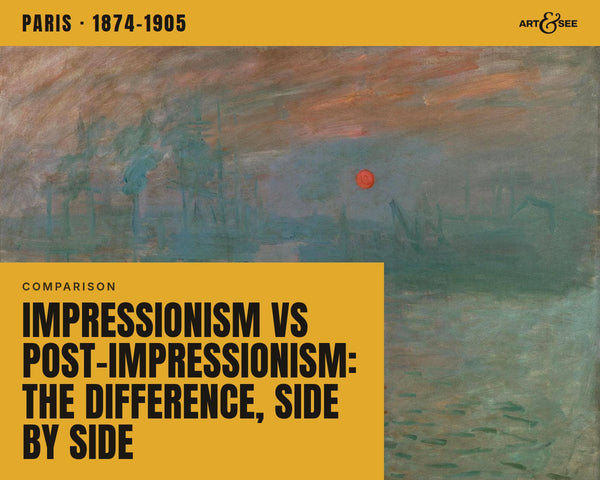
If Monet is the reason you came, know that his most famous works are spread over three Paris museums. Impression, Sunrise (1872), whose title inspired the critic Louis Leroy's mocking review "L'exposition des impressionnistes" in April 1874, belongs to the Musée Marmottan Monet. The Water Lilies, eight compositions he offered the state the day after the Armistice of November 11, 1918, were installed in two elliptical rooms at the Musée de l'Orangerie in 1927. At the Orsay, look also for The Saint-Lazare Station (1877), listed in Room 31 in November 2025, which Caillebotte bought from Monet on March 10, 1878, for 685 francs. Our ranking of Monet's most famous paintings says where to find the rest.
Room 31: Paris at work and at leisure
04The Floor Scrapers, Gustave Caillebotte (1875)
The Orsay calls The Floor Scrapers one of the first pictures of the urban working class: peasants and country laborers had often been painted, by Millet and Courbet among others, but city workers seldom. Caillebotte signed and dated it 1875, and it measures 102 × 147 cm (40.2 × 57.9 in).
The Salon jury of 1875 rejected it, and some critics called the subject vulgar. Caillebotte, trained in the academic way under Léon Bonnat, then joined the Impressionists and showed it at their second exhibition in 1876, where Degas showed his first Ironers. Zola was struck by it, even as he condemned a painting "so accurate that it makes it bourgeois".
His method was old-school: he drew each part separately and transferred it to the canvas with a grid, and the bare torsos owe more to heroes of antiquity than to Paris workmen. After his death in 1894 his heirs gave it to the state through Renoir, his executor, and it reached the Musée du Luxembourg in 1896. Its page placed it in Room 31 on August 4, 2026.
05The Ballet Class, Edgar Degas (1873 to 1876)

Zoom
Hand-painted oil reproductionSee sizes ›
The Ballet Class took Degas years. The Fitzwilliam Museum in Cambridge, which owns his portrait of the dancer Jules Perrot, a study for it, says he began the canvas in 1873 and completed it between 1875 and 1876; in 1874, with this version set aside, he finished a very similar picture that is now at the Metropolitan Museum of Art in New York. The Orsay dates its canvas between 1873 and 1876. It measures 85.5 × 75 cm (33.7 × 29.5 in).
Perrot, white-haired, stands in the middle of the room with his stick, and the dancers around him wait, stretch and fidget; a small dog sits by the feet of the girl in front. Its page listed it in Room 31 on August 25, 2026. For why Degas kept painting dancers, see our story of Degas and his ballerinas.
06In a Café (L'Absinthe), Edgar Degas (1875 to 1876)

Zoom
Hand-painted oil reproductionSee sizes ›
The Orsay catalogs it as Dans un café, but most visitors know it as L'Absinthe. Degas set it in the Nouvelle Athènes on the place Pigalle, where the modern painters met, yet he painted it in the studio, not in the café. It dates from 1875 to 1876 and measures 92 × 68.5 cm (36.2 × 27.0 in).
He cast friends: Ellen André, an actress who also posed for artists, and the painter and engraver Marcellin Desboutin. The picture so damaged their reputations that Degas had to state publicly that neither of them was an alcoholic. The museum links it to Zola's novel L'Assommoir, written a few years later; Zola told Degas that in more than one place in his pages he had quite simply described some of his paintings.
Notice the framing. The empty tables crowd the couple to the right, and the edge of the canvas cuts through the man's pipe and hand, a device the Orsay traces to Japanese prints. Behind them, a mirror repeats their shadows. The museum's English page listed it in Room 31 on October 4, 2026; its French page had marked it as off view in April 2026.
Room 32: the first woman in the group
07The Cradle, Berthe Morisot (1872)
The Orsay calls The Cradle Berthe Morisot's most famous painting, beyond question. She painted it in Paris in 1872: her sister Edma watches over her sleeping daughter, Blanche. It measures 56 × 46.5 cm (22.0 × 18.3 in) and is the first image of motherhood in Morisot's work, a subject that became one of her favorites.
The museum points to a single diagonal that ties mother to child, from Edma's gaze down her folded arm to the baby's folded arm and closed eyes, and to the veil Edma draws between us and the cradle. Morisot showed it at the first Impressionist exhibition in 1874, as the first woman to exhibit with the group. It was barely noticed, though some leading critics praised its grace and elegance; she tried to sell it without success, never exhibited it again, and it stayed in Edma's family until the Louvre bought it in 1930.
Its page placed it in Room 32 on September 12, 2026. How she and Manet shaped each other's work is the subject of Manet and Morisot, friends, rivals and family.
Room 36: Van Gogh in Arles and Auvers
08Starry Night Over the Rhône, Vincent van Gogh (1888)

Zoom
Hand-painted oil reproductionSee sizes ›
Van Gogh reached Arles on February 8, 1888, and, the Orsay notes, spent months wanting to paint night effects. He managed it in September: first the café terrace now at the Kröller-Müller Museum in Otterlo, then Starry Night Over the Rhône, 73 × 92 cm (28.7 × 36.2 in). Around September 29 he sent Theo a sketch of it and called it "the starry sky at last, actually painted at night, under a gas-lamp", with a green-blue sky, royal blue water and mauve land.
The blues are Prussian blue, ultramarine and cobalt, according to the museum, and the gas lights of the town burn orange in the water. A pair of lovers at the bottom adds to the calm, and the museum finds the picture more serene than the one he painted at Saint-Rémy the next year. The Orsay's page listed it in Room 36 on October 10, 2026.
“It often seems to me that the night is even more richly coloured than the day, coloured in the most intense violets, blues and greens.”
Its route to Paris was slow. After Theo and then Jo van Gogh-Bonger, it passed through several collections until Robert and Marguerite Kahn-Sriber gave it to the state in 1975 while keeping the use of it, and it came to the Orsay when that right ended in 1995.
09The Church at Auvers, Vincent van Gogh (1890)
In Auvers-sur-Oise in 1890, Van Gogh painted the village church from behind its apse. On June 5 of that year he described it to his sister Willemien: the building "appears purplish against a sky of a deep and simple blue of pure cobalt", the stained-glass windows look like patches of ultramarine, and the roof is violet and partly orange. It was, he added, almost the same thing as his studies of the old tower and cemetery at Nuenen, painted years earlier in the Netherlands.
The canvas measures 93 × 74.5 cm (36.6 × 29.3 in). It belonged to Dr. Paul Gachet of Auvers, and the state bought it in 1952 with help from his son, also named Paul, and an anonymous Canadian donation. Its page listed it in Room 36, the same room as the Rhône night, on October 9, 2026.
Away this season: Renoir's dance and Cézanne's card players

Zoom
Hand-painted oil reproductionSee sizes ›
Bal du moulin de la Galette, painted in 1876 and measuring 131.5 × 176.5 cm (51.8 × 69.5 in), is the Orsay's best-known Renoir, and this season it is in London. The exhibition Renoir and Love ran at the Orsay from March 17 to July 19, 2026, then moved to the National Gallery, which shows it from October 3, 2026, to January 31, 2027, and says the canvas is on view in the UK for the first time. The Orsay's page marked the painting as not currently exhibited on August 19 and again on September 30, 2026.
Is Renoir an Impressionist? This picture is the plainest answer. He showed it at the group's exhibition of 1877, and the Orsay calls it "doubtless Renoir's most important work of the mid 1870's" and one of the masterpieces of early Impressionism. Friends of the painter appear in it, but the museum says his real aim was the joyful mood of a popular dance garden on the Butte Montmartre: a moving crowd in daylight and lamplight, laid down in vibrant, brightly colored strokes whose blur put off critics at the time.
It reached the state through Caillebotte's bequest. In November 1896 Léonce Bénédite collected it from Martial Caillebotte for the Musée du Luxembourg, where it stayed until January 30, 1929. More of the painter is in our list of Renoir's best-known paintings.

Zoom
Cézanne's The Card Players, dated 1893 to 1896 and measuring 47 × 56.5 cm (18.5 × 22.2 in), was marked "Artwork not currently exhibited in the museum" on its page on October 4, 2026. Its exhibition history lists a 2026 loan to the Fondation Beyeler in Basel for a Cézanne exhibition.
The museum's text tells you what to look for. Cézanne knew The Cardplayers attributed to the Le Nain brothers in the museum of his hometown, Aix-en-Provence, and he turned the theme into a silent face-off. The bottle, catching the light, is the central axis that splits the canvas into two symmetrical halves. The men are said to be peasants Cézanne saw on his father's estate, the Jas de Bouffan, and the pipe smoker has been identified as "père Alexandre", the gardener there. Of the five paintings of card players, the Orsay calls this one of the most spare.
One reading the museum mentions is personal: the two players as Cézanne's struggle to get his father to accept his painting. The canvas passed through the dealers Ambroise Vollard and Durand-Ruel and entered the Louvre with the Camondo bequest of 1911.
Is The Starry Night Impressionist?
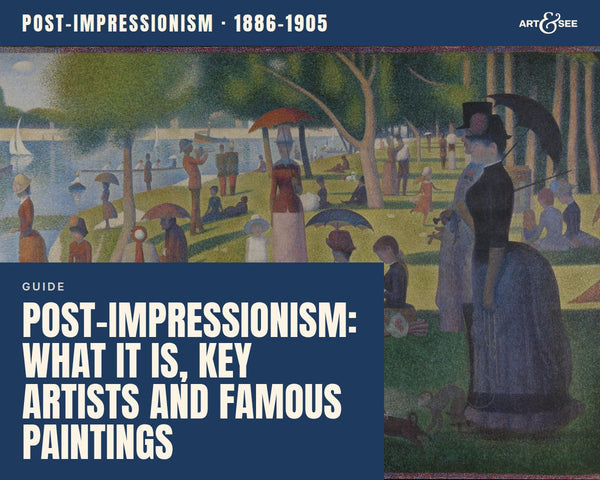
No. Van Gogh was a Post-Impressionist, a term Tate defines as the changes in Impressionism from about 1886, the year of the last Impressionist group show in Paris; the critic Roger Fry first used it in 1910 for his exhibition Manet and the Post-Impressionists. Tate adds that Van Gogh painted from nature but used color and brushwork to express his own emotional response.
The Starry Night most people mean is not in Paris. Van Gogh painted it at Saint-Rémy in June 1889, telling Theo around June 18 that he had "a new study of a starry sky", and it belongs to the Museum of Modern Art in New York. The Orsay's own night sky is the Rhône view in Room 36. For the two movements side by side, see Impressionism vs Post-Impressionism, and for the New York canvas among his other works, Van Gogh's ten most famous paintings.
The original and our hand-painted copy
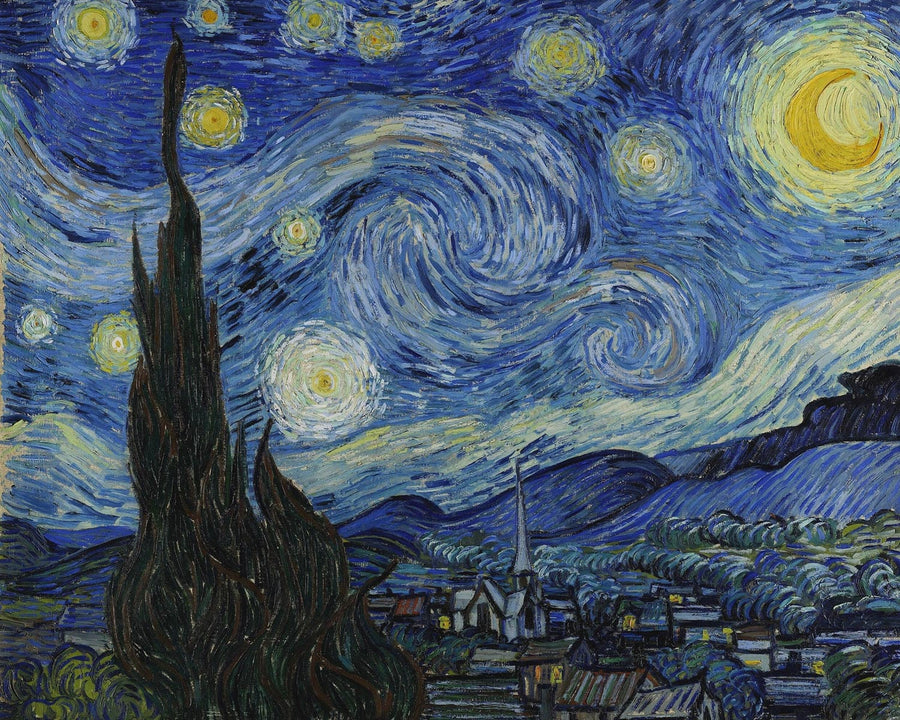
The original
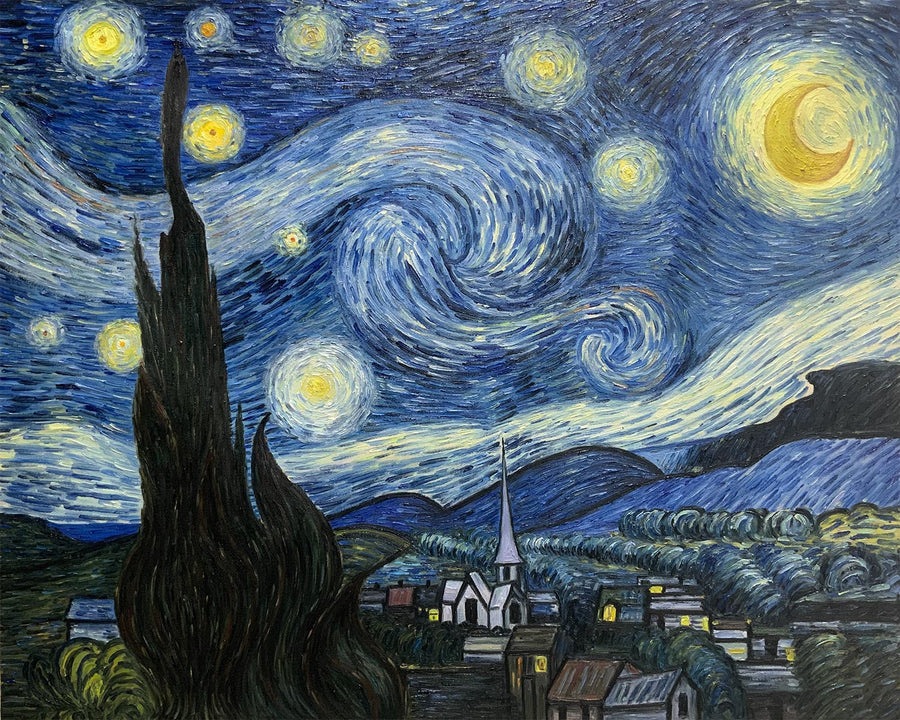
Our reproduction, painted by hand in oil
From these rooms to your own wall
Walked in order, these rooms run from Manet's Salon scandals of the 1860s to the church Van Gogh painted at Auvers in 1890, the year he died. If one picture stays with you, our hand-painted Poppies and Bal du moulin de la Galette are good places to start, and our guide to the most famous paintings in the world gathers many more.
Sources
- Musée d'Orsay, Olympia (Manet)
- Musée d'Orsay, Le Déjeuner sur l'herbe (Manet)
- Musée d'Orsay, Coquelicots (Monet)
- Musée d'Orsay, La Gare Saint-Lazare (Monet)
- Musée d'Orsay, Raboteurs de parquets (Caillebotte)
- Musée d'Orsay, La Classe de danse (Degas)
- Musée d'Orsay, Dans un café (Degas), English page
- Musée d'Orsay, Dans un café (Degas), French page
- Musée d'Orsay, Le Berceau (Morisot)
- Musée d'Orsay, La Nuit étoilée (Van Gogh)
- Musée d'Orsay, L'église d'Auvers-sur-Oise (Van Gogh)
- Musée d'Orsay, Bal du moulin de la Galette (Renoir)
- Musée d'Orsay, Les Joueurs de cartes (Cézanne)
- National Gallery, London, Renoir and Love (press release)
- Fitzwilliam Museum, Degas, Portrait of the dancer Jules Perrot
- Van Gogh Letters, letter 678 to Willemien (September 1888)
- Van Gogh Letters, letter 691 to Theo (September 1888)
- Van Gogh Letters, letter 777 to Theo (June 1889)
- Van Gogh Letters, letter 782 to Theo (June 1889)
- Van Gogh Letters, letter 879 to Willemien (June 1890)
- Tate, Post-impressionism
- Britannica, Musée d'Orsay
- Musée Marmottan Monet, Impression, soleil levant
- Musée de l'Orangerie, The Water Lilies by Claude Monet