4.9/5


Neoclassicism is the art of the late 1700s and early 1800s that rebuilt painting, sculpture and architecture on Greek and Roman models: firm outlines, smooth surfaces, figures lined up like a carved relief, and stories of duty taken from ancient history. You can see that look in our Neoclassical paintings, hand-painted in oil. This guide covers where the style began, how to spot it in a museum, the artists who made it, and six paintings that show it at work, from David's oath-swearing Romans to Ingres's crowded tribute to Homer. Right after the quick facts, a chart sets the new style beside the Rococo it pushed aside, one point at a time, with a painting from this guide for each.
Rococo versus Neoclassicism: how to spot the change
| What to check | Rococo, before | Neoclassicism | Painting that shows it |
|---|---|---|---|
| Line | Curving lines | A firm outline comes first, and the figures look carved. |  The Oath of the Horatii, Louvre, where the brothers are all straight lines and locked joints |
| Color | Pastel colors | Even light with a few strong accents |  Portrait of a Black Woman (Portrait of Madeleine), Louvre, where white, red and blue add up to the French flag |
| Mood | Playful | Severe and calm, so grief is a bowed head and not a scream | The Death of Marat, Brussels, where Marat slumps quietly in his bath with the letter still in his hand |
| Purpose | Made to decorate | Made to teach a lesson, such as courage, loyalty or virtue | Cornelia, Mother of the Gracchi, Richmond, Virginia, where a mother points to her children as her treasures |
Both sides follow the Met's account quoted in this guide, which sets the "pastel, curving, playful decoration" of the Rococo against pictures that are severe, easy to read and meant to teach.
Two more signs from the list further down help in a museum. Look for figures lined up in a shallow band near the front, and for props copied from real ancient objects.
What Neoclassicism is
The name means "new classicism." In the Met's account, the second half of the eighteenth century saw classical antiquity gain a growing hold on European style and taste, with Raphael and Poussin serving as a bridge back to ancient harmony, simplicity and proportion. In practice that meant turning away from the pastel, curving, playful decoration of the Rococo, the world of our guide to famous Rococo painters, toward pictures that are severe, easy to read and meant to teach. The same forms reshaped sculpture, architecture, furniture and the decorative arts, so the word covers a teapot as easily as a temple.
Where it began: Rome in the 1750s and 1760s
Archaeology came first. The Met's essay on Neoclassicism lists the illustrated volumes that carried the finds across Europe: The Ruins of Palmyra (1753), James Stuart and Nicholas Revett's Antiquities of Athens (1762) and Robert Adam's book on Diocletian's palace at Split (1764), alongside views of Herculaneum and Pompeii near Naples. Wealthy travelers on the Grand Tour came home from Rome with portraits of themselves by Pompeo Batoni, copies of Palladio's architecture books and ancient objects, and sculptors such as Antonio Canova kept their studios open so these clients could see work on display.
Then came the theory. In 1755 the German scholar Johann Joachim Winckelmann published Reflections on the Painting and Sculpture of the Greeks, which held up statues such as the Apollo Belvedere as finer than nature itself.
“The most eminent characteristic of Greek works is a noble simplicity and sedate grandeur in gesture and expression. As the bottom of the sea lies peaceful beneath a foaming surface, a great soul lies sedate beneath the strife of passions in Greek figures.”
His protégé Anton Raphael Mengs, court painter in Dresden, put the program into paint with Parnassus (1760–1761), Apollo among the Muses, made for the Villa Albani in Rome. The Met counts Mengs, the British painter Gavin Hamilton, Joseph-Marie Vien, Benjamin West, Jean-Baptiste Greuze and Angelica Kauffman as the first generation of Neoclassical painters. In Paris, a younger painter would turn their ideas into the defining pictures of the movement.
How to recognize a Neoclassical painting
- The outline comes first. The Met sums up David's manner as "rigorous contours, sculpted forms, and polished surfaces." Figures look carved, and you rarely see a brushstroke.
- A shallow stage. Figures stand in a band near the front of the picture, like a frieze on a temple, against plain walls, columns or arches.
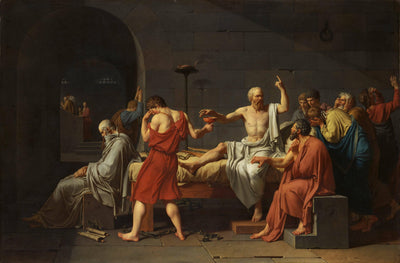
- Props checked against antiquity. Helmets, sandals, couches and columns follow ancient models. For The Death of Socrates, the Met notes, David consulted antiquarian scholars on the furniture and the clothing.
- A lesson in the subject. Greek and Roman stories of courage, loyalty and sacrifice, painted, in the Met's phrase, as "moral exemplars."
- Restraint in color and feeling. Even light, a few strong accents, and grief shown by a bowed head rather than a scream.
The artists
Jacques-Louis David (1748–1825) is the center of the story. According to the Met's essay on David's legacy, he studied under Vien, won the Prix de Rome in 1774, painted for the king, the revolutionaries and then Napoleon, who named him First Painter to the Emperor in 1804, and went into exile in Belgium in 1816. His pupils carried the style forward: Antoine-Jean Gros, Anne-Louis Girodet, François Gérard and, briefly in the late 1790s, Jean-Auguste-Dominique Ingres (1780–1867).
David's whole career has its own guide, Jacques-Louis David's paintings in twelve works, but two more of his pictures belong in any account of the style. The Death of Socrates (1787), at the Metropolitan Museum of Art, shows the philosopher reaching for the hemlock while still talking; the museum points out that Plato, slumped at the foot of the bed, was not there at the death but wrote the account of it, the Phaedo. Madame Récamier (1800) was ordered by the sitter and her husband, begun in the spring of 1800 and left unfinished by the end of that year, which is why the Louvre's canvas looks half sketched; compare it with a hand-painted Madame Récamier. His Napoleon pictures are told in full elsewhere: the rearing horse of Napoleon Crossing the Alps (1800–1801) in our famous Napoleon paintings, and The Coronation of Napoleon (1805–1807) in our famous French paintings.
Two women stand out among the painters who worked in the style. The Swiss painter Angelica Kauffman (1741–1807) belongs to the Met's first generation. Marie-Guillemine Benoist signed the portrait below with her maiden name, Laville Leroulx, and her married name, Benoist, and the Louvre hangs it in its gallery for David and his pupils.
Key works
The Oath of the Horatii, Jacques-Louis David (1784)

Zoom
The Roman historian Livy tells how two sets of triplets, the Roman Horatii and the Alban Curiatii, were chosen to settle a war between their cities by combat, and admits that his sources disagreed about which family fought for which side. David shows the moment before the fight: the brothers swear on swords raised by their father, while the women and children of the family slump at the right. The men are all straight lines and locked joints, echoed by the columns behind them; the women are curves.
The Louvre's record explains how the picture came about. Louis XVI commissioned it through the comte d'Angiviller, director of the King's Buildings, in late 1781 or early 1782, on a different subject, Horatius victorious, and for a square canvas. David put it off, got permission in July 1784 to paint it in Rome, and changed both the subject and the format. He signed it in Latin with the year 1784 but finished it in July 1785, showed it first in his Roman studio near the Piazza del Popolo, then sent it to the Paris Salon of 1785. It measures 330 × 425 cm (129.9 × 167.3 in). After the Salon, David took it back to paint a replica, now in the Toledo Museum of Art. You can also hang a hand-painted Oath of the Horatii.
Cornelia, Mother of the Gracchi, Angelica Kauffman (1780s)

Zoom
The full title used by the Virginia Museum of Fine Arts tells the story: Cornelia, Mother of the Gracchi, Pointing to Her Children as Her Treasures. A Roman visitor, seated at the right in red, shows off a chain from her jewel box. Cornelia, in white, opens her hand toward her two sons at the left, the younger one carrying a scroll, while her small daughter holds her other hand.
It is the same lesson as David's, virtue over luxury, told with a mother and children in place of soldiers. The museum dates the canvas to between 1780 and 1790 and gives its size as 101.6 × 127 cm (40.0 × 50.0 in).
The Death of Marat, Jacques-Louis David (1793)

Zoom
The revolutionary Jean-Paul Marat was killed in his bath on July 13, 1793, and the letter in his hand is the one Charlotte Corday wrote to get in to see him. According to the Louvre's 2025 David exhibition, the National Convention commissioned the picture the day after the murder, from a David who was by then a deputy for Paris and a member of the Committee of General Security.
The Louvre's reading is that David made Marat an icon of the Revolution by borrowing from religious art. The body is inspired by Caravaggio's Deposition in the Vatican Pinacoteca; the sheet, the blood and the knife recall the Passion and the martyr saints; the rough wooden crate used as a desk reflects the plain living Marat preached. The canvas, 165 × 128 cm (65.0 × 50.4 in), belongs to the Royal Museums of Fine Arts of Belgium in Brussels. It hung in the Convention's hall, on one side of the speakers' platform, with David's portrait of the murdered deputy Le Peletier, now destroyed, on the other.
Portrait of a Black Woman (Portrait of Madeleine), Marie-Guillemine Benoist (1800)

Zoom
Benoist showed this half-length portrait at the Salon of 1800, six years after the National Convention abolished slavery in the French colonies on February 4, 1794. The sitter turns her face to us while her body sits sideways in a Louis XVI armchair, against a plain light-gray wall with no depth at all. The Louvre's catalog entry notes that the white dress, red sash and blue shawl add up to the colors of the French flag, and that the bared breast echoes the allegories of the Republic painted at the time.
The name is less certain than the picture. The museum's title is Portrait d'une femme noire; since 2019 it has also been called Portrait of Madeleine, after researchers found a "Magdeleine, servante" traveling with Benoist's brother-in-law on a ship from Guadeloupe that reached Rochefort in December 1798. The Louvre treats that name as a convention: the passenger list is the only document that mentions her, and nothing in it ties her to the sitter. Benoist kept the canvas for herself until 1818, when the king's household bought it along with three of her other paintings. It measures 81 × 65 cm (31.9 × 25.6 in). Benoist's portrait is also available as a hand-painted Portrait d'une femme noire.
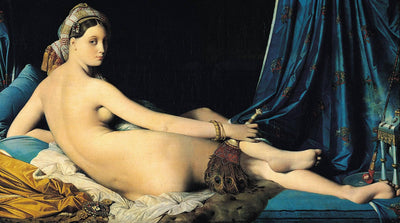
La Grande Odalisque, Jean-Auguste-Dominique Ingres (1814)

Zoom
Hand-painted oil reproductionSee sizes ›
Ingres signed this nude in Rome in 1814, painted it for Caroline Murat, Queen of Naples, and showed it at the Salon of 1819, according to the Louvre's record. The technique is pure David: smooth surfaces, a firm contour, cool blue silks. The body is not. The Met observes that Ingres's painted portraits undercut his teacher's model with "stylized contours and anatomical distortions," and here the same habit reaches the nude, whose back runs on far longer than any real spine. The canvas is 91 × 162 cm (35.8 × 63.8 in), and the Louvre bought it in 1899. The Grande Odalisque in oil shows how that long line reads at home.
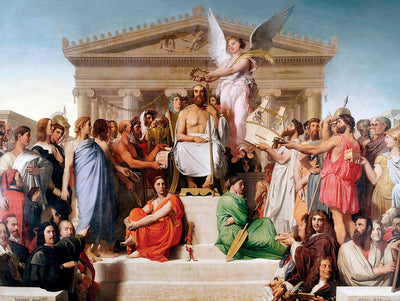
The Apotheosis of Homer, Jean-Auguste-Dominique Ingres (1827)

Zoom
Hand-painted oil reproductionSee sizes ›
Here Ingres turns the whole classical tradition into one crowd scene. Homer sits enthroned before a Greek temple; at his feet sit the Iliad, holding a sword, and the Odyssey, holding an oar. Around him stand Aeschylus with a scroll, the painter Apelles with brushes and palette, Pindar with a lyre, the sculptor Phidias with a mallet, then Dante and Raphael, and lower down the French masters of the 1600s: Racine, Boileau, Molière, Corneille, La Fontaine and Nicolas Poussin.
It was made for a ceiling. The Louvre's record says it was commissioned, together with its painted coving, for 20,000 francs, to decorate a ceiling of the new Musée Charles X inside the Louvre, rooms that now hold Egyptian antiquities. It was shown at the Salons of 1827 and 1833, taken down in 1855 and replaced overhead by a copy. The composition draws on Raphael's own Parnassus. It measures 386 × 512 cm (152.0 × 201.6 in); there is also a hand-painted Apotheosis of Homer.
Beyond painting: sculpture and buildings
Canova's Psyche Revived by Cupid's Kiss (1787–1793) shows the style in marble: Cupid bends over Psyche to wake her with a kiss, in a group 155 cm (61.0 in) high that the Louvre shows in room 403, on level 0 of the Denon wing. In architecture the same columns and pediments crossed the Atlantic. In Philadelphia, William Strickland's Second Bank of the United States, built between 1819 and 1824, borrows the blank pediments and Doric columns of the Parthenon, and the National Park Service calls it a fine example of Greek Revival. Today it houses a collection of portraits of the Founding Fathers.
How it gave way to Romanticism
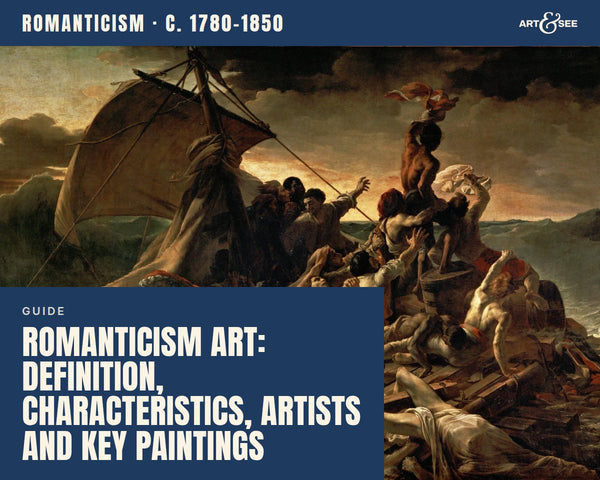
The Met traces the cracks from inside David's own studio. Girodet's Sleep of Endymion (1791) chose a sensual myth with no moral lesson at all. In the late 1790s a group of David's pupils known as the Barbus, or Bearded Ones, rejected his classicism for something even plainer, modeled on archaic Greek vase painting, and around 1800 the Troubadour painters turned to France's medieval past. By the 1820s, Romanticism, with its free brushwork and wider range of subjects, offered what the Met calls "an alternative to Davidian Neoclassicism," and the line between the two styles blurred in the work of David's own pupils. Ingres's Apotheosis of Homer belongs to that same decade. Our guide to Romanticism in art picks up the story from there.
Living with a Neoclassical painting
Neoclassical painters wanted a picture to make its point at a glance: one gesture, one clear outline, one lesson. That clarity is what lets these canvases hold a plain modern wall as well as a period room. Start with the most famous paintings in the world or with David's Death of Socrates.
Sources
- The Met, Heilbrunn Timeline of Art History: Cybele Gontar, “Neoclassicism” (2003)
- The Met, Heilbrunn Timeline of Art History: Kathryn Calley Galitz, “The Legacy of Jacques Louis David (1748–1825)” (2004)
- The Met, Jacques Louis David, The Death of Socrates (31.45)
- Musée du Louvre, Jacques-Louis David, Le serment des Horaces (INV 3692)
- Livy, The History of Rome, Book 1, chapter 24 (Perseus Digital Library)
- Virginia Museum of Fine Arts on Google Arts & Culture, Angelica Kauffman, Cornelia, Mother of the Gracchi, Pointing to Her Children as Her Treasures
- Musée du Louvre, Jacques-Louis David exhibition, “Une icône de la Révolution” (Marat assassiné, in French)
- Musée du Louvre, Marie-Guillemine Benoist, Portrait d'une femme noire (INV 2508)
- Musée du Louvre, Jean-Auguste-Dominique Ingres, Une odalisque, dite La grande odalisque (RF 1158)
- Maigne, Chatellier and Norlöff, “Extra vertebrae in Ingres' La Grande Odalisque,” Journal of the Royal Society of Medicine (2004)
- Musée du Louvre, Jean-Auguste-Dominique Ingres, Homère déifié, dit aussi L'apothéose d'Homère (INV 5417)
- Musée du Louvre, Jacques-Louis David, Portrait de Juliette Récamier (INV 3708)
- Musée du Louvre, Antonio Canova, L'Amour et Psyché (MR 1777)
- National Park Service, Second Bank of the United States
- Tate, Romanticism
- Tate, Genres