4.7/5


Famous self-portraits run from Albrecht Dürer facing us head-on in 1500 to Van Gogh painting his bandaged ear in January 1889, with Velázquez at his easel inside Las Meninas and Rembrandt studying his own aging skin along the way. Each picture makes a case about the person holding the brush: that a painter deserved a gentleman's rank, that a woman could run a studio, that a wounded man could still work. Most of them can be ordered as hand-painted copies from our portrait paintings collection. The table that opens the list ranks the ten painters' faces by their monthly Google searches across the US, then adds how that interest moved over the last six months.
Portraits of other sitters, from van Eyck's Arnolfini couple to the Mona Lisa, are in our list of famous portraits. Here there are ten painters and one picture each, in four groups, followed by Frida Kahlo and the 20th century.
The top 10 self-portraits, from most searched to least
| Search spot | Self-portrait | Who holds the brush | Searches each month | Latest trend |
|---|---|---|---|---|
| 1 |  Las Meninas |
Diego Velázquez | 27,100 | Down 36% |
| 2 | Self-Portrait | Raphael | 1,600 | Down 22% |
| 3 |  Self-Portrait |
Judith Leyster | 720 | Down 35% |
| 3 |  Self-Portrait with Bandaged Ear |
Vincent van Gogh | 720 | Up 4% |
| 5 |  Self-Portrait in a Convex Mirror |
Parmigianino | 70 | Down 40% |
| 5 |  Self-Portrait as the Allegory of Painting (La Pittura) |
Artemisia Gentileschi | 70 | Down 31% |
| 7 |  Self-Portrait at the Easel |
Sofonisba Anguissola | 50 | Down 12% |
| — |  Self-Portrait in a Straw Hat |
Elisabeth Louise Vigée Le Brun | Fewer than 50 | Too few to tell |
| — |  Self-Portrait at the Age of 63 |
Rembrandt | Fewer than 50 | Too few to tell |
| — |  Self-Portrait with Fur-Trimmed Robe |
Albrecht Dürer | No data | No data |
These are US Google search averages collected in October 2026; the trend checks whether the most recent six months beat the six that came earlier.
Las Meninas is far ahead, but people searching for it want the whole court scene, not just the painter at his easel. Van Gogh's bandaged ear is the only face here that drew more searches lately.
Renaissance painters claiming a higher rank
01Self-Portrait with Fur-Trimmed Robe, Albrecht Dürer (1500)

Zoom
Dürer kept coming back to his own face, and each version asks for more. Two years before this panel, in a self-portrait now in the Museo del Prado, he painted himself at 26 in a striped cap and grey kid gloves beside a window onto Alpine peaks; the Prado reads the gloves as a mark of rank, the sign of a learned artist rather than a craftsman. In 1500 he dropped the window and the scenery. The Munich panel turns him fully frontal, with the hand raised at his chest in what the Alte Pinakothek calls the sign of a blessing, borrowed from icons of Christ the Saviour.
The museum also points out that the direct gaze and the hand together stand for seeing and making, the two halves of a painter's work. The Latin inscription and the panel's long history in Munich are covered in our article on famous German paintings.
02Self-Portrait, Raphael (1506)
Raphael's small panel, 47.3 × 34.8 cm (18.6 × 13.7 in), is quiet next to Dürer's: head and shoulders, a dark cap, a dark robe. The Uffizi dates it to 1506 and reads the plain clothes as a painter's working dress, worn on purpose as a statement about his trade. It later joined Cardinal Leopoldo de' Medici's collection of artists' self-portraits and now hangs in the gallery's room of self-portraits. Why this face is accepted as his, and which other faces might be, is the subject of our article on Raphael's self-portrait.
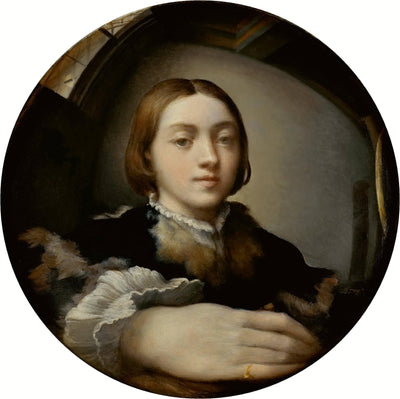
03Self-Portrait in a Convex Mirror, Parmigianino (about 1523–1524)

Zoom
Parmigianino copied the distorted reflection of a convex mirror onto a round panel of curved wood, 24.4 cm (9.6 in) across, so the picture bulges like the glass it imitates. The Kunsthistorisches Museum in Vienna dates the convex roundel about 1523–1524 and says its puzzle, mirror or picture, goes to the heart of modern painting: deception and illusion.
It was also a calling card. On arriving in Rome, the young painter gave it to Pope Clement VII to win commissions, and it went on to pass through famous hands: the writer Pietro Aretino, Valerio Belli, then the architect Andrea Palladio, who sold it in 1560 to the sculptor Alessandro Vittoria. Vittoria's bequest took it to Emperor Rudolf II in 1608.
Women who painted themselves at work
Each of these four painters uses the picture to show herself as a working professional, tools in hand. Their wider careers are traced in our list of famous female artists.
04Self-Portrait at the Easel, Sofonisba Anguissola (1554)

Zoom
Hand-painted oil reproductionSee sizes ›
Anguissola was born around 1532 in Cremona to a noble but impoverished family, and here she paints a devotional Virgin and Child instead of posing as a model. The easel self-portrait, 67 × 56 cm (26.4 × 22.0 in), belongs to the Castle Museum in Łańcut, Poland, which dates it to 1554; other catalogues give about 1556. It came from the Lubomirski family, the castle's former owners. The museum notes that it often travels to exhibitions around the world.
Her father sent one of her drawings to Michelangelo, who praised it. In 1559 Philip II invited her to the Spanish court, where she spent 14 years painting the royal family. She ended her life in Palermo, where she died in 1625, and the year before, the 25-year-old Anthony van Dyck came to draw her and wrote about the visit in his sketchbook.
“In making her portrait, she gave me several pieces of advice: not to raise the light too high, so that the shadows in the wrinkles of old age would not grow too large”
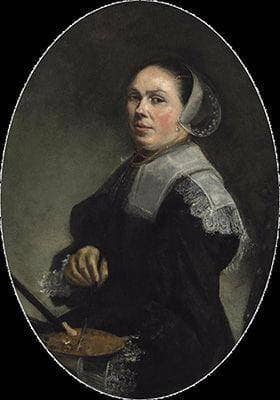
05Self-Portrait, Judith Leyster (about 1630)

Zoom
Leyster turns from the easel in mid-stroke, smiling, in a dark dress with a wide lace collar. The canvas, 74.6 × 65.1 cm (29.4 × 25.6 in), is in the National Gallery of Art in Washington, which dates it about 1630. Infrared images show that she first painted a woman's face on the easel, probably her own, then replaced it with the fiddler from her own Merry Company, a scene she painted around 1629 to 1631.
For a long time the portrait itself was given to Frans Hals, the older Haarlem painter; Abraham Bredius was the first to recognize it as Leyster's own face, according to the gallery's catalogue entry. She entered Haarlem's Guild of St. Luke in 1633, and the picture came to Washington as a gift from Mr. and Mrs. Robert Woods Bliss in 1949.
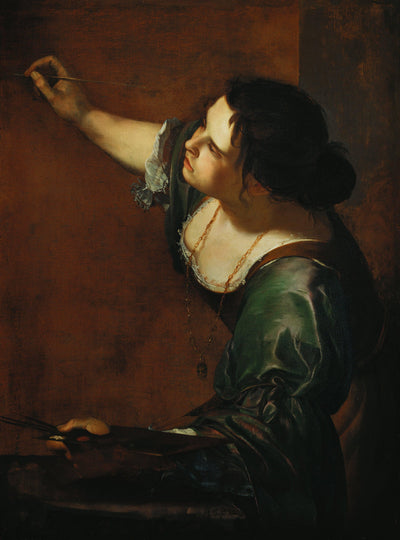
06Self-Portrait as the Allegory of Painting (La Pittura), Artemisia Gentileschi (about 1638–1639)

Zoom
Hand-painted oil reproductionSee sizes ›
Gentileschi did not paint herself beside her work; she painted herself as Painting itself, the personification described in Cesare Ripa's Iconologia, down to the gold chain with a mask pendant. The Royal Collection points to the sweat on her brow and the apron over a fine dress. The canvas, 98.6 × 75.2 cm (38.8 × 29.6 in), is dated about 1638–1639.
Charles I had invited her to London in 1638, and she probably painted it there. It is the only firmly attributed work to survive from her stay in England, and she may have given it to the king himself.
07Self-Portrait in a Straw Hat, Elisabeth Louise Vigée Le Brun (1782)

Zoom
Hand-painted oil reproductionSee sizes ›
In Antwerp, Vigée Le Brun saw Rubens's portrait of Susanna, long known as Le Chapeau de Paille although the hat in it is beaver felt, and studied how it mixes ordinary daylight with direct sun. She painted her reply in Brussels in 1782; that first version belongs to the baronne Edmond de Rothschild. The London version, 97.8 × 70.5 cm (38.5 × 27.8 in), is her own signed copy, probably made the same year.
“This painting delights me and inspired me to make my own portrait in Brussels in search of the same effect.”
The copy is not identical. The National Gallery points to heavier eyebrows, a fuller lower lip and a wider smile, a dress changed from lilac to rose pink, and wispy clouds added to a sky that critics had found too blue. She wears her own unpowdered hair, not the wig a formal portrait would expect. She was one of only four women admitted to the Académie royale in the 18th century and became the preferred painter of Marie-Antoinette.
Inside the scene, and to the end of a life
08Las Meninas, Diego Velázquez (1656)
Velázquez put his self-portrait inside a court scene. In Las Meninas he stands at the left with brush and palette before a huge canvas whose front we never see, while the Infanta Margarita and her attendants fill the room and the king and queen appear only as a reflection in the mirror on the back wall. The Prado dates it to 1656; at 320.3 × 279.1 cm (126.1 × 109.9 in), it is by far the largest picture here.
The palace inventory of 1666 does not use the name Las Meninas; it lists a portrait of the empress with her ladies and a dwarf. The red cross of the Order of Santiago on the painter's chest came later: Velázquez was made a knight only in 1659, after the canvas was finished, as Smarthistory explains. Picasso's long reply to the painting is told in our list of famous Spanish paintings.
09Self-Portrait at the Age of 63, Rembrandt (1669)

Zoom
Hand-painted oil reproductionSee sizes ›
No painter of his time left more self-portraits: the National Gallery in London counts about 80, in paint, etching and drawing, across a 40-year career. Two in the gallery's own collection show how far that arc runs. In the 1640 portrait at 34, Rembrandt poses in fur and velvet as a gentleman of the 1520s, leaning on a ledge taken from a Titian portrait, with echoes of Raphael and of Dürer's 1498 self-portrait: a claim to rank and to a place beside the great names. The portrait at 63, 86 × 70.5 cm (33.9 × 27.8 in), is one of three he painted in the months before his death in 1669.
Here he turns a spotlight on his face. The fold under his right eye is a single swirl of loaded paint, the blemishes on his forehead are blots of thick pigment, and X-rays show he first painted himself at work, hands open with a brush, before taking that out. The gallery is wary of reading it as soul-searching: studying his own aging skin may simply have helped him paint clients of his age. That right eye repays a close look, because one stroke does the work of a dozen. The gallery bought it in 1851 for 10 guineas, and it sits among our most famous Rembrandt paintings.
Painting through a crisis
10Self-Portrait with Bandaged Ear, Vincent van Gogh (1889)

Zoom
Hand-painted oil reproductionSee sizes ›
On the evening of 23 December 1888, after a row with Paul Gauguin, Van Gogh cut off most of his left ear in Arles. He left the hospital on 7 January 1889 and was soon painting again. The Courtauld's canvas, 60.5 × 50 cm (23.8 × 19.7 in), shows the dressing over his right ear because he worked from a mirror, and the fur cap was a recent purchase to hold the bandage in place and keep out the winter cold. Behind him, the easel and the Japanese print are signs, the Courtauld says, of his determination to keep working.
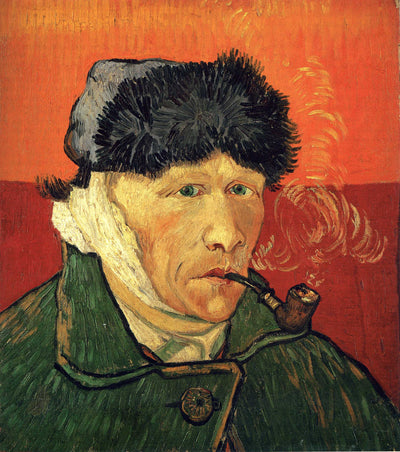
Samuel Courtauld bought it in October 1928, from a line of owners that began with Père Tanguy in Paris. It has a twin: within a day or two, Van Gogh painted a second bandaged self-portrait, smoking a pipe against an orange and red background, now in a private collection, as Martin Bailey writes in The Art Newspaper. How those weeks fit into the rest of his output is covered in our count of how many paintings Van Gogh painted.
After 1900: Frida Kahlo and the modern self-portrait
The numbered list stops in 1889, but no account of the genre is complete without Frida Kahlo. Her Self-Portrait with Thorn Necklace and Hummingbird (1940), oil on canvas mounted on board, 62.5 × 48 cm (24.6 × 18.9 in), shows her face framed by a necklace of thorns and a hummingbird. The photographer Nickolas Muray, whose affair with her had ended in 1939, bought it from her to help during a difficult financial period, and the Harry Ransom Center at the University of Texas at Austin acquired his collection of modern Mexican art in 1966. The same year she painted Self-Portrait with Cropped Hair, described in our guide to famous paintings at MoMA.
Later painters pushed the format to extremes. Chuck Close's Big Self-Portrait (1967–1968), acrylic on canvas, 273.1 × 212.1 cm (107.5 × 83.5 in), enlarges his own head and shoulders to the height of a wall and was one of the first pictures he made with an airbrush; the Walker Art Center in Minneapolis bought it in 1969.
A face that looks back
A self-portrait on a wall is the painter watching the room, and these ten do it in very different moods, from Leyster's grin to Rembrandt's last stare. Our hand-painted copies start from the same faces, including Van Gogh with his pipe and bandage and Gentileschi as Painting, and the rest of our portrait collection sits beside the famous paintings people most often hang at home.
Sources
- Alte Pinakothek, Albrecht Dürer, Self-Portrait with Fur-Trimmed Robe
- Museo del Prado, Albrecht Dürer, Self-Portrait (1498)
- Albertina on Google Arts & Culture, Dürer, Self-Portrait at Thirteen (1484)
- Uffizi Galleries, Raphael, Self Portrait
- Kunsthistorisches Museum Vienna, Parmigianino, Self-Portrait in a Convex Mirror
- Castle Museum in Łańcut, Sofonisba Anguissola, Self-Portrait at the Easel
- The Art Newspaper, extract from Jennifer Higgie, The Mirror and the Palette (van Dyck visits Anguissola)
- National Gallery of Art, Judith Leyster, Self-Portrait
- National Gallery of Art, Dutch Paintings of the Seventeenth Century: Leyster, Self-Portrait (catalogue entry)
- Mauritshuis, Judith Leyster, Man Offering Money to a Young Woman
- Mauritshuis, Judith Leyster (1609–1660)
- Royal Collection Trust, Artemisia Gentileschi, Self-Portrait as the Allegory of Painting (La Pittura)
- National Gallery, London, Elisabeth Louise Vigée Le Brun, Self Portrait in a Straw Hat
- Museo del Prado, Diego Velázquez, Las Meninas
- Smarthistory, Diego Velázquez, Las Meninas
- National Gallery, London, Rembrandt, Self Portrait at the Age of 34
- National Gallery, London, Rembrandt, Self Portrait at the Age of 63
- The Courtauld, Vincent van Gogh, Self-Portrait with Bandaged Ear (collection record)
- The Courtauld, Self-Portrait with Bandaged Ear (collection highlight)
- The Art Newspaper, Martin Bailey, Van Gogh's Self-portrait with Bandaged Ear and Pipe (2026)
- Harry Ransom Center, Frida Kahlo, Self-Portrait with Thorn Necklace and Hummingbird
- Harry Ransom Center on Google Arts & Culture, Frida Kahlo, Self-Portrait with Thorn Necklace and Hummingbird
- Walker Art Center, Chuck Close, Big Self-Portrait
- National Gallery, London, Jan van Eyck, Portrait of a Man (Self Portrait?)
- Royal Collection Trust, A portrait of Leonardo
- Van Gogh Museum, Vincent van Gogh, Self-Portrait (1887)
- Musée d'Orsay on Google Arts & Culture, Vincent van Gogh, Self-Portrait (1889)