4.9/5
4.9/5


Most famous paintings of women were painted by men who wanted something from the picture: a commission, a scandal, a reputation, sometimes just a better job than the last man. The women themselves were brides, mistresses, maids, models paid by the hour and, once, the painter herself. What follows is my list of the twenty that people actually recognize, grouped by era, with the story that made each one stick.
I left out sculpture and kept to canvas and panel. If you want the wider set, start with the museum pictures most often copied by hand, where these women sit next to the landscapes and battle scenes.
The Renaissance: brides, mistresses and goddesses
1. Mona Lisa, Leonardo da Vinci (1503–1519)
Lisa Gherardini was the wife of a Florentine silk merchant, Francesco del Giocondo, and Leonardo started her portrait around 1503, probably for him. He never handed it over. He kept the poplar panel with him, and King François I bought it from him in 1518. Her real fame arrived on 21 August 1911, when she vanished from the Louvre and stayed gone for over two years, until a glazier who had worked in the museum, Vincenzo Peruggia, tried to sell her in Italy. Today the panel, just 79.4 cm tall sits behind glass in the Salle des États, the largest room in the palace. You can see a hand-painted Mona Lisa copy up close without the crowd.
2. Lady with an Ermine, Leonardo da Vinci (about 1490)
Cecilia Gallerani was sixteen or seventeen and the mistress of Ludovico Sforza, Duke of Milan. The animal in her arms is a joke with teeth: Ludovico had received the Order of the Ermine in 1488 and was nicknamed the white ermine. It's one of just over a dozen surviving portraits by Leonardo, and Adam Jerzy Czartoryski bought it in Italy around 1800. It now hangs in the Czartoryski Museum in Kraków, and Cecilia and her ermine in oil is one of the quieter Leonardos to live with.
3. The Arnolfini Portrait, Jan van Eyck (1434)
A merchant, probably Giovanni di Nicolao Arnolfini, and his wife stand in a room in Bruges. Look at the convex mirror on the back wall: it reflects two more men walking in, and van Eyck signed his name right above it. Every object in that room, down to the fur trim and the chandelier, was chosen to show what the couple could afford.
4. The Birth of Venus, Sandro Botticelli (about 1485)
Venus lands on Cyprus on a scallop shell, pushed by Zephyr and, perhaps, Aura, while a young woman runs to cover her with a flowered cloak. It's tempera on canvas, 172.5 × 278.5 cm, and the orange trees are likely a nod to the Medici, whose name echoes the old word for the fruit. The first written mention is from 1550.
5. Primavera, Sandro Botticelli (about 1480)
Nine figures from myth walk across a meadow. On the right, Zephyrus grabs the nymph Chloris, who becomes Flora a step later; on the left, the three Graces dance. Botticelli painted at least 42 identifiable plant species into the grass, and nobody has fully cracked what the whole thing means.
6. Venus of Urbino, Titian (1538)
A letter from 1538 records Guidobaldo II della Rovere buying this "naked woman" straight from Titian. She is a young bride waiting to be dressed, and the roses in her hand stand for the constancy of love. The picture reached Florence in a dowry and now hangs in the Uffizi. Manet would borrow her pose three centuries later (see number 13). Titian's reclining bride is also one of the hardest skin tones a copyist can attempt.
The 1600s and 1700s: women doing something
7. Judith Beheading Holofernes, Artemisia Gentileschi (about 1620)
Painted for Grand Duke Cosimo II de' Medici, this is the most violent picture on the list, and the only one here by a woman before the 20th century. Judith holds the general by the hair and saws through his neck while her maid pins him down. The painting shocked Florence so badly that it was at first kept out of the gallery, and Artemisia struggled to get paid after the Grand Duke died in 1621. She was the first woman admitted to Florence's Academy of Art and Design.
8. The Milkmaid, Johannes Vermeer (about 1660)
A maid pours milk and nothing else in the room moves. The canvas is small, 45.5 × 41 cm. The Rijksmuseum bought it in 1908 as part of a group of 39 paintings from the heirs of the Six family.
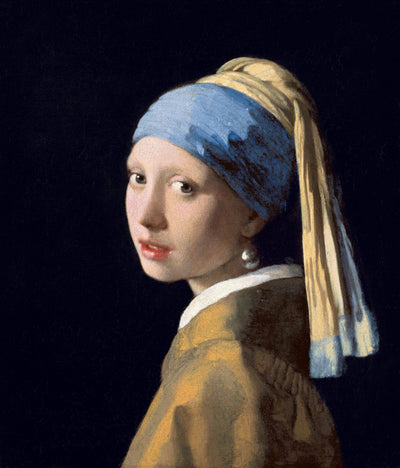
9. Girl with a Pearl Earring, Johannes Vermeer (about 1665)

She was never a portrait of anyone. It's a tronie, a study of a type: a girl in exotic dress with a blue and yellow turban (the blue is the precious pigment ultramarine). The pearl is too big to be real, and it's made of two brushstrokes: one highlight at the top, one reflection of the white collar underneath. No hook. If you want her at home, the girl in the blue turban measures only 44.5 × 39 cm in the original, so a copy at true size fits almost any wall. The rest of Vermeer's small interiors work the same way.
10. The Swing, Jean-Honoré Fragonard (about 1767)
A young woman in pink silk flies up on a swing, a slipper sails off her foot, and her lover in the bushes gets the view. The commission came from a "gentleman of the Court" who first asked the history painter Gabriel-François Doyen to paint his mistress, with a bishop pushing the swing. Doyen was appalled and passed the job on, and by October 1767 Fragonard was at work. In the finished picture there's no bishop: the man working the ropes from the right is her elderly husband.
The 19th century and its scandals
11. Liberty Leading the People, Eugène Delacroix (1830)
The July Revolution of 1830 in Paris, turned into one bare-breasted woman with a flag and a rifle. Delacroix painted it between September and December 1830, showed it at the Salon of 1831, and the French state bought it that August. It is huge, 2.6 × 3.25 m.
12. Ophelia, John Everett Millais (1851–1852)

Millais painted the riverbank outdoors on the Hogsmill River at Ewell, in Surrey, then the drowning girl indoors in his Gower Street studio. His model, Elizabeth Siddall, was nineteen and had been spotted working in a hat shop. She lay in a bath of water warmed by oil lamps; once the lamps went out, Millais didn't notice, and she fell ill. The embroidered dress cost him four pounds secondhand. Millais's drowning Ophelia is the one reproduction on this list where the flowers take longer than the face.
13. Olympia, Édouard Manet (1863)
Titian's Venus again, but now a Paris courtesan staring you down. At the Salon of 1865 critics mocked the "yellow-bellied odalisque," and Émile Zola defended it. In 1890 Claude Monet organized a public subscription to give it to the French state.
14. Whistler's Mother, James McNeill Whistler (1871)
Its real title is Arrangement in Grey and Black No. 1. The French state has owned it since 1891, and it's often called the most important American painting not on American soil. It hangs in the Musée d'Orsay.
15. Woman with a Parasol, Claude Monet (1875)
Monet's wife Camille and their son, painted outdoors, probably in one session of a few hours. The sun is behind her, turning the top of the parasol white, while the wildflowers throw yellow up onto her dress. It was in the second Impressionist exhibition in 1876, and Paul Mellon gave it to the National Gallery of Art in Washington in 1983.
16. Madame X, John Singer Sargent (1883–1884)
Virginie Amélie Avegno Gautreau, a Louisiana-born society beauty in Paris, sat for Sargent without a commission, because he wanted a showpiece for his reputation. At the Salon of 1884 the fallen right strap of her gown and her lavender-toned skin drew ridicule. Sargent repainted the strap, kept the canvas for over thirty years and sold it to the Met in 1916, remarking, "I suppose it is the best thing I have done."
17. The Lady of Shalott, John William Waterhouse (1888)
From Tennyson's poem: the cursed lady drifts downriver, letting go of the boat's chain. Three candles burn by the crucifix in front of her, and two have already gone out. Henry Tate gave it to the nation in 1894.
The 20th century
18. Portrait of Adele Bloch-Bauer I, Gustav Klimt (1907)

Klimt started it in 1903, then saw the Byzantine mosaics in Ravenna that December and called them of "unprecedented splendor." You can see the result in the gold. Adele clasps her hands in an odd knot to hide a damaged finger. The Nazis seized the painting in 1938, and in Vienna it was renamed Woman in Gold to hide who she was. The surviving heir, Maria Altmann, fought for decades; an Austrian arbitration panel ordered the return in 2005, and Ronald Lauder bought it in 2006 for the Klimt room at the Neue Galerie in New York. A copy with real gold leaf is a different object from a print, because the metal catches light as you move.
19. Les Demoiselles d'Avignon, Pablo Picasso (1907)
Five women from a brothel on Carrer d'Avinyó in Barcelona, broken into angular planes. Picasso was twenty-five and made hundreds of studies for it. It wasn't shown publicly until 1916, and it's at MoMA, 243.9 × 233.7 cm, and it hangs on the fifth floor.
20. The Two Fridas, Frida Kahlo (1939)
Kahlo painted herself twice after splitting from Diego Rivera: one Frida in a white European lace dress, the other in the Tehuana dress Rivera loved, their exposed hearts connected. André Breton had called her work surrealist in 1938, and the painting went into the International Exhibition of Surrealism in 1940. It has been in the Museo de Arte Moderno since 1966.
How were women depicted in Renaissance art?
Mostly as saints, goddesses, brides and mistresses, and nearly always for a man who paid. The portraits in this list show how much the sitter's status mattered. Lisa Gherardini and Cecilia Gallerani turn toward us with real presence, but they are still dressed and posed to flatter a husband or a duke. The nudes are always excused by a story: Botticelli's Venus is a goddess, Titian's is a bride. It took Manet in 1863 to strip the excuse away, and that's why Olympia caused a scandal where the Venus of Urbino never did.
If you ask which Renaissance painting of a woman is the most famous, the answer is easy. It's the Mona Lisa, and it isn't close.
A famous Pre-Raphaelite painting of a woman
Ophelia is the one most people picture, and The Lady of Shalott is a close second. Both are drowning or doomed girls taken from English literature, both hang at Tate Britain, and both came in Henry Tate's gift of 1894. Siddall, Millais's Ophelia, married his friend Dante Gabriel Rossetti in 1860.
Living with one of them
A painting of a woman changes a room in a way a landscape doesn't: someone is looking back at you. Several women on this list are painted by hand in oil at Art & See, and you can browse the rest of the masterpieces we copy before choosing. Start with the face you keep coming back to.