4.7/5


Famous religious paintings are the Bible stories and saints' lives that painters made for altars, chapels and monastery walls, and the ten below run from the Ghent Altarpiece, first set up in 1432, to Henry Ossawa Tanner's Annunciation of 1898. Each entry says what the picture shows, where to see it and one detail worth finding in it. Hand-painted versions of most of them are in our religious paintings collection. To start, a chart lines up the stories from the Creation to the saints and tells you where each painting lives today.
Many more scenes from Christ's own life, such as Grünewald's Isenheim Altarpiece and Caravaggio's Calling of Saint Matthew, are in our guide to the most famous paintings of Jesus, and Nativities and Adorations are gathered in famous Christmas paintings. This list takes in the Last Supper and the Cross too, but most of it follows the rest of the story: Genesis, the Virgin, the saints, a parable and a vision.
Ten famous religious paintings: the story and the place to see it
| Story from the Bible | Painting of it | Go to | How long it has been there |
|---|---|---|---|
| God gives life to Adam, one of nine Genesis scenes on the ceiling | The Creation of Adam | Sistine Chapel, Vatican City | Painted right on the vault, which was finished in 1512 |
| God brings Eve to Adam in Eden, then come a false paradise and Hell |  The Garden of Earthly Delights |
Museo del Prado, Madrid | Since 1933, on loan from Patrimonio Nacional |
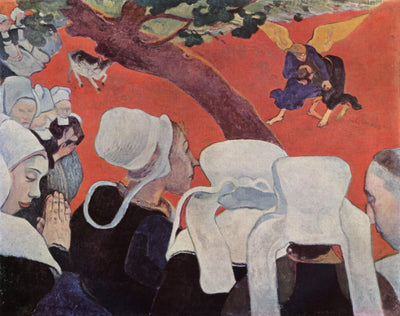
| Jacob wrestles an angel all night (Genesis 32) |  Vision of the Sermon (Jacob Wrestling with the Angel) |
National Galleries of Scotland, Edinburgh | Bought in 1925 |
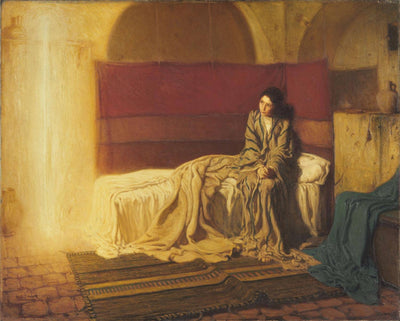
| The angel Gabriel visits Mary |  The Annunciation |
Philadelphia Museum of Art | Bought in 1899, the first Tanner in an American museum |
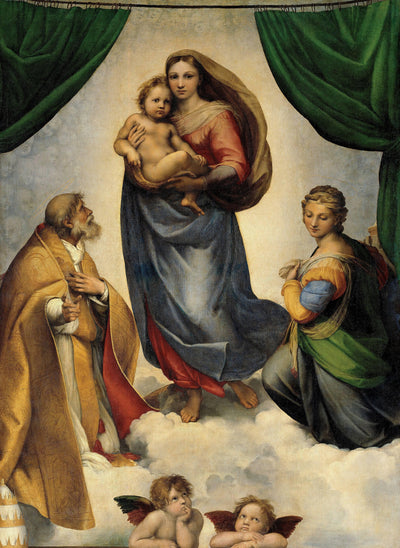
| Mary holds the Christ Child between two saints |  The Sistine Madonna |
Gemäldegalerie Alte Meister, Dresden | Since 1752/54, apart from ten years in Russia after 1945 |
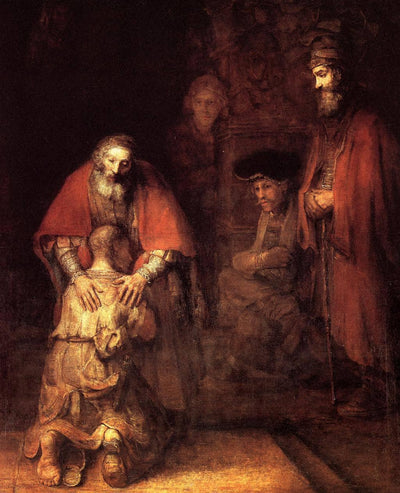
| A son wastes his share and comes home with nothing (Luke 15:11–32) |  The Return of the Prodigal Son |
Hermitage, St. Petersburg | Since 1766, with Catherine the Great's collection |
| Jesus shares a last meal with his apostles | The Last Supper | Santa Maria delle Grazie, Milan | On the friars' dining hall wall where it was painted in 1495–1498 |
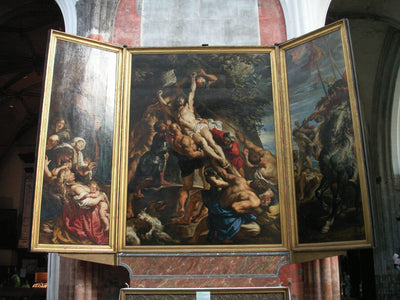
| Men heave Christ up on the cross |  The Elevation of the Cross |
Cathedral of Our Lady, Antwerp | Moved there after its first church, St. Walburga's, was destroyed |
| Saint Paul lies flat under his horse at the moment of his conversion |  The Conversion of Saint Paul |
Santa Maria del Popolo, Rome | In the Cerasi Chapel it was made for, since about 1601 |
| Saints and martyrs gather around the Lamb of God (John 1:29) |  The Ghent Altarpiece |
St Bavo's Cathedral, Ghent | First set up in this church on 6 May 1432 |
Places and dates come from the museums and churches that look after each work.
Four of the ten still hang in the building they were made for, in Ghent, Milan, the Vatican and Rome.
Altarpieces from the Low Countries
01The Ghent Altarpiece, Hubert and Jan van Eyck (1432)

Zoom
On 6 May 1432 this polyptych was first set up in the chapel of Joos Vijd and Elisabeth Borluut, two prominent citizens of Ghent, in the church that is now St Bavo's Cathedral. A verse on the frame, in the translation Smarthistory gives, credits Hubert van Eyck, "than whom none was greater," with beginning it and Jan, "second in art," with completing it. Which brother painted which panel is still unsettled.
Closed, the wings show the kneeling donors and Gabriel greeting Mary. Opened on feast days, they reveal prophets on foot, princes on horseback, saints and martyrs converging on the Lamb of God, the image of Christ taken from John 1:29. A restoration begun in 2012 removed hardened varnish and later overpaint, so the van Eycks' own paint can be seen for the first time since the 16th century. The open altarpiece is also available as a hand-painted copy, and our guide to famous Gothic paintings sets it beside the medieval panels that came before it.
02The Garden of Earthly Delights, Hieronymus Bosch (1490–1500)

Zoom
Closed, Bosch's triptych is almost without color: its grisaille wings show the third day of Creation, with God the Father small at the top left. Opened, it reads from left to right as a warning. In the left panel God presents Eve to Adam in Eden, a scene the Prado's catalogue says replaced a Creation of Eve that Bosch painted there first. The center is a false paradise of naked couples given over to lust, and the right panel is Hell, sometimes called the "musical Hell" for the instruments used to torment the damned.
Philip II of Spain bought the triptych at a sale in 1591 and sent it to the monastery of El Escorial on 8 July 1593. It moved to the Museo del Prado in 1933 and hangs there on loan from Patrimonio Nacional. It is oil and grisaille on oak, and the central panel alone measures 185.8 × 172.5 cm (73.1 × 67.9 in). Our studio artists also paint Bosch's Garden of Earthly Delights by hand.
Three Renaissance icons
The next three date from 1495 to 1513, years when Leonardo, Michelangelo and Raphael were all at work in Italy. Our guide to Italian Renaissance paintings places them among the other masterpieces of those years.
03The Last Supper, Leonardo da Vinci (1495–1498)

Zoom
Leonardo painted it, probably between 1495 and 1498, on a wall of the dining hall of the Dominican friars of Santa Maria delle Grazie in Milan. The patron was Ludovico Sforza, Duke of Milan, whose coats of arms and initials fill the three lunettes above. The bottom edge of the mural sits about 2.4 m (8 ft) above the floor, so, as Britannica explains, Leonardo set his vantage point about 4.6 m (15 ft) up: from floor level, the friars would have seen mostly the underside of the table.
The painting has survived a great deal. In 1652 a door was cut into it, removing Jesus' feet, and during World War II an Allied bomb brought down the roof and one wall of the refectory, leaving the painting exposed for months. A 20-year restoration ended in 1999. Britannica calls it one of the most famous artworks in the world; for others in that league, see our page of the most famous paintings in the world.
04The Creation of Adam, Michelangelo (1508–1512)

Zoom
Michelangelo's contract of 8 May 1508 asked for twelve apostles and some ornament on the Sistine Chapel ceiling. He called that plan a "poor thing," the Vatican Museums record, and Julius II let him design the program himself: nine stories from Genesis inside painted architecture, with prophets, sibyls and the ancestors of Christ around them. The Creation of Adam is one of the nine. He finished the half running from the entrance wall to the Creation of Eve in August 1510, so Adam belongs to the second campaign, and the vault was done by 31 October 1512; the pope celebrated Mass in the chapel the next day.
It is a fresco on the vault, so the original can only be seen by standing in the chapel and looking up. For the few other paintings he made, see our guide to Michelangelo's handful of famous paintings.
05The Sistine Madonna, Raphael (1512/1513)

Zoom
Hand-painted oil reproductionSee sizes ›
Pope Julius II ordered this altarpiece for the monastery church of San Sisto in Piacenza. Saint Sixtus, at the left, is there because he was the patron saint of the pope's family, the Della Rovere; his tiara rests on the very edge of the picture as he points out toward the worshippers. Saint Barbara looks down at the two winged angels, who look up, and the clouds behind the Virgin hide dozens of faint putti, as Britannica describes.
The Gemäldegalerie Alte Meister in Dresden dates it 1512/13; it is oil on canvas, 269.5 × 201 cm (106.1 × 79.1 in). It stayed in Piacenza for almost 250 years, until Augustus III of Saxony acquired it for Dresden in 1752/54. Taken to Russia in 1945, it came back to Dresden in 1955. Our guide to Raphael's most famous paintings follows the rest of his career, and the Sistine Madonna is one of the Raphaels our studio artists paint by hand.
Baroque drama in Rome and Antwerp
06The Conversion of Saint Paul, Caravaggio (about 1601)

Zoom
Hand-painted oil reproductionSee sizes ›
In 1600 Tiberio Cerasi, treasurer general to the pope, hired Caravaggio for two paintings in his funerary chapel at Santa Maria del Popolo: the conversion of Saint Paul and the crucifixion of Saint Peter, on the side walls beside an Assumption of the Virgin by Annibale Carracci. The church stood at the northern edge of Rome and was one of its main pilgrim churches, and Britannica reads both canvases as aimed at poor pilgrims, who were meant to see themselves in Christ's equally poor first followers.
Caravaggio's first version was rejected; that crowded picture is now in the Odescalchi Balbi Collection in Rome. The one in the chapel cuts the story down to a man, a horse and a groom. Paul, dressed as a Roman soldier although he never was one, lies flat in a pool of light with his arms thrown open, and the horse fills the upper half of the canvas. Look first at the horse's raised foreleg, held just clear of the fallen man. Our list of the most famous Caravaggio paintings maps where the rest of his altarpieces hang, and the Conversion of Saint Paul from the Cerasi Chapel is available as a hand-painted copy.
07The Elevation of the Cross, Peter Paul Rubens (1609–1610)
Rubens had recently returned to Antwerp from Italy when the wardens and priest of the Church of St. Walburga, backed by the wealthy merchant Cornelis van der Geest, commissioned this triptych for their high altar; Smarthistory calls it "his first big splash" in the city. St. Walburga's has since been destroyed, and the triptych now stands in Antwerp's Cathedral of Our Lady, which dates it 1609–1610. It is oil on panel: the center panel measures 460 × 340 cm (181.1 × 133.9 in) and each wing 460 × 150 cm (181.1 × 59.1 in).
In the center, a team of men heaves the cross upright along a steep diagonal. The cathedral points visitors to Christ's face, which recalls both "My God, my God, why hast thou forsaken me?" and "Father, into thy hands, I commend my spirit," and asks them to choose a side: the grieving Virgin and Saint John on the left wing, the indifferent henchmen of the executioner in the center, or the power of evil on the right wing. Britannica sees Tintoretto and Caravaggio in it, joined to Flemish realism. Two other Rubens altarpieces in the same cathedral, the Descent from the Cross and the Assumption of the Virgin, were painted for the building itself. There is also a hand-painted Elevation of the Cross in our collection.
A parable, a vision and an Annunciation
08The Return of the Prodigal Son, Rembrandt (about 1668)

Zoom
Hand-painted oil reproductionSee sizes ›
Luke 15:11–32 tells of a younger son who takes his inheritance, wastes it and comes home with nothing. Rembrandt paints the end of the story. The son, pale and emaciated in the museum's words, kneels with his back to us; the old father bends over him, his red cloak forming a kind of canopy over the boy, while the witnesses look on in silence.
The Hermitage dates the canvas to about 1668, painted months before Rembrandt's death in 1669, and it measures 262 × 205 cm (103.1 × 80.7 in). It entered the museum in 1766 with the collection of Catherine the Great. How Dürer, Murillo and others told the same parable is the subject of the Prodigal Son in art, and Rembrandt's Return of the Prodigal Son is one of the works our studio artists copy by hand.
09Vision of the Sermon (Jacob Wrestling with the Angel), Paul Gauguin (1888)

Zoom
Hand-painted oil reproductionSee sizes ›
Genesis 32 tells how Jacob, after fording the river Jabbok with his family, wrestled all night with a mysterious angel. Gauguin painted the story at Pont-Aven in Brittany in 1888, but the real subject is the congregation: Breton women in regional costume who have just heard a sermon on that passage and now see the fight before them. The National Galleries of Scotland, which bought it in 1925 and show it in Edinburgh, use the full title Vision of the Sermon (Jacob Wrestling with the Angel). It is oil on canvas, 72.2 × 91 cm (28.4 × 35.8 in), and our studio artists paint Gauguin's Vision of the Sermon by hand.
10The Annunciation, Henry Ossawa Tanner (1898)
Tanner, an American painter based in Paris and the son of a minister in the African Methodist Episcopal Church, traveled to Egypt and Palestine in 1897 to see the people, buildings and light of the Holy Land, and painted this soon after he got back. Mary is a teenager in rumpled Middle Eastern peasant clothes, sitting on the edge of her bed with no halo, and the angel Gabriel appears only as a shaft of light.
After the Paris Salon of 1898 the canvas was bought for the Philadelphia Museum of Art in 1899, the first work by Tanner to enter an American museum. It is oil on canvas, 144.8 × 181 cm (57.0 × 71.3 in). Below, the original sits beside our hand-painted Annunciation.
The original and our hand-painted copy

The original

Our reproduction, painted by hand in oil
From the chapel wall to your own
Most of these pictures were made for one particular wall, to be seen from a pew or a refectory bench, and the ones still in place repay a trip planned around them. For a wall at home, our religious paintings collection gathers hand-painted Madonnas, saints and Bible scenes, from Raphael's Sistine Madonna to Tanner's Annunciation.
Sources
- The Ghent Altarpiece, St Bavo's Cathedral, Ghent
- Jan van Eyck, The Ghent Altarpiece, Smarthistory
- The Most Stolen Work of Art, Encyclopaedia Britannica
- The Garden of Earthly Delights Triptych, Museo Nacional del Prado
- Last Supper, Encyclopaedia Britannica
- The Ceiling of the Sistine Chapel, Vatican Museums
- Sistine Madonna, Encyclopaedia Britannica
- The Sistine Madonna, Gemäldegalerie Alte Meister, Dresden
- Sistine Madonna and its two angels, Gemäldegalerie Alte Meister, Dresden
- The Conversion of St. Paul, Encyclopaedia Britannica
- The Elevation of the Cross, Cathedral of Our Lady, Antwerp
- Rubens in the cathedral, Cathedral of Our Lady, Antwerp
- Peter Paul Rubens, Elevation of the Cross, Smarthistory
- The Elevation of the Cross, Encyclopaedia Britannica
- Return of the Prodigal Son, State Hermitage Museum
- Vision of the Sermon (Jacob Wrestling with the Angel), National Galleries of Scotland
- The Annunciation, Henry Ossawa Tanner, Philadelphia Museum of Art