4.9/5
4.9/5


Why was Klimt controversial? Because he put naked bodies, desire and death into pictures that Vienna expected to be dignified, and some of them were paid for by the state. His ceiling paintings for the University of Vienna were called pornographic, professors protested, parliament took up the question, and in 1905 Klimt handed the money back and walked away.
That fight shaped everything he painted afterward, including the gold pictures people now know best. If you have only seen The Kiss on a mug or a poster, it can be hard to picture the same man as the most attacked painter in the city. The story below follows the scandals in the order they happened, then the question of what kind of person he was. If you want to look at the pictures while you read, the Klimt paintings that get copied most are a good place to start.
The rebel of 1897
Klimt did not start as a provocateur. Born on 14 July 1862 in Baumgarten, near Vienna, he was trusted with official work, and in 1894 the Ministry of Education commissioned him and Franz Matsch to decorate the Great Hall of the University of Vienna. At that point he was the safe choice.
Three years later he helped found the Vienna Secession, a breakaway group of artists, and became its first president. The Secession wanted exhibitions for unconventional young artists and the best foreign art in Vienna. Klimt's own statement of intent came in 1899 with Nuda Veritas, a life-size naked woman holding up a mirror to whoever stands in front of her. Above her he lettered a line from Schiller: "If your deeds and your art cannot please everyone, please a few. To please many is terrible." You can read more about the naked truth and her mirror from the Vienna museum that exhibited it for his 160th anniversary. It read as a warning to the critics, and the critics took the hint.
Why was Klimt controversial at the University of Vienna?
The university wanted three allegories for its ceiling: Philosophy, Medicine and Jurisprudence, the so-called Faculty Paintings. It expected reason triumphing over darkness. Klimt delivered something closer to a nightmare.
Philosophy, 1900
Klimt showed Philosophy at the seventh Secession exhibition in March 1900. Instead of a wise figure lighting the way, the canvas showed a dreamlike mass of naked bodies on the left, the cycle of birth, fruition and decay, a globe of mystery on the right, and only a small figure of knowledge glowing at the bottom. Eighty-seven faculty members protested against the murals and asked that the painting not go up in the hall it was made for.
Medicine, 1901
The second panel, shown at the tenth Secession exhibition in 1901, made things worse. It measured about 4 by 3 meters. On the right ran a "stream of life" of bodies, with a heavily pregnant naked woman and a skeleton standing for the threat of death. At the bottom stood Hygieia, goddess of health, with a snake drinking from her bowl. The Medical University of Vienna describes the lost canvas figure by figure, and the list makes the problem clear: doctors had asked for healing and got mortality.
This time the dispute went into politics. More than 20 members of parliament put a formal interpellation to the Minister for Culture and Education criticizing the painting. The sixth issue of the Secession's magazine Ver Sacrum was confiscated because its nude studies of a pregnant woman and its reproduction of Medicine were judged to violate public morality. The whole affair around the Faculty Paintings took five years to play out.
Jurisprudence, 1903, and the break
Jurisprudence appeared at the 18th Secession exhibition in November 1903. Where the ministry wanted Justice enthroned, Klimt painted a naked condemned man caught in the grip of an octopus, surrounded by three female Furies, while Truth, Justice and Law look on from far above. By then he was done with the whole arrangement. "Enough of censorship. I will resort to self-help," Klimt wrote. "I refuse all support from the state, I will do without all of it."
In May 1905, with the help of the collectors August and Serena Lederer, he bought the three paintings back and returned the 30,000 crowns he had been paid. It was the last public commission he accepted. The paintings never reached the ceiling, and they no longer exist: on 8 May 1945 Immendorf Castle in Lower Austria, where they were stored, burned down, allegedly set on fire by retreating SS units. All that remains are preparatory sketches and a few photographs.
Nudes that looked back at the viewer
The Faculty Paintings were the public scandal. The private one ran through his exhibitions at the same time, and the charge was the same: his women were too frank. The frieze he painted for Beethoven in 1902 filled a room at the 14th Secession exhibition, which drew nearly 60,000 visitors between April 15 and June 27, 1902. What people argued about was the middle wall, the "hostile forces": the Gorgons, Lasciviousness and Wantonness, drawn with open eroticism next to Sickness, Madness and Death. Critics called it "painted pornography."
"These paintings might prove quite serviceable for some subterranean cavern where heathen orgies are held, but not for exhibition rooms into which the artists have the gall to invite respectable women and young girls."
That was one reviewer's verdict, quoted in a look back at the frieze's strange afterlife. The frieze was only meant to last for the show. It survived because collectors bought it, and it has been back on public view in the Secession building since 1986.

Look at Judith I (1901) and you see what bothered people. The biblical widow who saves her town by killing a general appears half-dressed, eyes half shut, lips parted, the severed head almost cropped out at the edge. Critics took her for Salome, the seductress, which is why Klimt's brother made a metal frame with "Judith and Holofernes" engraved on it. The face is usually identified as that of the socialite Adele Bloch-Bauer.
Klimt answered his critics directly at least once. In 1902 he wanted to call a painting of naked women in water, one of whom turns her backside toward the viewer, "To my critics." Friends talked him out of it, and it is known as Goldfish.

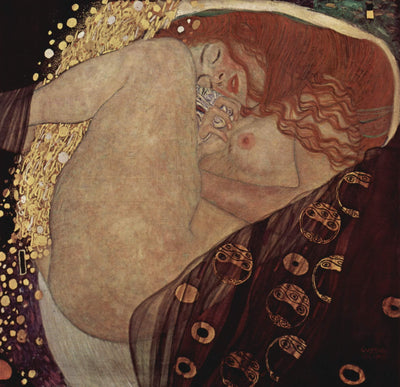
Then came his Danaë of 1907, curled up in a purple veil. In the myth Zeus visits the imprisoned princess as a shower of gold. Klimt paints that gold flowing between her legs and leaves no doubt about the look on her face. It is a small canvas, and it remains one of the most openly erotic pictures of his career.
Was The Kiss ever a scandal?

In its own time it barely was. The Kiss, finished in 1908, was shown that year at the Kunstschau under the title Liebespaar (Lovers), received with enthusiasm, and bought, still unfinished, by the Austrian government. It went to the Moderne Galerie, the museum that is now the Belvedere, and it has never left Vienna. Three years after he refused state money, the state paid him for his most famous picture.
The questions people ask about it now come from what you see. The couple kneels at the very edge of a flowering meadow that ends under the woman's bare feet. Her eyes are closed, one arm around his neck, her face turned up to take a kiss on the cheek. Some art historians read the scene as Orpheus losing Eurydice, since the woman looks slightly translucent, as if she were fading. The pair is often taken to be Klimt and his companion Emilie Flöge. The painting is 180 by 180 cm, laid over with gold and silver, and the same frankness that caused the Faculty scandal is here, only wrapped in pattern.
The scandal that came after him
The fight over Klimt did not end with his death. After the Anschluss of 1938, five Klimt paintings were seized from the Bloch-Bauer home, among them the golden portrait of Adele that Klimt had worked on from 1903 to 1907. It hung in Vienna for decades under a name, Dame in Gold, that erased the Jewish sitter's identity. Maria Altmann, a niece of Adele's husband Ferdinand, sued the Republic of Austria. In 2005 an Austrian arbitration panel ruled that the paintings go back to the heirs, and in 2006 Ronald Lauder bought the portrait for $135 million. It now hangs in the Klimt Gallery of a New York museum, and the case became the 2015 film Woman in Gold, with Helen Mirren as Altmann.
The Lederers, the family who had helped him buy back the Faculty Paintings, were caught in the same history. Their Portrait of Elisabeth Lederer (1914–1916) was seized by the Nazis and restituted to her brother Erich in 1948. On November 18, 2025 it sold at Sotheby's New York for $236.4 million, a new auction record for Klimt.
Was Gustav Klimt a good person?
A mixed answer, and it depends on what you weigh. He never married. He fathered at least fourteen children with different women, several of them his models, and after his death the legal rights of four of those children were recognized. His closest bond, with the fashion designer Emilie Flöge, whom he met in the early 1890s, was intimate and probably platonic.
What disease did Klimt have?
No long illness. On 11 January 1918 he had a stroke that paralyzed his right side. He died in Vienna on 6 February 1918 of pneumonia brought on by the Spanish flu, aged 55, and was buried in Hietzing Cemetery.
A century on, the man called a pornographer is on the short list of the paintings nearly everyone recognizes.
A little gold for your own wall
If one of these pictures stayed with you, the rest of his work in the collection is painted by hand in oil, from the gold portraits to the quieter canvases. Look at how the gold catches light and how the skin reads against the pattern; that is where a copy by hand shows the difference.
Sources
- Gustav Klimt Database, The Klimt Affair Surrounding the Faculty Paintings
- Medical University of Vienna, The Medicine by Gustav Klimt
- Theatermuseum Vienna, Nuda Veritas
- Vienna Secession, Beethoven Frieze
- Vienna Tourist Board, A Kiss Makes History
- Neue Galerie New York, Portrait of Adele Bloch-Bauer I
- Sotheby's, The New York Sales, November 2025