4.7/5


Famous ocean paintings start with Hokusai's Great Wave and Aivazovsky's Ninth Wave and run through Turner's fiery seas, Rembrandt's storm on the Sea of Galilee, Géricault's raft, Courbet's wall of green water, Monet's harbor at dawn and Winslow Homer's sailor among the sharks. Our sea paintings collection gathers these and many quieter seascapes. First comes a top 10 by the number of photos of each work on Wikimedia Commons, along with the water each one shows.
The ten below run from 1633 to 1899 and are grouped by what the water is doing in them: carrying a human drama, rising as a wave with nobody to fight it, or setting a mood. Seascapes are one branch of a bigger family, explained in our guide to the three types of landscape painting.
Which ocean painting gets photographed the most?
| Place | Seascape | Artist | Which water | 📷 Photos on Commons |
|---|---|---|---|---|
| 1 |  The Raft of the Medusa |
Théodore Géricault | Off West Africa, where the French frigate struck a sandbank | 69 |
| 2 | The Great Wave off Kanagawa | Katsushika Hokusai | Off Kanagawa in Japan, with Mount Fuji tiny in the distance | 40 |
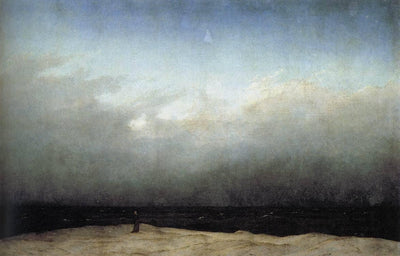
| 3 |  The Monk by the Sea |
Caspar David Friedrich | Not named; a pale dune, black water and a huge sky | 29 |
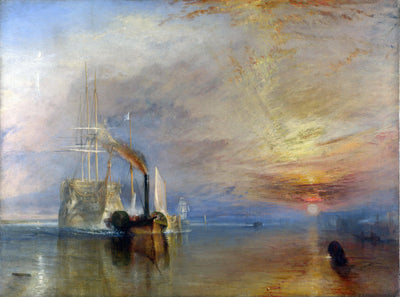
| 4 |  The Fighting Temeraire |
J.M.W. Turner | Not the sea at all: the River Thames | 23 |
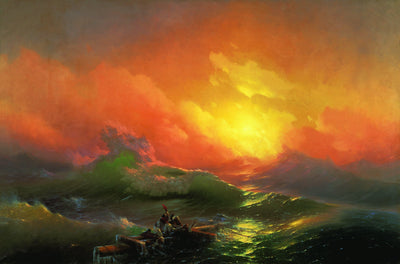
| 5 |  The Ninth Wave |
Ivan Aivazovsky | Not named; a rough sea lit by the dawn | 17 |
| 6 |  Christ in the Storm on the Sea of Galilee |
Rembrandt | The Sea of Galilee, during a storm from the Gospels | 14 |
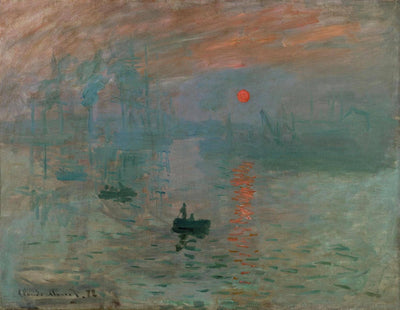
| 7 |  Impression, Sunrise |
Claude Monet | Le Havre harbor, early morning | 10 |
| 8 |  The Gulf Stream |
Winslow Homer | The Gulf Stream, drawn from Homer's trips to the Bahamas | 7 |
| 9 |  Slave Ship |
J.M.W. Turner | Not named; a sea with a typhoon coming on | 3 |
| 10 |  The Stormy Sea (The Wave) |
Gustave Courbet | The coast at Étretat, in Normandy | No data |
Each count is the number of pictures of the work that people have uploaded to Wikimedia Commons, as of October 2026. No count was found for the Courbet.
Turner shows up twice, far apart on the list, and one of his two scenes is not even at sea: the Temeraire is being towed up the Thames.
Storms and shipwrecks: the sea as a stage
01Christ in the Storm on the Sea of Galilee, Rembrandt (1633)

Zoom
The oldest picture here is also the only seascape Rembrandt ever painted. It follows the Gospel story of a storm that hits the disciples' boat on the Sea of Galilee while Jesus sleeps: light breaks through the clouds onto the rearing bow and the ripped sail, and the darker half of the boat holds the men gathered around Christ. One passenger looks straight out at us, and the Isabella Stewart Gardner Museum in Boston, which owns the oil on canvas of 160 × 128 cm (63.0 × 50.4 in), points out that his face resembles Rembrandt's self-portraits.
On March 18, 1990, thieves cut the canvas from its frame, and the empty frame still hangs in the museum's Dutch Room. Our hand-painted Storm on the Sea of Galilee follows the composition while the original stays lost; the rest of his career is in our guide to Rembrandt's most famous paintings.
02The Raft of the Medusa, Théodore Géricault (1818–1819)

Zoom
On July 2, 1816, the French frigate Méduse ran aground on the Arguin Shoal off West Africa. A raft about 20 meters long was built from spars and timber and towed behind the ship's boats until the men in them cut it loose. The Louvre puts about 150 people on it; Royal Museums Greenwich counts 146 men and one woman. When help came on July 17, after 13 days adrift, 15 were still alive, and Greenwich adds that five of them died within days.
Géricault interviewed two survivors, the ship's surgeon Henri Savigny and the engineer Alexandre Corréard, as Smarthistory recounts, and the Louvre adds that he used scale models, visited morgues and studied dying patients in hospital. He chose a moment Greenwich calls despair: on the last day the survivors sighted a ship that did not see them, though the Argus came to their rescue two hours later. The canvas, 491 × 716 cm (193.3 × 281.9 in), was thought scandalous at the Salon of 1819 and is now counted among the first great Romantic paintings. The Raft of the Medusa belongs to the Louvre, and the museum's other highlights are in our guide to famous paintings at the Louvre.
03Slave Ship, J.M.W. Turner (1840)

Zoom
Hand-painted oil reproductionSee sizes ›
Turner showed this canvas at the Royal Academy in 1840 as Slavers Throwing Overboard the Dead and Dying, Typhoon Coming On. The Museum of Fine Arts, Boston, which owns the canvas, 90.8 × 122.6 cm (35.7 × 48.3 in), says he drew on an 18th-century poem about a slave ship caught in a typhoon and on the Zong, whose captain in 1781 threw sick and dying enslaved people overboard to claim insurance. The color hits first; only then do you find the drowning bodies.
In December 1843 John James Ruskin bought the picture for his son, the critic John Ruskin. It went to a New York collector in 1872, Alice Sturgis Hooper of Boston bought it at his sale in 1876, and her nephew sold it to the museum in 1899. The Slave Ship is a hard painting to look at for long, and that is its force.
04The Gulf Stream, Winslow Homer (1899)

Zoom
Hand-painted oil reproductionSee sizes ›
The Metropolitan Museum of Art traces this picture to sketches and watercolors Homer made on winter trips to the Bahamas in 1884 and 1898. A sailor drifts on a fishing boat with no mast and no rudder, with only a few stalks of sugarcane to live on, while sharks circle with open jaws and a waterspout builds in the distance. Homer later added a schooner on the left horizon, a hint of rescue that the man on deck has not noticed.
The Met dates it 1899, reworked by 1906, the year it bought the canvas, 71.4 × 124.8 cm (28.1 × 49.1 in). It hangs in gallery 767. The Gulf Stream belongs with the pictures in our list of famous American paintings.
The wave as the subject
05The Great Wave off Kanagawa, Katsushika Hokusai (about 1830–32)

Zoom
The most famous wave in art is not a painting. It is a color woodblock print that Hokusai designed for his series Thirty-six Views of Mount Fuji, and the Met, which dates its impression to about 1830–32, catalogs it as Under the Wave off Kanagawa. The sheet measures 25.7 × 37.9 cm (10.1 × 14.9 in). Hokusai plays with perspective so that Japan's grandest mountain shrinks to a small triangle in the hollow of the wave, and his landscapes became famous for a palette of indigo and imported Prussian blue, a pigment his publisher advertised as new when the series appeared, as the Met's essay on the print explains.
“these waves are claws, the boat is caught in them, you can feel it.”
Vincent was answering his brother: Theo had reacted to Hokusai's waves with the words above, and Vincent replied that Hokusai draws that cry out of you with his lines and his drawing, and that making the color or the drawing "very correct" would not create such emotions (letter 676). Because it is a print, there was never one single original; the Met's impression came with the Havemeyer bequest in 1929.
06The Ninth Wave, Ivan Aivazovsky (1850)

Zoom
Hand-painted oil reproductionSee sizes ›
In oil paint, the wave with the best claim to fame is this one. The State Russian Museum calls it "probably Aivazovsky's most famous and popular work": oil on canvas, 221 × 332 cm (87.0 × 130.7 in), acquired for the Imperial Hermitage and among the first paintings of the Russian Museum in 1897. In popular legend, the museum notes on Google Arts & Culture, the ninth wave is the most terrible and destructive of all, yet the dawn light turns the scene toward survival. Our guide to famous Russian paintings tells the rest of its story.
Ask who is the most famous painter of the sea and Aivazovsky has the strongest claim: he was a marine painter for his entire working life. Born in 1817 in Feodosia, on the Crimean coast, he studied at the Imperial Academy of Arts from 1833 to 1838, became an academician in 1844, served as painter to the Russian Naval General Staff, and lived and worked in Feodosia, where he founded a picture gallery in 1880 and died in 1900, according to the Russian Museum's biography. The Ninth Wave is the canvas to start with.
07The Stormy Sea (The Wave), Gustave Courbet (1870)

Zoom
Hand-painted oil reproductionSee sizes ›
Courbet settled in Étretat, on the Normandy coast, in 1869 and brought back 20 seascapes, the Musée d'Orsay says. This one, oil on canvas, 116.5 × 160 cm (45.9 × 63.0 in), is built in three bands: the beach with two boats drawn up, the sea, and a sky that takes most of the canvas. He laid the water on with a knife in thick layers of dark green, and the museum points out that the little yacht on the horizon is in more danger than the boats on the shore.
He showed it at the Salon of 1870 beside The Cliff at Étretat after the Storm; the French state acquired it in 1878 for the Musée du Luxembourg, and it was assigned to the Orsay in 1986. In a passage the Orsay quotes, Guy de Maupassant wrote that the picture became known as The Wave and caused a stir. In any painted sea the foam is the hardest part, and the knife work in The Stormy Sea shows how it can be done.
The sea as a mood
08The Monk by the Sea, Caspar David Friedrich (1808–1810)
Friedrich removes almost everything: a strip of pale dune, a band of black water, a sky that fills most of the picture and one small figure with his back to us. He spent two years on it and kept painting things out, the museums' Friedrich portal notes, until little was left but those bands. The canvas, 110 × 171.5 cm (43.3 × 67.5 in), is in Berlin's Alte Nationalgalerie, and its companion, The Abbey in the Oakwood, is in the same collection. The king who bought the pair, the ships found under the paint and Heinrich von Kleist's review are in our guide to famous German paintings.
09The Fighting Temeraire, J.M.W. Turner (1839)
The Temeraire had fought at Trafalgar in 1805, "defending Nelson's flagship Victory," in the words of the National Gallery. In June 1838 the Admiralty ordered the decaying ship sold, and Turner shows her towed up the Thames to the breakers, pale as a ghost behind a squat black steam tug, while the sunset fills the right-hand third of the canvas. He showed it at the Royal Academy in 1839, and the picture, 90.7 × 121.6 cm (35.7 × 47.9 in), came to the gallery with the Turner Bequest in 1856.
The Fighting Temeraire is the calm counterpart to the Slave Ship above: the same painter, a year apart, mourning instead of accusing. The debate it caused and the rest of his weather, from snowstorms to steam trains, are in our guide to Turner's landscapes.
10Impression, Sunrise, Claude Monet (1872)

Zoom
Hand-painted oil reproductionSee sizes ›
Monet painted the port of Le Havre at dawn in a few fast strokes on a canvas of only 50 × 65 cm (19.7 × 25.6 in). When he was asked for a title for the catalogue of the 1874 group show, he judged that it could not decently pass for a view of Le Havre and called it Impression, the Musée Marmottan Monet explains. The critic Louis Leroy seized on the word in his mocking article "L'exposition des impressionnistes" in Le Charivari on April 25, 1874, and the label stuck to the whole group.
The painting has belonged to the Marmottan since 1940, a gift of Eugène and Victorine Donop de Monchy. Impression, Sunrise is the proof that an ocean painting can be about a few minutes of weather; the rest of his career is in our ranking of Monet's most famous paintings.
Painting under the water
Every picture above stays on the surface. The American Museum of Natural History calls Zarh Pritchard (1866–1956) probably the first artist to paint underwater: around 1905, off Tahiti, he worked with oil crayons on oil-soaked drawing paper fixed to a sheet of glass. The museum holds 13 of his oil paintings, many of them made underwater in Tahiti.
Storm or first light
These ten pull in two directions: the storms of Rembrandt, Géricault, Homer and Aivazovsky, and the quiet of Friedrich's shore and Monet's harbor at sunrise. Several of them also stand among the most famous paintings in the world, and our collection of sea paintings keeps both moods, from wrecks and breakers to calm water at dawn.
Sources
- The Met, Katsushika Hokusai, Under the Wave off Kanagawa (The Great Wave)
- The Met, Heilbrunn Timeline of Art History, The Great Wave: Anatomy of an Icon
- The Met, Perspectives, Hokusai and Debussy's evocations of the sea
- Van Gogh Letters, letter 676, Vincent to Theo van Gogh, Arles, 8 September 1888
- Isabella Stewart Gardner Museum, Rembrandt, Christ in the Storm on the Sea of Galilee
- Isabella Stewart Gardner Museum, The 1990 theft
- Musée du Louvre, Le Radeau de la Méduse (collection record)
- Musée du Louvre, The Raft of the Medusa (visitor trail)
- Royal Museums Greenwich, The Raft of the Medusa (print record with the history of the wreck)
- Smarthistory, Théodore Géricault, Raft of the Medusa
- Museum of Fine Arts, Boston, J.M.W. Turner, Slave Ship (Slavers Throwing Overboard the Dead and Dying, Typhoon Coming On)
- The Met, Winslow Homer, The Gulf Stream
- State Russian Museum (Virtual Russian Museum), Ivan Aivazovsky, The Ninth Wave
- State Russian Museum on Google Arts & Culture, The Ninth Wave
- State Russian Museum (Virtual Russian Museum), Ivan Aivazovsky, biography
- Musée d'Orsay, Gustave Courbet, La Mer orageuse (collection record)
- Musée d'Orsay on Google Arts & Culture, La Mer orageuse (The Stormy Sea) or La Vague (The Wave)
- Caspar David Friedrich portal (Hamburger Kunsthalle, Staatliche Museen zu Berlin, Staatliche Kunstsammlungen Dresden), Monk by the Sea
- National Gallery, London, J.M.W. Turner, The Fighting Temeraire, NG524
- Musée Marmottan Monet, Claude Monet, Impression, soleil levant (inv. 4014)
- Texas State University, Monet's Impression, Sunrise dated by astronomer Donald Olson (press release, 2014)
- American Museum of Natural History Library, Zarh Pritchard, 1866–1956 (archives record)