4.9/5


The most famous Rococo painters start with three French names, Antoine Watteau, François Boucher and Jean-Honoré Fragonard. To them you can add Giovanni Battista Tiepolo from Venice, who carried the style up onto palace ceilings. Three more painters worked in the same years, even if they didn't always paint the same way. They are Jean-Baptiste-Siméon Chardin, Élisabeth Vigée Le Brun and Thomas Gainsborough. Below, each of the seven gets the one picture that best explains them. You can see more in our collection of Rococo paintings. A quick chart puts the seven in order of how often English books mention them, and says what each one painted.
Rococo was a light, elegant style that began in Paris early in the 1700s. Its name comes from rocaille, the French word for the shells and rocks that lined man-made garden caves. It was a lighter answer to the heavy grandeur of King Louis XIV's palace at Versailles. Rococo loves curves shaped like the letters C and S, and it avoids perfect balance. Its colors are pale pastels with ivory and gold. In French painting, Watteau began it with his gently sad scenes. Boucher took it to its height with his playful nudes, and then Fragonard closed it with his freely painted scenes of everyday life.
The style it pushed against was the Baroque, and you can meet those painters in our guide to Baroque artists. The Baroque had broken away from the style before it, too, and you can see how in Baroque art next to the Renaissance.
Rococo painters ranked by how often books name them
| Rank | Painter | Known for | The painting to know | Mentions in books |
|---|---|---|---|---|
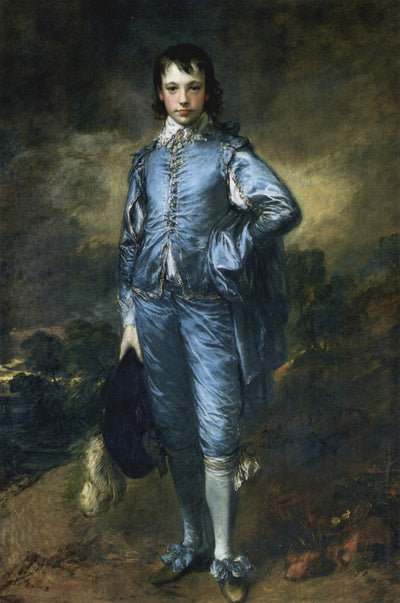
| 1 | Thomas Gainsborough | Portraits and landscapes in England |  The Blue Boy |
100 |
| 2 | Antoine Watteau | Elegant outdoor parties, with a feel for the theater |  Pilgrimage to Cythera |
49 |
| 3 | François Boucher | Shepherds and shepherdesses dressed in silk | Madame de Pompadour (also: Diana Leaving Her Bath) | 29 |
| 4 | Jean-Honoré Fragonard | Playful outdoor scenes, landscapes and portraits |  The Swing |
20 |
| 5 | Giovanni Battista Tiepolo | Huge painted ceilings full of sky | Apollo and Daphne (also: the Würzburg staircase ceiling) | 19 |
| 6 | Élisabeth Vigée Le Brun | Portraits of the French court, including Marie Antoinette |  Marie Antoinette in a Muslin Dress |
19 |
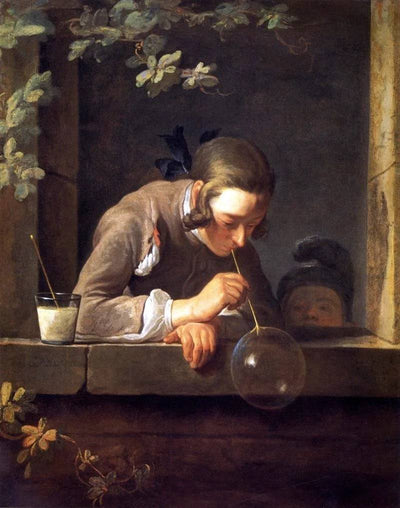
| 7 | Jean-Baptiste-Siméon Chardin | Quiet everyday scenes in thick, textured paint |  Soap Bubbles |
10 |
Ranked by how often English books from 2000 to 2019 mention each painter's full name (Google Books Ngram), with Gainsborough set at 100.
France: from Watteau to Vigée Le Brun
01Pilgrimage to Cythera, Antoine Watteau (1717)

Zoom
Antoine Watteau learned a lot from the theater. In Paris, starting around 1703, he worked for Claude Gillot. Gillot designed stage sets, and he painted scenes from Italian comedy plays. Later Watteau worked with a decorator who had a post at the Luxembourg Palace. There he could study a huge set of paintings by Rubens, and they left a deep mark on him.
This painting is also called The Embarkation for Cythera. In 1717 Watteau joined the Royal Academy of Painting and Sculpture, and this was the picture he gave it. It then hung in the Academy's meeting room at the Louvre for the rest of the 1700s. Its couples strolling down to the boat make it a classic fête galante. That means a party of elegant lovers relaxing outdoors. These dreamy scenes became a model for the painters who followed him.
Watteau died in 1721, when he was only 36. His painting is still in the Louvre, and you can find it among the museum's famous paintings.
02Madame de Pompadour, François Boucher (1756)

Zoom
François Boucher is the painter most closely tied to Rococo at its height, and he helped spread it across Europe. As a young man in the 1720s, he made prints of Watteau's drawings for a collector. He rose all the way to the top. In 1765 he became both the king's first painter and the head of the Royal Academy. His freshest idea was a new kind of country scene. In it, shepherds and shepherdesses in silk clothes act out love stories.
Madame de Pompadour asked Boucher for this portrait of herself. She was the official mistress of King Louis XV, and she gave him advice on politics. She wanted people to see her as beautiful and educated. So Boucher surrounded her with books, letters, sheet music and drawings. Early in 1756, the year of the portrait, she was also named a lady-in-waiting to the queen. That was a real position at court.
Boucher painted the gods of old myths, too. In Diana Leaving Her Bath from 1742, the goddess rests with a friend after the hunt. But in the end, critics turned against him. The writer Denis Diderot had mixed feelings about Boucher. In his review of the Salon of 1761, he wrote this line:
“That man is capable of everything, except the truth.”
By the 1750s the Rococo was already under attack in France. People found it silly and too full of decoration. Then in the 1760s a sterner style began to replace it, and you can read about it in our guide to Neoclassicism.
03Soap Bubbles, Jean-Baptiste-Siméon Chardin (about 1733–1734)

Zoom
Hand-painted oil reproductionSee sizes ›
Chardin is the balance on this list. While Boucher painted goddesses, Chardin painted simple objects and quiet moments at home, and his brushwork had a rich texture. He spent his whole life in his own part of Paris, Saint-Germain-des-Prés. Diderot, the same critic who had mixed feelings about Boucher, called Chardin the "grand magicien." That means the great magician.
Soap Bubbles, from about 1733 or 1734, shows how he worked. In earlier paintings from northern Europe, a person blowing bubbles was a warning that life is short. Chardin moved that old symbol into everyday life. Here a young man leans over a stone ledge to blow a bubble through a straw. A small child peeks over the edge to watch him.
He liked to repeat his best ideas, so there is more than one Soap Bubbles. Besides the one in New York, later versions belong to museums in Los Angeles and Washington. The Washington painting is taller, and it has vine leaves over the window.
04The Swing, Jean-Honoré Fragonard (1767–1768)
Fragonard trained with Boucher from about 1748, and later he went to study in Rome. Back in Paris, he made his name in 1765 with a large history painting. It was bought for King Louis XV. But after 1767 he almost stopped showing his work at the Salon. Instead he turned to landscapes, portraits and the romantic outdoor scenes people remember him for.
The Swing is the one everyone knows, and a writer named Charles Collé told how it began. Late in 1767 a gentleman of the court went to another painter, Gabriel-François Doyen. We don't know his name. He wanted a picture of his young mistress on a swing pushed by a bishop. He would be below, looking up at her legs. Doyen said no, and he suggested Fragonard instead.
In the finished painting, the man pulling the ropes is no longer a bishop. Fragonard also added a barking dog. A statue by Falconet called Menacing Love seems to comment on the scene. Her slipper flies off, and the young man in the bushes lifts his hat in reply. Few portraits rank higher among the great paintings of women.
The original and our hand-painted copy
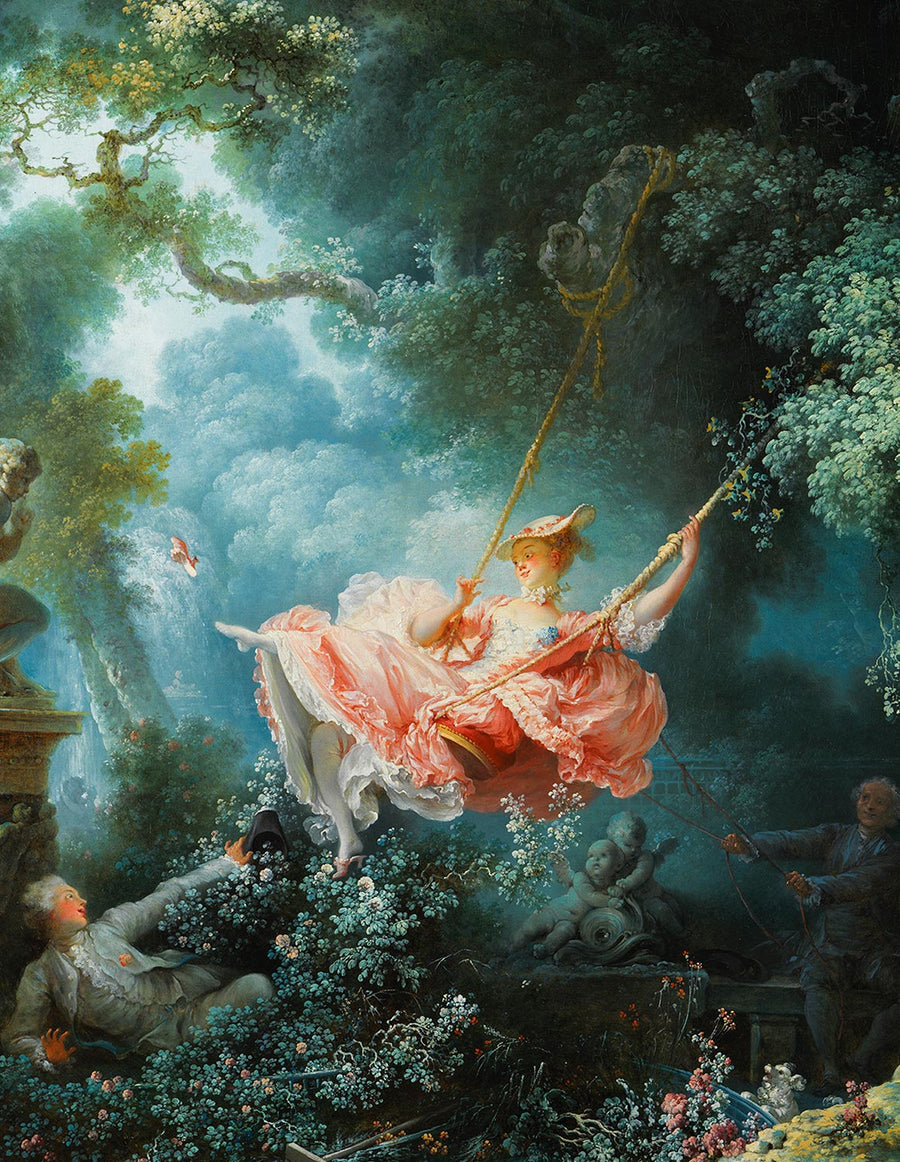
The original
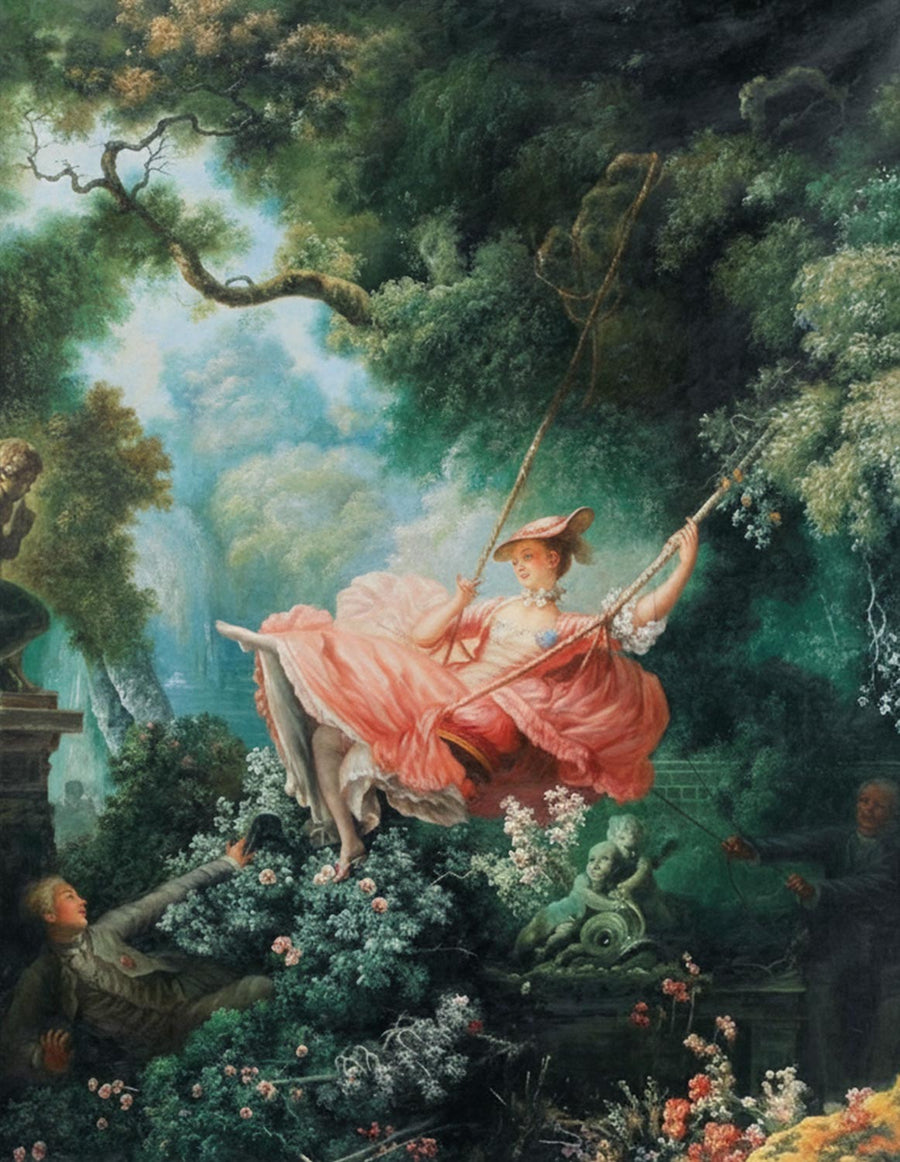
Our reproduction, painted by hand in oil
This painting marked a turn in his career. From then on he painted small, clever pictures for private buyers who knew art well. He no longer painted big history scenes for the king. One reason was that payments from the king's arts office had become a problem. Then the French Revolution took away his private buyers. He died in Paris in 1806, and hardly anyone noticed. He made more than 550 paintings, but only five of them have a date.
05Marie Antoinette in a Muslin Dress, Élisabeth Vigée Le Brun (1783)

Zoom
Hand-painted oil reproductionSee sizes ›
Vigée Le Brun painted the last years of the court that Rococo had decorated. In 1779 she was called to Versailles to paint Queen Marie Antoinette, and the two women became friends. She went on to paint the queen more than 20 times. At first her marriage to an art dealer kept her out of the Royal Academy. But the queen stepped in, and in 1783, at the age of 28, she joined it. She was one of only four women members.
That same year she showed her work at the Salon for the first time. One painting showed the queen in a loose dress of muslin, a light cotton cloth. Marie Antoinette liked to wear it at the Petit Trianon. But visitors felt the dress was beneath a queen's rank, so the painting was quickly taken down. Vigée Le Brun painted a new one in the same pose, this time in blue-gray silk. It was a quiet way to support the silk weavers of Lyon, and it was a success.
A copy of the portrait in the muslin dress belongs to the National Gallery of Art in Washington. We don't know who made it. Vigée Le Brun left France in 1789, and she lived abroad for 12 years. She painted in Naples, Vienna, St. Petersburg and Berlin. By her own count she made about 900 pictures, and some 600 of them were portraits. You can read more of her life among history's great women artists.
Venice and England
06Apollo and Daphne, Giovanni Battista Tiepolo (1741)

Zoom
Hand-painted oil reproductionSee sizes ›
In Italy, the Rococo lived mainly in Venice, and Tiepolo's huge decorative paintings show it at its fullest. In 1736 a count named Tessin was looking for a painter for the royal palace in Stockholm. He described Tiepolo as "full of spirit . . . of infinite fire, dazzling colour, and astonishing speed."
Tiepolo's frescoes are paintings made on wet plaster. They carry on the Baroque habit of painting ceilings, but they feel light and elegant in the Rococo way. His biggest one is in Germany, over the grand staircase of a palace in Würzburg. He painted it in 1752 and 1753. At about 600 square meters, it is the largest ceiling fresco ever painted. Royal-looking women stand for America, Asia and Africa. The star is Europe, with the Würzburg court shown as a center of the arts.
For Tiepolo at a smaller size, look at Apollo and Daphne from 1741. It was probably painted for a collector in Florence. Apollo lunges toward Daphne as laurel leaves sprout from her raised hand. Below her, an old man with an oar crouches low.
07The Blue Boy, Thomas Gainsborough (1770)

Zoom
Hand-painted oil reproductionSee sizes ›
England picked up the Rococo in the 1740s, and Gainsborough learned it close to the source. He went to London at 13, and there he worked as a helper to Hubert Gravelot, a French painter and engraver. From him he picked up the French Rococo style that runs through his early landscapes. In 1759 he moved to Bath, where there were plenty of fashionable people to paint.
The Blue Boy comes from his years in Bath, and he painted it in 1770. It was his first try at a full-length figure in the kind of clothes seen in Van Dyck's portraits. The young man wears knee breeches, a jacket with slits and a lace collar. It was shown at the Royal Academy that year, and people compared it with Van Dyck. That helped make Gainsborough's name in London.
Cleaning and repair work in 2018 and 2019 showed how the shimmering blue was built up. Gainsborough mixed several blue paints called ultramarine, smalt and Prussian blue, and he possibly used azurite too.
A style made for rooms people lived in
Rococo began as decoration for the new townhouses of noble families in Paris. Several of the pictures above were also made for private eyes. Pompadour ordered her own portrait, and The Swing started as one courtier's request. That is one reason the work of these famous Rococo painters still sits easily on a living-room wall. For the wider story, start with art's best-known masterpieces. Then come back to our Rococo collection for more Watteau, Boucher and Fragonard.
Sources
- Louvre Collections, Watteau, Pèlerinage à l'île de Cythère
- Louvre Collections, Boucher, Diane sortant du bain
- Alte Pinakothek, Boucher, Madame de Pompadour
- The Met, Heilbrunn Timeline: François Boucher (1703–1770)
- The Met, Chardin, Soap Bubbles
- National Gallery of Art, Chardin, Soap Bubbles
- Wallace Collection, Les hasards heureux de l'escarpolette (The Swing)
- Wallace Collection on Google Arts & Culture, The Swing
- Château de Versailles on Google Arts & Culture, Marie-Antoinette, Queen of France
- The Met, Vigée Le Brun: Woman Artist in Revolutionary France
- National Gallery of Art, Marie-Antoinette (after Vigée Le Brun)
- Louvre Collections, Tiepolo, Apollon et Daphné
- Bavarian Palace Administration, Würzburg Residence: the staircase
- The Huntington, Gainsborough, The Blue Boy
- Britannica, Rococo
- Britannica, Fête galante
- Britannica, Antoine Watteau
- Britannica, François Boucher
- Britannica, Jean-Baptiste-Siméon Chardin
- Britannica, Jean-Honoré Fragonard
- Britannica, Élisabeth Vigée-Lebrun
- Britannica, Giovanni Battista Tiepolo
- Britannica, Thomas Gainsborough
- The Met, Heilbrunn Timeline: American Rococo