4.9/5


The Pre-Raphaelite Brotherhood was a secret society of six young London artists and one writer, formed in 1848, who wanted English painting to look the way art had looked before Raphael: bright, sharply drawn, studied from real faces and real plants, and full of stories to read. Their Pre-Raphaelite paintings outraged critics in the 1850s; today Tate counts them among the most popular works in its collection. First, a quick roll call sets out all seven, the part each one played, a picture to know them by and how often English books name them.
The Brotherhood itself soon broke up, but the way of painting it started, in which a nettle at the edge of the canvas gets as much care as the face at its center, carried on through Rossetti, Burne-Jones, William Morris and Waterhouse until the end of the century.
The seven founders and what each one brought
| Founder | Part in the group | Work to know | Book mentions (Millais = 1) |
|---|---|---|---|
| Dante Gabriel Rossetti | One of the three Academy students who led it, and the son of an Italian revolutionary | Ecce Ancilla Domini! | About 5, but that count covers every Rossetti, his sister and brother included |
| John Everett Millais | A leader at 19, after joining the Academy Schools at 11 as their youngest student ever | Ophelia | 1 |
| William Holman Hunt | The third leader, who had watched the Chartists march on Parliament with Millais | The Light of the World | No data, because the count for "Hunt" sweeps in every other Hunt |
| William Michael Rossetti | The writer of the seven and editor of their magazine, The Germ | No painting; The Germ ran for four issues | Folded into the Rossetti count above |
| James Collinson |  A painter who left when Christ in the House of His Parents was called blasphemy |
None named in this guide | No data |
| Frederic George Stephens | One of the two painters who joined the core trio | None named in this guide | No data |
| Thomas Woolner | The only sculptor, who moved to Australia when money ran short | No painting; his friends sent him portraits of one another | No data |
The book numbers come from Google Books Ngram, averaged over 2000 to 2019 and searched by surname only, with Millais counted as 1.
Ford Madox Brown, who painted Work, stood close to the group but was never one of the seven, so he is not on this list.
Who founded the Pre-Raphaelites, and when
Tate dates the founding to November 1848, a year when revolutions were breaking out across Europe. Three students at the Royal Academy Schools led it. Dante Gabriel Rossetti was the son of an Italian revolutionary. John Everett Millais, 19 that year, had been admitted to the Academy Schools at 11, the youngest student they ever took. William Holman Hunt had watched, with Millais, as Chartist campaigners marched on Parliament to demand rights for workers. Four more joined to make seven: Rossetti’s younger brother William Michael, a writer; the painters James Collinson and Frederic George Stephens; and the sculptor Thomas Woolner. A blue plaque at 7 Gower Street celebrates the founding.
They were short of money and long on attitude. Tate’s guide to its Rossettis exhibition records their nickname for the Academy’s founder, Sir Joshua Reynolds: “Sir Sloshua,” a jab at the generic, conventional style the schools taught. They signed their first pictures with the initials PRB and refused to explain them; by 1850 the meaning had leaked. One of those first pictures was Millais’s Isabella, begun just after the founding and now at the Walker Art Gallery in Liverpool. It illustrates a poem by John Keats, and the tragedy is already planted in the details: the lovers share a blood orange, and one of Isabella’s brothers is aiming a kick at her dog.
What “Pre-Raphaelite” means
The name is aimed at Raphael (1483–1520). The Royal Academy taught his graceful, balanced compositions as the summit of painting, and to the Brotherhood that formula had gone stale. For the style they were reacting against, see our guide to Raphael’s art style. They looked further back, to medieval and early Renaissance painters and above all to frescoes, borrowing their flat compositions and minute detail and giving a figure and the ground around her equal weight.
In practice they painted onto a white ground, which kept their colors startlingly bright, and drew forms with sharp outlines and little shadow. Much of their thinking came from John Ruskin’s Modern Painters (1843), which urged artists to go to nature; according to the Ashmolean, they skipped its praise of Turner’s landscapes and kept the philosophy. That put them close to the painters of realism, who were also insisting on what was really in front of them, but the Pre-Raphaelites kept their Bible stories and poems. They came of age as Romanticism was ending (Tate dates that movement about 1780 to 1830), shared its taste for Keats and medieval legend, and painted those stories in hard, even focus.
How to recognize a Pre-Raphaelite painting
- Color that glows. Pure, little-mixed colors over a white ground, with few dark shadows.
- Everything in focus. A flower at the edge gets the same care as the face in the middle. Tate curator Alison Smith compares the effect to “a high definition film, where the whole depth of field is sharp.”
- A story from a book. The Bible, Shakespeare, Dante, Keats, Tennyson and medieval romance supply most subjects.
- Symbols to decode. Tate calls the pictures “so densely encoded with signs and symbols that you have to work hard at deciphering them.”
- Real people in real places. Friends and family as models; actual rooms, rivers and workshops as settings.
- Later on, a recognizable woman. In Rossetti’s circle after about 1860: a long neck, heavy loose hair and large, serious eyes.
Key works of the Brotherhood
Six pictures from the first ten years show the range, from a scandalous Holy Family to a modern morality tale.
Christ in the House of His Parents, Millais (1849–50)

Zoom
Millais showed it at the Royal Academy in 1850 with an Old Testament verse read as a forecast of the Crucifixion: “What are these wounds in thine hands?” According to a Tate teachers’ pack, he lived for a short time in a real carpenter’s shop on Oxford Street, gave Joseph his own father’s face and painted the flock in the background from sheep’s heads bought at a butcher’s. The tools and timber all point ahead to the Cross. The canvas, 86.4 × 139.7 cm (34.0 × 55.0 in), is at Tate Britain, and you can see a hand-painted reproduction of the carpenter’s shop.
Critics read the realism as an insult. Charles Dickens attacked it in his weekly Household Words that June, telling readers to prepare for “the lowest depths of what is mean, odious, repulsive, and revolting,” and describing the boy at the center like this:
“a hideous, wry-necked, blubbering, red-headed boy, in a bed-gown”
Mary fared no better: Dickens called her “so horrible in her ugliness” that she would stand out as a monster in the lowest gin-shop in England.
Ecce Ancilla Domini!, Rossetti (1849–50)
Rossetti’s first three oil paintings all used his sister, the poet Christina Rossetti, as a model, and here she is Mary. Tate points out how unusual the setting is: Mary is in her bedroom, the angel has woken her, and her wide eyes and shrinking pose read as anxiety rather than calm acceptance. The picture is small, 72.4 × 41.9 cm (28.5 × 16.5 in), almost entirely white, and hangs at Tate Britain.
Ophelia, Millais (1851–2)

Zoom
Tate’s account of Ophelia explains that Millais painted it in two places. The riverbank came first, outdoors on the Hogsmill River at Ewell in Surrey; because he worked there over five months, flowers that bloom in different seasons appear side by side. The figure came afterward, in his studio on Gower Street.
The model was Elizabeth Siddal, then 19. From December 1851 to the end of March 1852 she lay in a bath of water kept warm by oil lamps underneath. Once the lamps went out, Millais did not notice, Siddal said nothing, and she caught a cold; her father sent Millais the doctor’s bills, £50. The silver-embroidered dress she wore cost Millais four pounds secondhand.
The picture was sold before it was finished: the dealer Henry Farrer bought it on 10 December 1851 for 300 guineas, and it went on show at the Royal Academy in 1852. Tate, which received it with Henry Tate’s gift of 1894, measures it at 76.2 × 111.8 cm (30.0 × 44.0 in). It also appears among our famous paintings of women, and Millais’s Ophelia is available as a hand-painted canvas.
The Awakening Conscience, Hunt (1853)

Zoom
Hand-painted oil reproductionSee sizes ›
Hunt’s modern-life picture shows a wealthy man in the apartment he keeps for his mistress. The song he is idly playing reminds her of her earlier life, and she starts up toward the bright world reflected in the mirror. Tate’s labels list the clues: a cat toying with a bird, a female figure trapped under a glass dome, no wedding ring, and a glove dropped on the floor that hints at how he will discard her. It measures 76.2 × 55.9 cm (30.0 × 22.0 in) and hangs at Tate Britain; there is also a hand-painted reproduction of The Awakening Conscience.
Royal Academy visitors in 1854 did not get it. Ruskin wrote to The Times that people gazed at it “in a blank wonder” and left “hopelessly,” then explained it object by object, down to the glossy new rosewood furniture: “There is not a single object in all that room... but it becomes tragical, if rightly read.”
The Light of the World, Hunt (1851–53)

Zoom
Hunt’s other picture at the 1854 Academy was religious. Christ stands outside before dawn holding a lantern and knocks at a door with rusty nails and hinges, choked with ivy and without a handle on the outside. Keble College, Oxford, which owns the original, reads the two lights this way: the lantern is conscience, the halo is salvation, and the door is the human soul, which cannot be opened from outside. Ruskin defended this one in The Times too, after standing beside it for more than an hour and watching the few visitors who stopped react, almost always with contempt, to the idea of Christ carrying a lantern.
Hunt began it in 1851, and Keble dates the finished picture to 1853. Martha Combe, widow of the University Press superintendent Thomas Combe, gave it to the college, where it hangs in the Side Chapel; a button on the wall lights it. Engravings and a later version that toured the British Empire made it one of the most widely shared images of the Victorian age, and a larger replica that Hunt painted when he was nearly 70 now hangs in St Paul’s Cathedral. It is also one of the famous paintings of Jesus in our guide.
Work, Ford Madox Brown (1852–65)

Zoom
Hand-painted oil reproductionSee sizes ›
Brown was never one of the seven, but he belonged to their circle, and Work is the strongest case for Pre-Raphaelite detail turned on modern life. The idea came from navvies he saw digging a drain in Hampstead while he was reading Thomas Carlyle’s Past and Present. At the right stand Carlyle himself and F. D. Maurice, founder of the first college for working men: the “brainworkers” set against the laborers. The Leeds industrialist Thomas Plint, who commissioned the picture, asked for the two portraits; Brown had first put himself in that spot. Manchester Art Gallery dates the canvas 1852 to 1865, and you can order Brown’s Work as a hand-painted reproduction.
What happened to the Brotherhood
It came apart quickly. James Collinson had left Catholicism for the Church of England to become engaged to Christina Rossetti; he went back to his old faith and left the circle when Christ in the House of His Parents was publicly accused of blasphemy. Woolner, struggling to make a living, emigrated to Australia, and the friends he left behind painted portraits of one another to send him. Their magazine, The Germ, edited by William Michael Rossetti, first appeared on 1 January 1850, promised “an entire adherence to the simplicity of nature,” printed poems by Christina, and lasted four issues.
The rescue came from Ruskin. In May 1851 The Times reviewed Millais and Hunt in a tone he called “scornful as well as severe,” and he answered with two letters to the editor, dated 9 and 26 May. The second ended with a prediction:
“they may, as they gain experience, lay in our England the foundations of a school of art nobler than the world has seen for three hundred years”
Tate dates the Brotherhood to 1848–53. By then the members were going their own ways. Millais moved to a broader, looser style and in time collected a baronetcy and the presidency of the Royal Academy, the very institution the seven had set out to overturn.
The second wave: Rossetti, Burne-Jones and Morris
In 1857 Rossetti talked his way into decorating the new debating hall of the Oxford Union, offering to paint it for board, lodging and unlimited soda water. The Ashmolean calls the result a second Pre-Raphaelite Brotherhood: seven artists, among them two young Oxford men, William Morris and Edward Burne-Jones, painting Arthurian scenes on the upper walls. The murals faded fast, because the painters worked straight onto the walls without preparation, and the group abandoned them at the end of the summer vacation. In 1861 Morris and his friends founded the interiors firm Morris, Marshall, Faulkner & Co., where, as the V&A puts it, everything was to be crafted by hand, against the mainstream faith in industrial progress.
Tate sees a second phase of the style beginning around 1860, inspired above all by Rossetti and feeding into Symbolism. Its central image is Rossetti’s Beata Beatrix (c. 1864–70), painted after Elizabeth Siddal, by then his wife, died in 1862 of an overdose of laudanum, a drug made from opium. Rossetti cast her as Beatrice, the woman whose death the poet Dante mourned. A bird drops a white opium poppy into her open hands, and a sundial marks the hour. The canvas is 86.4 × 66 cm (34.0 × 26.0 in) and hangs at Tate Britain; it also has a place among our famous love paintings.

Zoom
Hand-painted oil reproductionSee sizes ›
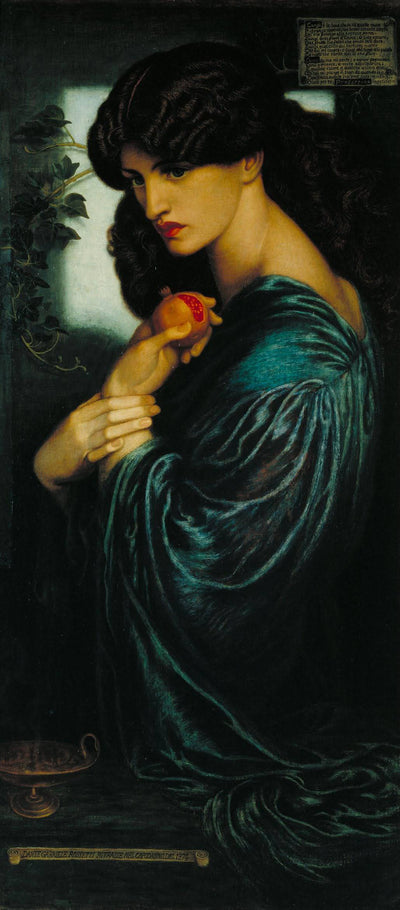
In Proserpine (1874, Tate), Jane Morris is the goddess who ate pomegranate seeds in the underworld and must return there for six months of every year. Burne-Jones built his own dreamier world, as in The Golden Stairs (1880, Tate), a procession of young women with musical instruments descending a curving stair. A generation later John William Waterhouse took the look into the late 1880s with The Lady of Shalott (1888), from Tennyson’s poem; Henry Tate presented it to the nation in 1894.

Zoom
Hand-painted oil reproductionSee sizes ›
The women who posed and painted
Elizabeth Siddal was working in a hat shop near Leicester Square when Walter Deverell discovered her. Her boyish looks made her his Viola in a Twelfth Night picture, and she went on to sit for Millais and Rossetti. She also wanted to paint and write. Collectors competed for her inventive scenes as well as Rossetti’s, Ruskin agreed to buy their work, she attended the Sheffield School of Art, and in 1857 she showed her own pictures beside Rossetti’s in an exhibition of Pre-Raphaelite art seen in London and New York. They married in 1860. One of her pen-and-ink drawings, two men in a boat with a woman punting, is in the Ashmolean in Oxford.
Jane Burden was the daughter of an Oxford stableman. The artists spotted her at an Oxford theater during the Union project; she modeled for Guinevere on its walls, married Morris in 1859 and became Rossetti’s most frequent model. Other women worked inside the movement as artists: Birmingham Museum & Art Gallery shows Emma Sandys, Kate Bunce and Joanna Boyce Wells, and the Delaware Art Museum owns Marie Spartali Stillman’s Love’s Messenger. For more women who built careers in painting before the twentieth century, see our guide to famous female artists.
Where to see Pre-Raphaelite paintings
Most of the key pictures are in British public collections, and several of them are free to visit.
| Museum | City | What to look for |
|---|---|---|
| Tate Britain | London | The Beauty as Protest rooms, with Christ in the House of His Parents, Ecce Ancilla Domini!, The Awakening Conscience, Beata Beatrix and Proserpine; Ophelia and The Lady of Shalott also belong to Tate |
| Birmingham Museum & Art Gallery | Birmingham | What the museum calls the world’s largest collection of art and design by the Pre-Raphaelites and their followers; over 60 works in four refurbished galleries, free entry |
| Manchester Art Gallery | Manchester | Ford Madox Brown’s Work |
| Walker Art Gallery | Liverpool | Millais’s Isabella |
| Ashmolean Museum, Keble College and the Oxford Union | Oxford | The Combe bequest of early Pre-Raphaelite works and a Siddal drawing; The Light of the World at Keble; the 1857 murals at the Union |
| Delaware Art Museum | Wilmington, Delaware | Samuel Bancroft’s collection, which the museum calls the premier Pre-Raphaelite collection outside the UK, including Rossetti’s Lady Lilith and Found |
Bringing the Brotherhood home
These pictures were made to be read slowly, one flower or one dropped glove at a time, which suits a wall you pass every day. Our Pre-Raphaelite paintings collection gathers hand-painted reproductions of many of these works and more from the circle, and our famous paintings page sets them beside the rest of art history.
Sources
- Tate, Pre-Raphaelite (art term)
- Tate, Think you know the Pre-Raphaelites?
- Tate, Why were the Pre-Raphaelites so shocking?
- Tate Britain, Beauty as Protest 1845–1905 (gallery labels)
- Tate, The Rossettis exhibition guide (2023)
- Tate, Millais exhibition teachers’ pack (2007)
- Tate, The Story of Ophelia
- Tate, Millais, Ophelia (collection record)
- Tate, Millais, Christ in the House of His Parents (collection record)
- Tate, Rossetti, Ecce Ancilla Domini! (collection record)
- Tate, Hunt, The Awakening Conscience (collection record)
- Tate, Rossetti, Beata Beatrix (collection record)
- Tate, Waterhouse, The Lady of Shalott (collection record)
- Charles Dickens, “Old Lamps for New Ones,” Household Words No. 12, 15 June 1850 (Project Gutenberg)
- John Ruskin, Arrows of the Chace, vol. 1: letters to The Times, 1851 and 1854 (Project Gutenberg)
- Keble College, The Light of the World
- Keble College, Copyright History and The Light of the World
- Manchester Art Gallery, Ford Madox Brown, Work (collection record)
- Manchester Art Gallery, Brown, Ford Madox: Work
- Manchester Art Gallery, Work and Studies for Work
- National Museums Liverpool, Millais, Isabella
- Ashmolean Museum, Oxford and the Pre-Raphaelites
- Birmingham Museums, The Pre-Raphaelites
- Delaware Art Museum, British Pre-Raphaelites
- V&A, Introducing William Morris
- Apollo, Rossetti’s Obsession: Images of Jane Morris
- North East Museums, Pre-Raphaelites: Art and Poetry
- Art Fund, A Call to Art: William Morris and the Pre-Raphaelites