4.9/5
4.9/5


Stand in front of a Klimt and you get two paintings at once. There's a face, soft and carefully modeled, with pink in the cheeks and shadow under the eyes. Then there's everything around it: flat fields of gold, spirals, checkerboards, eyes in triangles, flowers pressed into a pattern. Klimt's art style lives in that collision between a real person and a surface that refuses to pretend it's real space. Once you see it, you can pick out a Klimt across a room, and you can tell roughly when he painted it.
Below are the signs to look for, then the three stretches of his career where they change, with the works that make each one obvious. If you'd rather browse while you read, the Klimt paintings people hang at home are all in one place.
What type of art style is Klimt?
Klimt was a Symbolist painter and the leading figure of the Vienna Secession, the group of artists who broke away from Vienna's conservative Künstlerhaus in 1897 and elected him their president. He didn't start there. Born in 1862 near Vienna, the son of a goldsmith and engraver, he trained at the School of Arts and Crafts from 1876 and spent the 1880s painting ceilings and staircases in the Neo-Renaissance manner with his brother Ernst and Franz Matsch. The Burgtheater staircases were theirs.
That decorator's training never left him. What changed around 1900 was what he did with it. The 1902 Beethoven Frieze, a 34-meter cycle painted for the Secession's 14th exhibition, already has the grammar of everything that followed: figures isolated on a flat wall, line doing the storytelling, ornament taking over whole zones of the picture. Nearly 60,000 people came to see that show.
So the short answer: Symbolism in subject (love, death, desire, the cycle of life), Secession in method, with a craftsman's obsession with materials that no other painter of his time shared.
Four things that give him away
A real face inside a flat pattern
This is the big one. Klimt paints skin, hands and hair with care, then wraps them in clothing and backgrounds that have no depth at all. In the embracing couple on the flower meadow, the two bodies merge into one golden mass. The only thing telling his body from hers is the pattern on each robe. You read the faces as people and the rest as a jewel.
Actual metal on the canvas
The gold isn't yellow paint. Klimt used gold leaf, silver, platinum and gold powder bound in oil so he could brush it on. The figures in The Kiss carry gold, silver and platinum leaf; the background is beaten brass glazed over, with flakes of metal scattered across it like dust. It changes as you walk past it, which is why photographs of these pictures always look a bit dead.
Ornament borrowed from far away
Byzantine mosaics, Egyptian motifs, Japanese lacquer and East Asian painting all end up in his surfaces. Look at the dress in Adele Bloch-Bauer's first portrait and you'll find eyes set inside golden triangles, and her initials worked in low relief into the cloak. For the dining room of the Stoclet house in Brussels he wrote on his full-size drawings that only the finest materials should be used, meaning enamel, mother-of-pearl and gold leaf.
A square canvas
The Kiss is 180 by 180 cm. Most of his landscapes are square too. It's an odd choice for a painter of the period, and it pushes everything toward pattern: no horizon pulling your eye sideways, just a field to fill edge to edge.
The golden phase, 1901–1909
His first big use of real gold leaf came in Judith I in 1901, a biblical heroine painted as a femme fatale, half patriot and half man-eater. The gold was there from the start. What turned it into a full style was Italy.
In 1903 Klimt went to Ravenna twice, in May and again from late November into December, traveling with the painter Maximilian Lenz. The sixth-century mosaics at San Vitale hit him hard. Lenz wrote that "the golden, shimmering mosaics of the churches of Ravenna exert an enormous, decisive influence on him." You can see it in the Portrait of Fritza Riedler of 1906, in the Stoclet Frieze he designed from 1905 onward, and most of all in his golden portrait of Adele Bloch-Bauer, begun in 1903 and finished in 1907 in oil, gold and silver. That picture is on permanent view in New York since Ronald S. Lauder bought it in 2006.

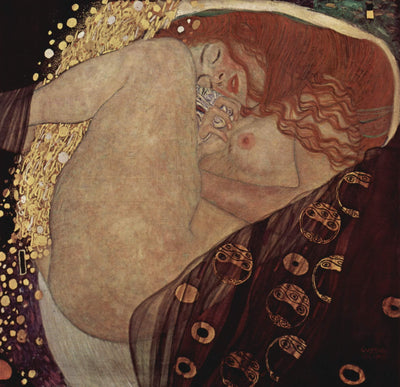
Then the gold turns erotic. His curled-up Danaë of 1907/08 takes a myth about a rape and paints pleasure instead, eyes closed, lips parted. (Vienna had already been fighting him for years over his nudes; the scandals behind his university paintings are their own story.)
The Kiss closes the chapter. Klimt showed it unfinished at the Kunstschau Wien in 1908, where he hung 16 paintings and 18 drawings across three rooms. The Austrian state bought it there for 25,000 crowns, and he took it back to the studio to finish it in 1909. The high point and the end of the gold years are the same picture.

After the gold: color takes over
A year later, at the 1909 Kunstschau, Klimt's pictures hung alongside van Gogh, Gauguin, Matisse and Munch. You can feel him looking. The metal fades out and bright color moves in, along with patterns taken from Asian textiles and prints.
The clearest bridge is Death and Life, started in oil in 1910. On the left stands death, a skeleton in an ornamented cloak. On the right, lovers, a mother with her baby and an old woman melt into a single patterned oval of color. When it won a gold medal in Rome in 1911, the background was still gold. In 1915 Klimt went back and painted it over in gray, and made death more aggressive, raising a small red club. The version hanging in Vienna today is the gray one, and that single change tells you where his style was going.

The late portraits push this as far as it goes. Friederike Maria Beer (1916) almost disappears into her patterned clothes, and behind her Klimt packs the background with small figures in an Asian style until they blur into one tapestry. Elisabeth Lederer, painted 1914–1916, stands in white against groups of Asian figures; she's also the sitter behind the record set for his work at auction. The faces stay careful. Everything else flickers into separate patches of color.
How to spot late Klimt, then: no gold, hot pinks and greens, fashionable clothes, and a background that's full rather than empty. Several of these were never finished. On 11 January 1918 he had a stroke, and he died on 6 February, leaving The Bride and Adam and Eve unfinished in the studio.
Lakes and forests, seen the same way
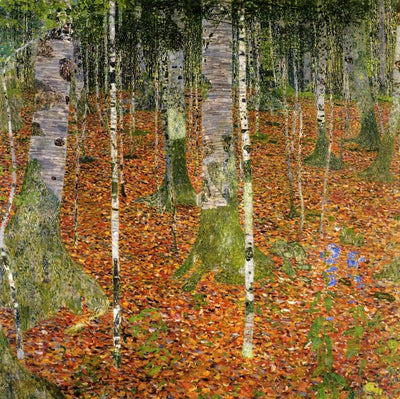
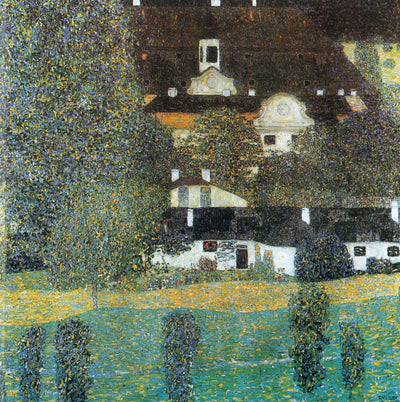
Klimt painted landscapes every summer, mostly on the Attersee, where he stayed with the Flöge family from 1900. They follow the portraits closely. Early forests like his birch trunks against a carpet of leaves use pointillist dots and flatten nature into a screen of vertical stripes. Later lakeside views such as the castle at Kammer seen from the water lean toward van Gogh, whose brushwork shaped that whole series. Both are square, both have almost no sky. There's more on the summers he spent painting the lake in a separate piece.
If you're building a wall around one painter, Klimt sits comfortably next to the hundred or so canvases everyone recognizes, and he's the one guests ask about first.
Bringing the gold home
Klimt is hard to copy well because the metal matters. A good hand-painted version builds the gold in layers so it catches light the way the original does, and keeps the faces soft against the flat pattern. If one of these periods is the one you keep coming back to, every Klimt the studio paints by hand is gathered on a single page, from Adele to the Attersee.
Sources
- Belvedere, The Kiss (Lovers), collection record
- Belvedere, Why did Gustav Klimt use gold?
- Klimt Foundation database, Biography
- Klimt Foundation database, The Final Years
- Neue Galerie, Portrait of Adele Bloch-Bauer I
- Leopold Museum, Death and Life
- MAK, Stoclet Frieze working drawings
- Secession, Beethoven Frieze