4.9/5


Romanticism in art is the European movement, running from the late 1700s to the middle of the 1800s, in which painters made strong feeling, private imagination and the frightening power of nature the real subject of a picture, in place of the order and restraint of classical art. It gave us a demon squatting on a sleeper, a firing squad at night, a raft of dying castaways and a lone walker above the clouds, and you can find many such canvases in our collection of Romanticism paintings, hand-painted in oil. Just below the quick facts, a chart pairs each of the five traits with the Neoclassical habit it pushed against and one of the seven paintings.
This guide explains where the movement came from, lists five traits you can spot on a canvas, names the leading painters country by country and then looks closely at seven pictures, with dates, sizes and locations taken from the museums that own them.
Five Romantic traits set against Neoclassicism
| Romantic trait | The Neoclassical way | The Romantic way | Painting to check |
|---|---|---|---|
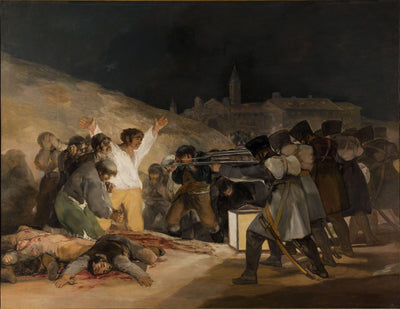
| 1. Emotion before reason | Order, calm and balance come first. | Feeling leads, with brushwork you can see and hard contrasts of light and dark. |  The Third of May 1808, where a lantern lights a man with his arms flung wide |
| 2. Nature as something to fear | Harmony and an idealized, perfect world | Storms, peaks and seas that dwarf people and fill them with awe or terror |  Wanderer above the Sea of Fog, where one man looks over peaks rising from the fog |
| 3. The news, painted big | The largest canvases go to history scenes with a moral lesson. | Things that had just happened, like a shipwreck or a street fight, get the same huge size. |  The Raft of the Medusa, 491 × 716 cm, finished about three years after the wreck |
| 4. Far away, long ago and uncanny | Lessons from Greek and Roman history | Dreams, faraway lands and the weird or the monstrous |  The Nightmare, where a demon squats on a sleeping woman |
| 5. The artist's own eye | Formal rules guide the picture. | The painter's own spirit counts for more than the rules. |  The Hay Wain, built in the studio from years of Constable's open-air sketches |
The Neoclassical side comes from what Britannica and the Met say Romanticism turned against, as quoted further down.
The other two paintings fit more than one row. Liberty Leading the People mixes the news with myth, and The Slave Ship joins the true story of the Zong to a raging typhoon.
Where Romanticism came from
Britannica derives the name from the medieval romance, a tale of chivalric adventure, and describes Romanticism as an outlook that shaped Western literature, painting, music, architecture and history writing from the late 18th to the mid-19th century. It turned against the order, calm, harmony, balance and idealization of Classicism, and to some extent against the Enlightenment’s faith in reason. The Met’s Heilbrunn Timeline ties that turn to disillusionment with Enlightenment values in the aftermath of the French Revolution of 1789.
Painting followed writing. The Met says the term was first defined in literary criticism around 1800, gained momentum in French and British art in the early decades of the 19th century and flourished until mid-century, while Tate puts the height of the change at about 1780 to 1830. In England, Britannica dates the start to the 1790s and Lyrical Ballads by William Wordsworth and Samuel Taylor Coleridge; Wordsworth’s preface to the 1800 edition, which called poetry “the spontaneous overflow of powerful feelings,” became the manifesto of English Romantic verse.
The break with Neoclassicism was never clean. Early French Romanticism, the Met notes, was shaped largely by painters trained in Jacques-Louis David’s studio, among them Antoine-Jean Gros, Anne-Louis Girodet and Jean-Auguste-Dominique Ingres. At the Salon of 1827 the Paris public split over two pictures that both grew out of David’s teaching: Ingres’s orderly Apotheosis of Homer and Delacroix’s tumultuous Death of Sardanapalus, which Britannica connects to Lord Byron’s play Sardanapalus.
“Romanticism is precisely situated neither in choice of subject nor in exact truth, but in a way of feeling.”
Five traits you can see on the canvas
- Emotion before reason. Britannica’s list of Romantic attitudes opens with a deeper love of natural beauty and “a general exaltation of emotion over reason and of the senses over intellect.” In paint that meant energetic, visible brushwork, hard contrasts of light and dark, and compositions that hit you before you have worked out the story.
- Nature as something to fear. Edmund Burke tied the sublime to terror in a treatise of 1757, and a decade later Denis Diderot echoed him: “all that stuns the soul, all that imprints a feeling of terror, leads to the sublime,” in the Met’s translation. Friedrich’s The Monk by the Sea (1808–1810), 110 × 171.5 cm (43.3 × 67.5 in), in Berlin’s Alte Nationalgalerie, reduces the world to a strip of sand, a dark sea and a vast sky over one small figure; the museums’ Friedrich portal says he worked on it for two years, changing and painting over parts until the composition reached an unusual degree of abstraction. In Turner’s Hannibal crossing the Alps of 1812, now at Tate, a whole army is dwarfed by the mountains and swallowed by a whirl of snow. This strand has its own guide, romantic landscape paintings.
- The news, painted big. Romantic painters gave canvases the size of history paintings to things that had just happened: a shipwreck, mass executions, a revolution in the streets. Britannica counts Antoine-Jean Gros, who painted “dramatic tableaus of contemporary incidents of the Napoleonic Wars,” among the chief early Romantics in France.
- Far away, long ago and uncanny. The Met describes Romantic painters trading the moral lessons of Neoclassical history painting for imaginary and exotic subjects. Delacroix traveled to Morocco in 1832, Byron’s 1819 tale of Mazeppa tied to a wild horse captivated painters from Delacroix to Théodore Chassériau, and Walter Scott’s Ivanhoe gave Delacroix his Abduction of Rebecca. Britannica adds a taste for “the mysterious, the weird, the occult, the monstrous,” and in architecture the same longing for the past produced the Gothic Revival, London’s Houses of Parliament (1837–1860) among them.
- The artist’s own eye. Britannica describes a new view of the artist as “a supremely individual creator,” whose creative spirit counted for more than formal rules. Constable wrote that a sketch represents “nothing but one state of mind”: “that which you were in at the time.” Géricault turned the same inward attention on psychiatric patients, whose portraits he painted as studies of mental illness.
Romantic painters, country by country
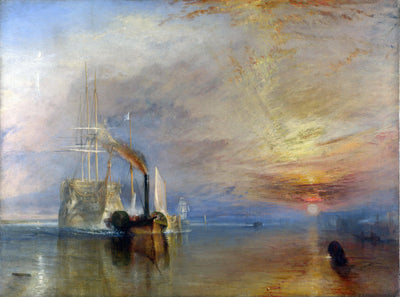
- Britain. The Swiss-born Henry Fuseli belonged to a group of artists in London and Rome who, Britannica says, turned in the 1760s and 1770s to themes that were “bizarre, pathetic, or extravagantly heroic.” William Blake, poet and painter, was the other principal early Romantic artist in England; Tate notes that he examined man’s place in the cosmos and his relationship to God. In the next generation J.M.W. Turner and John Constable made landscape the great British Romantic genre. Turner’s The Fighting Temeraire (1839), at the National Gallery in London, follows a veteran of Trafalgar being towed up the Thames to the breakers in 1838, a scene the gallery reads as the age of sail giving way to the age of steam.
- France. Britannica credits Théodore Géricault with truly inaugurating the movement around 1820 and calls Eugène Delacroix the greatest French Romantic painter, for his free brushwork, rich color and dynamic compositions. Paul Delaroche and Théodore Chassériau belong to its later, more academic phase. Our guide to famous French paintings places Géricault and Delacroix in the longer French story.
- Germany. Philipp Otto Runge gave German Romantic painting its symbolic, allegorical streak, and Caspar David Friedrich, in Britannica’s words the greatest German Romantic artist, painted eerily silent, stark landscapes that can stir a sense of mystery and religious awe. More of his work appears in our guide to famous German paintings.
- Spain. Francisco de Goya (1746–1828), born in Fuendetodos near Zaragoza, carried Romanticism into Spanish painting. Besides the war scene below, he painted the Black Paintings (1820–1823) on the walls of his own house, and they now hang in the Prado; the ten most famous Goya paintings follow his whole career.
- Italy. In Milan, Francesco Hayez led what the Pinacoteca di Brera calls historical Romanticism: scenes from history or literature, set in the past, that work as allegories of the present. His The Kiss (1859), 112 × 88 cm (44.1 × 34.6 in), was painted in the year French and Sardinian troops defeated Austria and entered Milan, and Brera reads its couple in 14th-century dress as a volunteer patriot saying goodbye to the woman he loves. It is one of the famous Italian paintings we cover in depth.
Seven paintings that explain Romanticism
In date order, from a nightmare of 1781 to a burning sea of 1840.
The Nightmare, Henry Fuseli (1781)

Zoom
A woman in white lies flung backward across a bed, her head and one arm hanging over the edge, while the squat demon on her body stares straight out at us. The Detroit Institute of Arts, which owns the canvas, 101.7 × 127.1 cm (40.0 × 50.0 in), reads it as a picture of how the sleeper feels in the grip of a nightmare rather than of what she sees.
Painted eight years before the French Revolution, it shows the Romantic appetite for dreams, terror and the supernatural already fully formed. The museum hangs it today in a gallery called Era of Revolution. Our studio also paints The Nightmare by hand in oil.
The Third of May 1808, Francisco Goya (1814)

Zoom
On May 2, 1808, Madrid rose against the French troops occupying the city. In February 1814, as Ferdinand VII prepared to return to the throne, the Regency Council commissioned Goya to paint the episode, and the Prado, which owns the result, has shown from frame invoices that he painted two canvases, not the four often claimed: the street fight of May 2 and this scene of the executions, 268 × 347 cm (105.5 × 136.6 in).
Goya bent the facts for drama. The Prado notes that the shootings were already under way in broad daylight on the afternoon of May 2, yet he set them on the rainy night that followed. A square lantern on the ground lights a man in a white shirt with his arms flung wide, while the grenadiers and guard sailors of the firing squad turn their backs to us, and more prisoners file in from the city to wait their turn. It went to the Royal Palace in 1814 and had reached the Prado by 1834, yet the museum did not list it in its catalogue until 1872. The Third of May 1808 is available hand-painted in oil.
Wanderer above the Sea of Fog, Caspar David Friedrich (about 1817)

Zoom
Hand-painted oil reproductionSee sizes ›
The Hamburger Kunsthalle dates this canvas, 94.8 × 74.8 cm (37.3 × 29.4 in), to about 1817. Its walker seen from behind, the Rückenfigur, is the most prominent one in Friedrich’s work, and it lets you look through his eyes without ever learning his name: the museums’ Friedrich portal says there are no reliable clues to who he is, and calls the picture an examination of “an entire bundle of fundamental Romantic topoi.”
It is Romanticism reduced to one man and a view: solitude, awe, a landscape larger than anyone in it. You can own a hand-painted Wanderer above the Sea of Fog.
The Raft of the Medusa, Théodore Géricault (1818–1819)

Zoom
Hand-painted oil reproductionSee sizes ›
On July 2, 1816, the French frigate Méduse, bound for Senegal under a captain who had not been to sea for twenty years, ran aground on the Arguin Shoal off the coast of present-day Mauritania. A raft about 20 meters long took 146 men and one woman; the boats meant to tow it cut it loose, and when the brig Argus found it on July 17, after 13 days, 15 men were alive, as Royal Museums Greenwich recounts. The surgeon’s report leaked to the press that September and turned the wreck into a political scandal.
The Louvre’s record follows the canvas, 491 × 716 cm (193.3 × 281.9 in), from a studio Géricault rented on the rue du Faubourg-du-Roule to the foyer of the Théâtre-Italien, where he finished it in July 1819, and on to the Salon that August under the neutral title Scene of a Shipwreck. The Met names what made it new: “its horrifying explicitness, emotional intensity, and conspicuous lack of a hero.” The crown bought it at the sale after his death in 1824, and it has been on view at the Louvre since 1826, except in wartime. The Raft of the Medusa can be ordered as a hand-painted canvas.
The Hay Wain, John Constable (1821)

Zoom
Hand-painted oil reproductionSee sizes ›
Constable sent it to the Royal Academy in 1821 as Landscape: Noon; “The Hay Wain” was a nickname from his friend Archdeacon Fisher, according to the National Gallery in London, which owns the canvas, 130.2 × 185.4 cm (51.3 × 73.0 in). It shows the millpond at Flatford on the River Stour in Suffolk, where the Constable family ran a corn mill, with an empty wagon crossing toward haymakers in the far meadow. He painted it in his London studio from years of open-air sketches and a full-size oil sketch.
It found no buyer in London, but it reached France. Géricault saw it at the Academy and, according to Delacroix, went home “quite stunned.” In 1824 a dealer bought it with two other Constables and sent them to the Paris Salon, where Charles X awarded Constable a gold medal, chiefly for this picture, and critics and artists, the Met writes, embraced his work as “nature itself.” The Hay Wain in oil brings that quiet strand of Romanticism home.
Liberty Leading the People, Eugène Delacroix (1830)

Zoom
Hand-painted oil reproductionSee sizes ›
The Louvre’s title, The 28th of July 1830: Liberty Leading the People, ties the picture to the street fighting in Paris that drove Charles X from the throne. Its central figure is an allegory, a trope inspired by antiquity, as Britannica puts it, yet she climbs over real bodies on a real barricade among Parisians with real guns. That mix of myth and reportage is what makes it Romantic.
The Louvre’s record traces a bumpy career for the canvas, 260 × 325 cm (102.4 × 128.0 in). It was shown at the Salon of 1831 and bought by the state that August, hung at the Musée du Luxembourg in 1832 and 1833, then went into storage; around 1839 it was handed back to Delacroix, who kept it at his aunt’s house in Frépillon. It came out again for the 1855 Exposition Universelle and entered the Louvre in November 1874. A cleaning from October 2023 to April 2024 tackled grime and eight layers of discolored varnish; Smithsonian Magazine reports that Liberty’s dress turned out to be light gray with hints of gold, not yellow, and that the boy with two pistols stands in front of her, not beside her. Liberty Leading the People is also painted by hand in oil.
The original and our hand-painted copy
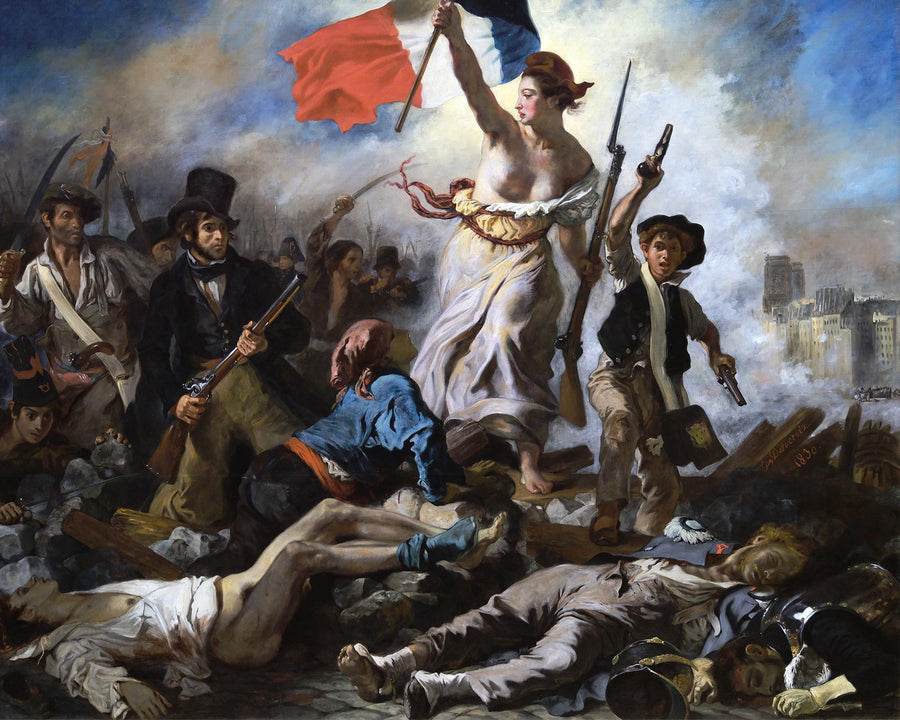
The original
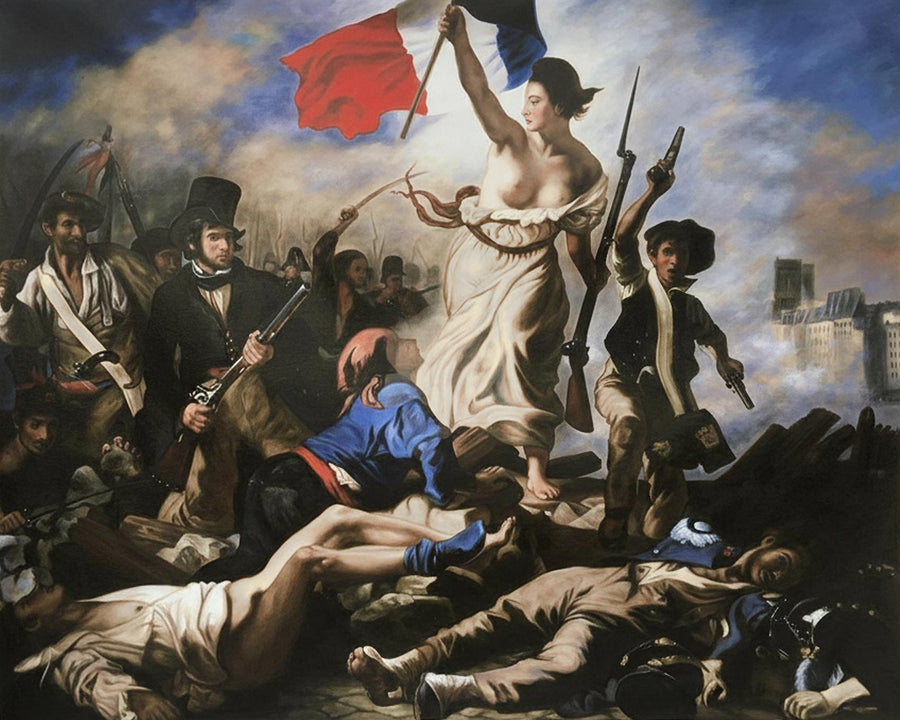
Our reproduction, painted by hand in oil
It now hangs in the Louvre’s Salle Mollien, the room the museum labels “Romanticism,” a few steps from Géricault’s Raft; the museum’s other highlights are in our guide to famous paintings in the Louvre.
The Slave Ship, J.M.W. Turner (1840)

Zoom
Hand-painted oil reproductionSee sizes ›
Turner showed it at the Royal Academy in 1840 as Slavers Throwing Overboard the Dead and Dying, Typhoon Coming On, paired with lines from his own unfinished poem “Fallacies of Hope.” The Museum of Fine Arts, Boston, which owns the canvas, 90.8 × 122.6 cm (35.7 × 48.3 in), says he drew on an 18th-century poem about a slave ship caught in a typhoon and on the Zong, a British ship whose captain in 1781 threw sick and dying enslaved people overboard to collect insurance paid only for those “lost at sea.” Hot, churning color merges sea and sky, and the victims are left half hidden in the waves of the foreground.
The critic John Ruskin was its first owner. His father bought it for him in December 1843, and Ruskin sold it in 1872 to John Taylor Johnston of New York; it reached the museum in 1899. The Slave Ship is available as a hand-painted reproduction.
“I believe, if I were reduced to rest Turner’s immortality upon any single work, I should choose this.”
Romanticism in person, and at home
Seeing all seven originals means visits to six cities: Paris, Madrid, Hamburg, London, Boston and Detroit. Between trips, each is linked above as a hand-painted canvas, our Romanticism collection holds more of the period, and our page on the most famous paintings in the world shows where these pictures stand among the rest.
Sources
- Tate, Romanticism (art term)
- The Metropolitan Museum of Art, Heilbrunn Timeline of Art History, Romanticism (Kathryn Calley Galitz, 2004)
- Britannica, Romanticism
- Detroit Institute of Arts, Henry Fuseli, The Nightmare
- Museo del Prado, Goya, The 3rd of May 1808 in Madrid, or “The Executions”
- Caspar David Friedrich portal (Hamburger Kunsthalle, Staatliche Museen zu Berlin, Staatliche Kunstsammlungen Dresden), Wanderer above the Sea of Fog
- Caspar David Friedrich portal, Monk by the Sea
- Louvre, Le radeau de la Méduse (collection record)
- Royal Museums Greenwich, The Raft of the Medusa (print record with the history of the wreck)
- National Gallery, London, John Constable, The Hay Wain
- Louvre, Le 28 juillet 1830. La Liberté guidant le peuple (collection record)
- Smithsonian Magazine, Liberty Leading the People returns to the Louvre after restoration (2024)
- Museum of Fine Arts, Boston, J.M.W. Turner, Slave Ship
- John Ruskin, Modern Painters, volume 1 (Project Gutenberg text)
- National Gallery, London, J.M.W. Turner, The Fighting Temeraire
- Pinacoteca di Brera, Il Bacio di Francesco Hayez (room 38 description, in Italian)