4.9/5


Baroque artists were the painters who shaped a bold, dramatic style from about 1585 to the early 1700s. They worked in rival cities across Europe, and each city had its own stars. Caravaggio and Annibale Carracci led the way in Rome, while Ribera and Artemisia Gentileschi worked in Naples. Rubens and Van Dyck came from Antwerp, and Rembrandt, Hals and Vermeer worked in the Dutch Republic. Velázquez painted in Seville and Madrid, and Poussin and Georges de La Tour painted for France. Their work is the heart of our Baroque paintings collection. The chart below follows the same route from city to city, and it adds how often English books mention each painter.
Each city had its own reason to want this art. From 1545 to 1563, Catholic Church leaders met at the Council of Trent. After that, the Church set out to win believers through art that spoke straight to people's feelings. Catholic kings used the same grand style to show off their power. But the Dutch were Protestant, so no Church and no king paid for their art. That is why their paintings look so different. To spot the signs of a Baroque painting, start with our guide to what Baroque paintings have in common.
Baroque artists city by city, with how often books name them
| City | Baroque painter | A work to know | Book mentions (Caravaggio = 100) |
|---|---|---|---|
| Rome | Caravaggio |  The Calling of Saint Matthew, shown in 1600 |
100 |
| Rome | Annibale Carracci | The Farnese Gallery ceiling, shown in 1600 | 6 |
| Naples | Jusepe de Ribera |  The Clubfoot, 1642 |
1 |
| Naples, after Rome, Florence and Venice | Artemisia Gentileschi | Judith Beheading Holofernes, about 1620 | 6 |
| Antwerp | Peter Paul Rubens |  The Descent from the Cross, 1611–1614 |
15 |
| Antwerp, then London | Anthony van Dyck |  Charles I at the Hunt, about 1636 |
4 |
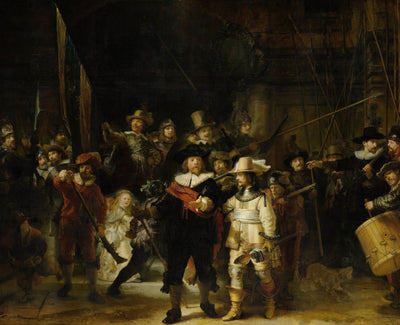
| Amsterdam | Rembrandt van Rijn |  The Night Watch, 1642 |
7 |
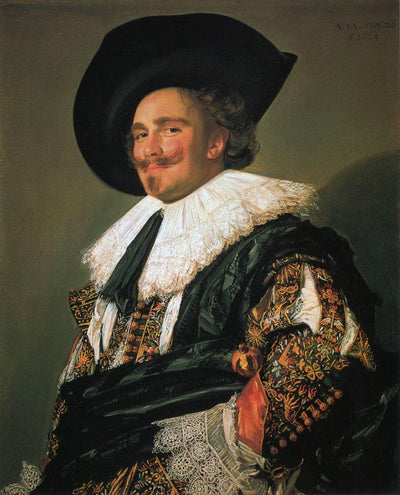
| Haarlem | Frans Hals |  Laughing Cavalier, 1624 |
10 |
| Delft | Johannes Vermeer |  The Milkmaid, about 1660 |
4 |
| Seville, then Madrid | Diego Velázquez |  Las Meninas, 1656 |
4 |
| Rome, with two years in Paris | Nicolas Poussin | The Death of Germanicus, 1627 | 9 |
| Lunéville, in Lorraine | Georges de La Tour |  The Cheat with the Ace of Diamonds, about 1636–1640 |
1 |
Book figures are Google Books Ngram averages for 2000 to 2019. Each name was searched just as it is written here, so a painter often called by a shorter name may score lower.
Caravaggio leads by a wide margin. English books name him more than six times as often as Rubens, who comes second.
Rome: where the style began
Around 1600, Rome had two answers to the Church's call for art that could win people over. Both hang in the same chapel, the Cerasi Chapel of Santa Maria del Popolo. Annibale Carracci's Assumption of the Virgin (1600 to 1601) sits above the altar. Caravaggio's Crucifixion of Saint Peter and Conversion of Saint Paul hang on the side walls. Together these two men started the Baroque, but in different ways. Carracci followed the calm, classic style of the past, and Caravaggio painted real life as it looked.
The word "baroque" began as an insult. It may come from the Portuguese word barroco, which means a pearl with an odd shape. In the 1700s, critics used it for art from the 1600s that they found bizarre. It only became a plain name for a style in 1888, with a book by Heinrich Wölfflin.
Caravaggio (1571–1610)

Zoom
Caravaggio got his big chance through Cardinal Francesco Maria del Monte, a powerful Church leader. The cardinal bought his painting The Cardsharps, gave him rooms in his palace and got him his first job for a church. That job was a set of paintings for the Contarelli Chapel in San Luigi dei Francesi. The Calling of Saint Matthew was one of them, and when they were shown in 1600, they made his name. Our list of famous Italian paintings tells the story of that picture.
Caravaggio had trained in Milan, and he worked in Rome from 1592 to 1606. He painted straight from real models who posed for him. That broke with the Renaissance idea of making people look perfect. A critic of his time said his light fell from high up, as if through the one window of a room with black walls. So the lit parts were very bright, and the shadows were very dark.
Painters from other lands came to Rome and took up his way of working. Among them were Hendrick ter Brugghen and Gerrit van Honthorst from the Netherlands, and Valentin de Boulogne from France. Through them, painting like Caravaggio became a movement across many countries. Our guide to where to see each Caravaggio lists his most famous works.
Annibale Carracci (1560–1609)
Carracci came from Bologna, where he worked with his older brother Agostino and his cousin Ludovico. They turned away from Mannerism, a stiff and fussy style of their day. Instead they went back to nature and to the great painters of northern Italy. They looked most of all to Correggio, Titian and Veronese.
In 1595 the Farnese family invited him to Rome. On the ceiling of the Farnese Gallery, he painted stories from old myths. He framed them with painted statues and nude figures that seem lit by the real windows of the room. When it was shown in 1600, people praised it at once as "the equal of any work in the past." Our comparison of Baroque and Renaissance art shows how the old style gave way to this new one.
In the long run, Carracci won the argument. By 1630, paintings in Caravaggio's style were going out of fashion. A new group of young artists was studying Carracci's work instead. Rubens, Poussin and Bernini all owed a great deal to him. Bernini wasn't a painter, though. He made statues and buildings, and he designed the rows of columns in front of Saint Peter's. He is called the greatest Baroque artist who did both.
Naples: Caravaggio's refuge, Ribera's city
Caravaggio reached Naples in 1606 as a man on the run. He had been found guilty of a killing in Rome, so he fled the lands ruled by the pope. In Naples he painted The Seven Works of Mercy (1606 to 1607). It was the first painting for the church of the Pio Monte della Misericordia, a charity started by seven men. One of them, Giovan Battista Manso, was among Caravaggio's new buyers.
The painting cost 400 ducats, a huge price, and it still hangs in the charity's chapel. The charity says it started a new wave of true-to-life painting in the city. Caravaggio then went on to Malta and Sicily. He came back to Naples in 1609, and he died the next year.
Jusepe de Ribera (1591–1652)

Zoom
Ribera's The Clubfoot, signed and dated 1642, shows a beggar from Naples with a badly bent foot. He grins at us against a wide, bright sky, and he carries his crutch over his shoulder like a weapon. In his hand is the paper that Naples made all beggars carry. Ribera painted him full length and from below, the way he would have painted a king or a saint.
The paper says, in Latin, "give me alms for the love of God." Alms are gifts for the poor. But the boy's thumb covers two of the letters, A and M. Ribera signed the picture on the ground at the lower right as "Jusepe de Ribera español," which means "the Spaniard."
Ribera was born in Xàtiva, in the region of Valencia. He joined Caravaggio's followers in Rome, and then he moved to Naples in 1616 and stayed until he died in 1652. He soon became the painter everyone in the city wanted. He was known for church paintings that show old and sick bodies up close.
Artemisia Gentileschi (1593–1654 or later)
Artemisia was born in Rome. She was the only daughter of the painter Orazio Gentileschi, and he trained her. In the 1600s, most women artists could only paint portraits and still lifes, which show things like fruit and flowers. But Artemisia painted history scenes. These were big scenes from the Bible, myths and the past, and back then they were the most respected kind of art. She also ran her own workshop and worked for several rulers in Europe. Her Judith Beheading Holofernes (about 1620), now in the Uffizi, is one of at least five paintings she made of the story of Judith.
She lived in Florence, Rome and for a short time Venice, and then she moved to Naples around 1630. In 1638 she went to London, where her father had become the painter to King Charles I. She stayed on after he died in 1639, and she probably went back to Naples in 1640 or 1641. The last trace of her is a paper dated 1654, and some experts think she died in the plague of 1656. Our list of famous women artists follows her life from the start.
Antwerp: Rubens and his best student
Peter Paul Rubens (1577–1640)

Zoom
Hand-painted oil reproductionSee sizes ›
Rubens painted The Descent from the Cross (1611 to 1614) for the Cathedral of Our Lady in Antwerp. It is a triptych, a painting in three panels, and the center panel alone is more than four meters tall. It still hangs in the church it was made for, and so does his Assumption of the Virgin. Next to them is his Elevation of the Cross (1609 to 1610), which came from another church.
Rubens had plenty of work like this. Protestants who were against holy images had damaged the church art of the Spanish Netherlands. So Antwerp's churches needed new altar paintings, and that kept his workshop busy for years. His bold, slanting scenes and strong, full-bodied people are seen as the very model of Baroque painting.
Rubens was born in Germany in 1577 to parents from Antwerp, and his mother brought him back to the city as a boy. From 1600 he spent eight years in Italy, where he studied Renaissance painting and ancient statues. Back home he became the court painter for the rulers of the Southern Netherlands. In 1610 he bought a house on the Wapper and rebuilt it like an Italian palace with a studio. Today it is the Rubenshuis museum. In a letter to Sir Dudley Carleton in 1618, he described himself in plain words:
“After all, I am not a prince, but someone who lives by his handiwork.”
He was also a diplomat, someone who helps countries talk to each other. From 1621 he worked as a secret agent for Archduchess Isabella in peace talks between Spain and England. He was made a knight twice, and he died at his house on the Wapper on May 30, 1640.
Anthony van Dyck (1599–1641)

Zoom
Hand-painted oil reproductionSee sizes ›
Van Dyck painted Charles I at the Hunt around 1636. It is a hunting portrait, but it has no dog, no gun and no animals to hunt. Blaise Ducos, a curator at the Louvre, sees it as a pause in one of the king's long rides. The rest of the hunting party is just outside the frame. Ducos calls it Van Dyck's most famous portrait, and probably the best-known picture of any English king.
For a long time, people thought the horse was bowing to its master. In fact it has just finished a hard gallop, and it is wiping the foam from its mouth on its front leg.
Van Dyck was a teenage star in Rubens's studio. He could paint so much like his master that he sometimes took his place. In 1620 Rubens trusted him with ceiling paintings for Antwerp's Charles Borromeo Church. Rubens called him "il miglior mio discepolo," which means "my very best student." Van Dyck then worked at several courts in Italy and for the Habsburg rulers in Brussels. At last he served Charles I in London, and it was said that the king had hired the Titian of his time.
The Dutch Republic: Amsterdam, Haarlem and Delft
North of Antwerp lay the Dutch Republic, which was Protestant and newly free. It had lost the two richest buyers of art, the king and the Church. In their place, a middle class with money bought smaller pictures for their homes. Landscapes, still lifes and scenes of everyday life also grew popular, and they are among the century's greatest gifts to Western art. Many art books group Rembrandt, Hals and Vermeer with the Baroque. Still, Britannica points out that in important ways they stayed apart from it. Our list of Dutch Golden Age paintings goes through the period picture by picture.
Rembrandt van Rijn (1606–1669)
Rembrandt moved from his hometown of Leiden to Amsterdam in the winter of 1631 to 1632. There he became the city's most original portrait painter. By the end of that decade, he had students, a growing art collection and a house. He bought the house in 1639, and today it is the Rembrandt House Museum.
In 1642 he painted The Night Watch for the hall of one of Amsterdam's civic guards. These were groups of men who trained to defend the city. A popular legend says the people in it were unhappy, so they turned against him. But the facts of his later career say otherwise. Important buyers like Jan Six and the Amsterdam city government kept hiring him. He went on making great paintings even after he went broke in 1656. Over his life he also made about 350 etchings, which are prints made from lines cut into metal. Our ranking of Rembrandt's most famous paintings picks up from here.
The original and our hand-painted copy
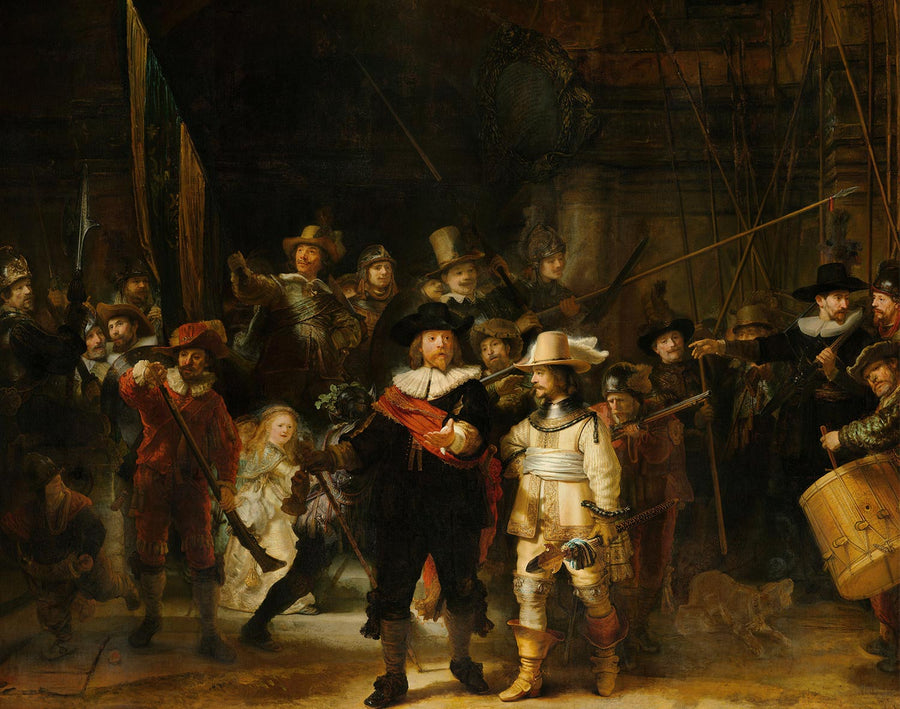
The original
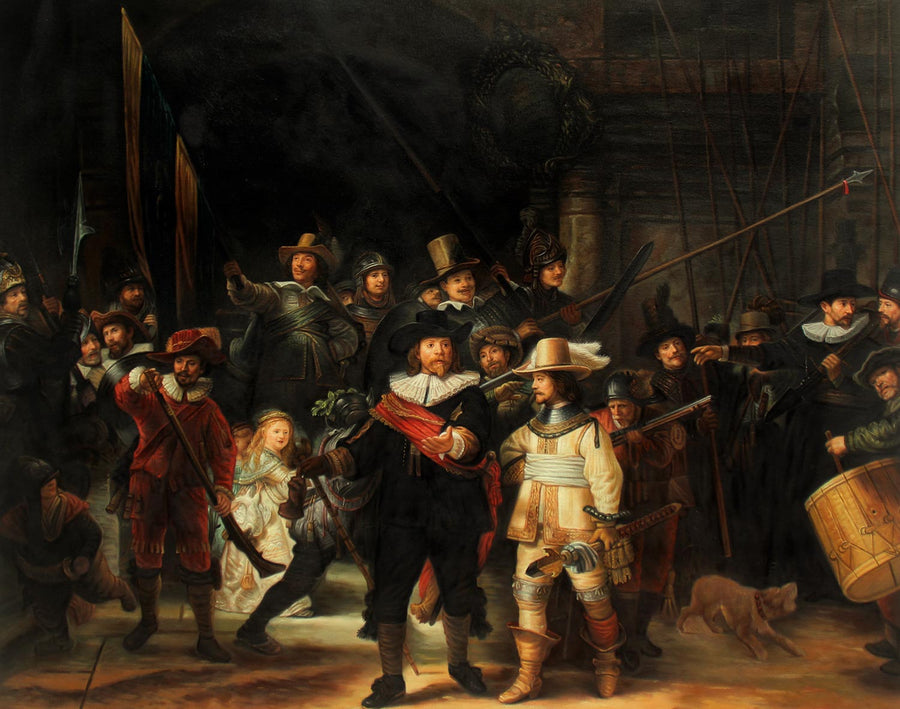
Our reproduction, painted by hand in oil
Frans Hals (1582/83–1666)
Frans Hals was born in the Spanish Netherlands, and when he was small his parents moved from Antwerp to Haarlem. He joined the city's painters' guild, a kind of club for painters, in 1610. From 1612 to 1624 he also served in the city's Saint George civic guard. In 1616 he painted the guard's officers, and that was the first of about ten big group portraits for public groups in Haarlem. He painted the last two around 1664, when he was about 82. They show the men and the women who ran a home for old men.
In 1616 Hals also went to Antwerp to study, from August to the middle of November. His lively, crowded Merrymakers at Shrovetide is from about that year, and it looks back to the work Rubens had done just before. His Laughing Cavalier (1624) hangs in the Wallace Collection in London.
Johannes Vermeer (1632–1675)

Zoom
Hand-painted oil reproductionSee sizes ›
Vermeer's The Milkmaid, from about 1660, is a small painting less than half a meter tall. In it, only the stream of milk is moving. The woman stands as still as a statue. The light breaks over the bread and the pots in hundreds of tiny dots of color.
Vermeer was baptized in Delft in October 1632, and he was buried there in December 1675. He spent his whole working life in that one city, and only about 36 of his paintings survive. He started in the early 1650s with large scenes from the Bible and from myths. Then he turned to the quiet scenes inside homes that made him famous. Our guide to every Vermeer painting tells you where each one hangs.
Spain: Seville and Madrid
Diego Velázquez (1599–1660)

Zoom
Hand-painted oil reproductionSee sizes ›
Las Meninas (1656) by Velázquez is more than three meters tall. The painter shows himself at a tall canvas on the left. Princess Margarita and her helpers fill the front. The Prado museum in Madrid sees it as a pause. The princess and her servants stop because the king and queen have just come in.
Velázquez was born in Seville in 1599, and his early paintings show ordinary people eating or working. He made The Waterseller of Seville in his late teens or early twenties. In it an old man in ragged clothes pours water for two customers, but they look away from him and from each other. That painting had an adventure of its own. In June 1813, at the Battle of Vitoria, it was rescued from Joseph Bonaparte's baggage wagons with other Spanish paintings. Now it hangs at Apsley House in London.
Velázquez joined the court of King Philip IV in 1623, and he lived in Madrid for the rest of his life. As the king's painter, he went to Italy in 1649 to buy paintings for the royal art collection. In Rome he also painted Pope Innocent X. Our list of famous Spanish paintings names every person in Las Meninas. It also adds Zurbarán and Murillo, two more painters of his time in Spain.
France: from Paris to Lorraine
France took a quieter road. Britannica calls the French Baroque "more subdued and classicist," which means calmer and more balanced. In its view, the best example of Baroque show in France isn't a painting at all. It is the royal palace and gardens at Versailles, which were built on a huge scale to show the power of the state. The same source finds a taste for plain, true-to-life art in the work of the Le Nain brothers and Georges de La Tour.
Nicolas Poussin (1594–1665)
Nicolas Poussin was born in Les Andelys, in Normandy, in June 1594. He arrived in Rome in the spring of 1624. Apart from two years in Paris, from 1640 to 1642, he lived there for the rest of his life. He painted his first great masterpiece, The Death of Germanicus (1627), for Cardinal Francesco Barberini. It was the first heroic deathbed scene in the history of painting, which means a hero shown as he dies in bed. By 1633 he had given up the rich Venetian color of his early work. In its place he chose a strict, orderly style that came from Raphael and ancient art. He is called the founder of the French Classical tradition.
Georges de La Tour (1593–1652)

Zoom
Hand-painted oil reproductionSee sizes ›
La Tour's The Cheat with the Ace of Diamonds, from about 1636 to 1640, shows a rich young man being tricked at cards. A courtesan, a servant pouring wine and a cheat are all taking his money. The game is probably prime, an Italian game that came before poker. Caravaggio painted the same idea, a foolish young man fooled by experts, in his Cardsharps.
La Tour was born in Vic-sur-Seille, in Lorraine, in 1593, and he settled in Lunéville, where he died in 1652. Even King Louis XIII owned his work. Yet after La Tour died, he was forgotten until well into the 20th century. Then experts began to spot his paintings among pictures that had long been credited to other artists. His early work shows the dramatic light of Caravaggio or his followers. His later paintings are lit by a single candle or torch, and the figures are cut down to simple, almost geometric shapes. The lighter, cozier style that came next in France is the subject of our list of famous Rococo painters.
From Rome to Delft on one wall
Side by side, these Baroque artists show how far one style stretched in about sixty years. It runs from a tax collector's table in Caravaggio's Rome to a maid's table in Vermeer's Delft. You can follow that whole range in our Baroque collection. Then our page of the world's most famous paintings places these artists next to the rest. The shadows are the hardest part to copy, because a Baroque dark has to look like deep space, not flat black.
Sources
- Smarthistory, Esperança Camara, "Baroque art, an introduction"
- Encyclopaedia Britannica, Baroque art and architecture
- The Met, Heilbrunn Timeline, Keith Christiansen, "Caravaggio (Michelangelo Merisi) (1571–1610) and His Followers"
- The Met, Heilbrunn Timeline, Keith Christiansen, "Annibale Carracci (1560–1609)"
- Pio Monte della Misericordia, Naples, Caravaggio's Seven Works of Mercy
- Musée du Louvre, collection record: Jusepe de Ribera, Le Pied-Bot (The Clubfoot), 1642
- Musée du Louvre, Ophélie Lerouge, notice on The Clubfoot (archived museum page)
- Encyclopaedia Britannica, Artemisia Gentileschi
- Rubenshuis, Antwerp, Biography of Rubens
- Cathedral of Our Lady, Antwerp, 4x Rubens at a glance
- Cathedral of Our Lady, Antwerp, Rubens, The Descent from the Cross
- Cathedral of Our Lady, Antwerp, Rubens, The Elevation of the Cross
- Musée du Louvre, Antoon Van Dyck: catalogue raisonné des tableaux du musée du Louvre, cat. 18, Portrait of Charles I, King of England, known as "The King at the Hunt"
- Musée du Louvre, interview with curator Blaise Ducos on Van Dyck's Charles I (February 5, 2025)
- The Met, Heilbrunn Timeline, "Rembrandt van Rijn (1606–1669): Paintings"
- Rijksmuseum, The Night Watch, Rembrandt van Rijn, 1642
- The Met, Heilbrunn Timeline, Walter A. Liedtke, "Frans Hals (1582/83–1666)"
- The Wallace Collection, The Laughing Cavalier
- Encyclopaedia Britannica, Johannes Vermeer
- Rijksmuseum, The Milkmaid, Johannes Vermeer, about 1660
- Wellington Collection, Apsley House, Spanish paintings (The Waterseller of Seville, Pope Innocent X)
- Museo Nacional del Prado, Las Meninas
- Encyclopaedia Britannica, Nicolas Poussin
- Encyclopaedia Britannica, Georges de La Tour
- Musée du Louvre, collection record: Georges de La Tour, The Cheat with the Ace of Diamonds
- Musée du Louvre, collection record: Leonardo da Vinci, Mona Lisa
- Encyclopaedia Britannica, Michelangelo