4.9/5
4.9/5


Stand in front of a Caravaggio and you'll feel it before you can name it. A shaft of light cuts across a dark room and somebody is about to leap out of a chair. That jolt is the quickest way into Baroque paintings, and the characteristics behind it are easy to learn once you know where to look.
The style ran through Europe in the 17th century and the first half of the 18th, starting in Italy. Nobody at the time called it Baroque. People reached for words like "bizarre," and the name we use came later, originally as an insult; it may come from the Portuguese barroco, an irregular pearl. If you want a feel for the range before reading on, flip through the Baroque paintings studio artists copy by hand and keep a few in mind. Every sign below will show up in them.
What are the main characteristics of Baroque paintings?
Baroque paintings grab you with drama. Look for hard light against deep shadow, a story frozen at its most intense second, diagonal compositions that pull you into the picture, real faces instead of idealized ones, emotion aimed straight at the viewer, and rich color and texture on either a vast or an intimate scale.
- Spotlight lighting (chiaroscuro and tenebrism)
- A single moment of action, caught mid-movement
- Diagonals and space that spill toward you
- Ordinary, unidealized people
- Emotion built to persuade
- Deep color, rich surfaces, extreme scale
Most lists online stop at five. The sixth, scale, is the one that fools people, because some of the most Baroque pictures ever made are small enough to hang over a desk.
1. Light that works like a spotlight

This is the first thing to check, and it settles most cases. Two Italian words cover it. Chiaroscuro literally means "light-dark": strong tonal contrast used to model a body in space. Leonardo used it to make figures look solid. Caravaggio pushed it for drama.
The more extreme version has its own name, tenebrism, from the Italian tenebroso, darkened. Faces and hands blaze out of a room that is mostly black. Caravaggio's late paintings are the textbook case, and so are those of many of his followers.
You can watch it happen in his canvas of Christ calling the tax collector Matthew, one of the Saint Matthew pictures for the Contarelli Chapel in San Luigi dei Francesi in Rome. Their public unveiling made him famous almost overnight. He had arrived in Rome in 1592, aged 21, and spent the first years selling still lifes and half-length figures on the street. After the chapel, he was the painter every collector wanted.
A quick test: cover the brightest patch of the picture with your thumb. In a Renaissance altarpiece the light is spread fairly evenly and not much changes. In a Baroque picture the story disappears, because the light is the story.
2. A story stopped at its loudest second
Renaissance painters liked a calm, balanced moment. Baroque painters wanted the instant just before or just after something happens. Pose, gesture, facial expression and even the folds of drapery are arranged so the figures look as if they had been stopped in mid-action.
Caravaggio's Supper at Emmaus in London's Room 32, commissioned in 1601 by Ciriaco Mattei, is the cleanest example. The disciples realize, all at once, that the stranger at the table is the risen Christ. One is about to jump out of his chair, his elbow jutting toward you. The other throws his arms wide. Half a second later, the scene would be over.
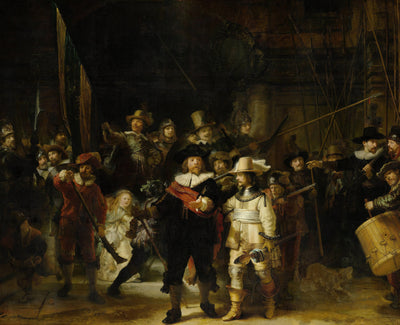
Rembrandt took the same idea into a group portrait, which was almost unheard of. Civic guard pictures in Amsterdam usually lined the members up like a team photo. In his militia company stepping out in 1642, the captain in black is telling his lieutenant to start the company marching while the men scramble into formation. Rembrandt was the first to paint the figures in a group portrait actually doing something.
3. Diagonals that pull you into the scene
Draw a line through the main action of a Baroque painting and it usually runs corner to corner, not straight across. Diagonal compositions and illusionistic effects are the two tools the style relies on to impress, and the altarpieces Rubens turned out in Antwerp are full of both.
The diagonal does two jobs. It makes a still image feel like it's moving, and it breaks the invisible wall between the painting and the room. Caravaggio liked to make his canvases look like an extension of real space, so you feel you're sitting at the same table. That jutting elbow at Emmaus is aimed at you on purpose.
Ceilings took this furthest. Painters opened church vaults into fake skies full of flying saints, and in Rome Gian Lorenzo Bernini (1598–1680) fused sculpture and architecture into single rooms built to deliver one message. In easel painting the effect is quieter: a foreshortened arm reaching out of the frame, or a figure looking straight back at you.
4. Real people with real faces
This is where Baroque broke hardest with the past, and it shocked people. Caravaggio used working people with rough, irregular, characterful faces as models for saints, and dressed them in clothes you could see on the street. In the Emmaus picture the disciples have lined, bearded faces and ragged sleeves. Critics were horrified. Collectors loved it.
The painter himself was no saint either. One of his early biographers complained that "after a fortnight's work he will swagger about for a month or two with his sword at his side." In 1606 a fight ended with a man dead and Caravaggio on the run from Rome. The naturalism outlived him by decades, carried by followers across Europe.
In Seville, a young Velázquez, whose court portraits changed Spanish painting, picked it up early. Born in 1599 and apprenticed at eleven to Francisco Pacheco, he painted bodegones, kitchen and tavern scenes of everyday life, lit like Caravaggio's saints. Francisco de Zurbarán, the leading painter in Seville in the decades after Velázquez left for Madrid in 1623, took the same realism into religious pictures. His bound lamb set against a black ground is about as plain and as spiritual as a painting gets.
5. Emotion designed to persuade
Why all the drama? In Catholic Italy and Spain, a big part of the answer is the Church's response to the Protestant Reformation. The Council of Trent set out what kind of religious imagery would best serve the faith, and new orders such as the Jesuits wanted pictures that reached ordinary worshippers through the senses. Art had to move people, not just instruct them.
So Baroque paintings talk to your gut first and your head second. Martyrdoms bleed. Conversions happen in a flash of light. Even a mythological or secular subject is played for feeling.

Rubens (1577–1640) spent eight years in Italy and saw Caravaggio's experiments firsthand. Back in Antwerp he painted Samson asleep in Delilah's lap, about 1609–10, for his friend Nicolaas Rockox, the mayor of the city. It's a story of love and betrayal told almost entirely through light: Delilah's skin glows in warm pools while a single torch picks out the soldiers waiting at the door.
The Protestant north is the useful counterexample. After the Reformation, Dutch churches stopped commissioning pictures, so painters like Rembrandt worked for private buyers and city institutions. The emotion didn't go away. It moved indoors, into portraits and Bible scenes for the home. From the 1630s Rembrandt, who built faces out of light and shadow, stopped simply lighting one side of a face and shading the other, and the shadow around the eyes makes his sitters seem to be thinking while you look at them.
6. Rich surfaces, at any size
Baroque color is deep and saturated: crimsons, golds, olive greens and blacks that look like velvet. Paint is often thick where the light hits and thin in the shadows, so the surface itself catches the eye. Texture matters as much as drawing. Silk, fur, armor and skin each get their own handling.
Scale runs to extremes. Rembrandt's civic guard canvas measures 379.5 × 453.5 cm, bigger than most living-room walls. It was painted for the hall of the Amsterdam arquebusiers, and the light is aimed at a few details, like the captain's gesturing hand and the young girl in the background who served as the company's mascot.

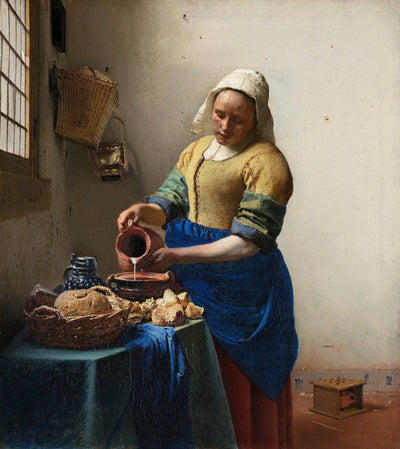
Then go small. Vermeer's maid pouring milk, painted about 1660, is just 45.5 × 41 cm. Nothing moves except the thin stream from the jug, and yet it's the same idea in miniature. One light source, a figure solid as a statue. Look closer and you'll find hundreds of tiny dots of color where the window light breaks over the bread. People often leave Dutch interiors out of the Baroque because they're so quiet. They shouldn't. The light and the frozen instant are both there. If quiet rooms are your taste, the rest of Vermeer's interiors repay a slow look.
What is the most famous Baroque painting?
There's no official ranking, but two pictures come up again and again. The first is the Rembrandt militia piece above. The second is Velázquez's portrait of the Spanish court at work, Las Meninas, the Maids of Honour.

It ticks almost every box on this list. Light falls from the windows on the right and picks out the princess. The scene is caught mid-moment, with several figures glancing out toward the spot where you stand, and the painter himself stands at a huge canvas, brush raised, looking straight out at you. In 1658 Velázquez was made a Knight of Santiago, an honor he had always wanted, and the badge of the order was added to his self-portrait in the picture. He died two years later, in 1660.
If you want to go further, Caravaggio's chapel canvases are the place to start for the dark, theatrical side of the style. Everything Caravaggio painted is short on calm and long on light, and it's the quickest education in the look you'll get. After that, it's worth checking how Baroque pictures sit among the paintings people ask to see first in any museum.
Living with one at home
Baroque pictures lose something in print, because so much of the effect is thick paint catching real light. That's the case for a canvas copy. At Art & See each one is painted by hand in oils, so the highlights sit on the surface as real paint and change as the daylight in your room moves. You can browse the full set of 17th-century works in the studio and pick a size that suits your wall.