4.9/5
4.9/5


The most famous Spanish paintings are Velázquez's Las Meninas, Goya's The Third of May 1808, El Greco's Burial of the Count of Orgaz and Picasso's Guernica. Eleven are below, in three groups: the Golden Age, Goya, and the twentieth century. Most hang in Madrid, and several rank among the world's best-known famous paintings.
For comparison with Spain's neighbors, see famous Italian paintings and famous German paintings.
At a glance
| # | Painting | Artist | Year | Where to see it |
|---|---|---|---|---|
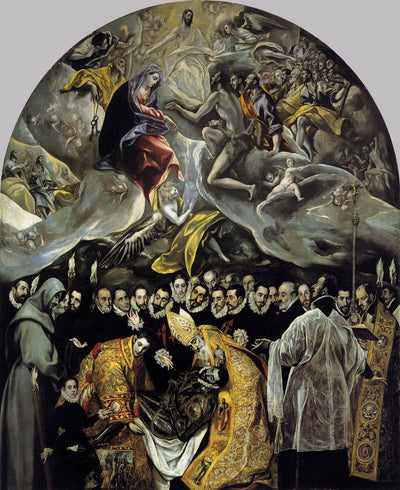
| 1 |  The Burial of the Count of Orgaz The Burial of the Count of Orgaz |
El Greco | 1586 to 1588 | Santo Tomé, Toledo |
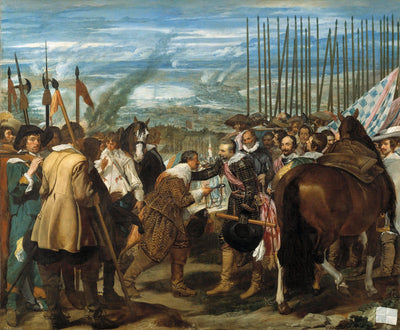
| 2 |  The Surrender of Breda The Surrender of Breda |
Diego Velázquez | 1634 to 1635 | Prado, Madrid |
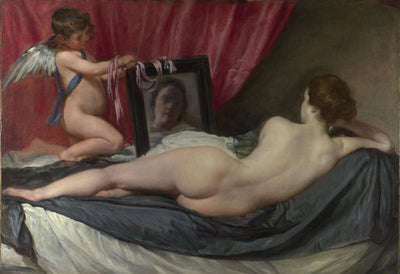
| 3 |  Rokeby Venus Rokeby Venus |
Diego Velázquez | c. 1647 to 1651 | National Gallery, London |
| 4 |  The Young Beggar The Young Beggar |
Bartolomé Esteban Murillo | c. 1647 to 1648 | Louvre, Paris |
| 5 |  Las Meninas Las Meninas |
Diego Velázquez | 1656 | Prado, Madrid |
| 6 |  The Nude Maja The Nude Maja |
Francisco de Goya | c. 1797 to 1800 | Prado, Madrid |
| 7 |  Charles IV of Spain and His Family Charles IV of Spain and His Family |
Francisco de Goya | 1800 to 1801 | Prado, Madrid |
| 8 |  The Third of May 1808 The Third of May 1808 |
Francisco de Goya | 1814 | Prado, Madrid |
| 9 | Saturn Devouring His Son | Francisco de Goya | c. 1820 to 1823 | Prado, Madrid |
| 10 | Guernica | Pablo Picasso | 1937 | Museo Reina Sofía, Madrid |
| 11 | The Persistence of Memory | Salvador Dalí | 1931 | Museum of Modern Art, New York |
The Golden Age: 1586 to 1656
01The Burial of the Count of Orgaz, El Greco (1586 to 1588)

Zoom
The parish priest Andrés Núñez signed the contract with El Greco on March 18, 1586, for a chapel in the church of Santo Tomé in Toledo. The price was set by appraisal, and El Greco accepted the lower estimate of 13,200 reales. The canvas is 480 by 360 centimeters and still hangs in that church.
It illustrates a legend about Gonzalo Ruiz de Toledo, lord of Orgaz, who died in 1323: Saints Stephen and Augustine came down from heaven to bury him. The picture has two tiers, a heavenly upper half and an earthly lower half. El Greco's son Jorge Manuel stands at the left, with a handkerchief in his pocket that carries the artist's signature and the date 1578, his birth year.
02The Surrender of Breda, Diego Velázquez (1634 to 1635)

Zoom
Philip IV commissioned this for the Hall of Realms in his Buen Retiro palace, where it hung with nineteen other paintings. It is the Spanish victory over the Dutch at Breda, 307 by 367 centimeters, and it shows the moment on June 5, 1625 when Justinus van Nassau handed the city's key to the general Ambrogio Spinola.
The composition is the story: the surrender fills the foreground, battle smoke rises behind, and the Spanish soldiers outnumber the Dutch. José Ortega y Gasset called the upright lances "the backbone of the entire picture." It hangs in the Prado.
03Rokeby Venus, Diego Velázquez (c. 1647 to 1651)

Zoom
It is the only surviving female nude by Velázquez, and in seventeenth-century Spain nudes were rare because the Inquisition actively policed painting. The Rokeby Venus is 122.5 by 177 centimeters, per the National Gallery. It left Spain in 1813, and John Morritt bought it for £500 and hung it at Rokeby Park in Yorkshire.
The National Art Collections Fund bought it for the National Gallery in London in 1906, with King Edward VII anonymously contributing £8,000. On March 10, 1914, the suffragette Mary Richardson slashed it seven times with a meat cleaver. Chief restorer Helmut Ruhemann repaired every cut.
04The Young Beggar, Bartolomé Esteban Murillo (c. 1647 to 1648)
Murillo is better known for sweet Madonnas, but The Young Beggar, also called the Lice-Ridden Boy, shows an orphaned street child picking lice from his shirt. Shrimp shells and a basket of apples lie nearby, so the boy has just eaten. It is described as the first of Murillo's street-child pictures. The canvas is 134 by 110 centimeters, was once in the collection of Louis XVI, and the Louvre, which dates it to 1647 to 1648, shows it today (museum record).
05Las Meninas, Diego Velázquez (1656)

Zoom
Hand-painted in oil · From $350See sizes ›
Las Meninas measures 318 by 276 centimeters. The five-year-old Infanta Margaret Theresa stands at the center, with her maids of honor, a chaperone, a bodyguard, two dwarfs and a dog. Velázquez stands at a large canvas on the left. In a mirror on the back wall, the king and queen, Philip IV and Mariana, are reflected.
The red cross of the Order of Santiago on his chest is a later addition: Velázquez did not join the order until 1659, three years after the painting, and the court painter Palomino wrote that Philip IV ordered it added after his death. The picture entered the Prado when the museum opened in 1819. The Italian painter Luca Giordano called it "the theology of painting," and in 1957 Picasso painted 58 interpretations of it.
Goya: 1797 to 1823
06The Nude Maja, Francisco de Goya (c. 1797 to 1800)

Zoom
Hand-painted in oil · From $250See sizes ›
The Nude Maja is 97 by 190 centimeters, probably commissioned by Manuel Godoy for a private cabinet of nudes. Its companion, The Clothed Maja, shows the same woman in the same pose, dressed. The pair usually hang together in the Prado.
Unlike the Rokeby Venus, this is a nude Spanish woman, shown full frontal. Inquisition investigators turned up the painting in Godoy's collection, and Goya was summoned on a charge of moral depravity. He escaped prosecution when the tribunal accepted that he was following Velázquez and Titian. The model is unknown: Godoy's mistress Pepita Tudó has been suggested, and so has the Duchess of Alba, though many scholars reject that.
07Charles IV of Spain and His Family, Francisco de Goya (1800 to 1801)

Zoom
Hand-painted in oil · From $350See sizes ›
The group portrait is 280 by 336 centimeters and shows the royal family in life-size, with Goya himself barely visible in the shadows at left. He modeled it partly on Las Meninas and, like Velázquez, shows himself working at a canvas whose back we see.
The French writer Théophile Gautier called it a "picture of the corner grocer who has just won the lottery." It hangs in the Prado.
08The Third of May 1808, Francisco de Goya (1814)

Zoom
Hand-painted in oil · From $350See sizes ›
In February 1814, after the French were expelled, Goya asked the provisional government to commemorate the uprising against Napoleon, and it accepted. He finished The Third of May in 1814, 268 by 347 centimeters, as the companion to The Second of May 1808. On May 2, 1808, Madrid rose against the occupiers. Before dawn on May 3, hundreds of Spaniards were rounded up and shot.
Manet borrowed from it for his Execution of Emperor Maximilian (1868 to 1869), and Picasso's Massacre in Korea (1951) refers to it directly. It hangs in the Prado.
09Saturn Devouring His Son, Francisco de Goya (c. 1820 to 1823)
Goya painted this on a wall of his house, the Quinta del Sordo near Madrid, which he bought in 1819, as part of the Black Paintings. The mural was moved to canvas later, a job directed by Salvador Martínez Cubells, chief restorer of the Prado, for Baron Émile d'Erlanger, who owned the house. It is 143.5 by 81.4 centimeters and is in the Prado.
Peter Paul Rubens painted the same myth, and Goya likely knew it. The difference is mood: Rubens's victim shows clear pain, while Goya's Saturn acts from madness.
The twentieth century
Both works below are by artists who died after 1955, so they are still under copyright and this article shows no images of them. They belong on any list of Spanish masterpieces anyway.
10Guernica, Pablo Picasso (1937)
German Condor Legion aircraft bombed the Basque town of Guernica on April 26, 1937. Picasso began the canvas in May and finished it on June 4, about 35 days of work. It is 3.49 by 7.76 meters, in gray, black and white, and was unveiled in July 1937 at the Spanish Pavilion of the Paris International Exposition.
Picasso wanted it kept out of Spain until liberty and democracy returned, so it stayed at the Museum of Modern Art in New York until 1981. It arrived in Spain in September 1981, was first shown at the Casón del Buen Retiro, and moved in 1992 to the Reina Sofía in Madrid, where it remains.
11The Persistence of Memory, Salvador Dalí (1931)
This small oil painting is only 24 by 33 centimeters. It was first shown at the Julien Levy Gallery in 1932, where it sold for $250, and an anonymous friend of the museum bought it from Levy and gave it to the Museum of Modern Art in 1934. Asked whether the soft watches came from Einstein's relativity, Dalí said they were inspired by a Camembert cheese melting in the sun.
A few of them on your wall
The Spanish masters listed above who are in the public domain, from Velázquez's Meninas to Goya's firing squad, are available at Art & See as oil paintings made by hand on canvas, in seven sizes with custom sizes on request. Browse the full collection of famous paintings and choose the one you keep thinking about. A photo of the finished canvas is sent for your approval before it ships, shipping is free worldwide and returns are open for 90 days.
Sources
- Wikipedia, The Burial of the Count of Orgaz
- Wikipedia, The Surrender of Breda
- Wikipedia, Rokeby Venus
- Wikipedia, The Young Beggar
- Wikipedia, Las Meninas
- Wikipedia, The Nude Maja
- Wikipedia, Charles IV of Spain and His Family
- Wikipedia, The Third of May 1808
- Wikipedia, Saturn Devouring His Son
- Wikipedia, Guernica (Picasso)
- Wikipedia, The Persistence of Memory
- Louvre, Le Jeune mendiant (collection record)
- National Gallery, The Toilet of Venus (The Rokeby Venus)
- Smarthistory, Goya, Saturn Devouring One of His Sons
- Fundación Goya en Aragón, El tres de mayo de 1808
- MoMA, Salvador Dalí, The Persistence of Memory
- Museo Reina Sofía, Guernica at the Casón del Buen Retiro