4.9/5
4.9/5


Rome holds five of the 12 famous Caravaggio paintings below if you count the Vatican, and three still hang in the buildings they were painted for. One of those, the church of San Luigi dei Francesi, charges nothing at the door. Another is an oratory in Malta where the Knights expelled Caravaggio from their order, in front of the altarpiece he had painted for them that same year.
What is Caravaggio's most famous painting?
The Calling of Saint Matthew, because it's the painting that made him. When it went up in San Luigi dei Francesi in 1600 with The Martyrdom of Saint Matthew, the pair caused an immediate sensation, and he never lacked commissions again. Ask scholars for his greatest work and many name The Beheading of Saint John the Baptist instead. Both show why he still draws crowds: live models, hard light against deep shadow, and a way of staging holy stories that Rubens, Ribera, Velázquez and Rembrandt all learned from.
Twelve paintings, in the order he made them
The table is the short version, useful for planning a route or for picking a favorite to set beside the hand-painted Caravaggio copies in the collection. The stories follow.
| Painting | Year | Where it hangs |
|---|---|---|
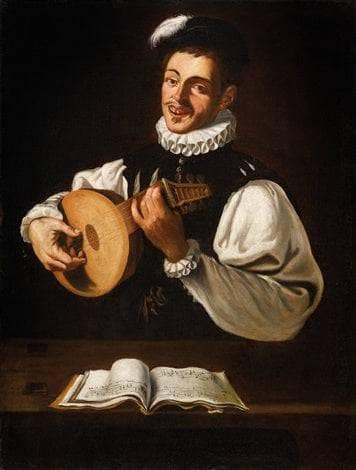
| The Lute Player | c. 1596 | Hermitage Museum, St. Petersburg |
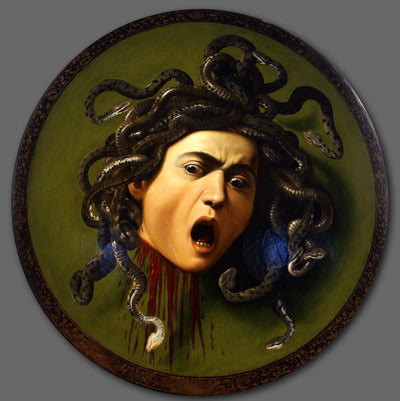
| Medusa | c. 1597 | Uffizi, Florence |
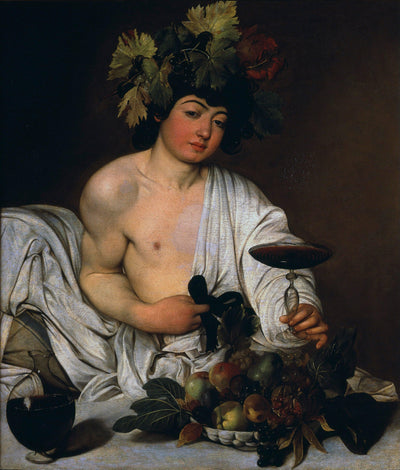
| Bacchus | c. 1598 | Uffizi, Florence |
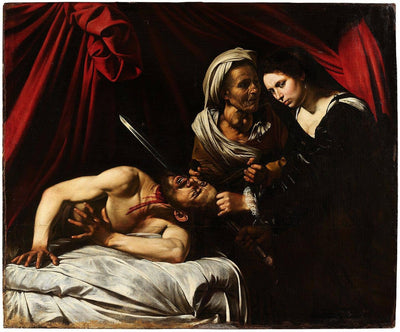
| Judith Beheading Holofernes | c. 1599 | Palazzo Barberini, Rome |
| Basket of Fruit | c. 1599 | Pinacoteca Ambrosiana, Milan |
| The Calling of Saint Matthew | 1599–1600 | San Luigi dei Francesi, Rome |
| The Conversion of Saint Paul | 1601 | Santa Maria del Popolo, Rome |
| The Supper at Emmaus | 1601 | National Gallery, London |
| The Entombment of Christ | c. 1600–1604 | Vatican Pinacoteca |
| Death of the Virgin | 1601–1606 | Louvre, Paris |
| The Beheading of Saint John the Baptist | 1608 | St. John's Co-Cathedral, Valletta |
| David with the Head of Goliath | 1609–1610 | Galleria Borghese, Rome |
1. The Lute Player, c. 1596 (St. Petersburg)
In St. Petersburg hangs the Hermitage lute player, which belonged to Caravaggio's patron Vincenzo Giustiniani until it was bought for Alexander I of Russia at a Paris auction in 1808. A soft-faced boy sings a madrigal by Jacques Arcadelt from sheet music you can actually read. Look for the crack in the body of the lute, a hint that love doesn't last either. Describing a lute player made for Cardinal del Monte, the biographer Giovanni Baglione passed on Caravaggio's own verdict: "the best piece that he ever painted."
2. Medusa, c. 1597 (Florence)
Cardinal Francesco Maria del Monte ordered this screaming head on a parade shield as a present for Ferdinando I de' Medici. It is painted on linen over convex poplar, caught at the instant of decapitation, mouth open, blood pouring from the neck, and the face is Caravaggio's own. An earlier version, painted in 1596 and signed, is privately owned.

3. Bacchus, c. 1598 (Florence)
A room away, a drowsy young Bacchus holds out a shallow goblet of red wine as if you're invited. Del Monte gave it to Ferdinando I de' Medici too, for his son Cosimo II's wedding in 1608, and it turned up in the Uffizi storerooms in 1913, when Roberto Longhi recognized the hand. Check the fruit bowl for a bursting pomegranate and a rotting apple: youth and pleasure spoil like everything else.
4. Judith Beheading Holofernes, c. 1599 (Rome)
At Palazzo Barberini, Judith, blade already in his neck, holds Holofernes at arm's length while he twists toward her. Caravaggio painted the moment of decapitation itself, and her face mixes determination and disgust. Her model was probably the courtesan Fillide Melandroni. The Genoese banker Ottavio Costa commissioned it; it resurfaced in 1950, and it deeply influenced Artemisia Gentileschi.

5. Basket of Fruit, c. 1599 (Milan)
Milan's Pinacoteca Ambrosiana treats this as the prototype of the Italian still life, and it's probably the most famous picture Cardinal Federico Borromeo ever owned. Caravaggio painted it over a canvas that already carried grotesques. Look for the worm-eaten fruit and drying leaves beside the fresh ones. He once told the collector Vincenzo Giustiniani that a good picture of flowers took him as much workmanship as one of human figures.
6. The Calling of Saint Matthew, 1599–1600 (Rome)
The Contarelli Chapel Calling still hangs on the chapel's left wall in San Luigi dei Francesi, a few steps from Piazza Navona, facing The Martyrdom of Saint Matthew. The church is free to walk into, though it stays shut on the morning of every first Wednesday of the month.

Christ walks in on a table of money counters and points. His outstretched hand is almost a mirror image of Adam's in Michelangelo's Creation of Adam, and the window above it is divided in the shape of a cross. Most historians read Matthew as the bearded man pointing at his own chest ("Me?").
7. The Conversion of Saint Paul, 1601 (Rome)
In Santa Maria del Popolo, the Cerasi Chapel holds two Caravaggios face to face: this one and the Crucifixion of Saint Peter. Tiberio Cerasi's contract of 24 September 1600 asked for two cypress panels in eight months for 400 scudi; the first versions were rejected, and Caravaggio painted canvases instead. Saul lies on his back, arms open to the light, while an old groom steadies the huge skewbald horse. In 1855 Jacob Burckhardt complained that "the horse nearly fills the whole of the picture." He meant it as a criticism.
8. The Supper at Emmaus, 1601 (London)
This was the first of London's three Caravaggios, given to the National Gallery in 1839. Ciriaco Mattei commissioned it in 1601. Christ blesses the bread and the two disciples recognize him: one is about to leap out of his chair, the other throws his arms wide, and the innkeeper notices nothing. Christ is beardless, perhaps because in the Gospel he appears in another form. Look for the fruit basket teetering on the edge of the table.
9. The Entombment of Christ, c. 1600–1604 (Vatican City)
It now hangs in Room XII of the Vatican Pinacoteca, and it's one of his greatest altarpieces. Girolamo Vittrice ordered it for his family chapel in the Chiesa Nuova; it went to Paris in 1797 under the Treaty of Tolentino and came back about twenty years later. Nicodemus and John lower Christ onto the stone slab that will close the tomb. Rubens, Fragonard, Géricault and Cézanne all copied it.
10. Death of the Virgin, 1601–1606 (Paris)
Find it in the Louvre's Grande Galerie, Denon wing, room 712. Laerzio Cherubini ordered it in 1601 for a Carmelite church in Trastevere, and the clergy refused the finished picture. You can see why: the Virgin lies in a plain red dress with swollen, spread feet and none of the usual trappings of holiness. Bellori wrote that she looked "too much like the swollen corpse of an ordinary dead woman." Rubens praised it, the Duke of Mantua bought it, and in 1671 it passed to Louis XIV.
11. The Beheading of Saint John the Baptist, 1608 (Valletta)
It still hangs where the Knights of Malta commissioned it, in the Oratory of St. John's Co-Cathedral in Valletta. At 3.7 by 5.2 meters it's the largest altarpiece Caravaggio ever painted, and the only work he signed: "f. Michelang.o" in the blood spilling from the saint's throat. Months later, after a brawl and an escape from a Valletta jail, the Knights expelled him in absentia "as a foul and rotten member" in a ceremony held in front of this painting. It's widely considered his masterpiece.
12. David with the Head of Goliath, 1609–1610 (Rome)
The Galleria Borghese owns six Caravaggios, and this is the most personal. David holds Goliath's head by the hair, and the head is a self-portrait. The sword carries the letters H-AS OS, usually read as humilitas occidit superbiam, "humility kills pride." If it went as a gift to Cardinal Scipione Borghese, who had the power to pardon Caravaggio for murder, it reads as a plea for mercy. Book ahead: the Borghese takes visitors by reservation.

Seeing him without flying to Rome
Rome is still the place for Caravaggio, with 22 of his paintings on view in ten museums and churches, the Vatican included. But you don't need a passport for all of him.
Where can I see Caravaggio paintings in the USA?
Six American museums own seven Caravaggios between them:
- Metropolitan Museum of Art, New York: The Musicians (1597) and The Denial of Saint Peter (1610), both in Gallery 620.
- Kimbell Art Museum, Fort Worth: The Cardsharps, which disappeared in the 1890s and turned up in Zürich in 1987.
- Cleveland Museum of Art: The Crucifixion of Saint Andrew (1606–1607), the only Caravaggio altarpiece in America.
- Nelson-Atkins Museum of Art, Kansas City: Saint John the Baptist in the Wilderness (1604).
- Detroit Institute of Arts: Martha and Mary Magdalene (c. 1598).
- Wadsworth Atheneum, Hartford: Saint Francis of Assisi in Ecstasy (c. 1595), his first religious painting.
If this list left you wanting more, start with the other pictures everyone knows on sight.
Bring one of them home
Three of these originals will stay on the walls they were painted for, and the rest are a flight away. For your own room, every Caravaggio in the collection is painted by hand in oil, from the quiet Basket of Fruit to the Beheading. Choose the one whose light you keep thinking about after you close this page.
Sources
- Uffizi Galleries: Bacchus
- National Gallery, London: The Supper at Emmaus
- Louvre collections: La Mort de la Vierge
- Vatican Museums: Caravaggio, Deposition
- Veneranda Biblioteca Ambrosiana: Basket of fruit
- Cleveland Museum of Art: The Crucifixion of Saint Andrew
- Saint-Louis des Français, Rome: visiting hours
- Turismo Roma: Caravaggio's locations