4.7/5


Famous Gothic paintings run from Cimabue's gold-ground Maestà of the late 1200s to Jan van Eyck's Arnolfini Portrait of 1434, with Giotto's chapel in Padua, Duccio's Maestà in Siena, Simone Martini's Annunciation, the Wilton Diptych, the Très Riches Heures and the Ghent Altarpiece in between. Together they form the heart of our medieval paintings collection, and they show the century and a half in which gold backgrounds gave way to weight, space, real rooms and, finally, oil paint. There is no book count for single paintings, so the ranking below uses the number of languages Wikipedia covers each work in, and it adds what each one is painted on.
The eight are grouped by region: Italy first, then the royal courts of England and France, then Flanders. One name to set aside: Grant Wood's American Gothic (1930), in the Art Institute of Chicago, shows a farmer and his daughter, not his wife, in front of a farmhouse in the 1880s Carpenter Gothic style, an American way of building rather than medieval art.
The 8 most famous Gothic paintings, ranked by their reach on Wikipedia
| Spot | Gothic work | Artist | What it is painted on | Languages on Wikipedia |
|---|---|---|---|---|
| 1 |  The Arnolfini Portrait |
Jan van Eyck | Oil on wood, probably oak | 42 |
| 2 | Très Riches Heures du Duc de Berry | The Limbourg brothers | Paint on the vellum pages of a book | 41 |
| 3 |  The Ghent Altarpiece |
Hubert and Jan van Eyck | Oil on wooden panels | 38 |
| 4 | The Scrovegni Chapel frescoes | Giotto | Fresco on the chapel walls | 36 |
| 5 | Maestà | Duccio | A wooden panel painted on both sides | 19 |
| 6 | Annunciation with Saint Margaret and Saint Ansanus | Simone Martini and Lippo Memmi | An altarpiece with a gold background | 18 |
| 7 | The Wilton Diptych | Unknown English or French painter | Egg tempera on oak | 14 |
| 8 |  Maestà (The Virgin and Child in Majesty Surrounded by Six Angels) |
Cimabue | Tempera and gold on poplar | No data |
Counts checked in October 2026. The Giotto number belongs to the chapel's own article, and we could not match the Cimabue panel to an article.
Jan van Eyck's two oil paintings take two of the top three places, and they are also the youngest works on the list.
What counts as Gothic painting
Gothic art grew out of Romanesque art in the mid-12th century and lasted to the end of the 16th in some places, according to Britannica. If you want one example of Gothic art, start with a building: the earliest surviving Gothic church is the abbey of Saint-Denis, just north of Paris, begun in about 1140, and the style's signature, as the National Gallery's glossary puts it, is the pointed arch. The name began as an insult. Italian writers of the Renaissance blamed the style on the "barbarian" Goths who had destroyed the Roman Empire, and the word kept its sting until the 19th century, although the art has nothing to do with the Goths.
In painting, the same glossary looks for elongated figures and drapery drawn in flowing lines. You will find both below, on altarpieces of egg tempera and gold, on frescoed chapel walls, in a duke's prayer book and, at the very end, in oil.
Gothic is not Victorian, either. Victorian means Britain under Queen Victoria, who reigned from 1837 to 1901, and that is the century in which, Britannica notes, critics began to admire Gothic architecture again.
Italy: gold, tempera and the first real space
Four of the eight come from Italy, where rival city-states such as Florence and Siena each had a painting style of their own, as Smarthistory points out. What came after them, from Botticelli to Boccioni, is in our list of famous Italian paintings.
01Maestà (The Virgin and Child in Majesty Surrounded by Six Angels), Cimabue (1275–1300)

Zoom
The Louvre's collection record gives the facts: tempera on a gold ground on poplar, 427 × 280 cm (168.1 × 110.2 in), painted in the last quarter of the 13th century. It stood in the church of San Francesco in Pisa until 1810, spent two years in the city's Camposanto and entered the Louvre in October 1812, an acquisition the museum lists as "military conquest". It hangs in the Salon Carré, room 708 of the Denon wing.
Look at the frame as well as the picture. Its 26 painted medallions are original: Christ the Redeemer with four archangels at the top, prophets in the corners, the twelve apostles down the sides, and Saints Clare, Francis, Elizabeth of Hungary and Anthony of Padua along the bottom. Cimabue, born in Florence around 1240, died in 1301 or 1302, possibly in Pisa.
His later Santa Trinita Maestà, which the Uffizi dates to about 1290–1300, is in Florence, in the Primitivi rooms where the gallery shows the large panels of Cimabue, Duccio and Giotto; those rooms were built in the 1950s and modeled on the main room of a medieval church. We paint Cimabue's Louvre Maestà by hand in oil.
02The Scrovegni Chapel frescoes, Giotto (about 1303–1305)

Zoom
The chapel's official site says Giotto frescoed it between 1303 and 1305 for Enrico degli Scrovegni. The chapel is dedicated to St. Mary of the Charity, the stories of the Virgin and of Christ cover its walls from end to end, and the Last Judgment fills the wall opposite the altar. Next to Cimabue's gold, the change is easy to see: Giotto sets his figures in front of a painted sky, and Smarthistory describes them as more monumental, large and heavy, with a greater sense of accurate proportion.
In 2021 UNESCO added Giotto's frescoes to the World Heritage List as part of "Padua's fourteenth-century fresco cycles", eight groups of buildings with frescoes painted between 1302 and 1397. It credits Giotto's cycle with marking "the beginning of a revolutionary development in the history of mural painting".
A visit is short and booked ahead: groups of no more than 25 wait in an air-conditioned room, then get about 15 minutes inside, according to the chapel's visitor rules. Two of its scenes have their own stories on this blog: the comet over his Adoration of the Magi and the Lamentation that opens our list of famous paintings of Jesus.
03Maestà, Duccio (1308–1311)

Zoom
Siena's cathedral museum says Duccio painted the double-sided altarpiece from 1308 to 1311, with over forty figures on the front and almost eighty in the stories on the back, where 26 scenes tell the Passion. On 9 June 1311 it was placed on the cathedral's high altar. A Sienese chronicle, quoted in translation by Smarthistory, says that on the day it was carried to the cathedral the shops were shut and the bishop led priests and friars, the city's officials and the people, the worthiest holding lighted candles.
“Holy mother of God, be the cause of peace to Siena, and to the life of Duccio, because he has painted thee thus.”
Smarthistory also explains the look. Siena's style favored decorative surfaces, sinuous lines, elongated figures and heavy use of gold, and the altarpiece is a panel because fresco did not suit a cathedral built of alternating blocks of black and white marble. The Maestà now has a temperature-controlled room in the Museo dell'Opera del Duomo.
A smaller Duccio stays across town in the Pinacoteca Nazionale: his Madonna of the Franciscans, which Italy's Ministry of Culture says was lent to the Louvre for its 2025 Cimabue exhibition.
04Annunciation with Saint Margaret and Saint Ansanus, Simone Martini and Lippo Memmi (1333)

Zoom
This altarpiece was painted for the altar of St. Ansanus in the transept of Siena Cathedral, one of four altarpieces made to surround Duccio's Maestà, and it is signed and dated 1333 by Simone Martini and Lippo Memmi. The two shared a workshop and became brothers-in-law when Simone married Memmi's sister; the Uffizi, where it hangs today, notes that critics give most of the design and the painting to Simone.
Gabriel's greeting, AVE GRATIA PLENA DOMINUS TECUM ("Hail, full of grace, the Lord is with you"), runs across the gold toward Mary, who draws back and pulls her cloak around her. Smarthistory reads the olive branch in his hand as peace and the lilies as Mary's purity. Ansanus, one of Siena's patron saints, holds the city's banner on the left. The woman on the right may be Margaret or Ansanus's mother, Maxima, and the museum says the inscription at her feet calling her Judith is a mistake. Four prophets look down from roundels set into the frame: Jeremiah, Ezekiel, Isaiah and Daniel.
The courts: International Gothic
Around 1400 the style turned courtly. The National Gallery's glossary describes International Gothic as a name art historians gave to painting made for courts across Europe from the late 1300s to the mid-1400s, mainly in France, Italy and Bohemia: decorative, rich in color and gold, often illogical in its space but full of closely observed natural detail. Pisanello, Giovanni di Paolo and Stefan Lochner are among the painters it names.
05The Wilton Diptych, unknown English or French painter (about 1395–1399)

Zoom
The National Gallery's full title tells the story: Richard II presented to the Virgin and Child by his patron saint John the Baptist and Saints Edward and Edmund. It was made for Richard, king of England from 1377 to 1399, in the last five years of his life. It is egg tempera on oak, and the gallery says the painter's identity remains a mystery. The gallery bought it in 1929 with help from Samuel Courtauld and the Art Fund.
Edmund and Edward the Confessor were England's patron saints, and John the Baptist was Richard's own. The angels have red-gold hair like the king's, which the gallery takes as a sign that they stand for the English, and Richard reaches toward a banner bearing the red cross of St. George. The white hart the angels wear as a badge is Richard's emblem, and our guide to medieval animal paintings explains it with the other animals of the period.
06Très Riches Heures du Duc de Berry, the Limbourg brothers (about 1411–1416)

Zoom
Around 1411 Jean, Duke of Berry, brother of King Charles V of France, commissioned this book of hours from three young painters from Nijmegen, the brothers Paul, Jean and Herman Limbourg. Patron and painters all died in 1416 and left it unfinished. Barthélemy d'Eyck worked on it around 1440, and Jean Colombe added more around 1485 for Charles I of Savoy, who had inherited it, according to the Château de Chantilly.
It is a book, not a panel: 206 vellum leaves of 30 × 21 cm (11.8 × 8.3 in), with 66 large and 65 small paintings. The château calls its calendar of the months legendary and the whole book a treasure of International Gothic art, mixing Flemish, French, Italian, Eastern and ancient influences. The Duke of Aumale bought it in 1856, after it resurfaced in Genoa in December 1855.
Do not expect to see it on an ordinary visit. Because it is so fragile, the château keeps it in secure storage away from public view, the Duke of Aumale's wishes forbid exhibiting it outside Chantilly, and it goes on display only rarely; one such showing ran from June to October 2025, after a restoration, according to the château's exhibition press release.
Flanders: Gothic in oil
The last two works are painted in oil. Jan van Eyck did not invent the medium, and our article on whether Jan van Eyck invented oil painting explains what he did with it.
07The Ghent Altarpiece, Hubert and Jan van Eyck (1432)

Zoom
Saint Bavo's Cathedral records that the polyptych was first set up on 6 May 1432 in the chapel of Joos Vijd and Elisabeth Borluut. Opened, it measures about 348 × 460 cm (137.0 × 181.1 in), according to Smarthistory, which notes how the crowds in the lower tier converge on the altar across five panels, "overcoming the Gothic division of the frame".
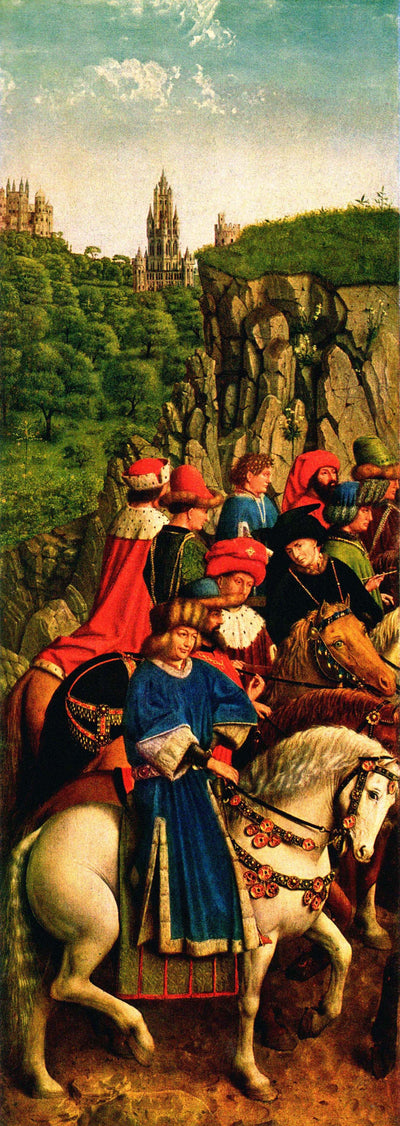
One panel is not original. The Just Judges, shown in our detail, was stolen in 1934 and never recovered, and a modern copy took its place during the 1945 restoration. Our studio artists paint the Just Judges riders as a canvas of their own. The ransom story, the frame verse and the restoration are told in famous religious paintings, and the altarpiece's role at the start of the Renaissance in our guide to Renaissance art.
08The Arnolfini Portrait, Jan van Eyck (1434)

Zoom
Hand-painted oil reproductionSee sizes ›
The National Gallery catalogs it as Portrait of Giovanni(?) Arnolfini and his Wife: oil on wood, probably oak, 82.2 × 60 cm (32.4 × 23.6 in), bought in 1842. The gallery describes the setting as a reception room in the modern mansion of a wealthy merchant, an Italian working in Bruges.
Set it beside Cimabue's Maestà and the whole Gothic story fits in two panels: an enthroned Virgin on gold, then a merchant couple in a room with a window, a chandelier and a mirror. It belongs among the most famous paintings in the world, and our article on what Jan van Eyck actually invented takes apart the mirror, the signature and the glazes. You can order the Arnolfini Portrait as a hand-painted oil copy.
Gothic gold, off the altar
Most of these works were made for churches, a king or a duke. Our medieval paintings collection brings several of them home as hand-painted canvases, from Cimabue's angels to the Arnolfini couple, and the art movements timeline shows where Medieval art sits among the movements that followed.
Sources
- Britannica, Gothic art
- National Gallery, London, glossary: Gothic
- The Royal Family, Queen Victoria
- Art Institute of Chicago, Grant Wood, American Gothic
- Musée du Louvre, Cimabue, The Virgin and Child in Majesty Surrounded by Six Angels (Maestà), INV 254
- Uffizi Galleries, Cimabue, Santa Trinita Maestà
- Uffizi Galleries, the "Primitivi" rooms
- Cappella degli Scrovegni, official site: The Scrovegni Chapel
- Cappella degli Scrovegni, official site: How to visit
- UNESCO World Heritage Centre, Padua's fourteenth-century fresco cycles
- Smarthistory (Beth Harris and Steven Zucker), Duccio, Maestà
- Opera della Metropolitana di Siena, Museo dell'Opera del Duomo
- Italian Art Society (Anne Leader), Duccio's Maestà was placed on the high altar of Siena Cathedral on 9 June 1311
- Britannica, Duccio
- Italian Ministry of Culture, Pinacoteca Nazionale di Siena display (Madonna dei Francescani)
- Uffizi Galleries, Simone Martini and Lippo Memmi, Annunciation
- Smarthistory (Steven Zucker and Beth Harris), Simone Martini, Annunciation
- National Gallery, London, glossary: International Gothic
- National Gallery, London, The Wilton Diptych
- Château de Chantilly, The Très Riches Heures du duc de Berry
- Château de Chantilly, press release for the 2025 Très Riches Heures exhibition
- Saint Bavo's Cathedral, Ghent, The Ghent Altarpiece
- Smarthistory, Jan van Eyck, The Ghent Altarpiece
- Britannica, The Most Stolen Work of Art
- National Gallery, London, Jan van Eyck, The Arnolfini Portrait