4.9/5
4.9/5


You can spot Renaissance paintings by seven traits that show up in the picture itself. The first three characteristics of Renaissance paintings are space that looks deep, settings painted from nature and bodies with real weight. Then come shapes made solid by light and shadow, stories from old myths and layouts built on simple shapes. The last is oil paint laid on so finely that a whole town fits into the background of a small panel. Each trait below comes with a painting and the exact detail to look for. The examples come from early Renaissance paintings and from the High Renaissance that grew out of them. The chart under the next heading turns the seven traits into a quick checklist, with the exact place to look in each example.
This guide is about spotting the style. For its history, cities and painters, start with our overview of Renaissance art. For a tour of single masterpieces, see our list of Italian Renaissance paintings. The examples here start with a Van Eyck panel from about 1430. They end with a Titian finished early in 1523, so they cover nearly a hundred years of change.
Seven Renaissance traits, the clue for each and a painting to test it on
| Renaissance trait | Clue to spot | Test it on | Where to look first |
|---|---|---|---|
| 1. Linear perspective | Lines on floors and buildings run back to one point, and people shrink at a steady rate. |  Marriage of the Virgin, Raphael, 1504 Marriage of the Virgin, Raphael, 1504 |
Follow the stones of the square to the temple's open double door. |
| 2. Nature studied from life | Holy stories take place in real gardens and landscapes, under real light. | Annunciation, Leonardo da Vinci, about 1472 | Find the shadow Gabriel throws on the grass, then study wings modeled on a bird of prey. |
| 3. Anatomy and foreshortening | A body with real weight, shown from a hard angle. |  Lamentation over the Dead Christ, Andrea Mantegna, about 1483 Lamentation over the Dead Christ, Andrea Mantegna, about 1483 |
Start at the soles of the feet, then notice how large the head was kept. |
| 4. Light and shadow that model form | One light shapes each form, so one side glows while the other slips into shadow. |  Lady with an Ermine, Leonardo da Vinci, about 1490 Lady with an Ermine, Leonardo da Vinci, about 1490 |
Trace the light across her forehead, the ermine's head and her long fingers. |
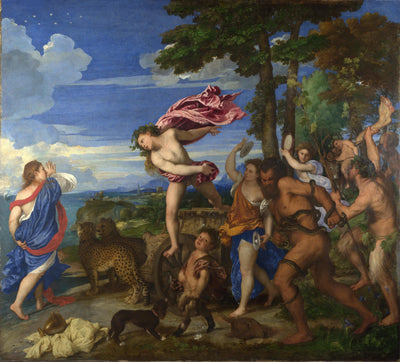
| 5. Stories from classical myth | Gods and heroes from ancient poems join the Bible stories. |  Bacchus and Ariadne, Titian, 1520–1523 Bacchus and Ariadne, Titian, 1520–1523 |
Look to the far left for the tiny ship of Theseus, then up at the ring of stars. |
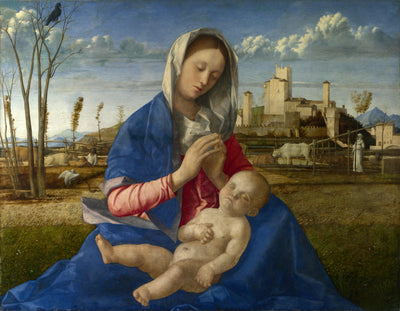
| 6. Balance built on geometry | A simple shape, most often a triangle, holds the scene steady. |  Madonna of the Meadow, Giovanni Bellini, about 1500–1505 Madonna of the Meadow, Giovanni Bellini, about 1500–1505 |
See how Mary's body and blue robe form an almost even triangle. |
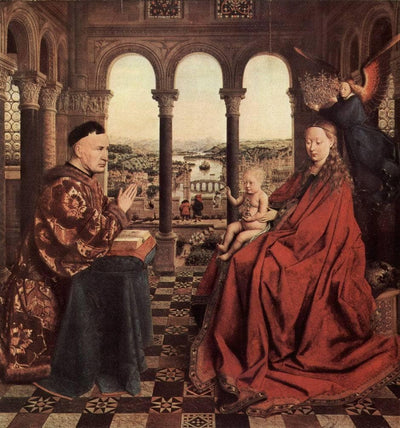
| 7. Oil glazes, fine detail and the patron in the picture | Thin layers of oil make color glow and keep tiny things sharp, and the person who paid may kneel in the scene. |  Virgin of Chancellor Rolin, Jan van Eyck, about 1430–1435 Virgin of Chancellor Rolin, Jan van Eyck, about 1430–1435 |
Look through the three arches to the river, the town and the snowy mountains. |
01Linear perspective

Zoom
In linear perspective, lines that run away from you all meet at one point, called the vanishing point. Those lines can be floor tiles, paving stones or the edges of a building. People also get smaller at a steady rate as they move back. Raphael's Marriage of the Virgin shows this at full strength. The stones of the square lead to a temple with sixteen sides. Its double door stands open, so your eye goes right through the building to the sky.
Raphael was about twenty when he painted it in 1504, for a chapel in a church in Città di Castello. He was probably asked to follow a painting of the same story by Perugino. But Raphael gave the temple twice as many sides, and he turned it from a backdrop into the center of the whole space. Above the middle arch he signed his name, RAPHAEL URBINAS, and he added the year in Roman numbers.
02Nature studied from life

Zoom
Renaissance painters moved holy stories into real gardens and landscapes under real light. Leonardo painted his Annunciation around 1472, while he was still working in Andrea del Verrocchio's studio. You can check its details for yourself. The angel Gabriel throws a shadow on the grass, and his wings are based on the wings of a large bird of prey. The evening light picks out dark trees against a far landscape of soft, blended colors.
The building is drawn to one central vanishing point. But Mary's right arm, stretched toward her book, looks too long. That may come from Leonardo's early study of how we see. The painting may have been planned to be seen from the right, from a side altar in a church.
03Anatomy and foreshortening

Zoom
Renaissance artists studied how a body carries its weight. Then they tested what they knew at hard angles. Andrea Mantegna probably painted his Lamentation over the Dead Christ around 1483. Christ lies on a stone slab with the bottoms of his feet toward you, and the wounds from the nails are still open. Using perspective on one body like this is called foreshortening. But Mantegna didn't follow the rules exactly. He made the head bigger so it wouldn't look smaller than the feet, and that way Christ keeps his dignity.
The painting also reminds us that not everything from this time is oil. Mantegna used a thin tempera paint held together with animal glue. He left it without varnish on purpose, so the surface stays dull instead of shiny. When he died in 1506, a list of the things in his studio named a "foreshortened Christ." If it is this canvas, he kept it for years. Some experts think he made it for his own prayers.
About 25 years later in Rome, Michelangelo painted the Sistine Chapel ceiling, from 1508 to 1512. He framed its Bible scenes with strong, muscular nude figures. He finished the first half in August 1510, so The Creation of Adam comes from the second half. You can see the ceiling's best-known scenes in our guide to Michelangelo's paintings.
04Light and shadow that model form
Renaissance painters didn't just draw an outline and fill it with flat color. Instead, they shaped a form with light. One side catches the light, and the other side slides into shadow. This play of light and dark is called chiaroscuro, which is Italian for "light-dark." Leonardo's Lady with an Ermine, from around 1490, is a perfect example. A single light, which may not be daylight, falls on Cecilia Gallerani from above and to the right. Follow it across her forehead, the ermine's head and her long fingers.
She sits turned partly toward us, and she looks at someone outside the picture. At that time, most portraits showed people from the side. Cecilia was the lover of Ludovico Sforza, the Duke of Milan. The ermine is seen as a sign of him, because he received the Order of the Ermine in 1488. The background was also painted over in the 1800s. At first it was shaped with light, so she seemed to step out of the half-dark.
The original and our hand-painted copy
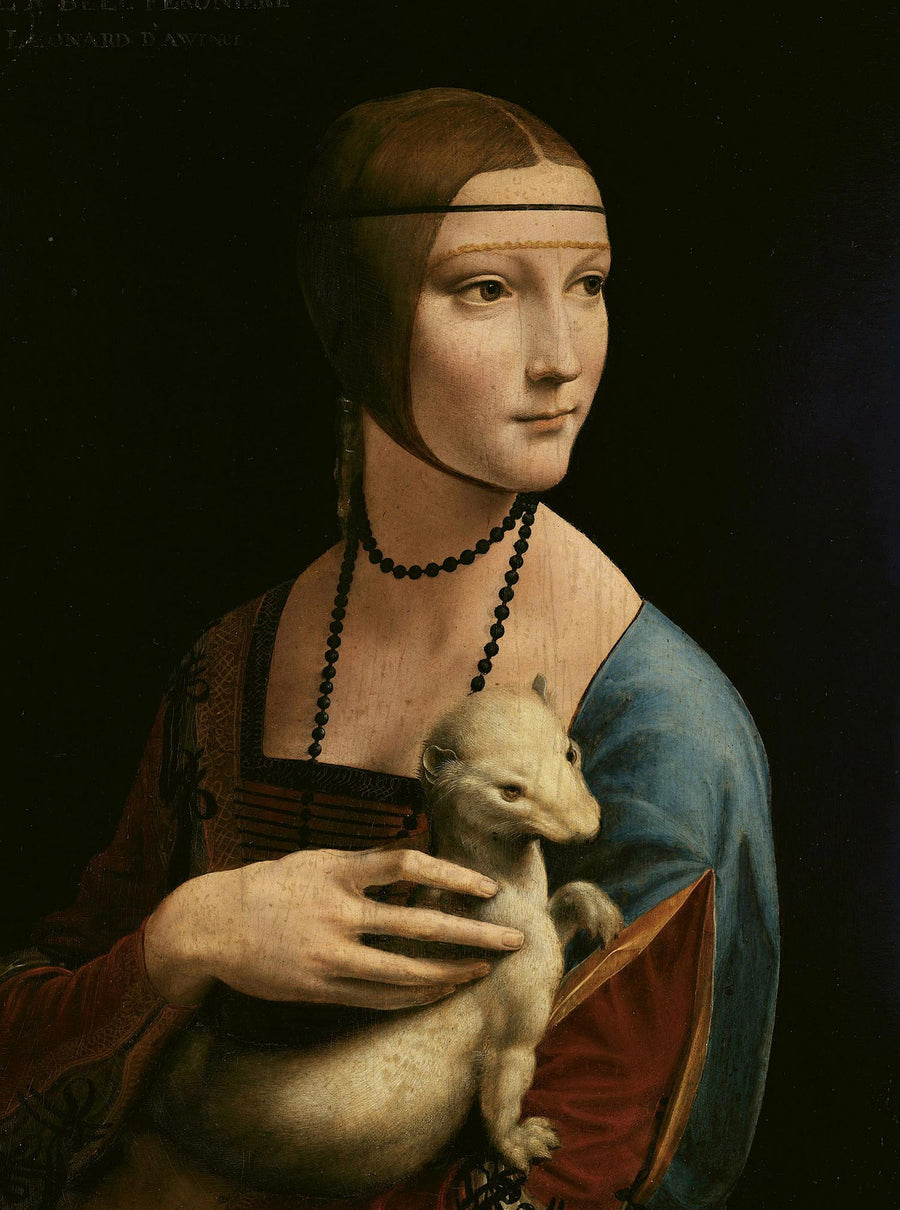
The original
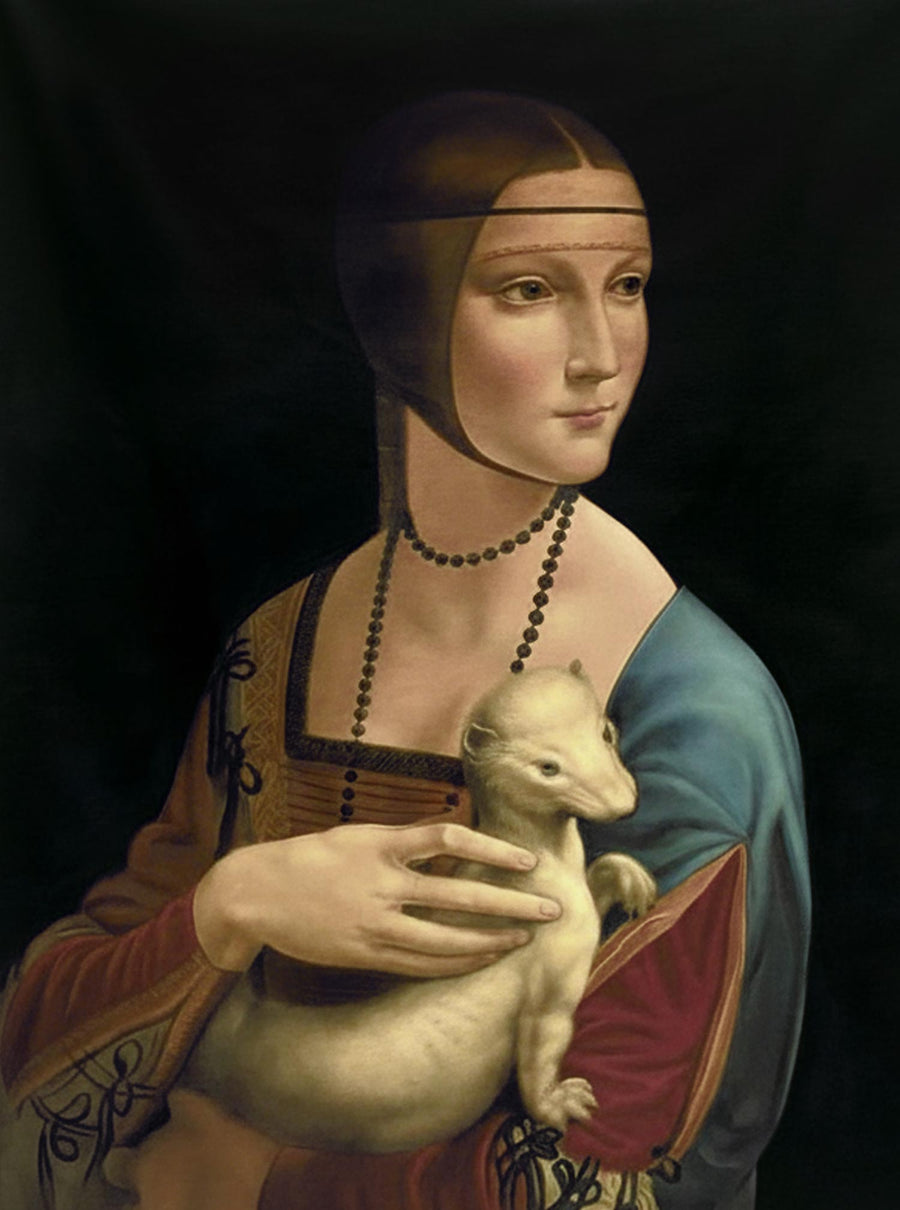
Our reproduction, painted by hand in oil
Leonardo took this softness even further in the Mona Lisa, which he worked on from 1503 to 1519. Her face moves from shadow to light so gently that you can't see where one ends. He laid it on in thin, see-through layers of oil, called glazes. They have very little color in them, and they blur every edge. This effect is called sfumato, from an Italian word for smoke. You can find more of his work in our guide to Leonardo da Vinci's paintings.
05Stories from classical myth

Zoom
Hand-painted oil reproductionSee sizes ›
People brought back the ideas of ancient Greece and Rome. So painters gained a second library of stories next to the Bible. In Florence, Botticelli's Birth of Venus, from about 1485, borrowed the goddess's shy pose from old statues. About 35 years later, Titian painted Bacchus and Ariadne, from 1520 to 1523. He took its story from the ancient poets Ovid and Catullus. Ariadne has been left behind on the island of Naxos. She turns as the god Bacchus leaps from a chariot pulled by two cheetahs.
The ship of Theseus, the lover who left her, is a tiny speck on the sea at the far left. The ring of stars above her head is her crown. In one version of the myth, Bacchus throws it into the sky, where it becomes a group of stars called Corona Borealis.
Titian painted the picture for a room in the palace of Alfonso I d'Este, the Duke of Ferrara. The duke had first ordered a painting on a similar subject from Raphael, but Raphael died in 1520, so Titian's took its place. Titian also borrowed the man wrapped in snakes from the Laocoön. That is an ancient Roman statue that was dug up in Rome in 1506.
06Balance built on geometry

Zoom
Hand-painted oil reproductionSee sizes ›
Renaissance pictures often rest on a simple shape, and it is usually a triangle. That makes them feel steady and calm. Giovanni Bellini's Madonna of the Meadow, from about 1500 to 1505, is a clear example. Mary's body forms an almost perfectly even triangle. Her blue robe makes it stand out even more, so it holds the whole scene in place. The only break is the small tilt of her head. Even her hands, pressed together in prayer, make an oval that repeats the shape of her face.
Around that still center the countryside keeps moving, and the small details are worth a close look. Two oxen rub their heads together, and a herder walks along behind them. A snake threatens a crane, and a vulture waits in a bare tree.
07Oil glazes, fine detail and the patron in the picture

Zoom
Hand-painted oil reproductionSee sizes ›
Look through the three arches in Jan van Eyck's Virgin of Chancellor Rolin, from around 1430 to 1435. The garden is full of lilies, wild roses, peonies, cornflowers and irises, and magpies and peacocks walk among them. Two small figures stand with their backs to us and lean toward a river. Beyond them you can find a bridge and an island with a small castle. Then comes a town with people in its streets, and snowy mountains rise behind it. No one has ever matched the town to a real place.
The man kneeling on the left paid for the painting. He is Nicolas Rolin, who worked as chancellor for Philip the Good, the Duke of Burgundy. He probably ordered the panel around 1430. He prays in the same room as Mary and the baby Jesus, and he is just as big as they are. So the person who paid has stepped right into the holy scene.
Painters in the Low Countries, above all Van Eyck and Rogier van der Weyden, showed what oil paint could do. By the 1500s it was the main paint in Europe. Most colors turn see-through when they are mixed with oil, so painters could build up color in thin layers called glazes. Oil also dries slowly, so it can be blended into soft, smooth shadows. Egg tempera was the old paint of southern Europe. It dries quickly to a light color, and it has to go on in short, crossed strokes.
Oil paint is older than Van Eyck, though. It was used in Northern Europe as early as the 1100s. In Venice, Giovanni Bellini was already using it in the 1460s. People long said that Antonello da Messina brought oil to Venice, but he only stayed there in 1475 and 1476. Our article on whether Van Eyck invented oil painting sorts the legend from the facts.
Subjects that give a Renaissance painting away
Most Renaissance paintings still tell religious stories, but those stories come from a wider library. The Marriage of the Virgin follows old Gospel stories that are not in the Bible. It also follows the Golden Legend, a book of saints' lives from the Middle Ages. In these stories, each man who hopes to marry Mary brings a dry stick to the temple. Only Joseph's stick bursts into flower. That is why the young man in the front on the right is breaking his stick over his knee.
Next to the altar paintings came portraits of living people, scenes from Ovid's poems and pictures of ancient thinkers. In The School of Athens in the Vatican, Raphael shows Plato pointing up and holding a book called the Timaeus. He gives the gloomy thinker Heraclitus the face of Michelangelo. He paints himself at the far right in a black beret. Our guide to the Raphael Rooms in the Vatican covers that room one wall painting at a time.
How to tell Renaissance from the styles around it
Before the Renaissance came Gothic art, with flat figures that stood for ideas and with little sense of real depth. That is the medieval way of painting that the Renaissance broke away from. After it, in the 1500s, came Mannerism. Some painters, like Parmigianino and Rosso Fiorentino, gave up the calm balance of the High Renaissance. They chose stretched-out figures and tense layouts instead.
Then came the Baroque, the main style of the 1600s. It has dramatic scenes, lively layouts and sharp contrasts of light and dark, as in the paintings of Caravaggio. Our guide to Baroque vs Renaissance art sets the two side by side.
In a gallery, check the floor before the faces. Tiles or paving stones that run to one point are the quickest sign that a painter knew the new rules.
Train your eye on one painting
Pick one of the characteristics of Renaissance paintings and test it on the next old painting you see. Try to find the vanishing point, the light or the hidden triangle before you read the label. For more pictures to practice on, browse the world's most famous paintings. Six of the seven examples above can also hang in your home as copies painted by hand in oil. You will find them through the links in their sections.
Sources
- Pinacoteca di Brera, 10 Masterpieces for You (Mantegna, Lamentation over the Dead Christ; Raphael, Marriage of the Virgin)
- Uffizi Galleries, Leonardo da Vinci, Annunciation
- Uffizi Galleries, Sandro Botticelli, Birth of Venus
- National Museum in Kraków, Lady with an Ermine
- Louvre, Portrait of Lisa Gherardini (Mona Lisa), collection record
- Vatican Museums, Sistine Chapel ceiling
- Vatican Museums, Raphael, School of Athens
- National Gallery, London, Titian, Bacchus and Ariadne (NG35)
- National Gallery, London, Giovanni Bellini, Madonna of the Meadow (NG599)
- Louvre, Jan van Eyck, The Virgin of Chancellor Rolin, collection record
- The Met, Heilbrunn Timeline of Art History, Painting in Oil in the Low Countries and Its Spread to Southern Europe
- Christie's, Renaissance art: style, artists and artwork
- Christie's, Baroque art