4.9/5
4.9/5


Did Van Eyck invent oil painting? No. Painters were binding pigment in drying oil hundreds of years before he was born, and a 12th-century monk described the method in writing. What Jan van Eyck (active 1422, died 1441) did was make oil do things nobody had managed: thin translucent layers, jewel-sharp detail, and light that seems to sit inside the paint.
So the famous claim is wrong, and the reason it stuck is more interesting than the claim. It started with one very readable storyteller in 16th-century Italy. It survived because the pictures themselves look like the work of someone who'd found a secret. Stand in front of any of the Van Eyck paintings people still copy by hand and you'll see why.
Oil paint is centuries older than Van Eyck
The oldest oil paintings found so far aren't in Europe at all. They're on the walls of Buddhist caves at Bamiyan, in Afghanistan, painted in the mid-7th century. In a 2008 synchrotron study of the Bamiyan murals, scientists from Tokyo, Paris, the Getty Conservation Institute and the ESRF found that 12 of the 50 caves had been painted with an oil technique, probably using walnut and poppy seed oils.
Europe had its own written record long before Van Eyck. Theophilus, a Benedictine monk writing around 1120, put together a manual on painting, stained glass and metalwork. In it, oil paint without wax is used for woodwork, and linseed oil is allowed for pictures on panels, though gum is preferred because it dries quicker. Hold on to that last detail. Slow drying is the exact problem Van Eyck would solve.
By around 1400 the Florentine painter Cennino Cennini could take the practice for granted. Chapter 89 of his handbook promises to teach you "to paint in oil on walls, or on panels, which is much practised by the Germans." It's easy to check in an 1899 English translation of Cennini. He treats oil as a northern habit: useful, familiar, nothing to boast about.
Where the invention story comes from
The legend comes from Giorgio Vasari's Lives of the Artists, the 16th-century collection of biographies that still shapes how people talk about Renaissance painters. In the chapter on Antonello da Messina, Vasari tells how "Giovanni da Bruggia" (Jan of Bruges) finished a panel with great labor, varnished it and set it in the sun to dry, only to watch it split at the joins. Jan tested one oil after another and, in Vasari's words, "finally discovered that linseed oil and oil of nuts dried more readily than any others of all that he had tried."
It's a good story. Failure, experiment, breakthrough. Vasari then has Antonello travel north, learn the secret and carry it home to Italy.
Most of it falls apart on inspection. Oil was already in the craft manuals, as you've seen. The Antonello half is shaky too, and modern scholarship disputes his role in bringing oil to Italy. He was probably trained in Naples, a city with strong links to the Netherlands, where oil paintings by Van Eyck and Rogier van der Weyden are recorded from an early date. He didn't need to go to Bruges. Bruges came to him.
What Vasari got right, almost by accident, is the drying problem. Van Eyck's real contribution sits right there.
What he changed on the panel
Look closely at a Van Eyck and the surface behaves a little like stained glass. That effect comes from building the image in glazes: thin, semi-transparent films of oil paint laid one over another, each letting light pass down to the pale ground and come back up through the color.
- Layering from light to dark. He applied at least three semi-transparent layers to his panels, moving from light to dark, so shadows deepen by accumulation.
- Faster drying. He added new drying agents made from nuts, so each layer was ready for the next one sooner. That's the answer to the complaint Theophilus had made three centuries earlier.
- A drawing underneath. Beneath the paint sits a careful drawing in black pigment. In the Arnolfini Portrait, the husband's hat was drawn over several times before any paint touched the panel.
- Brush, fingers and handle. Oil stays workable for hours. In the Arnolfini Portrait he bounced the brush off the panel for small touches of color, used his fingers and the brush handle, and left a thumbprint near the dog's shadow.
None of these steps is an invention on its own. Together they produced a kind of picture that egg-based paint couldn't match, and they're why the "inventor" label felt believable for so long.
What was Jan van Eyck's style of painting known for?
Realism at a scale you have to lean in to see. Van Eyck is credited with originating a style built on patient, exact observation of people and things, and oil let him push it further than anyone before him.
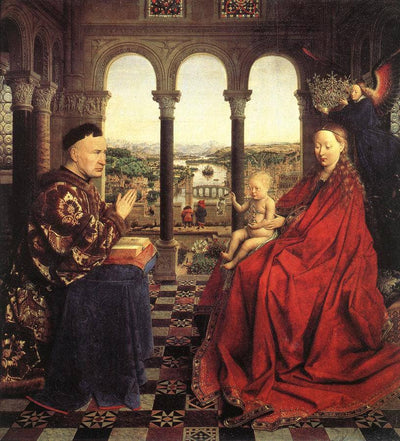
Take his portrait of Chancellor Rolin kneeling before the Virgin. Painted around 1430–1435 on an oak panel only 66 by 62 cm, it opens behind the figures onto a distant landscape you could study for an hour. It's now in the Richelieu wing of the Louvre, where it arrived in 1800. A 2021–2024 restoration was the first since it entered the museum.
Then there's the opposite case. His little panel of Saint Barbara, dated 1437 and just 32 by 18.2 cm, is almost all drawing: a tower under construction, with stones being carried in, cut and hoisted by crane. Whether he abandoned it before the oil layers or meant it as a finished monochrome is still debated at the Antwerp museum that owns it. Either way, it's the clearest look you'll get at the drawing under his color.

What is Jan van Eyck's most famous work?
Two works compete for the title, and they show the technique at opposite sizes.
The Ghent Altarpiece, 1432
The Ghent Altarpiece was completed in 1432 and has 18 panels. It's in St. Bavo's Cathedral in Ghent. Hubert van Eyck began it and his younger brother Jan finished it after Hubert's death. At its heart is the Adoration of the Lamb in the central panel, a meadow of saints, prophets and pilgrims gathered around the Lamb of God.
For centuries, visitors saw a version that wasn't entirely Van Eyck's. Restorers at Belgium's Royal Institute for Cultural Heritage found that around 45 percent of the central panel had been overpainted in the 16th century, while only 3 percent of the original paint underneath was lost. Taking the later paint off revealed the Lamb's intense, frontal gaze. The original oil layers had held up for nearly six centuries, well enough to be uncovered almost intact.

The Arnolfini Portrait, 1434
Smaller and far more intimate, the 1434 double portrait of Giovanni Arnolfini and his wife is the picture most people mean when they think of Van Eyck. It measures 82.2 by 60 cm, oil on wood, probably oak. Above the convex mirror he wrote "Johannes de Eyck fuit hic. 1434" (Jan van Eyck was here), and the mirror reflects two men coming into the room.
The painting hangs in the National Gallery in London, which bought it in 1842 for 600 guineas as its first Netherlandish painting. Every oil habit described above is visible in it at once, down to the bristles of the brush hanging by the bed, scratched into the paint.

Why is Jan van Eyck still important today?
Because he changed what painters expected oil to do, and that expectation traveled. From 1425 he worked at Bruges and Lille as painter to Philip the Good, Duke of Burgundy, and in 1428 the duke sent him to Portugal to paint Isabella, his future wife. Work from his circle reached Italy early. Antonello, who visited Venice in 1475–1476, painted an altarpiece there for the church of San Cassiano that set the pattern for Giovanni Bellini's great altarpieces.
After that, layered oil became the normal way to paint a serious picture in Europe. Van Eyck didn't invent the paint. He showed everyone what it was for.
And the pictures still reward close looking the way few others do. To see where he stands among the masterpieces people ask about most, start with the Arnolfini couple and the Ghent Lamb, then work outward.
A copy built the same way
Glazed oil can't be imitated by a print, because the depth comes from paint lying over paint. Art & See's artists reproduce Van Eyck by hand in oil, layer by layer. You can browse every Van Eyck panel the studio paints and choose the size that suits your wall.
Sources
- ESRF, Synchrotron light unveils oil in ancient Buddhist paintings from Bamiyan (2008)
- Cennino Cennini, The Book of the Art, trans. Christiana Herringham (1899)
- National Gallery, London, The Arnolfini Portrait
- National Gallery, London, Antonello da Messina
- Musée du Louvre, La Vierge du chancelier Rolin
- KMSKA Antwerp, Saint Barbara
- CODART, Van Eyck's original Lamb uncovered by restorers
- Visit Gent, Jan van Eyck's painting techniques