4.9/5
4.9/5


Leonardo left fewer than twenty paintings, several of them unfinished, and two of those are probably the most recognized pictures on earth. That scarcity is what makes a list of Leonardo da Vinci paintings so short, and why every single entry comes with a story: a theft, a fee dispute, a restorer who spent 22 years on one wall, a $450 million sale followed by total silence.
This ranking goes by fame, roughly the order in which people know these pictures and go looking for them. For each one you get the date, what to look at, and where it hangs, down to the room when the museum gives one. Ten of the twelve are on public view. (If you came here for a copy rather than a trip, the Leonardo paintings that get copied most are gathered on one page. This one is about the originals.)
The twelve, ranked
| # | Painting | Date | Where it is |
|---|---|---|---|
| 1 | Mona Lisa | 1503–1519 | Louvre, Paris, Room 711 |
| 2 | The Last Supper | 1494–1498 | Santa Maria delle Grazie, Milan |
| 3 | Lady with an Ermine | c. 1490 | Czartoryski Museum, Kraków |
| 4 | Salvator Mundi | disputed | Not on public view |
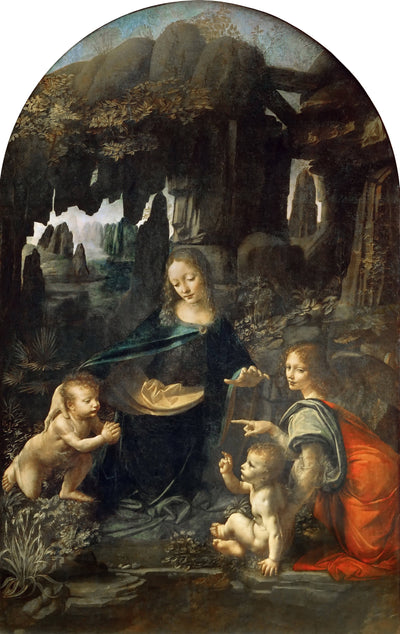
| 5 | The Virgin of the Rocks | 1483–1494 and c. 1491–1508 | Louvre, Room 710, and National Gallery, London |
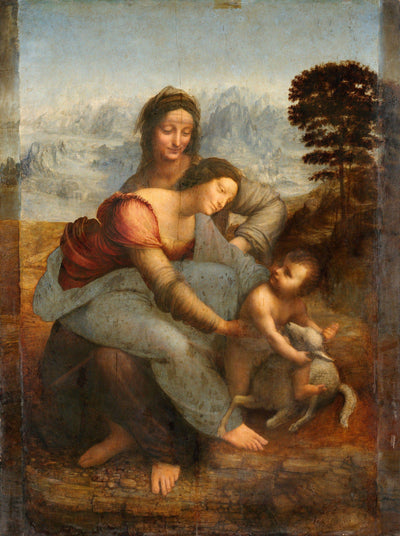
| 6 | The Virgin and Child with Saint Anne | 1503–1519 | Louvre, Room 710 |
| 7 | Saint John the Baptist | 1508–1519 | Louvre, Room 710 |
| 8 | Ginevra de' Benci | 1474–1478 | National Gallery of Art, Washington |
| 9 | Annunciation | c. 1472 | Uffizi, Florence, Room A35 |
| 10 | Adoration of the Magi | c. 1482 | Uffizi, Florence, Room A35 |
| 11 | La Belle Ferronnière | 1490–1497 | Louvre, Paris |
| 12 | Portrait of a Musician | 1485 | Pinacoteca Ambrosiana, Milan |
1. Mona Lisa, Louvre, Paris

Everything about the Mona Lisa is outsized except the painting. It measures 79.4 by 53.4 cm, oil on a poplar panel that has warped enough over five centuries to open a crack. The sitter is Lisa Gherardini, wife of the Florentine silk merchant Francesco del Giocondo. Leonardo began around 1503 and never delivered it. He kept retouching it, took it to France, and King François I bought it from him in 1518.
Part of its fame is owed to a crime. On 21 August 1911 it disappeared from the Louvre, lifted by Vincenzo Peruggia, a glazier who had worked in the building. A painting admired by specialists became a face everybody knew.
Where to see it: Room 711, the Salle des États, Denon wing, level 1. Since 2005 it has sat alone in a climate-controlled glass case in the middle of the room, and about 80 percent of Louvre visitors come to see it, so arrive at opening. Dimensions, provenance and inventory numbers are in its full catalogue entry.
2. The Last Supper, Santa Maria delle Grazie, Milan

Not a canvas, and not really a fresco either. Ludovico Sforza commissioned it for the refectory of the Dominican friars at Santa Maria delle Grazie, and Leonardo painted it between 1494 and early 1498 on dry plaster. He picked that method because it let him work slowly and change his mind, which true fresco doesn't allow. The cost of that freedom was paint that didn't hold. The wall is 460 by 880 cm. The last restoration, led by Pinin Brambilla Barcilon, took 22 years and was finished in 1999.
Giorgio Vasari called it "a thing most beautiful and marvelous," and you'll understand why once you see the apostles recoiling in groups of three from the sentence Christ has just spoken.
Where to see it: the Cenacolo Vinciano, Piazza di Santa Maria delle Grazie 2. Booking is mandatory, visits last 15 minutes, and no more than 40 people stand in the room at once. Tickets and hours are on the refectory's official site. Book as soon as your Milan dates are fixed.
3. Lady with an Ermine, Czartoryski Museum, Kraków

The young woman holding the ermine is Cecilia Gallerani (c. 1473–1536), lady-in-waiting and mistress of Ludovico Sforza, Duke of Milan, painted around 1490. The animal is a double joke. Ludovico had received the Order of the Ermine from the King of Naples in 1488, which earned him the nickname Ermellino Bianco, the white ermine. And the Greek word for the animal, gale, echoes her surname.
Look at the hand. Leonardo gave her long, tendoned fingers that seem to belong to the ermine as much as to her, and both heads turn the same way toward something we can't see.
Adam Jerzy Czartoryski bought it in Italy around 1800 and gave it to the family museum at Puławy. Poland counts it among the most valuable objects in its museums. Where to see it: second floor of the Czartoryski Palace in Kraków, which belongs to the Kraków museum that owns her.
4. Salvator Mundi, location unknown to the public
The most talked-about Leonardo that nobody can go and see. The half-length Christ raising his hand in blessing sold at Christie's in New York on 16 November 2017 for $400 million at the hammer, $450,312,500 with fees, against an estimate of around $100 million. Christie's said it would go on show at the Louvre Abu Dhabi. It never did. It hasn't been seen in public since the sale, and the most recent reporting places it in storage in Geneva.
Its rank here is fame, not certainty. When Martin Kemp, emeritus professor at Oxford, drew up his 2025 list of every painting by Leonardo, he left this one off because of the "polarised and acrimonious" fight over who painted it. How a panel with that much doubt attached reached that price is its own story, told in the story of the record sale.
5. The Virgin of the Rocks, Louvre and London
Two paintings, one commission, and a quarrel over money. On 25 April 1483 Leonardo and the brothers Ambrogio and Evangelista de Predis signed a contract with Milan's Confraternity of the Immaculate Conception for an altarpiece at San Francesco Grande. The first version, painted 1483–1494, ended up with the French kings (it's recorded at Fontainebleau in 1625) and is now in the Louvre. London's National Gallery puts the rest bluntly: when the confraternity balked at his price, "he sold it to someone else in disgust."
The replacement took years. Leonardo left Milan in 1499, came back in 1506 to finish it, and was paid in 1508. The two are nearly identical; the difference you notice is the angel, whose pose and gaze change between them. Stand in front of the earlier panel in Paris first, then look at the second version in London and see which angel you trust.
Where to see them: Louvre Room 710 (the Paris one was moved from wood to canvas in 1806) and the National Gallery, London, where the panel measures 189.5 by 120 cm.
6. The Virgin and Child with Saint Anne, Louvre
Three generations stacked into one pyramid: Anne, her daughter Mary leaning out from her lap, and the child pulling at a lamb. Nobody ordered it. Leonardo started it in Florence around 1503 on his own initiative, kept it with him for the rest of his life, and it was still unfinished when he died in 1519. During the 2010–2012 restoration, conservators found the last brushstrokes on Saint Anne's robe. The Virgin's face at the center never got its final touches either.
It's big, 168 by 113 cm as painted and later widened. The picture he never let go of hangs in Room 710, a few steps from the Virgin of the Rocks.
7. Saint John the Baptist, Louvre
A single figure coming out of darkness, smiling, one finger raised. Leonardo's late Saint John was conceived around 1508 and still in progress when he died; the right elbow, the forearm and the left arm are less finished than the face. It's small, 72.9 by 56.3 cm on walnut, and its travels are grand: King Charles I of England owned it from about 1630, it was sold at the Commonwealth sale in 1651 after his execution, passed to the banker Everhard Jabach, and reached Louis XIV in 1662.
Where to see it: Room 710, the Grande Galerie. Don't confuse it with the larger Saint John turned into Bacchus nearby, a workshop picture that was repainted with grapes and a crown of ivy in the 17th century.
8. Ginevra de' Benci, Washington
The only Leonardo painting in the Americas. He painted the young Florentine between 1474 and 1478, when he was in his twenties, and the back of the panel carries a juniper sprig, a pun on her name (ginepro is Italian for juniper). The National Gallery of Art bought it in 1967 for $5 million, at the time the highest price ever paid for a work of art, and it crossed the Atlantic in a suitcase.
Where to see it: the National Gallery of Art in Washington, DC.
9. Annunciation, Uffizi, Florence
A young man's picture, painted around 1472 while Leonardo was still in Andrea del Verrocchio's workshop. It's long and low, 90 by 222 cm, with Gabriel kneeling in a walled garden in front of a Renaissance palace, and the building is drawn to a single vanishing point with a beginner's care. Nobody knows who ordered it. It reached the Uffizi in 1867 from the church of San Bartolomeo a Monteoliveto, just outside Florence.
Where to see it: Room A35, the Uffizi's Leonardo room.
10. Adoration of the Magi, Uffizi, Florence
If you want to watch Leonardo think, stand in front of this one. In July 1481 the Augustinian monks of San Donato in Scopeto commissioned an altarpiece and gave him 30 months. He left it at the stage of a rough sketch, some figures barely outlined, others half modeled, and went to Milan. The monks eventually got a replacement from Filippino Lippi, finished in 1496.
The unfinished Adoration is 244 by 240 cm and was cleaned between 2012 and 2017. It hangs in the same Uffizi room as the Annunciation, so you see his start and his first great abandonment side by side.
11. La Belle Ferronnière, Louvre
The Louvre's own title is Portrait of a Woman, wrongly called La Belle Ferronnière. The nickname belonged to a different portrait in the collection and stuck to this one through a print by Ingres. The likeliest sitter is Lucrezia Crivelli, Ludovico Sforza's lover in 1495–1499, because a Latin poem in Leonardo's Codex Atlanticus praises a portrait of her painted for him. Painted 1490–1497, oil on walnut, 63 by 45 cm. She turns three-quarters toward you at a time when most portraits were still in strict profile.
Where to see it: the Louvre, though it isn't always on the wall, so check its page before you go.
12. Portrait of a Musician, Pinacoteca Ambrosiana, Milan
Painted in 1485, soon after Leonardo arrived in Milan. Nobody knew the young man was a musician until 1905, when restorers removed old overpaint and found his hand holding a sheet of music. The best guess now is Atalante Migliorotti, a Tuscan musician and a friend of Leonardo's. Where to see it: the Pinacoteca Ambrosiana.
Which Leonardo paintings are in the Louvre?
Five: the Mona Lisa, the Virgin of the Rocks, the Virgin and Child with Saint Anne, Saint John the Baptist and La Belle Ferronnière. No museum has more of his paintings, and the Louvre also holds 22 of his drawings. Four of the five hang in the Denon wing on level 1, the Mona Lisa in Room 711 and the others in Room 710, so you can see most of them in half an hour if the crowd around the Mona Lisa lets you.
Outside Paris, the twelve are spread thin: two in Florence, two in Milan, and one each in Kraków, London and Washington.
The ones that didn't make the twelve
Martin Kemp counts around 16 paintings that are mainly or wholly Leonardo's, plus four or five he worked on with others. The ones left out here are quieter: the Benois Madonna in St Petersburg, the unfinished Saint Jerome at the Vatican, the Madonna and Child in Munich, the Madonna of the Yarnwinder in Edinburgh and the painted trees of the Sala delle Asse in Milan. If you want all of them, period by period, the full count of his surviving work goes through each one. And if Leonardo has you looking further, the paintings everyone recognizes on sight are gathered on one page.
Leonardo on your own wall
Most of these twelve can't leave their rooms, and one can't be seen at all. Art & See's painters make hand-painted oil reproductions of them, brushstroke by brushstroke, from the Ermine to the Saint Anne. If one of these pictures stayed with you, browse every Leonardo copy the studio paints and choose the one you want to live with.
Sources
- Musée du Louvre, Mona Lisa catalogue entry
- Museo del Cenacolo Vinciano, The Last Supper
- National Museum in Kraków, Lady with an Ermine
- The National Gallery, The Virgin of the Rocks
- Uffizi, Adoration of the Magi
- Uffizi, Annunciation
- The Art Newspaper, How to see every painting by Leonardo
- The Art Newspaper, Where is Salvator Mundi?