4.9/5
4.9/5


Most people walk through the Raphael Rooms in about twenty minutes, shuffling behind a tour flag toward the Sistine Chapel. That is a mistake. These four rooms on the second floor of the papal palace were the private apartment of Pope Julius II, and between 1508 and 1524 Raphael and his workshop covered them wall to wall and ceiling to floor. The official overview of the Stanze gives you the bare facts. This guide gives you the order, the frescoes worth stopping for, and the faces hidden in them.
A bit of context first. Raphael was born in Urbino in 1483 and arrived at the papal court in 1508, at 25, to help redecorate the apartment. Nobody expected a young painter from the provinces to take over the whole commission. He did, and he was dead at 37, in 1520, before the last room was finished. If you already love the Raphael paintings in museums across Europe, these walls are where his mature style was built, one room at a time.
The order you'll see them in (and the order he painted them)
The Vatican runs a one-way route, so you don't get to choose. You enter the Hall of Constantine, then the Room of Heliodorus, then the Room of the Segnatura, and you leave through the Room of the Fire in the Borgo. Raphael worked in a different sequence: Segnatura first (1508–1511), then Heliodorus, then the Fire in the Borgo (1514–1517), and the Hall of Constantine last, finished by his pupils after he died.
So you meet the end of the story first. My advice: walk the first room quickly, spend most of your time in the third, and keep in mind that the Segnatura is the room where everything began.
| Room on the route | Painted | Pope | Don't miss |
|---|---|---|---|
| 1. Hall of Constantine | after 1520, ceiling finished 1585 | Leo X, then successors | Battle of the Milvian Bridge |
| 2. Room of Heliodorus | after the Segnatura, finished under Leo X | Julius II, Leo X | Liberation of St Peter |
| 3. Room of the Segnatura | 1508–1511 | Julius II | School of Athens |
| 4. Room of the Fire in the Borgo | 1514–1517 | Leo X | Fire in the Borgo |
Hall of Constantine: Raphael's design, other hands
The biggest room was built for receptions and official ceremonies, and it tells the story of Constantine (306–337 A.D.), the emperor who granted Christians freedom of worship. Four episodes run around the walls: the Vision of the Cross, the Battle of the Milvian Bridge, the Baptism of Constantine and the Donation of Rome. The hall was painted by Raphael's school from his drawings, because he died in 1520 before the work was finished.
Look at the battle. Maxentius is on the right, about to drown in the Tiber, and the landscape is real: Monte Mario, and the building site of Villa Madama, a villa Raphael himself was designing in those years. Giulio Romano did the actual painting and finished it after his master's death. In the Vision of the Cross, the sky carries the motto IN HOC SIGNO VINCES, "in this sign you will win," written in Greek.
Two small allegorical figures, Comitas and Iustitia, are the ones to hunt for. A recent restoration confirmed that Raphael painted them himself, in oil, an experiment on a wall meant for fresco. The ceiling, with its Triumph of Christianity over Paganism, is much later: Tommaso Laureti designed it under Gregory XIII and it was done at the end of 1585.
Room of Heliodorus: four rescues and a lesson in light

This was the pope's private audience chamber, and every wall shows God stepping in to protect the Church: its faith, its pope, its city and its treasury. Julius II wanted the message understood. He was fighting to push the French out of Italy and to shore up the papacy's temporal power, and the frescoes say, in paint, that heaven is on his side.
Expulsion of Heliodorus. The room takes its name from this scene from 2 Maccabees: a heavenly horseman and two youths drive the thief Heliodorus out of the temple in Jerusalem. On the left, Julius watches from his sedan chair. One of the chair bearers is Marcantonio Raimondi, an engraver and friend of the painter; the other is Raphael himself.
Mass of Bolsena. In 1263, a Bohemian priest who doubted transubstantiation saw blood seep from the host onto the altar cloth. Raphael fits the scene around an awkward window, and Julius kneels to the right of the altar with his cardinals and the chair bearers.
Liberation of St Peter. Stop here. An angel frees Peter from prison while the guards sleep, a nod to Julius, who had been cardinal of St Peter in Chains before he became pope. The painting is a study in competing lights: the angel's glow, dawn, the moon, torches, their reflections on armor, and the real daylight from the window below. Nothing painted in Rome before it looks like this at night.
Leo the Great and Attila. The last fresco in the room was finished after Julius died in 1513, so the new pope, Leo X, appears twice, once as Pope Leo the Great and once as a cardinal. Saints Peter and Paul appear in the sky with swords, and Attila turns back. The meeting happened in 452 near Mantua; Raphael moved it to the gates of Rome and added the Colosseum.
Look up, too. Raphael painted the four Bible scenes on the ceiling. The grotesques and arches around them still hold work by Luca Signorelli, Bramantino, Lorenzo Lotto and Cesare da Sesto, left from Julius's first plan for the room, before Raphael's success next door changed it.
Room of the Segnatura: where Raphael started

This is the room you came for. It was Julius II's private library and office, and between 1508 and 1511 Raphael turned it into the opening statement of the High Renaissance. The room gets its name later, from the papal court known as the Segnatura Gratiae et Iustitiae that met here around the mid-1500s. A theologian worked out the program: the four walls stand for Truth, Good and Beauty, with truth split into its divine and its rational halves.
What is the most famous Raphael painting in the Vatican?
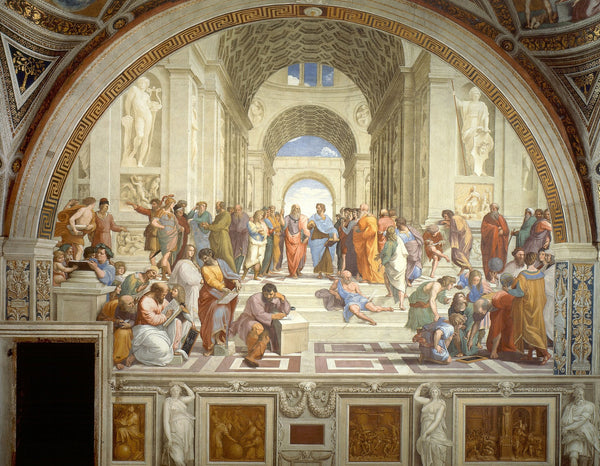
The School of Athens, on the philosophy wall of this room. Plato points up and holds his Timaeus; Aristotle, beside him, holds the Ethics. Pythagoras explains a musical ratio in the foreground, Diogenes sprawls on the steps with his dish, Euclid teaches geometry to his pupils, and Zoroaster and Ptolemy hold the heavenly and earthly spheres. The brooding man leaning on a marble block is Heraclitus, painted with the features of Michelangelo, who was painting the Sistine Chapel nearby in the same years. And the young man at the far right in a black beret, looking straight out? Raphael. The museum's figure-by-figure key to the fresco is worth reading on your phone while you stand in front of it.
The architecture behind them comes from Bramante's plan for the new St Peter's. It's a building that didn't exist yet, painted as if you could walk into it.
The Disputation of the Holy Sacrament, opposite, is theology: the Trinity above, saints and prophets on a bank of clouds, and below them an argument around the altar. Pope Gregory the Great has Julius II's face. Look for Dante, Fra Angelico and Pope Sixtus IV in the crowd.
Parnassus is poetry. Apollo plays at the top of the hill among the nine Muses, with blind Homer, Virgil and Dante behind him, and the poet Sappho at bottom left, her name written on the scroll in her hand.
The Virtues and the Law, the fourth wall, is justice. The pope receiving the Decretals is Julius again, and the two cardinals beside him are Giovanni de' Medici and Alessandro Farnese, the future popes Leo X and Paul III. The smaller scene on the left of the window, the Pandects handed to Justinian, is by Lorenzo Lotto.
It helps to know how quickly Raphael changed. A few years earlier, in his Marriage of the Virgin, he was still painting calm, symmetrical scenes: a temple in the distance, figures lined up in front of it. Here the space swallows you. Under Leo X the room became a study and music room, and its wood paneling was lost in the 1527 Sack of Rome; the gray monochrome base you see now is by Perin del Vaga.
Room of the Fire in the Borgo: the workshop takes over

By the time Leo X turned this old courtroom into a dining room, Raphael was the busiest artist in Rome. In 1514 he was also named architect of St Peter's. So the walls here, painted 1514–1517, were handed largely to his workshop. The ceiling above them is older, by Perugino, commissioned by Julius in 1508 and left in place.
The theme is flattery with a history lesson. Every scene stars an earlier pope called Leo, and every one of those popes has Leo X's face.
- Fire in the Borgo. In 847 a fire broke out in the neighborhood in front of St Peter's, and Leo IV put it out with a blessing from the loggia. Ignore the tiny pope in the distance and watch the foreground, where people pass water jars and climb walls to escape.
- Battle of Ostia. The papal victory over a Saracen fleet in 849, painted when Leo X was calling for a crusade.
- Crowning of Charlemagne. Christmas night, 800. Leo III is Leo X and Charlemagne is the French king Francis I, most likely a nod to their concordat of 1515.
- The Oath of Leo III. The pope answers his accusers the day before the coronation. The weakest wall in the room, and you can skip it.
Before you leave the Vatican
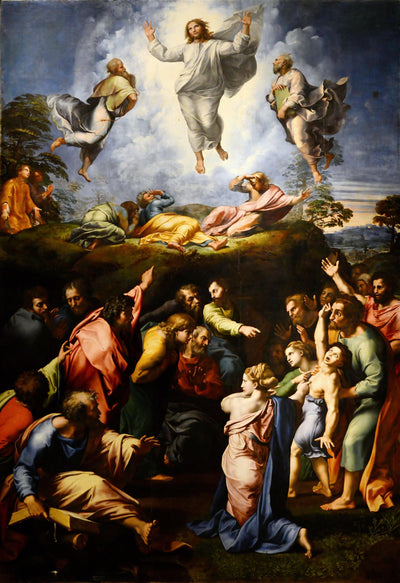
Don't exit without the Pinacoteca. In Room VIII hangs the Transfiguration, his final altarpiece, a panel 410 × 279 cm painted 1516–1520. It was his last painting, and Giorgio Vasari called it "the most famous, the most beautiful and most divine." After the frescoes, it shows you where Raphael was heading when he died. The Pinacoteca page for the altarpiece has a good zoomable image.
And keep your ticket. A Vatican Museums ticket, within 7 days, gets you reduced admission at the Chigi villa across the Tiber, where Raphael painted the Galatea and the loggia of Cupid and Psyche for a banker instead of a pope. For a short, reliable account of his life, the National Gallery's biography of the painter covers the Rome years well.
Taking Raphael home
You can't lift a fresco off a Vatican wall, but his panel paintings travel well. Art & See paints copies by hand in oil on canvas, from the Transfiguration to the Madonnas, and you can browse every Raphael the studio can paint for you. If you want to compare him with his rivals first, start with the paintings people come back to most.