4.7/5


The painters who made still life a genre of its own are Caravaggio, Juan Sánchez Cotán, Clara Peeters, Willem Claesz Heda, Willem Kalf, Rachel Ruysch, Jean-Baptiste-Siméon Chardin, Henri Fantin-Latour, Vincent van Gogh and Paul Cézanne. Each one found something new to do with a few objects on a ledge or a table, from a single basket of fruit around 1600 to a tilting table of apples in the 1890s. Many of the same subjects hang in our still life paintings. The opening table lines up the ten painters by how often their names turn up in English books, with the one picture to know by each.
None of them invented the genre. Britannica names a 1504 picture by the Italian Jacopo de' Barbari as the one generally considered the first still life. What changed around 1600 is that it became a specialty. In the Met's essay on Northern European still life, the curator Walter Liedtke describes still life flourishing as an independent genre in the Netherlands in the early 1600s, with less continuous Italian and Spanish traditions starting in the same years. Leiden painters, for example, made a specialty of skulls and hourglasses, a branch with its own guide to vanitas painting and its symbols. This list follows the painters instead: who they were, where they worked and what each one changed.
Top 10 famous still life artists: who books talk about most
| Book rank | Still life painter | Picture to see | City and museum | Book mentions, with Heda as 1 |
|---|---|---|---|---|
| 1 | Caravaggio |  Basket of Fruit |
Milan, Pinacoteca Ambrosiana | About 730 |
| 2 | Vincent van Gogh |  Sunflowers |
Amsterdam, Van Gogh Museum | About 215 |
| 3 | Paul Cézanne |  The Basket of Apples |
Chicago, Art Institute | 61 |
| 4 | Henri Fantin-Latour | Still Life with Flowers and Fruit | New York, The Met | 7 |
| 5 | Rachel Ruysch |  Still Life with Flowers on a Marble Tabletop |
Amsterdam, Rijksmuseum | 4.9 |
| 6 | Willem Kalf |  Still Life with a Porcelain Jar |
Indianapolis, Newfields | 3.2 |
| 7 | Clara Peeters |  Still Life with Cheeses, Almonds and Pretzels |
The Hague, Mauritshuis | 2.8 |
| 8 | Juan Sánchez Cotán | Quince, Cabbage, Melon and Cucumber | San Diego, Museum of Art | 1.1 |
| 9 | Willem Claesz Heda | Still Life with a Gilt Cup | Amsterdam, Rijksmuseum | 1 |
| — | Jean-Baptiste-Siméon Chardin | The Ray | Paris, Louvre | No data |
Mentions come from English books printed from 2000 to 2019, counted by Google Books Ngram. Heda, the name books use least here, counts as 1, so Caravaggio turns up about 730 times as often.
Caravaggio, Van Gogh and Cézanne also painted many other kinds of pictures, so books name them for far more than still life. We have no book count for Chardin, so he sits at the end without a place.
Italy and Spain, around 1600
01Basket of Fruit, Caravaggio (about 1597–1600)

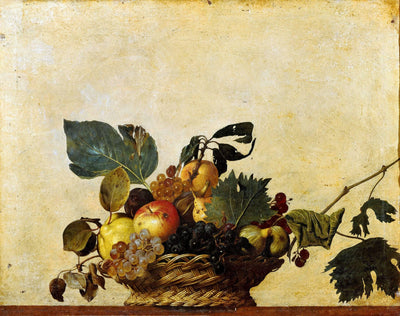
Caravaggio (1571–1610) showed that fruit alone could carry a whole picture. There is no table, no room and no figure here. The Pinacoteca Ambrosiana in Milan dates its oil on canvas to about 1597–1600, gives its size as 54.5 × 67.5 cm (21.5 × 26.6 in) and calls it a sort of prototype of the still life genre.
What set it apart was honesty. Next to fresh grapes and a ripe apple, Caravaggio painted worm-eaten fruit and leaves drying and shriveling, which the museum reads as time passing. The picture was the pride of Cardinal Federico Borromeo, whose collection became the core of the Ambrosiana. Borromeo wrote that he had looked in vain for a companion piece, and so, "for its incomparable beauty and excellence, it remained alone." Our studio artists paint the Basket of Fruit by hand, withered leaves included, and the rest of his work is listed year by year in Caravaggio's paintings from Rome to Malta.
02Quince, Cabbage, Melon and Cucumber, Juan Sánchez Cotán (about 1602)

One of Spain's first great still lifes is by a painter who became a monk. Sánchez Cotán (1560–1627) lived in Toledo until 1603, when he joined a Carthusian monastery as a lay brother, according to the San Diego Museum of Art, which owns this oil on canvas of 68.9 × 84.5 cm (27.1 × 33.3 in). He painted at least twelve still lifes, and seven survive.
What sets his pictures apart is the setting. Instead of a table he used a deep stone opening against pure black, hung two of the foods on strings and spaced the rest along the sill, so that each object stands alone in the dark. The Meadows Museum in Dallas, which borrowed the canvas in 2022, calls it among the earliest and best of its genre in European art. The San Diego curator Michael Brown adds that the painter gave it to the archbishop of Toledo in 1603, who passed it on to the king.
Antwerp and the Dutch Republic
Britannica places the golden age of still life in the Low Countries in the 17th century, and the Met's essay maps its specialties by city: flower pieces in Antwerp, Middelburg and The Hague, plain breakfast tables in Haarlem and luxury displays in Amsterdam. For the great Dutch pictures of the same century beyond still life, from Rembrandt to Vermeer, see Dutch Golden Age paintings.
03Still Life with Cheeses, Almonds and Pretzels, Clara Peeters (about 1615)

Peeters was one of the first painters of food still lifes, and the Mauritshuis credits her laid tables with a great influence on painters in the Northern Netherlands. Almost nothing is known of her life. The museum gives her dates as about 1580/1590 to in or after 1621, places her in Antwerp partly because the panels she used carry Antwerp makers' marks, and notes that her name is missing from the city's surviving guild lists, although women could join from 1602.
Her trademark was to put herself in the picture. In the pewter lid of the earthenware jug, a tiny woman's face under a white cap is reflected: Clara's self-portrait, the museum says. The same bridal knife turns up in at least five of her still lifes, which raises the question of whether it was her own. The panel is small, 34.5 × 49.5 cm (13.6 × 19.5 in), and the Mauritshuis bought it in 2012. In 2016 the Prado gave her the first exhibition it had ever devoted to a woman painter. You can order the cheese and pretzel table as an oil copy.
04Still Life with a Gilt Cup, Willem Claesz Heda (1635)

Haarlem made its name with the breakfast or banquet piece in near-monochrome, a specialty the Met's essay ties to Pieter Claesz, Heda and others. Heda (1594–1680) was born and died in Haarlem. The Rijksmuseum calls his kind of picture the "tonal banquet piece" and notes that a 1628 description of Haarlem by Samuel Ampzing already named him and Pieter Claesz as banquet painters. He was related to several Haarlem brewing families and started out as a history painter.
The museum's catalogue calls this panel, 87.8 × 112.6 cm (34.6 × 44.3 in), the largest and most impressive of his paintings. Seen from a low viewpoint, the table is so crowded that things overlap: oysters on a pewter plate, a broken loaf, a salt cellar, a green roemer, a silver tazza lying on its side and a large pewter jug. He signed it on the edge of the tablecloth, "HEDA. 1635," and the Rijksmuseum bought it in 1984.
05Still Life with a Porcelain Jar, Willem Kalf (1669)
Kalf (1619–1693) went the other way from Heda: more color, more gold, more shine. The National Gallery in London calls him the leading still-life painter in Holland in the mid-17th century and translates his type, the pronkstilleven, as "ostentatious still life," a display of lavish man-made things. Born in Rotterdam, he was in Paris by about 1639, back in Rotterdam by 1646 and settled in Amsterdam in 1653. His earliest paintings were kitchen and farm interiors.
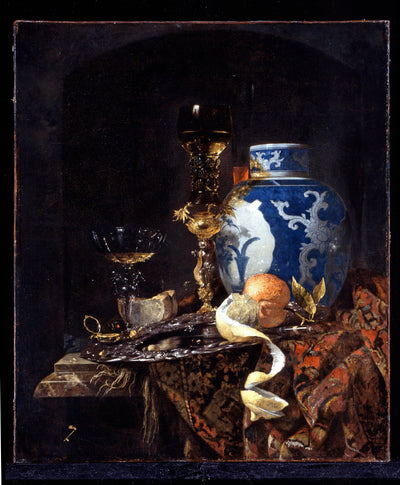
Amsterdam was by then the financial capital of the Netherlands, and Liedtke describes its display pieces as imported fruit, porcelain, Venetian glass and silver-gilt cups rendered in glistening light. In this 1669 canvas at the Indianapolis Museum of Art at Newfields, 78.1 × 66.0 cm (30.8 × 26.0 in), a blue-and-white jar stands beside a lemon whose peel spirals down, a Venetian glass and a wine glass on a gilded mount where a putto clutches a cornucopia. The museum's label says the light turns them into sparkling gems that rival the objects themselves, and the National Gallery adds that his later Amsterdam pictures have been compared with Vermeer's for their handling of light. Kalf's porcelain jar still life is also available as a hand-painted copy.
06Still Life with Flowers on a Marble Tabletop, Rachel Ruysch (1716)

Hand-painted oil reproductionSee sizes of Still Life with Flowers on a Marble Tabletop ›
Ruysch (1664–1750) carried the Dutch flower piece deep into the 18th century. The National Gallery says she was born in The Hague, the daughter of the botanist and anatomist Frederik Ruysch, trained in Amsterdam with the flower painter Willem van Aelst from 1679, and in the 1680s took cues from Otto Marseus van Schrieck's dark forest floors full of insects and lizards. She worked in The Hague from 1701 to 1708, as the first woman member of the painters' society Confrerie Pictura, and then served as court painter to the Elector Palatine in Düsseldorf until 1716.
This canvas is signed and dated in that last Düsseldorf year. The Rijksmuseum counts more than ten species of flowers in it, blooming at different times of year, so such a bouquet would have been hard to gather in real life; her study of live and prepared flowers let her paint it anyway. In her lifetime, the museum adds, she was one of the most celebrated flower painters in Europe. This 1716 bouquet is one of several Ruysch flower pieces in our catalog.
France, from Chardin to Cézanne
From the 18th century until after World War II, France was the center of still life, Britannica says, and most major artists who lived there tried it, Chardin, Manet, Monet and Van Gogh among them.
07The Ray, Jean-Baptiste-Siméon Chardin (1728)

Hand-painted oil reproductionSee sizes of The Ray ›
Chardin (1699–1779) got into the Royal Academy with a fish. The Louvre calls the canvas The Ray, also Kitchen Interior, and lists it as his reception piece of 1728, oil on canvas, 114.5 × 146 cm (45.1 × 57.5 in). It stayed with the Academy until the Revolution and was first shown at the Louvre in June 1796. Britannica, which titles it The Skate, says he presented it with The Buffet and owed his admission partly to the portrait painter Nicolas de Largillière.
Britannica describes his carefully built still lifes as being about the objects themselves and the treatment of light rather than piles of appetizing food, and it retells a story from his friend, the engraver Charles-Nicolas Cochin. When another artist boasted about how he purified his colors, Chardin replied: "One uses colours, but one paints with feeling." His figure paintings from 1733 on, such as Soap Bubbles, are covered in our guide to famous Rococo painters. Our hand-painted Ray keeps the cat and the oysters.
08Still Life with Flowers and Fruit, Henri Fantin-Latour (1866)
Fantin-Latour (1836–1904) was born in Grenoble and first taught by his father, a portrait painter. He is also known for group portraits of the writers and artists of his day, but his flower paintings were especially appreciated in England. Britannica says that, through Whistler and Millais, he met Edwin Edwards, a wealthy amateur engraver who supported him for years by buying his still lifes.
The Met's canvas shows how seriously he took the genre. It is one of four still lifes commissioned by Michael Spartali, a Greek businessman and diplomat living in London, and Fantin worked on them from March to September 1866. One of the four went to the Paris Salon that year and now belongs to the National Gallery of Art in Washington. The Met reads the picture as an attempt at serious, complex compositions in a realist style inspired by Chardin and Courbet.
09Sunflowers, Vincent van Gogh (1889)

Hand-painted oil reproductionSee sizes of Sunflowers ›
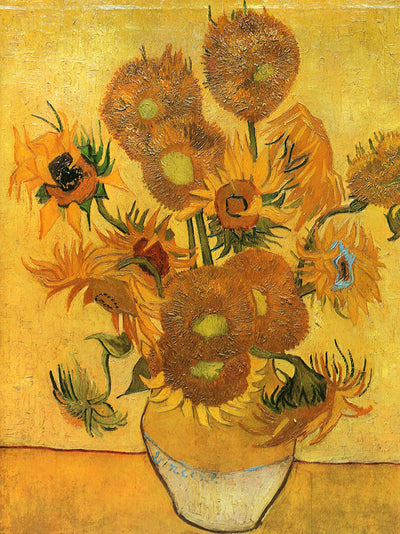
Van Gogh (1853–1890) painted the Sunflowers in Arles in 1888 and 1889. In a letter to his brother Theo of 21 or 22 August 1888 he described three sunflower canvases under way and a plan: for the studio he hoped to share with Paul Gauguin, a decoration of "nothing but large Sunflowers," a dozen or so panels making "a symphony in blue and yellow."
“I’m painting with the gusto of a Marseillais eating bouillabaisse, which won’t surprise you when it’s a question of painting large Sunflowers.”
The Van Gogh Museum says he painted five large canvases of sunflowers in a vase, with three shades of yellow "and nothing else," and hung the first two in Gauguin's room. Gauguin found them "completely Vincent" and later asked for one, which Van Gogh was reluctant to give. He went on to make two loose copies; the one dated January 1889, 95 × 73 cm (37.4 × 28.7 in), is in Amsterdam, and our hand-painted Sunflowers follows it. The picture also has a place among the most famous paintings in the world, and the other canvases in the series are covered in Van Gogh's most famous flower paintings.
A year later, during his year at Saint-Paul-de-Mausole in Saint-Rémy, he painted a bouquet of irises twice in May 1890. The Van Gogh Museum's version sets the flowers against yellow for a strong color contrast, mainly as a study in color; in the other, he contrasted purple and pink with green.
The original and our hand-painted copy
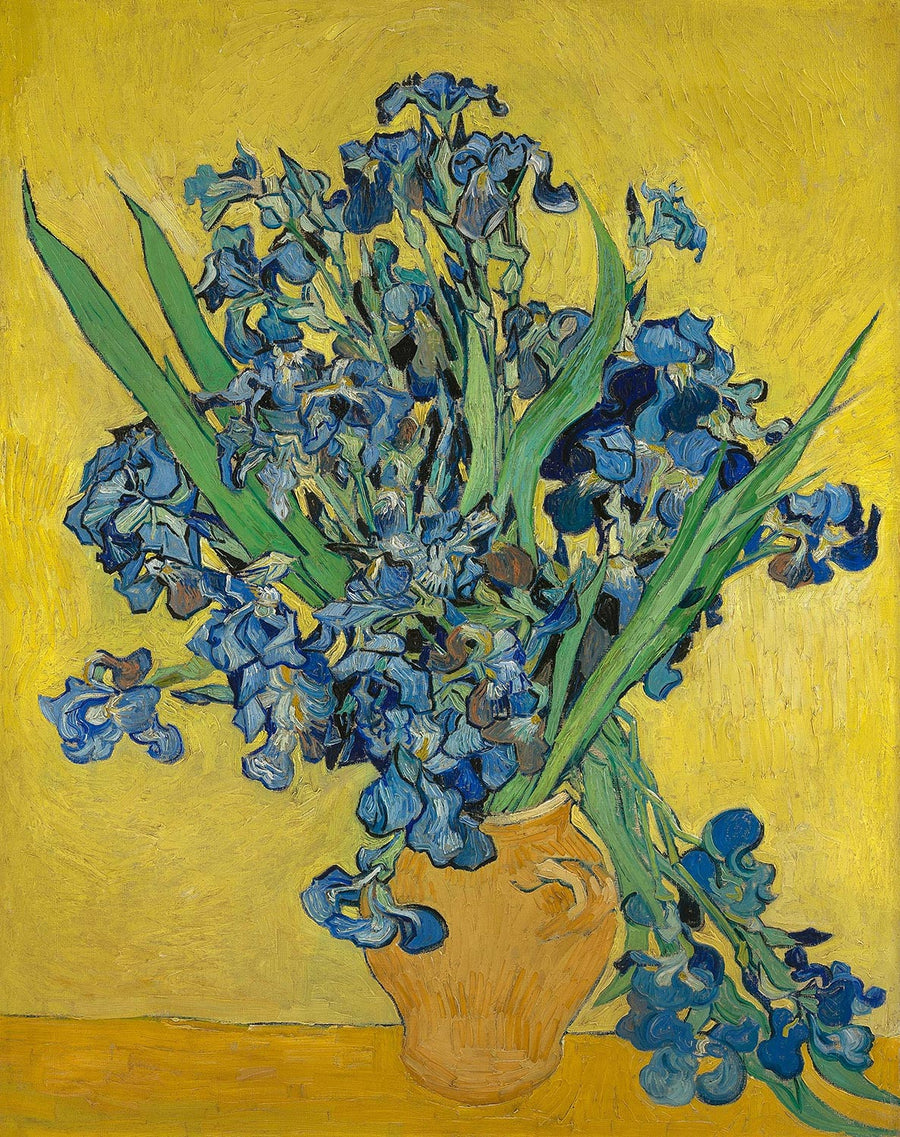
The original
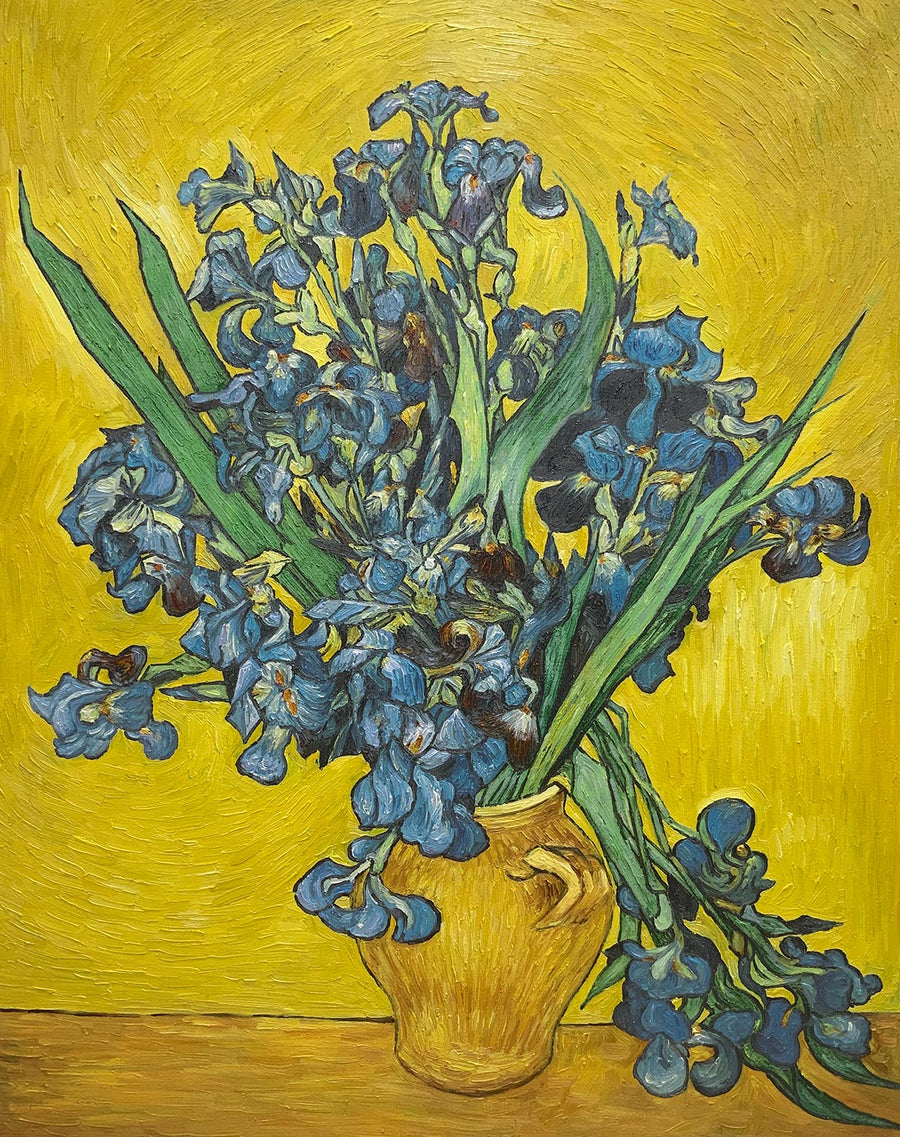
Our reproduction, painted by hand in oil
10The Basket of Apples, Paul Cézanne (about 1893)

Hand-painted oil reproductionSee sizes of The Basket of Apples ›
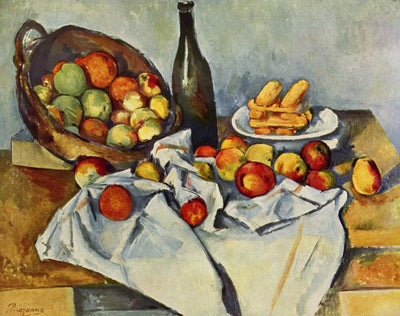
Cézanne (1839–1906) closes the list, and the museum that owns this canvas explains why. The Art Institute of Chicago, which dates this oil on canvas to about 1893 and gives its size as 65 × 80 cm (25.6 × 31.5 in), says his arresting and complex still lifes changed the traditional nature morte, French for still life and literally "dead nature." At first glance it is a laden table anchored by a wine bottle. Look longer and the tabletop does not line up, the bottle tilts, the apples cascade forward and a stack of langues de chat biscuits stops just short of falling out of the picture.
It was the first work by Cézanne to enter the museum's collection. His place among the painters who moved beyond Impressionism is covered in our guide to Post-Impressionism, and our copy of The Basket of Apples follows the Chicago canvas.
After 1900: Morandi and the modern still life
The genre did not stop with Cézanne. Picasso, Braque, Matisse and Bonnard all painted still lifes, and Giorgio Morandi (1890–1964), who was born and died in Bologna, made his name with them. Britannica describes his simple, contemplative pictures of bottles, jars and boxes in clay-toned whites, drab greens and umber browns, and names Cézanne as his major influence.
From a cardinal's study to a dining room
Still lifes were made for private rooms long before museums owned them: a cardinal in Milan, a king of Spain and a diplomat in London were among the early owners of the pictures above. Our still life collection has hand-painted copies of seven of them, from Peeters' cheeses to Cézanne's apples.
Sources
- Pinacoteca Ambrosiana, Caravaggio, Basket of fruit
- Meadows Museum, Masterpiece in Residence: Juan Sánchez Cotán
- San Diego Museum of Art, Masterpiece Minute on Sánchez Cotán, episode 1
- San Diego Museum of Art, Masterpiece Minute on Sánchez Cotán, episode 33
- Mauritshuis, Clara Peeters, Still Life with Cheeses, Almonds and Pretzels
- Museo del Prado, The Art of Clara Peeters (exhibition, 2016–2017)
- The Met, Walter Liedtke, Still-Life Painting in Northern Europe, 1600–1800
- Rijksmuseum, Willem Claesz Heda, Still Life with a Gilt Cup
- National Gallery, London, Willem Kalf
- Indianapolis Museum of Art at Newfields, Willem Kalf, still life of 1669 (45.9)
- Rijksmuseum, Rachel Ruysch, Still Life with Flowers on a Marble Tabletop
- National Gallery, London, Rachel Ruysch
- Musée du Louvre, Chardin, La Raie (INV 3197)
- Britannica, Jean-Baptiste-Siméon Chardin
- The Met, Fantin-Latour, Still Life with Flowers and Fruit
- Britannica, Henri Fantin-Latour
- Van Gogh Letters, letter 666 to Theo van Gogh (August 1888)
- Van Gogh Museum, Sunflowers (January 1889)
- Van Gogh Museum, Irises (May 1890)
- Art Institute of Chicago, Cézanne, The Basket of Apples
- Britannica, Still-life painting
- Britannica, Giorgio Morandi