4.9/5
4.9/5


Nearly all the Caravaggio paintings that survive were made in the eighteen years between his arrival in Rome in 1592 and his death at Porto Ercole in 1610. It was a short career and a crowded one. He started with half-length boys holding fruit and finished with enormous altarpieces painted in Malta and Sicily while he was a fugitive.
Below is the whole run in the order he painted it, grouped by the city he was working in. Each line gives the date museums use and the place you can see the work today. Where a picture has a story that changes how you look at it, you get a sentence or two more. If you'd rather scan the images before the dates, Caravaggio's paintings laid out as a gallery are a quicker way in.
How many did he paint?
Fewer than a hundred that scholars broadly accept, and the number moves every few years. Some pictures exist in two or more versions (the Fortune Teller, the Lute Player, Boy Bitten by a Lizard), and three were destroyed in Berlin in 1945. The list below sticks to works with a secure home in a museum, church or public collection.
Rome, the early years (1592–1599)
He came to Rome from Milan at 21, and in 1595 was taken into the household of Cardinal Francesco Maria del Monte. The cardinal bought his pictures, fed him, and showed him to the collectors who mattered. Almost everything from these years is a single figure or a small group, painted straight from a live model without studies on paper.

- Self-Portrait as Bacchus (Sick Bacchus), about 1595. Galleria Borghese, Rome. The greenish skin is usually read as the painter himself after a stay in hospital.
- Boy with a Basket of Fruit, about 1595. Galleria Borghese, Rome. Both this and the Sick Bacchus were confiscated from the Cavalier d'Arpino in 1607, together with his whole collection of 107 pictures, and handed to Cardinal Scipione Borghese.
- Boy Bitten by a Lizard, about 1594–95. National Gallery, London (a second version is in Florence).
- The Penitent Magdalene, 1594–95. Galleria Doria Pamphilj, Rome.
- The Cardsharps, about 1594. Kimbell Art Museum, Fort Worth.
- The Fortune Teller, 1595. Capitoline Museums, Rome (the second version is in the Louvre).
- Saint Francis of Assisi in Ecstasy, about 1595. Wadsworth Atheneum, Hartford.
- The Rest on the Flight into Egypt, 1595–96. Galleria Doria Pamphilj, Rome.
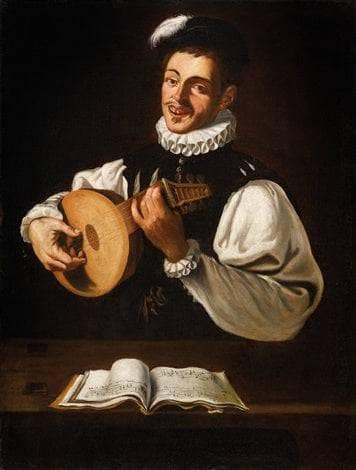
- The Lute Player, about 1596. Hermitage, Saint Petersburg. Of all the del Monte years, the boy singing over his lute is the quietest picture and the easiest to live with.
- The Musicians, 1597. Metropolitan Museum of Art, New York.
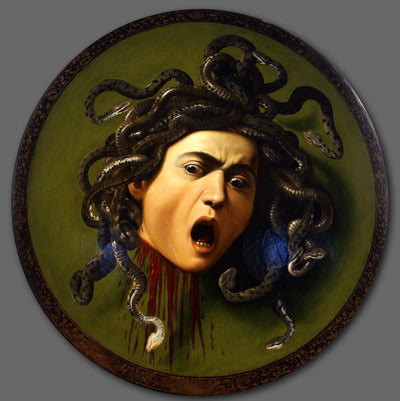
- Medusa, 1595–98. Uffizi, Florence. Del Monte had it painted on a wooden parade shield and sent it to Grand Duke Ferdinando I in 1598; the screaming Gorgon he painted for it catches her between life and death.
- Jupiter, Neptune and Pluto, about 1597. Casino Ludovisi, Rome.
- Basket of Fruit, after 1597. Pinacoteca Ambrosiana, Milan. Cardinal Federico Borromeo gave it to the Ambrosiana in 1618.
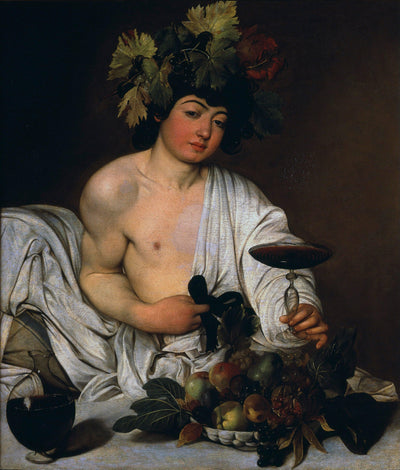
- Bacchus, about 1598. Uffizi, Florence. Another del Monte picture sent to the Medici, it sat in storage until 1913, when Roberto Longhi recognized the languid young Bacchus as a Caravaggio. It now hangs in Room D32 at the Uffizi.
- Saint Catherine of Alexandria, about 1598–99. Museo Nacional Thyssen-Bornemisza, Madrid. The model is the courtesan Fillide Melandroni.
- Martha and Mary Magdalene, about 1598. Detroit Institute of Arts.
- Narcissus, 1597–99. Palazzo Barberini, Rome.
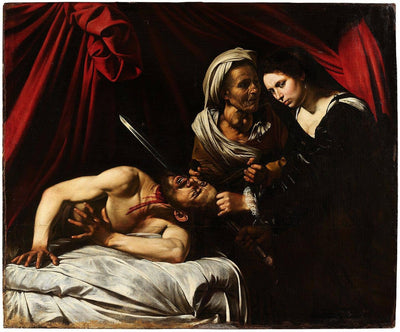
- Judith Beheading Holofernes, about 1599. Palazzo Barberini, Rome. The Italian State bought it in 1971. Watch the old maid in his Judith at the moment of the cut, leaning in with the sack ready.
- Portrait of Maffeo Barberini, 1598–1603. Palazzo Barberini, Rome. The sitter became Pope Urban VIII, and in March 2026 Italy paid €30 million for the portrait.
Rome, the churches (1599–1606)
In 1599 he got his first public commission, two big side canvases for the Contarelli Chapel in San Luigi dei Francesi. Those two canvases made his name. From here on the pictures get larger, the backgrounds go black, and the clients are churches and bankers. They also start sending work back.
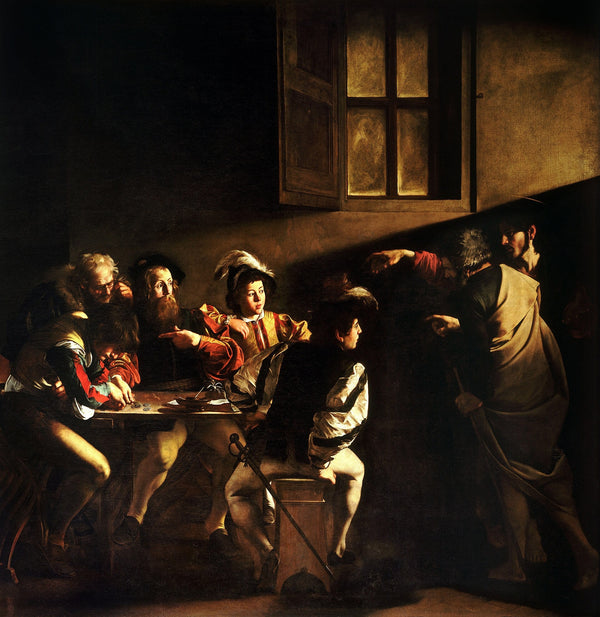
- The Calling of Saint Matthew, 1599–1600. Contarelli Chapel, San Luigi dei Francesi, Rome. A beam of light, Christ's pointing hand, and a tax collector who can't quite believe it's him: the tax collector's summons is the picture that launched his public career.
- The Martyrdom of Saint Matthew, 1599–1600. Same chapel, facing wall.
- Saint Matthew and the Angel, 1602. Same chapel, altar. An earlier version went to Berlin and was destroyed in 1945.
- The Conversion of Saul, 1600. Odescalchi collection, Rome (private). Painted on seven cypress planks for the banker Tiberio Cerasi; it never went into the chapel, and he painted the subject again on canvas.
- The Conversion of Saint Paul and The Crucifixion of Saint Peter, 1600–01. Cerasi Chapel, Santa Maria del Popolo, Rome. The second attempt at the Cerasi commission, on canvas this time.
- The Supper at Emmaus, 1601. National Gallery, London. One of three pictures Ciriaco Mattei commissioned from him in two years; the Emmaus supper in Room 32 has a fruit basket about to fall off the table into your lap.
- Amor Victorious, 1602. Gemäldegalerie, Berlin.
- The Incredulity of Saint Thomas, about 1602. Sanssouci Picture Gallery, Potsdam.
- The Taking of Christ, 1602. National Gallery of Ireland, Dublin. Another Mattei commission, lost for generations and found in 1990 in a Jesuit dining room on Leeson Street, where it hung as a Honthorst. The man holding the lantern on the right is Caravaggio at 31.
- Saint John the Baptist, 1602–03. Capitoline Museums, Rome.
- The Entombment, about 1600–04. Pinacoteca Vaticana. Painted for the Vittrice chapel in the Chiesa Nuova; it went to Paris under the Treaty of Tolentino in 1797 and came back in 1817.
- The Sacrifice of Isaac, 1603. Uffizi, Florence.
- Saint John the Baptist in the Wilderness, 1604. Nelson-Atkins Museum of Art, Kansas City. Made for the banker Ottavio Costa, the sulking Baptist in Kansas City has no halo and no lamb.
- Madonna di Loreto (Madonna of the Pilgrims), 1604–06. Sant'Agostino, Rome. The pilgrims' dirty feet are right at your eye level.
- Saint John the Baptist, 1604–06. Galleria Corsini, Rome.
- Madonna dei Palafrenieri, 1605. Galleria Borghese, Rome.
- Saint Jerome Writing, 1605–06. Galleria Borghese, Rome.
- Death of the Virgin, about 1601–06. Louvre, Paris. Laerzio Cherubini ordered it in 1601 for Santa Maria della Scala in Trastevere, and the clergy of that church refused it. The Duke of Mantua had it by 1607, Charles I of England by 1627, and Louis XIV bought it in 1671.
- Saint Francis in Meditation, 1606–07. Palazzo Barberini, Rome.
Naples, the first stay (1606–1607)
In 1606 he killed a man in a sword fight and ran. One early biographer described the pattern: "after a fortnight's work he will swagger about for a month or two with his sword at his side." He went south to Naples, where the church commissions kept coming.
- The Seven Works of Mercy, 1607. Pio Monte della Misericordia, Naples. All seven acts of mercy crammed into one dark street corner.
- The Flagellation of Christ, about 1607. Museo di Capodimonte, Naples.
- The Madonna of the Rosary, 1607. Kunsthistorisches Museum, Vienna.
- David with the Head of Goliath, 1607. Kunsthistorisches Museum, Vienna.
- The Crucifixion of Saint Andrew, 1606–07. Cleveland Museum of Art. Taken to Spain in 1610, it's the only altarpiece of his in America, with the saint tied to an upright cross instead of the usual X.
Malta (1607–1608)
He reached Malta in July 1607. Grand Master Alof de Wignacourt made him a Knight of Saint John on 14 July 1608. Five weeks later, on 19 August, he was in a cell in Fort St Angelo after a brawl. He escaped on 6 October and the Order expelled him on 1 December.
- Saint Jerome Writing, 1607. St John's Co-Cathedral, Valletta.
- Portrait of Alof de Wignacourt and his Page, 1608. Louvre, Paris.
- Sleeping Cupid, 1608. Palazzo Pitti, Florence.
- The Beheading of Saint John the Baptist, 1608. Oratory of St John's Co-Cathedral, Valletta. About 3.6 by 5.2 meters, his largest canvas and the only one he signed: "f. Michelang[e]lo," written in the blood running from the saint's neck. The "f" is for fra, the knight's title he was about to lose.
Sicily (1608–1609)
Three altarpieces in a year, each one emptier and darker than the last, with the figures pushed to the bottom of huge brown walls.
- The Burial of Saint Lucy, 1608. Santa Lucia al Sepolcro, Syracuse.
- The Raising of Lazarus, 1609. Museo Regionale, Messina.
- The Adoration of the Shepherds, 1609. Museo Regionale, Messina.
Naples again, and the end (1609–1610)
The last pictures are small, fast and grim. He died at Porto Ercole, on the Tuscan coast, in 1610.

- Salome Receives the Head of John the Baptist, about 1609–10. National Gallery, London.
- The Denial of Saint Peter, 1610. Metropolitan Museum of Art, New York.
- David with the Head of Goliath, about 1610. Galleria Borghese, Rome.
- Saint John the Baptist, 1610. Galleria Borghese, Rome.
- The Martyrdom of Saint Ursula, 1610. Gallerie d'Italia, Via Toledo, Naples. His last work in the city.
What is Caravaggio's most famous piece?
The Calling of Saint Matthew, if you go by how often it's reproduced and how many people line up in San Luigi dei Francesi to see it. Judith Beheading Holofernes and the Medusa shield run close. We ranked a dozen of them, with the reasons, in our shortlist of his best-known pictures.
Caravaggio paintings you can see in the USA
The main ones are in six museums, and only one of them is an altarpiece:
- Metropolitan Museum of Art, New York: The Musicians (1597) and The Denial of Saint Peter (1610).
- Cleveland Museum of Art: The Crucifixion of Saint Andrew (1606–07).
- Nelson-Atkins Museum of Art, Kansas City: Saint John the Baptist in the Wilderness (1604).
- Kimbell Art Museum, Fort Worth: The Cardsharps (about 1594).
- Detroit Institute of Arts: Martha and Mary Magdalene (about 1598).
- Wadsworth Atheneum, Hartford: Saint Francis of Assisi in Ecstasy (about 1595).
Rome still holds the largest share by far, spread across churches and palaces a short walk apart; the city-by-city guide maps every one. If you're building a trip around more than one painter, start from the hundred pictures everyone recognizes.
A Caravaggio on your own wall
Most of these canvases are nailed to church altars or can't travel, so a faithful copy is the only way to live with one. The studio paints the Bacchus, the Judith and the rest of his pictures in oil on canvas, by hand, so the black grounds and the single hard light come out the way he built them.
Sources
- National Gallery, London: Caravaggio
- Turismo Roma: Caravaggio's locations
- Galleria Borghese: Boy with a Basket of Fruit
- Louvre: The Death of the Virgin
- National Gallery of Ireland: The Taking of Christ
- Cleveland Museum of Art: The Crucifixion of Saint Andrew
- Vatican Museums: The Deposition
- The Art Newspaper: Italy buys the Barberini portrait