4.9/5
4.9/5


On 8 May 1889, Vincent van Gogh left the hospital in Arles and traveled about 25 km north-east to an old monastery outside Saint-Rémy-de-Provence. He asked to go. The plan was three months of rest, maybe a little painting. He stayed a year and a week, and Saint-Paul-de-Mausole, the asylum where Van Gogh lived that year, is where he made about 150 paintings, including the night sky that now hangs in New York.
That's the odd thing about this place. A man at the lowest point of his life walks into an asylum with a few tubes of paint and walks out 53 weeks later with a body of work that includes several of the Van Gogh paintings people know best. How that happened comes down to a barred window, a neglected garden and a doctor who let him keep working.

Why he checked himself in
By the spring of 1889, Arles had turned against him. After a winter of attacks, thirty people signed a petition to the mayor complaining about him. Mr. Salles, a local man who was helping with his affairs, told Theo about a private asylum in a former monastery near Saint-Rémy and sent him a prospectus. On 21 April Vincent told his brother that at the end of the month he wished to go there, or to some institution like it, and suggested they begin with three months.
The building he entered had been a place of religious life and care since around the year 1000. Canons ran it from 1080, archdeacons from 1317, Observant Franciscans from 1605 until the Revolution. In 1807 Dr. Mercurin bought it and turned it into a private asylum, licensed in 1852 for 50 men and 50 women. When Vincent arrived, the medical director was Dr. Théophile Peyron, with the Sisters of Saint Joseph doing much of the daily care. Peyron believed the illness was connected to epilepsy.
A room with a view of wheat
He described his room to Theo within the first weeks, and the letter is worth reading slowly. "I have a little room with grey-green paper with two water-green curtains with designs of very pale roses enlivened with thin lines of blood-red," he wrote around 23 May 1889. Then the line that explains half of what he painted that year: "Through the iron-barred window I can make out a square of wheat in an enclosure."
With more than 30 rooms standing empty, Peyron gave him a second room as a studio. For the first weeks he wasn't allowed outside the walls, which suited him fine. The garden, overgrown with tall pines and weeds, gave him enough to do. One morning he watched the countryside from his window long before sunrise, with nothing in the sky but the morning star, which looked very big.
He painted that walled field more than a dozen times: green, gold at harvest, flattened after a storm, with the sun coming up.
Why did he keep painting the same wheat field?
Partly because it was there. He couldn't leave, and the field was the one open piece of landscape he could see every day. But wheat also meant something to him. In early September 1889, after an attack had interrupted him, he finished a picture of a reaper in that field and explained it in a long letter: he saw in the reaper "the image of death," with humanity as the wheat being cut. "But in this death nothing sad, it takes place in broad daylight with a sun that floods everything with a light of fine gold." He was amused, too, that he had seen it all in pale blond yellow through the bars of a cell.
He called it the opposite of the Sower he had painted before. So the wheat was the whole cycle of life, framed by iron bars. That's the short answer to what he thought about wheat, and it's why the field keeps coming back.
What Van Gogh painted at Saint-Paul-de-Mausole
The count lands between 143 and 150 oil paintings in 53 weeks, plus a stack of drawings. Some weeks he couldn't hold a brush. During one attack he swallowed some of his paint, and for a while afterward he was only allowed to draw. The rest of the time he worked with a speed that still looks unreal on paper. His year at the hospital breaks into a few clear groups.
The garden and the grounds
Irises, ivy growing up tree trunks, the fountain, the stone vestibule. These came first, while he was confined to the grounds, along with quick drawings of the garden sent to Theo in rolls.
The night sky
In June 1889 he painted the starry sky he'd been watching from his window, with a sleeping village below and a flame-shaped cypress in front. In his letter to Theo it gets barely a line, a new study of a starry sky mentioned next to a landscape with olive trees. Jo van Gogh-Bonger later sold it to a Rotterdam collector, and in 1941 MoMA bought it, the first Van Gogh to enter a New York museum.
Cypresses and wheat
By late June the cypresses had him. He told Theo he wanted to do something with them like his sunflower canvases, because no one had painted them as he saw them, and he compared their lines and proportions to an Egyptian obelisk. The best-known result is the wheat field with a pair of dark cypresses and white clouds rolling over the hills. The canvas at the Met in New York measures 73.2 × 93.4 cm. In the same letter he called a very yellow wheatfield perhaps the brightest canvas he'd ever done.
Olive groves
Once he was allowed outside the walls in June, he found the olive groves below the Alpilles. Between June and December 1889 he painted fifteen canvases of olive trees, including the orange autumn grove in Minneapolis. The late ones turn the sky itself yellow, as in the grove under a yellow sky and a low sun, which he later paired with a pink-sky version.
Copies, and a second bedroom
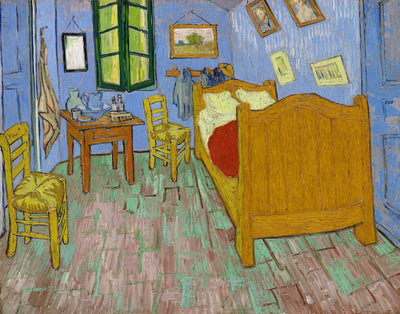
When he couldn't go out, he worked indoors. He copied prints after Millet and Rembrandt, reworking them in his own color. And in September 1889, because the original had been damaged, he repainted his bedroom from the Yellow House in Arles. That repetition is now in Chicago, and he made a third, smaller version at the same time for his mother and sister. If you've seen the bedroom with lilac walls and a blood-red bedspread, there's a good chance you were looking at a picture he painted inside the asylum.
Almond blossom for a baby
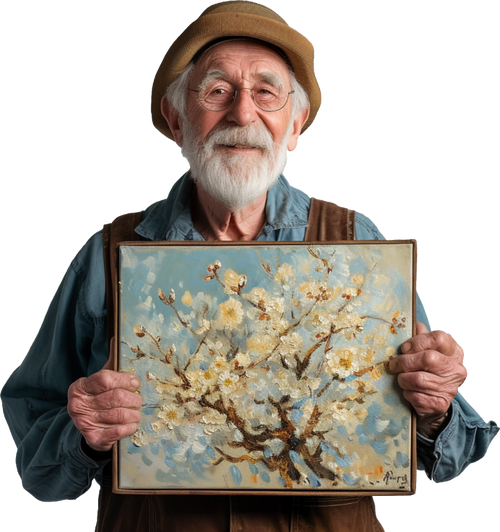
In January 1890 Theo and Jo had a son and named him Vincent Willem. His uncle started a painting for Theo and Jo's bedroom right away: big white almond branches against blue, borrowed in outline from Japanese prints. It was finished in February, sent to Paris at the end of April, and stayed with the family. The boy grew up to found the Van Gogh Museum.

Leaving in May 1890
The last months were hard. An attack in early 1890 cost him two months of work, and by the end of April he couldn't bring himself to open letters from home. On 29 April he wrote to Theo: "I have a great desire to leave this place." At the same time, word was reaching him that his work was finally being seen. Six paintings hung in Brussels that winter and one of them, The Red Vineyard, sold. In March, ten more went on show at the Indépendants in Paris.
He left the asylum on 16 May 1890, stopped in Paris to see Theo, Jo and the baby, and moved on to Auvers-sur-Oise. He died there that July. What he painted there is its own story, including the question of which canvas came last. Much of what we know about the Saint-Rémy year comes from the letters worth reading first, and the ones from the asylum are some of his calmest.
Can you visit his room today?
Yes, and it's worth the trip, but go in knowing that Saint-Paul-de-Mausole is still a working psychiatric clinic. A short-stay clinic for women runs on the site, in two units, one called Saint-Paul and one called Van Gogh. The public part is a cultural center run alongside it, open every day in season.
You walk up a tree-lined alley into the Romanesque cloister from the 11th and 12th centuries, with its square two-story bell tower. Upstairs, at the top of the old stone staircase, there's a reconstruction of a room like his and a studio facing it, similar to the ones Peyron gave him in the men's wing. The rooms themselves were never a shrine. In the 1940s the director, Dr. Edgar Leroy, turned the room Vincent had used into a small gallery of reproductions. Also open are Peyron's office, the pharmacy, the baths and a cell.
Outside, the enclosed field he painted from his window is now a garden with a strip of wheat, an orchard with an almond tree, and 33 large reproductions set out across the grounds. Standing at the wall with the Alpilles in front of you, the paintings stop feeling like inventions. The hills really do roll like that.
A canvas from that year on your wall
Most of the Saint-Rémy pictures are in museums from Amsterdam to Minneapolis, so the closest most of us get is a copy. Our studio paints them by hand in oil, from the cypresses to the almond branches, and you can browse every Van Gogh we reproduce on canvas or start from the paintings people ask us for most.