4.9/5


Post-Impressionism is the name for French painting of roughly 1886 to 1905 by artists who began with Impressionism's bright, unmixed color and broken brushwork and then turned it to other ends: solid structure for Cézanne, a scientific system for Seurat, symbol and imagination for Gauguin, and raw feeling for Van Gogh. It was never a single group with a shared program, and it got its name only in 1910. Many of the canvases below can be seen as hand-painted copies in our collection of Post-Impressionism paintings. Up first is a side-by-side chart of what changed after Impressionism, with one of the seven key paintings for each point.
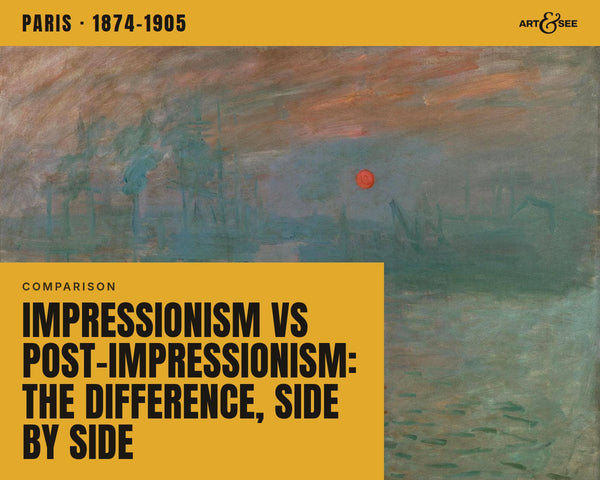
This guide explains where the label came from, follows the painters year by year, sorts out the smaller movements inside it and then looks at seven key paintings, with dates and sizes from the museums that own them. For the difference from Impressionism on its own, our comparison of Impressionism vs Post-Impressionism sets four pairs of paintings side by side.
Post-Impressionism beside Impressionism, one point at a time
| Point | Impressionism | Post-Impressionism | See it in |
|---|---|---|---|
| What lasts | The fleeting effects of light | Solid structure that holds deep space on a flat surface |  Montagne Sainte-Victoire with Large Pine |
| Color | Pure, brilliant and unmixed | Pushed past what the eye sees, with opposite colors set against each other |  Irises |
| Brushstrokes | Short strokes of broken color | Thick lines of paint that curve and swirl |  The Starry Night |
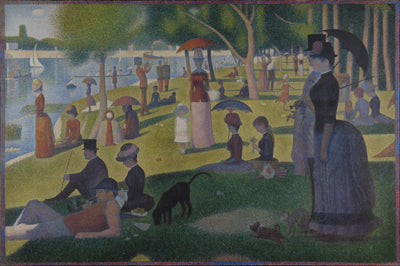
| How color is planned | Recorded straight from nature | Set on a scientific basis, in tiny separate touches |  A Sunday on La Grande Jatte |
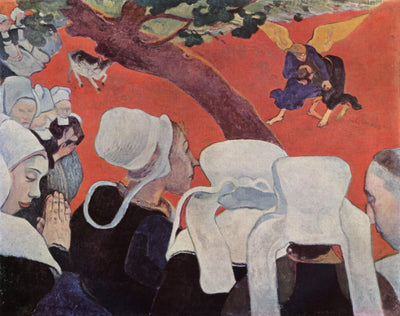
| Where the subject comes from | What is in front of the painter | What people believe or dream, mixed with what they see |  Vision of the Sermon (Jacob Wrestling with the Angel) |
| Edges | Vivid color left in broken touches | The same vivid color laid flat and closed by a winding outline | At the Moulin Rouge |
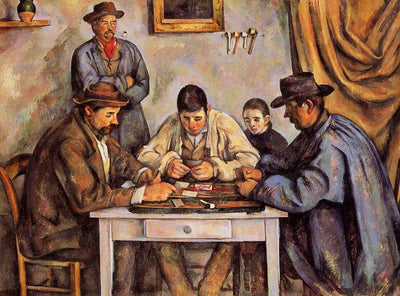
| Working life | A close-knit group of friends | Painters who often showed together but worked mainly alone, from Aix to Tahiti |  The Card Players |
The left column follows Britannica's and Tate's words on Impressionism as quoted below, and the right one sums up each painter's own section.
The name came late. Roger Fry coined it for a London show in 1910, when all four core painters were already dead.
What Post-Impressionism is
The term describes what happened to Impressionism after 1886, and Tate traces its first use to the English artist and critic Roger Fry, who in 1910 organized the exhibition Manet and the Post-Impressionists at the Grafton Galleries in London; the show ran into 1911. Every one of its four core painters was dead by the time it opened, so none of them ever worked under that label.
Britannica defines the movement as both an extension of Impressionism and a rejection of its limits. Impressionism, in Britannica's phrase, aimed at "the objective recording of nature in terms of the fugitive effects of color and light." The painters who came next kept the pure, brilliant color, the freedom of subject and the short strokes of broken color, and dropped the idea that recording light was the whole job. For the first generation itself, see our guide to the most famous Impressionist painters and one painting to know each by.
The result was variety, not a style. Tate keeps the term mostly for four painters and sums each up in a line: Cézanne kept painting from nature "but with added rigour," Seurat put Impressionist light and color "on a scientific basis," Gauguin "rejected painting from nature and reintroduced imaginative subject matter," and Van Gogh painted from nature with a "highly personal use of colour and brushwork." Britannica adds that they often exhibited together but, unlike the close-knit Impressionists, painted mainly alone.
When and where it happened
The starting line is the eighth and last Impressionist group show, held at the Maison Dorée on the rue Laffitte in Paris from May 15 to June 15, 1886. Seurat hung his huge park scene there, and Britannica's biography of Gauguin notes that it overshadowed the 19 paintings and the carved wood relief Gauguin showed in the same rooms.
After that the story leaves Paris. Cézanne worked in isolation at Aix-en-Provence, his hometown; Van Gogh went south to Arles and then Saint-Rémy; Gauguin painted in Brittany before sailing for the South Pacific. Toulouse-Lautrec stayed in the capital, among its café-concerts.
Post-Impressionism year by year
| Year | What happened |
|---|---|
| 1886 | Last Impressionist group show in Paris, with Seurat's La Grande Jatte. Van Gogh arrives in Paris. |
| 1888 | Van Gogh reaches Arles on February 20. Gauguin paints Vision of the Sermon at Pont-Aven in the summer, then joins Van Gogh in Arles in late October for about two months. |
| 1889 | Van Gogh enters the asylum at Saint-Rémy in May and paints The Starry Night in June. The Pont-Aven painters mount an exhibition of "synthétisme." The Moulin Rouge opens in Paris. |
| 1890 | Van Gogh leaves Saint-Rémy in May and dies at Auvers-sur-Oise in July. |
| 1891 | Seurat dies in Paris on March 29, aged 31. Gauguin settles in Tahiti. |
| 1903 | Gauguin dies on May 8 at Atuona, in the Marquesas Islands. |
| 1905 | The Fauves show at the Salon d'Automne in Paris. |
| 1906 | Cézanne dies at Aix-en-Provence. |
| 1910 | Roger Fry's Manet and the Post-Impressionists opens in London and gives the movement its name. |
The key artists, and how to tell them apart
Paul Cézanne (1839–1906)
Cézanne began among the Impressionists, then, Britannica says, withdrew from the movement in 1878 and spent the rest of his career on the underlying structure of natural forms and on making a flat surface hold deep space. He worked mostly at home in Aix, and the Courtauld notes that he drew and painted the Montagne Sainte-Victoire above the town from different vantage points throughout his career.
How to spot him: still lifes and landscapes with what Britannica calls "a monumental permanence and coherence," built from separate areas of color rather than drawn outlines.
Georges Seurat (1859–1891)
Seurat trained at the École des Beaux-Arts under Henri Lehmann, a follower of Ingres, and Britannica's biography stresses his unusually strong interest in the intellectual and scientific bases of art. When the official Salon refused his Bathers at Asnières in 1884, he helped found the Groupe des Artistes Indépendants, an association "with neither jury nor prizes." His working life was short: he left seven monumental paintings, 40 smaller paintings and sketches and about 500 drawings.
How to spot him: a surface of tiny, separate touches of contrasting color that merge into one tone from a few steps back, and compositions worked out in many preparatory studies.
Vincent van Gogh (1853–1890)
Van Gogh came to Paris in 1886 still painting in the dark tones of The Potato Eaters. His brother Theo, who managed the Goupil gallery on the Boulevard Montmartre, showed him the colorful work of Monet and other modern painters, and at Fernand Cormon's studio he met Toulouse-Lautrec and Émile Bernard, the Van Gogh Museum says. The brothers also collected Japanese woodcuts, whose bold outlines, cropping and color contrasts showed up in his work at once. In Arles he rented four rooms in the Yellow House on Place Lamartine, hoping to start an artists' colony; Gauguin was the first artist to move in, and the last.
How to spot him: thick strokes that curve and swirl, which Britannica describes as Impressionism's short strokes turned into "curving, vibrant lines of color," in hues pushed past anything he saw.
Paul Gauguin (1848–1903)
Gauguin turned to painting full time only in his mid-thirties. He worked as a stockbroker and spent holidays painting with Pissarro and Cézanne, and when he lost his job in the stock market crash of 1882 he welcomed it, Britannica says, as a chance to "paint every day." He showed at the Impressionist exhibitions of 1880, 1881, 1882 and 1886, then went looking for simpler places: Pont-Aven in Brittany that summer, Martinique with the painter Charles Laval in 1887, and Pont-Aven again in the summer of 1888, where younger painters such as Émile Bernard and Paul Sérusier gathered around him.
How to spot him: broad, flat fields of unshaded color inside firm outlines, simplified figures, and scenes that mix what is seen with what is believed or dreamed.
Henri de Toulouse-Lautrec (1864–1901)
Britannica places Toulouse-Lautrec with the Post-Impressionists while noting that he was less closely tied to the Impressionists than the others, and it describes his concern as "perceptive portraiture and decorative effect."
How to spot him: the vivid, contrasting colors of Impressionism laid in flat areas and closed by a distinct, sinuous outline.
The movements inside the label
Several smaller movements sit under the Post-Impressionist umbrella, and museum labels use their names often:
- Neo-Impressionism. Tate's name for the work of Seurat, Paul Signac and their followers, who, inspired by optical theory, painted with tiny adjacent dabs of color. The technique is properly called Divisionism; Signac rejected the popular word "pointillism."
- Synthetism. A term Gauguin coined, per Britannica, for the fusion of a painting's form with the idea or emotion it carries. Tate dates the formal "groupe synthétiste," with Gauguin and Émile Bernard, to 1891.
- Pont-Aven School. The painters who gathered around Gauguin in the Breton village, whom he urged to rely more on feeling than on direct observation.
- Symbolism. A literary movement first: the National Galleries of Scotland trace the word to the poet Jean Moréas's "Symbolist Manifesto," printed in Le Figaro in 1886. In painting it meant evoking ideas and moods through symbols instead of describing appearances; Britannica puts the mystical pictures of Odilon Redon closer to Symbolism than to Impressionism.
- The Nabis. A group active from 1888 to 1900, founded in secret by Paul Sérusier with Pierre Bonnard, Édouard Vuillard and Maurice Denis. Their name comes from the Hebrew word for prophet, and Tate says Gauguin's Synthetism inspired their simplified style.
Seven key Post-Impressionist paintings
Britannica singles out four works as the movement's landmarks: Seurat's La Grande Jatte, Gauguin's Vision of the Sermon, Van Gogh's The Starry Night and Toulouse-Lautrec's At the Moulin Rouge. The three added here are two Cézannes and a Van Gogh still life from his last spring in Provence.
A Sunday on La Grande Jatte, Georges Seurat (1884–86)

Zoom
Seurat's view of an island in the Seine shows people of every age and social class, in the words of the Art Institute of Chicago, and at 207.5 × 308.1 cm (81.7 × 121.3 in) it is nearly ten feet wide. Its title carries the year 1884, but the museum dates the canvas 1884–86 and its painted border 1888–89.
After Seurat's death the picture passed to his mother and then to his brother Émile, who sold it in 1900 for 800 francs to Casimir Brû. Brû gave it to his daughter Lucie, who as Lucie Cousturier published a book on Seurat in 1921. The Chicago collectors Frederic Clay and Helen Birch Bartlett bought it in 1924 and gave it to the Art Institute in 1926. There is also a hand-painted copy of A Sunday on La Grande Jatte in our catalog.
Montagne Sainte-Victoire with Large Pine, Paul Cézanne (about 1887)

Zoom
The Courtauld in London owns the most monumental and highly finished of the three canvases Cézanne devoted to this view. The branches of the pine in the foreground follow the outline of the mountain, a framing device he liked, and the only modern note is the railway viaduct on the right with the trail of steam from a passing train. Greens and yellows lead the eye across the valley to the mountain, painted in cool blues and pinks.
It was not a success at home. Shown at an exhibition of amateur artists in Aix, it met with incomprehension, and Cézanne gave it to the young poet Joachim Gasquet, who admired his work. It is also one of the very few paintings he signed after 1880. Montagne Sainte-Victoire with Large Pine is available as a hand-painted reproduction.
Vision of the Sermon (Jacob Wrestling with the Angel), Paul Gauguin (1888)

Zoom
Hand-painted oil reproductionSee sizes ›
Women in Breton headdresses, heads bowed, face the scene the title names: Jacob wrestling with the angel. Gauguin painted it at Pont-Aven in 1888, and Britannica calls it seminal, a step toward what he described as "a reasoned and frank return to the beginning, that is to say, to primitive art." The canvas measures 72.2 × 91 cm (28.4 × 35.8 in) and belongs to the National Galleries of Scotland, which give it its full title, Vision of the Sermon (Jacob Wrestling with the Angel); it is also known as The Vision after the Sermon.
A critic turned it into a definition. The National Galleries of Scotland note that Albert Aurier used this picture to define Symbolism in painting, and in his 1891 essay in the Mercure de France, quoted by Britannica, he called Gauguin's work "ideational, symbolic, synthetic, subjective, and decorative." Our hand-painted Vision after the Sermon follows the Edinburgh composition.
The Starry Night, Vincent van Gogh (1889)

Zoom
Hand-painted oil reproductionSee sizes ›
The Museum of Modern Art in New York acquired it in 1941 through the Lillie P. Bliss Bequest and dates it to June 1889 at Saint-Rémy; it is oil on canvas, 73.7 × 92.1 cm (29.0 × 36.3 in). MoMA reads the sky as dominated by the bright moon at right and Venus at center left, and points to what came from memory rather than from the view: the church steeple resembles those of his native Netherlands, while the mountains behind belong to the Provençal landscape around him.
How it overtook the Sunflowers in fame is the subject of our article on why The Starry Night became Van Gogh's most famous work. The Starry Night is also in our catalog, painted by hand in oil.
Irises, Vincent van Gogh (1890)
In May 1890, in his last weeks at the Saint-Rémy asylum, Van Gogh painted a large bouquet of cut irises in a vase. The Van Gogh Museum, which owns this canvas, 92.7 × 73.9 cm (36.5 × 29.1 in), calls it mainly a study in color: purple flowers set against a yellow ground so that the decorative forms stand out more strongly. He painted two still lifes of the bouquet, and in the other one he set purple and pink against green.
He explained the plan to Theo in a letter of May 11, 1890, written days before he left the asylum. The yellow picture, he wrote, set a violet bouquet "ranging up to pure carmine and Prussian blue" against "a striking lemon yellow background," and he described the result this way:
“An effect of terribly disparate complementaries that reinforce each other by their opposition.”
The flower's place in his work is traced in our article on how Japanese prints shaped Van Gogh's irises, and the asylum year in our account of Van Gogh's months at Saint-Paul-de-Mausole. Our hand-painted Still Life with Irises follows the Amsterdam canvas.
The original and our hand-painted copy
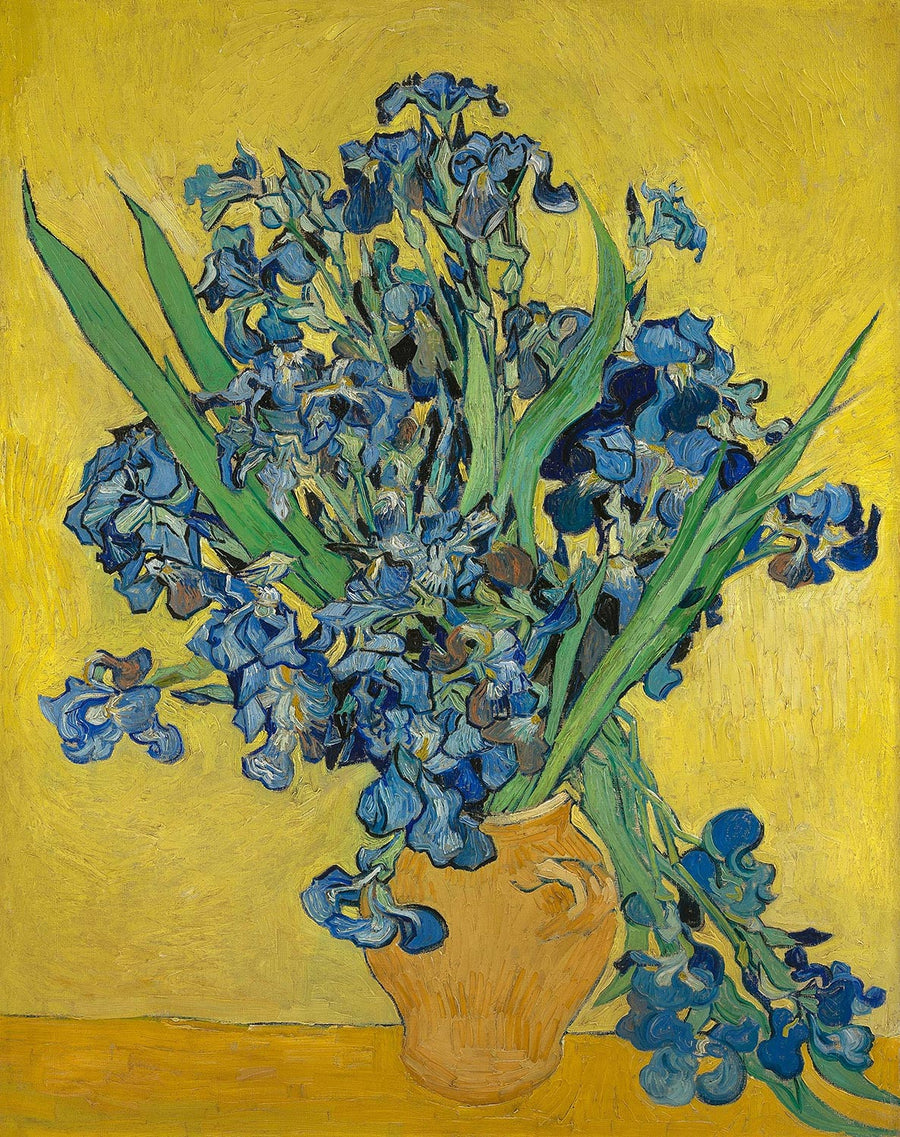
The original
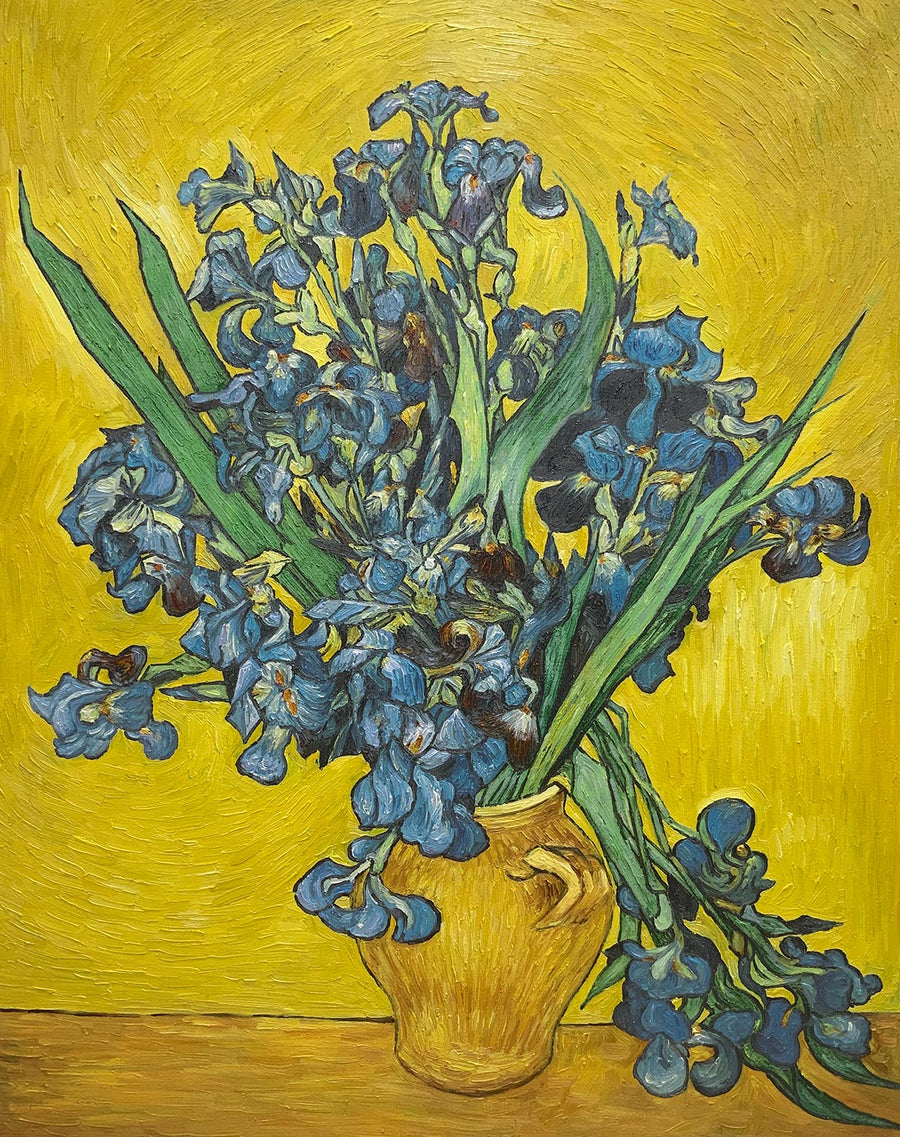
Our reproduction, painted by hand in oil
The Card Players, Paul Cézanne (1890s)

Zoom
Hand-painted oil reproductionSee sizes ›
The Musée d'Orsay says Cézanne took up card players many times during the 1890s and gave the scene an exceptional gravity. The largest version, of 1890–1892, belongs to the Barnes Foundation in Philadelphia, which by its own account has the largest single group of Cézanne's paintings in the world: 69 works, 61 of them oils. The Orsay's two-player canvas of 1893–1896, 47 × 56.5 cm (18.5 × 22.2 in), came to the French state in 1911 with the bequest of Count Isaac de Camondo; our guide to the Musée d'Orsay's Impressionist paintings covers the museum's other highlights. The Card Players is available hand-painted in the Barnes composition.
At the Moulin Rouge, Henri de Toulouse-Lautrec (1892–95)

Zoom
The Moulin Rouge was the most famous of the Paris café-concerts, and Toulouse-Lautrec had a permanently reserved table there, according to the Art Institute of Chicago, which owns this 123 × 141 cm (48.4 × 55.5 in) canvas. The picture is a group portrait of his circle: the dancer La Goulue arranges her hair in the background, and the dancers La Macarona and Jane Avril sit at the table with the photographer Paul Sescau, the poet Édouard Dujardin and the vintner Maurice Guibert. The painter put himself in too, a small figure in the center background beside his much taller cousin, the physician Gabriel Tapié de Céleyran.
The face most people remember is at the right edge: the singer May Milton, harshly lit and, in the museum's words, "a shocking acid green." The club was designed for electric lighting, and Toulouse-Lautrec reveled in what its glare could do. The painting came to the Art Institute in 1928 from Frederic Clay Bartlett, the same collector who had bought Seurat's island scene four years earlier, so the two now belong to the same museum.
Seeing the method up close
From across a room a Post-Impressionist canvas reads as a scene; up close it turns into the dots, patches, curving strokes and outlines that built it, which is why, as a painter, I find them the most instructive pictures to copy by hand. Our Post-Impressionism collection gathers hand-painted versions of most of the canvases above and many more, and the most famous paintings in the world shows where they stand among the rest.
Sources
- Britannica: Post-Impressionism
- Britannica: Paul Gauguin (Douglas Cooper)
- Britannica: Georges Seurat (Pierre Courthion)
- Tate: Post-impressionism (art term)
- Tate: Neo-impressionism (art term)
- Tate: Synthetism (art term)
- Tate: Nabis (art term)
- Tate: Fauvism (art term)
- National Galleries of Scotland: Symbolism (glossary)
- National Galleries of Scotland: Paul Gauguin, Vision of the Sermon (Jacob Wrestling with the Angel)
- Art Institute of Chicago: Georges Seurat, A Sunday on La Grande Jatte, 1884
- Art Institute of Chicago: Henri de Toulouse-Lautrec, At the Moulin Rouge
- MoMA: Vincent van Gogh, The Starry Night (1889)
- Van Gogh Museum: Vincent van Gogh, Irises (1890)
- Van Gogh Museum, Vincent van Gogh: The Letters, letter 870 to Theo (May 11, 1890)
- Van Gogh Museum: From Dark to Light, 1886–1888
- Van Gogh Museum: In the South of France, 1888–1889
- Van Gogh Museum: Vincent's Final Months, 1890
- The Courtauld: Paul Cézanne, Montagne Sainte-Victoire with Large Pine
- Musée d'Orsay: Paul Cézanne, Les Joueurs de cartes (1893–1896)
- Barnes Foundation: Cézanne in the Barnes Foundation (press release, 2021)